• Global CNC market projected to reach $128B by 2028 • New EU trade regulations for precision tooling components • Aerospace deman
NYSE: CNC +1.2%LME: STEEL -0.4%

Global Manufacturing Is Shifting Again, but Not Where Many Expected
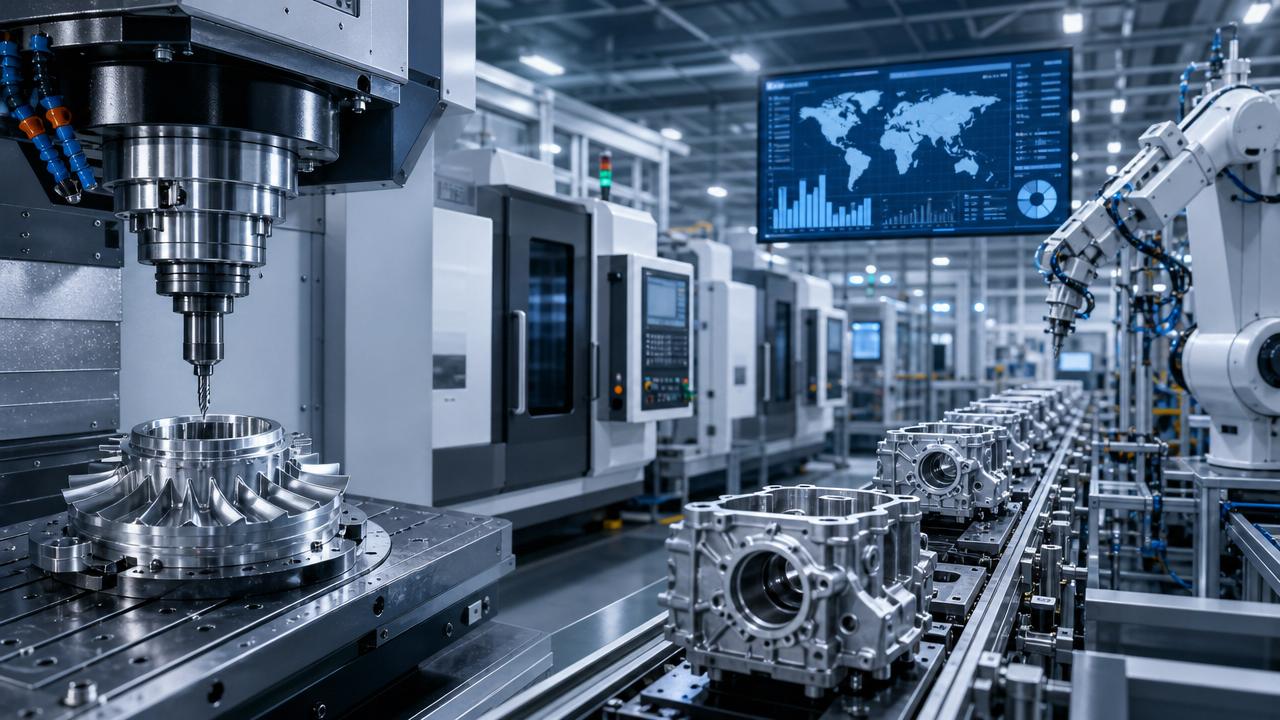
Global Manufacturing is shifting again, but not in a simple march toward the cheapest labor markets. The new map is being shaped by resilience, speed, energy security, digital visibility, and process control.
For precision industries, location now depends on more than wages. CNC machining, smart factory systems, automated assembly, and regional supply chain depth are becoming decisive factors in Global Manufacturing strategy.
This change matters across automotive, aerospace, electronics, energy equipment, and industrial components. It also changes where machine tools, cutting systems, and flexible production lines generate the highest long-term value.
The new Global Manufacturing shift is moving toward capability, not just cost
Earlier offshoring waves focused on labor arbitrage. Today, Global Manufacturing decisions are increasingly tied to uptime, quality consistency, logistics stability, and access to advanced industrial ecosystems.
Production is not leaving one region and entering another in a straight line. Instead, it is being redistributed across several hubs, each serving different product categories and risk priorities.
High-volume, less complex production may still favor lower-cost regions. Yet high-precision parts, regulated products, and time-sensitive assemblies often stay closer to engineering teams and end markets.
That is why Global Manufacturing now includes nearshoring, friend-shoring, dual-sourcing, and selective reshoring. The result is a more fragmented but more deliberate industrial footprint.
Signals show a broader realignment across industrial supply chains
Several signals indicate that this realignment is structural rather than temporary. Investment flows are spreading across North America, Southeast Asia, India, Eastern Europe, and established Asian industrial bases.
At the same time, China, Germany, Japan, and South Korea remain critical to Global Manufacturing because of mature supplier networks, tooling expertise, automation depth, and technical labor pools.
This means the future is not about replacing one center with another. It is about combining scale regions, innovation regions, and regional fulfillment bases into a layered operating model.
- More regional production for strategic products
- Greater demand for traceable and digitized supply chains
- Higher investment in CNC automation and robotics
- Stronger focus on lead time over unit labor cost
- Expansion of multi-country sourcing models
Why Global Manufacturing is being redirected
The latest shift is driven by overlapping pressures. No single factor explains it. The most important change is that location strategy now blends economics, technology, and geopolitical risk.
For advanced production, automation changes the labor equation. A highly automated machining cell can reduce the cost gap between regions while improving repeatability and scheduling accuracy.
That is especially relevant in Global Manufacturing segments requiring multi-axis machining, precision turning, closed-loop inspection, and integrated software control across design and production.
Precision manufacturing is gaining strategic weight in the new map
CNC machine tools are no longer just production assets. In many sectors, they are strategic infrastructure because they support localized capability for complex, high-value components.
Machining centers, CNC lathes, multi-axis systems, and automated handling platforms help plants respond faster to demand swings, engineering changes, and customer-specific production requirements.
This is why Global Manufacturing investment increasingly follows technical readiness. Regions with strong fixture design, tooling support, software integration, and service networks often attract durable industrial projects.
Where the strongest advantages now appear
- Dense supplier clusters for castings, motors, controls, and tooling
- Reliable engineering support for process validation and maintenance
- Access to skilled operators, programmers, and application technicians
- Industrial policies supporting automation and localization
- Stable utilities, digital infrastructure, and transport links
The impact of Global Manufacturing is different across business functions
The shift affects more than plant location. It changes sourcing logic, inventory design, engineering collaboration, equipment planning, and after-sales service expectations across the industrial chain.
For equipment-intensive operations, the biggest question is not where production is cheapest. It is where stable throughput and qualified output can be sustained under uncertainty.
What deserves close attention over the next phase
The next phase of Global Manufacturing will likely reward flexibility more than scale alone. Capacity that can switch products, reroute demand, and maintain tolerance control will hold stronger value.
- Compare total landed cost, not wage cost alone
- Audit local CNC service ecosystems before expansion
- Check tooling, fixture, and metrology availability by region
- Measure exposure to trade restrictions and compliance shifts
- Track energy stability and factory digitalization readiness
- Plan for workforce development in programming and maintenance
For sectors using high-precision machine tools, the ability to scale quality is becoming as important as the ability to scale volume. That distinction will define future winners in Global Manufacturing.
Practical ways to respond to the new Global Manufacturing landscape
A useful response starts with segmentation. Not every product needs the same footprint. Standard parts, critical parts, and fast-turn custom parts should not be placed using one universal rule.
- Separate products by complexity, tolerance, and delivery sensitivity.
- Match each product group with the right regional capability base.
- Increase automation where labor volatility threatens consistency.
- Digitalize machine, tooling, and inspection data for visibility.
- Create backup capacity for critical machining and assembly steps.
For industrial platforms focused on CNC machining and precision manufacturing, this is also a moment to deepen market intelligence. Regional demand patterns now shift faster than many annual planning cycles.
Global Manufacturing is becoming more regional, more automated, and more data-driven at the same time. The strongest strategies will align machine capability, supply security, and customer responsiveness.
The next step is clear: review regional production logic, benchmark process capability, and identify where smart factory investment can improve resilience. In the new era of Global Manufacturing, precision is strategy.
NEXT ARTICLE
Recommended for You
![]() Fuxing EMU Trainset Procurement Reaches ¥4.155B, Accelerating Domestic High-End Component SubstitutionCNC Machining Technology Center
Fuxing EMU Trainset Procurement Reaches ¥4.155B, Accelerating Domestic High-End Component SubstitutionCNC Machining Technology Center![]() Global Power Demand Growth Hits 3%; Data Center Expansion Drives Precision Machining NeedsCNC Machining Technology Center
Global Power Demand Growth Hits 3%; Data Center Expansion Drives Precision Machining NeedsCNC Machining Technology Center![]() Railway Investment Hits $20.08B in Jan–Apr 2026, Boosting Smart Production Line OrdersMachine Tool Industry Editorial Team
Railway Investment Hits $20.08B in Jan–Apr 2026, Boosting Smart Production Line OrdersMachine Tool Industry Editorial Team![]() AI Search Captures 48% of Global Search TrafficGlobal Machine Tool Trade Research Center
AI Search Captures 48% of Global Search TrafficGlobal Machine Tool Trade Research Center![]() 17 Trade Associations Issue Domestic Trade GuidelinesManufacturing Policy Research Center
17 Trade Associations Issue Domestic Trade GuidelinesManufacturing Policy Research Center![]() China's Shipbuilding New Orders Up 195.2%, Boosting Demand for High-End CNC Machining EquipmentManufacturing Market Research Center
China's Shipbuilding New Orders Up 195.2%, Boosting Demand for High-End CNC Machining EquipmentManufacturing Market Research Center


Aris Katos
Future of Carbide Coatings
15+ years in precision manufacturing systems. Specialized in high-speed milling and aerospace grade alloy processing.
▶
Global Manufacturing Is Shifting Again, but Not Where Many ExpectedManufacturing Market Research Center▶
China's Avg. Mobile Data Usage Hits 23.4GB, Boosting CNC Cloud Services AbroadManufacturing Market Research Center▶
What Global Manufacturing Trends Mean for Supplier RiskManufacturing Market Research Center▶
Global Manufacturing Is Shifting Again Where Demand Is MovingManufacturing Market Research Center▶
How Industrial Robotics Is Changing Small Batch ProductionManufacturing Market Research Center
Mastering 5-Axis Workholding Strategies
Join our technical panel on Nov 15th to learn about reducing vibrations in thin-wall components.

Providing you with integrated sanding solutions
Before-sales and after-sales services
Comprehensive technical support