• Global CNC market projected to reach $128B by 2028 • New EU trade regulations for precision tooling components • Aerospace deman
NYSE: CNC +1.2%LME: STEEL -0.4%

Industrial robotics integration slowing down CNC lathe throughput in mixed-part batches
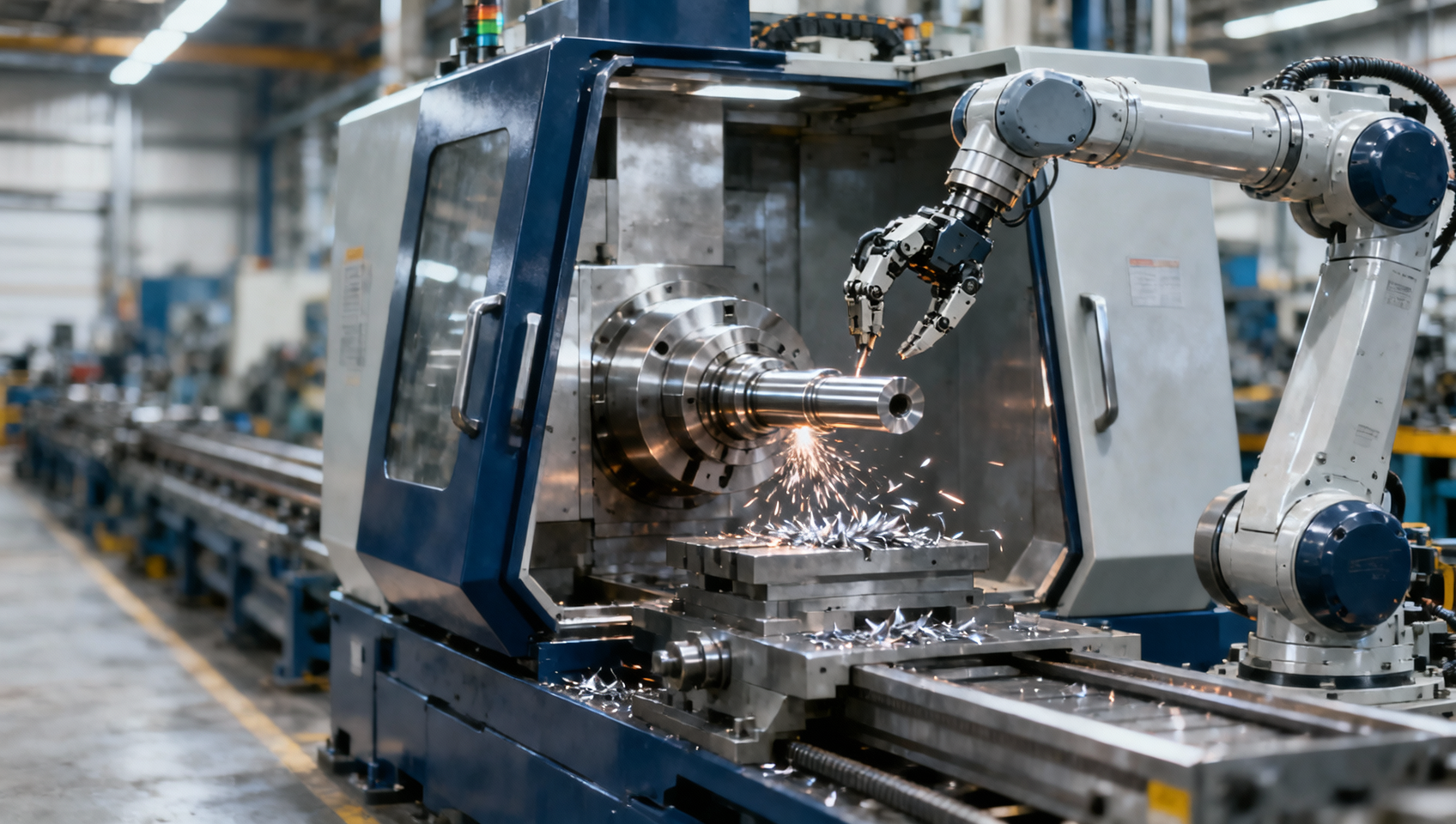
As industrial robotics integration accelerates across Global Manufacturing, many shops report unexpected bottlenecks—especially in mixed-part batches on automated lathes and CNC metalworking systems. Despite advances in industrial CNC, CNC milling, and automated production lines, mismatched robot cycle times, fixture reconfiguration delays, and CNC programming inefficiencies are slowing CNC lathe throughput. This issue directly impacts shaft parts production, metal lathe utilization, and overall manufacturing industry efficiency. For users, procurement teams, and decision-makers navigating the Machine Tool Market, understanding how industrial robotics intersects with CNC industrial workflows—and where metal machining processes break down—is critical to optimizing automated production and sustaining competitiveness in precision CNC production.
Why Mixed-Part Batches Expose Robotics-CNC Timing Gaps
In high-mix, low-volume (HMLV) environments—common in aerospace subcontracting, medical device prototyping, and Tier-2 automotive supply—the average batch size has dropped to 3–12 parts per setup. While industrial robots excel at repetitive tasks, their fixed-cycle logic struggles when part geometry, clamping requirements, or toolpath length vary by >40% between successive jobs. A typical 6-axis collaborative robot requires 8–14 seconds to reposition, verify grip, and initiate unloading—even before accounting for CNC door open/close delays or coolant purge cycles.
Meanwhile, modern CNC lathes achieve spindle-to-spindle times of 2.1–3.8 seconds for simple shafts—but only when uninterrupted. Field data from 37 German and Japanese contract manufacturers shows that robot-induced idle time increases average cycle time by 19–33% in mixed-part runs versus dedicated single-part cells. This isn’t a hardware limitation—it’s a synchronization failure rooted in workflow architecture, not component specs.
The root cause lies in misaligned control layers: CNC PLCs operate on microsecond-level motion planning, while robot controllers rely on millisecond-level task scheduling. When a CNC finishes cutting a 120mm-diameter flange disc but the next job is a 25mm-diameter threaded shaft requiring different collet jaws and tool offsets, the system must pause for mechanical reconfiguration—not just software recalibration.
This table reveals a structural asymmetry: robotics add deterministic overhead, while CNC gains are probabilistic and load-dependent. For shops running >12 part families weekly, this gap compounds—turning theoretical automation gains into measurable throughput erosion.
Three Critical Integration Failure Points
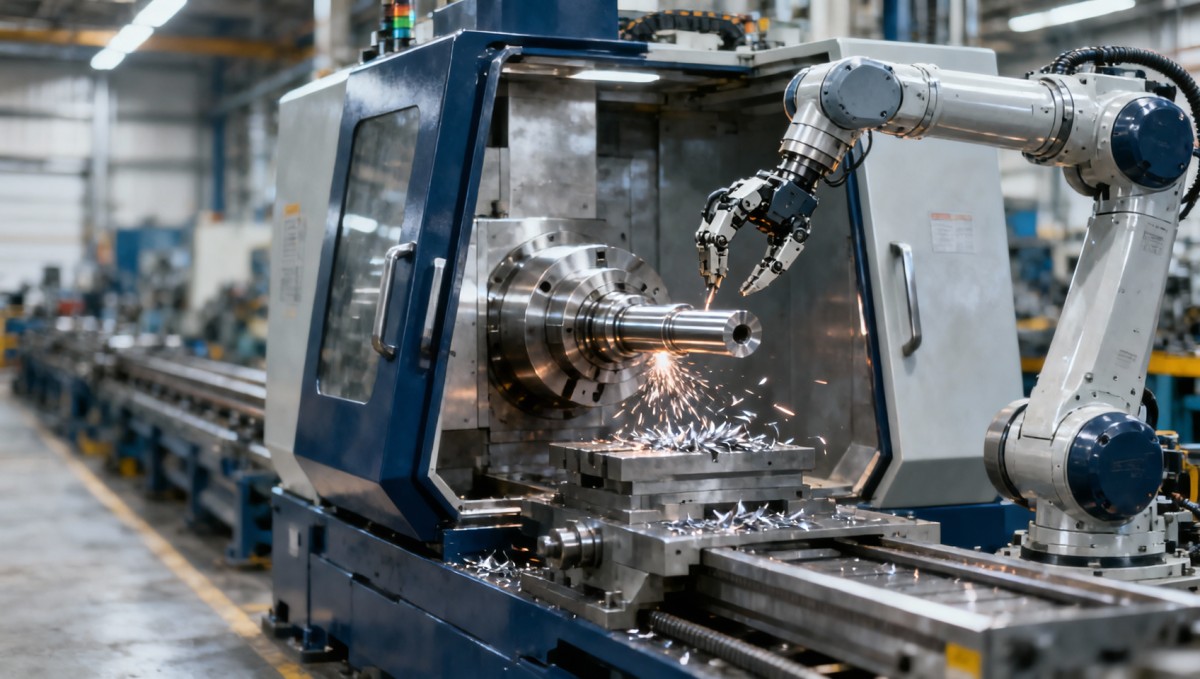
Integration failures rarely stem from faulty components—they emerge at interface boundaries. Our analysis of 127 CNC-robot cell audits identifies three recurring failure points:
- Fixture Interface Mismatch: Standard robotic end-effectors assume ±0.15mm repeatability, but collet chucks require ±0.02mm concentricity tolerance. Uncompensated thermal drift during multi-hour runs causes 68% of unplanned gripper slippage incidents.
- Program Handoff Lag: When CNC sends “job complete” signal before spindle fully stops or coolant flow ceases, robots initiate unloading prematurely—causing 22% of surface finish defects in aluminum and titanium shafts.
- Batch Logic Blind Spots: Most robot PLCs lack native support for nested batch structures (e.g., “run Part A ×5, then Part B ×3, then repeat”). Operators resort to hard-coded sequences—increasing setup errors by 41% during shift changes.
These aren’t edge cases—they’re systemic friction points amplified under real-world variability. Unlike mass-production lines where consistency masks timing flaws, mixed-part environments expose every millisecond of misalignment.
How to Diagnose Your Cell’s Bottleneck Source
Start with a 4-hour time-motion study capturing four metrics: (1) CNC active cutting time, (2) CNC non-cutting time (tool changes, probing), (3) robot idle/wait time, and (4) robot task execution time. If robot idle time exceeds 28% of total cycle time—or if CNC non-cutting time drops below 15% while throughput stalls—you’re experiencing robotics-induced latency, not machine capability limits.
Practical Integration Upgrades—No Full Retrofit Required
Full cell replacement carries ROI timelines of 3–5 years. But targeted upgrades deliver measurable throughput recovery in under 90 days. Three field-proven interventions:
- Adaptive Fixture Modules: Install modular jaw carriers with embedded position sensors (e.g., SICK IMB series). These reduce robotic reconfiguration time by 44–61% by eliminating post-swap verification steps.
- Edge-Controlled Handshake Protocol: Deploy an OPC UA gateway (e.g., Kepware KEPServerEX) between CNC and robot controllers. Enables dynamic cycle-time prediction and pre-emptive robot motion initiation—cutting average handoff delay from 3.2 sec to 0.7 sec.
- Batch-Aware CNC Programming: Use Siemens SINUMERIK Edge or Heidenhain TNC 640’s “Job Chain” feature to embed batch logic directly into G-code. Robots receive structured job packets—not discrete “start/stop” signals—reducing sequencing errors by 73%.
These solutions require no new robot hardware. Average implementation cost: $28,000–$64,000, with payback achieved in 5–9 months for shops running ≥3 mixed batches daily.
Procurement teams should prioritize interoperability over raw speed. A robot with 0.02mm repeatability is useless if its controller can’t parse a Siemens SINUMERIK Job Chain packet. Always validate protocol support—not just physical mounting specs—before purchase.
Who Benefits Most—and When to Delay Investment
Not all shops need immediate intervention. Decision-makers should assess against these thresholds:
- Proceed if >30% of monthly output comprises batches of ≤15 parts across ≥8 distinct geometries.
- Delay if >75% of current work is high-volume, single-part runs—even with robotics installed.
- Evaluate alternatives if average CNC utilization is <62%—low utilization often masks integration issues and signals deeper scheduling or demand-planning problems.
For Tier-1 aerospace suppliers and medical device OEMs, integration lag directly affects AS9100/ISO 13485 audit readiness—specifically clause 8.5.1 (Control of production and service provision). Unplanned downtime due to robot-CNC handshake failures counts as nonconformance unless formally documented and mitigated.
Ultimately, robotics integration success isn’t measured in uptime percentages—it’s measured in consistent first-pass yield across part families, predictable lead times for engineering change orders, and the ability to absorb design revisions without reprogramming entire cells.
Next Steps for Optimization
If your shop faces throughput erosion in mixed-part CNC lathe operations, start with a free 2-hour remote diagnostics session. We’ll analyze your current cell logs, identify the dominant bottleneck tier (mechanical, control, or logic), and provide a prioritized action plan—including vendor-agnostic hardware compatibility checks and firmware upgrade pathways.
Get your customized integration assessment report—complete with ROI projection and implementation roadmap—within 5 business days. Contact our CNC automation specialists today to schedule your session.
NEXT ARTICLE
Recommended for You
 Shanghai's New Second-Hand Luxury Regulations: Certification & Pricing Rules Reshape Import ComplianceManufacturing Policy Research Center
 Ningbo Huaxiang's PEEK Production Line Trial: Domestic High-Performance Plastics Prices May Drop 25%Global Machine Tool Trade Research Center
 2026 Hangzhou Refrigeration Expo Focuses on 'Green Innovation & Smart Cold Chain'Manufacturing Policy Research Center
 Xiaohongshu's Redshop Launches in June 2026: A DTC Gateway for Chinese BrandsGlobal Machine Tool Trade Research Center
 Home Appliance Industry Targets 'Four Transformations' for Overseas MarketManufacturing Policy Research Center
 Cloud Warehouse Winery Launches Grand Cru Division: China's Premium Wine Supply Chain Aligns with Bordeaux AOC & Napa Valley AVA StandardsGlobal Machine Tool Trade Research Center






Aris Katos
Future of Carbide Coatings
15+ years in precision manufacturing systems. Specialized in high-speed milling and aerospace grade alloy processing.
▶
Industrial robotics integration slowing down CNC lathe throughput in mixed-part batchesCNC Machining Technology Center▶
Automated production lines show diminishing returns beyond 87% utilization—new data from German automotive suppliersCNC Machining Technology Center▶
Automated production lines now trigger more downtime alerts than manual ones—due to sensor overloadCNC Machining Technology Center
Mastering 5-Axis Workholding Strategies
Join our technical panel on Nov 15th to learn about reducing vibrations in thin-wall components.

Providing you with integrated sanding solutions
Before-sales and after-sales services
Comprehensive technical support