• Global CNC market projected to reach $128B by 2028 • New EU trade regulations for precision tooling components • Aerospace deman
NYSE: CNC +1.2%LME: STEEL -0.4%

Machine Tool Market signals to watch before expanding capacity

The Machine Tool Market is sending clear signals that business leaders should assess before committing to new capacity. Shifts in automation demand, order cycles, supply chain resilience, and regional manufacturing investment are reshaping expansion decisions across the industry. For decision-makers, understanding these indicators is essential to reduce risk, time investment wisely, and capture growth in precision manufacturing.
Why a checklist approach matters before adding machine tool capacity
In the current Machine Tool Market, expansion is no longer a simple matter of reacting to short-term order growth. Capacity decisions now sit at the intersection of customer demand, financing cost, labor availability, automation readiness, and geopolitical exposure. A checklist-based review helps business leaders avoid one of the most common mistakes in manufacturing strategy: building for a temporary surge rather than for sustainable utilization.
For companies involved in CNC lathes, machining centers, multi-axis systems, cutting tools, fixtures, and automated production lines, the quality of expansion timing can determine margins for years. If the Machine Tool Market is entering a selective growth phase rather than a broad boom, the right question is not only whether demand is rising, but where it is rising, which applications are driving orders, and whether customers are investing in replacement, localization, or entirely new production programs.
This is why decision-makers should review a structured set of signals before approving new plants, adding shifts, investing in advanced lines, or expanding export-focused output.
The core Machine Tool Market signals to check first
Start with the indicators that most directly affect future capacity utilization. The following checklist is designed for executives, investors, plant leaders, and business development teams evaluating expansion in the Machine Tool Market.
- Order intake quality: Separate one-off project wins from repeatable demand. A strong backlog is less meaningful if it comes from delayed purchases finally being released rather than from sustained capital expenditure plans.
- Customer industry mix: Confirm whether growth is concentrated in automotive, aerospace, electronics, energy equipment, or general industrial manufacturing. Capacity built for one segment may not match the tolerance, automation, or volume profile of another.
- Lead-time direction: If machine delivery times are rising due to real demand, the market may support expansion. If lead times are rising because of component shortages, adding assembly capacity alone may not solve the bottleneck.
- Utilization versus margin: High factory utilization is useful only if pricing remains healthy. In the Machine Tool Market, some producers run full schedules while margin quality declines because of discounting, expedited freight, or unfavorable product mix.
- Automation pull-through: Track whether customers are ordering standalone machines or integrated cells with robotics, software, and flexible handling. The second pattern often signals more durable investment intent.
- Regional policy support: Manufacturing incentives, localization policies, and industrial upgrading programs can change demand concentration quickly. Expansion should follow structural policy-backed demand, not only spot inquiries.
- Supplier resilience: Critical items such as spindles, CNC controls, servo systems, castings, linear guides, and tool changers should be reviewed for single-source exposure before committing to growth plans.
Leaders who review these signals together are better positioned to judge whether the Machine Tool Market is supporting broad-based expansion or only selective investment in specific product families and geographies.
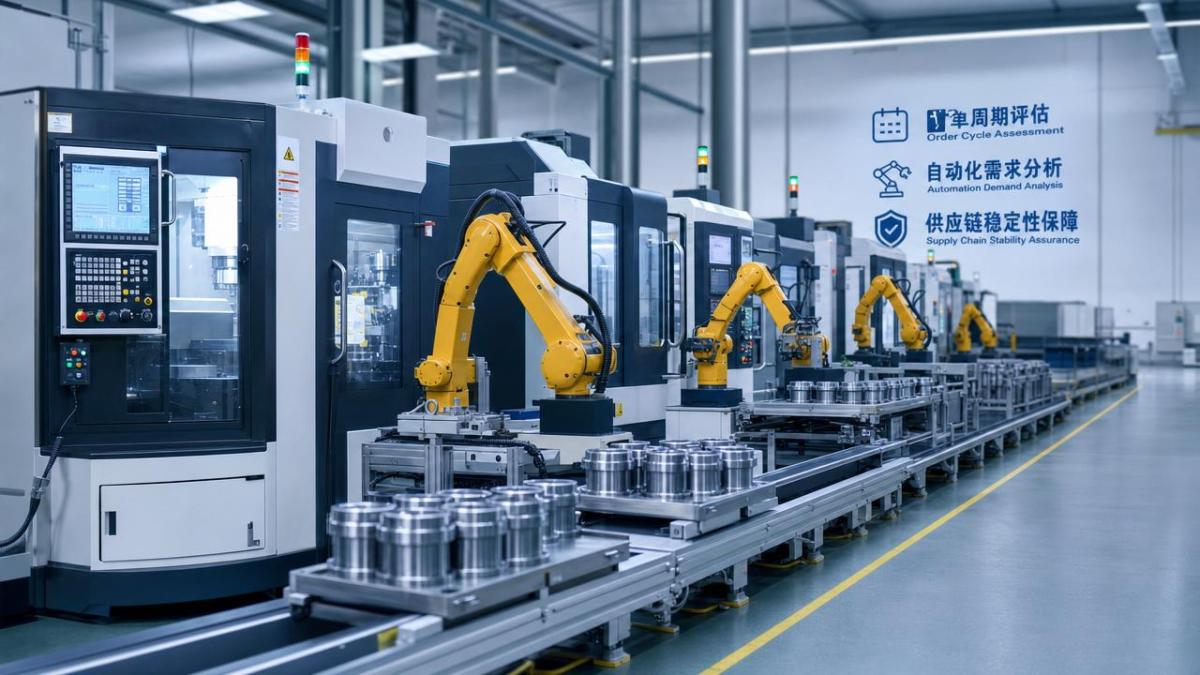
A practical scorecard for expansion decisions
A useful way to evaluate the Machine Tool Market is to convert market signals into an internal scorecard. This reduces bias from sales optimism or competitive pressure.
This scorecard is especially important when the Machine Tool Market appears strong on the surface but remains uneven across end-use sectors.
How to read demand signals by customer segment
Not every demand increase in the Machine Tool Market should trigger the same response. Decision-makers should distinguish among customer segments because each one implies different capacity needs and risk levels.
Automotive and EV manufacturing
This segment can generate large-volume orders, but platform transitions and model-cycle changes create timing risk. Capacity expansion makes more sense when machine demand is tied to long-horizon localization, battery component production, e-axle systems, or precision drivetrain applications rather than short bursts of retrofitting.
Aerospace and high-precision engineering
In this area of the Machine Tool Market, order volume may be smaller, but margins and technical barriers are often higher. Expansion should focus on advanced machining capability, quality systems, and process validation rather than only floor space.
Electronics and precision components
Growth here tends to favor speed, repeatability, and integration with automated handling. If this segment is driving incoming business, leaders should verify whether current production systems can meet takt-time and micron-level consistency targets.
Energy equipment and industrial infrastructure
This part of the Machine Tool Market often benefits from public and private capital projects, but order timing can be irregular. Capacity plans should be linked to pipeline quality and funding clarity, not just project announcements.
Signals that expansion may be premature
Many companies expand too early because they confuse activity with lasting demand. Watch for these warning signs before committing major capital in the Machine Tool Market.
- Backlog is growing, but customer deposits, engineering approvals, or release schedules remain uncertain.
- Sales growth depends heavily on price concessions rather than technology differentiation or lead-time advantage.
- A large share of demand comes from one geography exposed to trade barriers, sanctions, or unstable industrial policy.
- Internal bottlenecks are in commissioning, software integration, or service support rather than in physical manufacturing capacity.
- Key suppliers cannot guarantee availability of critical parts under expansion volumes.
- Management assumptions rely on peak-cycle utilization instead of average-cycle utilization.
If several of these conditions are present, a staged approach may be more appropriate than a full-scale expansion. In the Machine Tool Market, preserving flexibility can be more valuable than maximizing nominal output.
Often-overlooked factors that shape the Machine Tool Market outlook
Some of the most important expansion variables are easy to underestimate because they sit outside direct sales metrics.
Service capacity: As machines become more digital and connected, after-sales response, predictive maintenance support, and software updates influence purchasing decisions. A company may win orders more easily if it can scale service along with production.
Application engineering: In the modern Machine Tool Market, customers increasingly want process solutions rather than standalone equipment. Expansion should therefore include engineering bandwidth for tooling, fixturing, cycle optimization, and automation integration.
Digital readiness: Smart manufacturing, remote monitoring, and production data integration are no longer optional in many sectors. If new capacity is built without digital infrastructure, future competitiveness may weaken even if output rises.
Localization pressure: More buyers are seeking regional sourcing for resilience. This can benefit local production footprints, but it also requires compliance, spare parts coverage, and closer customer support in target markets.
Execution checklist for companies preparing to expand
Once the Machine Tool Market signals are favorable, the next step is disciplined execution. Leaders should prepare the following information before final approval:
- Validated customer pipeline: Identify committed programs, likely repeat orders, and sectors with strongest technical fit.
- Capacity bottleneck map: Confirm whether the true constraint is machining, assembly, testing, engineering, software integration, or field service.
- Investment scope definition: Decide whether the right move is a new facility, equipment upgrade, automation retrofit, subcontracting strategy, or regional satellite operation.
- Supplier backup plan: Secure alternate sources for controls, castings, drives, and precision components wherever practical.
- Talent plan: Build recruitment and training plans for machinists, assemblers, controls engineers, and service technicians before capacity comes online.
- Risk scenario model: Test returns under slower order intake, customer delays, currency shifts, and higher material costs.
This approach turns broad Machine Tool Market optimism into a practical expansion roadmap tied to real operating conditions.
FAQ for decision-makers reviewing expansion timing
Is backlog alone enough to justify more capacity?
No. In the Machine Tool Market, backlog must be tested for quality, release timing, customer concentration, and margin durability. Strong backlog without strong execution visibility can create false confidence.
Should companies expand production or expand automation first?
Often, automation of existing operations delivers faster returns and lower risk. If internal inefficiency is the main bottleneck, a new building may not solve the real problem. The better sequence depends on where value is currently being lost.
What regional trend matters most in the current Machine Tool Market?
Regional manufacturing investment linked to industrial policy, supply chain diversification, and local sourcing requirements is highly important. Demand supported by structural manufacturing relocation tends to be more durable than demand driven only by short-cycle replacement.
What to do next before making a final commitment
The Machine Tool Market continues to offer meaningful growth opportunities, especially in high-precision manufacturing, automation integration, and digitally enabled production systems. However, the strongest expansion decisions are built on evidence, not momentum. Business leaders should prioritize a short list of checks: demand quality, end-market mix, supply chain resilience, engineering readiness, service scalability, and return under weak-cycle conditions.
If your company is moving toward expansion, the most productive next conversation should focus on capacity parameters, application fit, lead-time assumptions, budget range, localization requirements, and supplier risk coverage. Clarifying these points early will improve investment timing and reduce execution risk in the evolving Machine Tool Market.
PREVIOUS ARTICLE
NEXT ARTICLE
Recommended for You
![]() Beijing’s New E-Bike Lock Regulation Spurs CNC Housing DemandGlobal Machine Tool Trade Research Center
Beijing’s New E-Bike Lock Regulation Spurs CNC Housing DemandGlobal Machine Tool Trade Research Center![]() New Drone Standard GB/T 44723–2026 Takes Effect May 2026Manufacturing Policy Research Center
New Drone Standard GB/T 44723–2026 Takes Effect May 2026Manufacturing Policy Research Center![]() New Maritime Code Takes Effect May 1, 2026: CNC Equipment Shipping Rules UpdatedManufacturing Market Research Center
New Maritime Code Takes Effect May 1, 2026: CNC Equipment Shipping Rules UpdatedManufacturing Market Research Center![]() 2026 China Cycle Shanghai: CNC E-Bike Frame Capacity Draws ODM FocusManufacturing Market Research Center
2026 China Cycle Shanghai: CNC E-Bike Frame Capacity Draws ODM FocusManufacturing Market Research Center![]() 2026 Foshan Tanzhou Auto Expo: EV Parts Sourcing FocusGlobal Machine Tool Trade Research Center
2026 Foshan Tanzhou Auto Expo: EV Parts Sourcing FocusGlobal Machine Tool Trade Research Center![]() New Hazardous Chemicals Safety Law Takes Effect May 2026Manufacturing Policy Research Center
New Hazardous Chemicals Safety Law Takes Effect May 2026Manufacturing Policy Research Center


Aris Katos
Future of Carbide Coatings
15+ years in precision manufacturing systems. Specialized in high-speed milling and aerospace grade alloy processing.
▶
Machine Tool Market signals to watch before expanding capacityManufacturing Market Research Center▶
Where the Machine Tool Market is slowing in 2026Manufacturing Market Research Center▶
Machine Tool Market Signals Worth Watching This YearManufacturing Market Research Center▶
How to Read Machine Tool Price Quotes Without OverpayingManufacturing Market Research Center▶
How to Compare Machine Tool Wholesaler Pricing FairlyManufacturing Market Research Center
Mastering 5-Axis Workholding Strategies
Join our technical panel on Nov 15th to learn about reducing vibrations in thin-wall components.

Providing you with integrated sanding solutions
Before-sales and after-sales services
Comprehensive technical support