• Global CNC market projected to reach $128B by 2028 • New EU trade regulations for precision tooling components • Aerospace deman
NYSE: CNC +1.2%LME: STEEL -0.4%

Industrial Turning Costs That Are Easy to Miss in Quotations

In industrial turning, the quoted unit price rarely tells the full story. For business evaluators comparing suppliers, overlooked factors such as tooling wear, setup time, tolerance control, scrap risk, and secondary operations can significantly change the real cost. Understanding these hidden cost drivers helps improve quotation analysis, reduce sourcing risk, and support more accurate procurement decisions.
Why do industrial turning quotations often look comparable when the real costs are not?
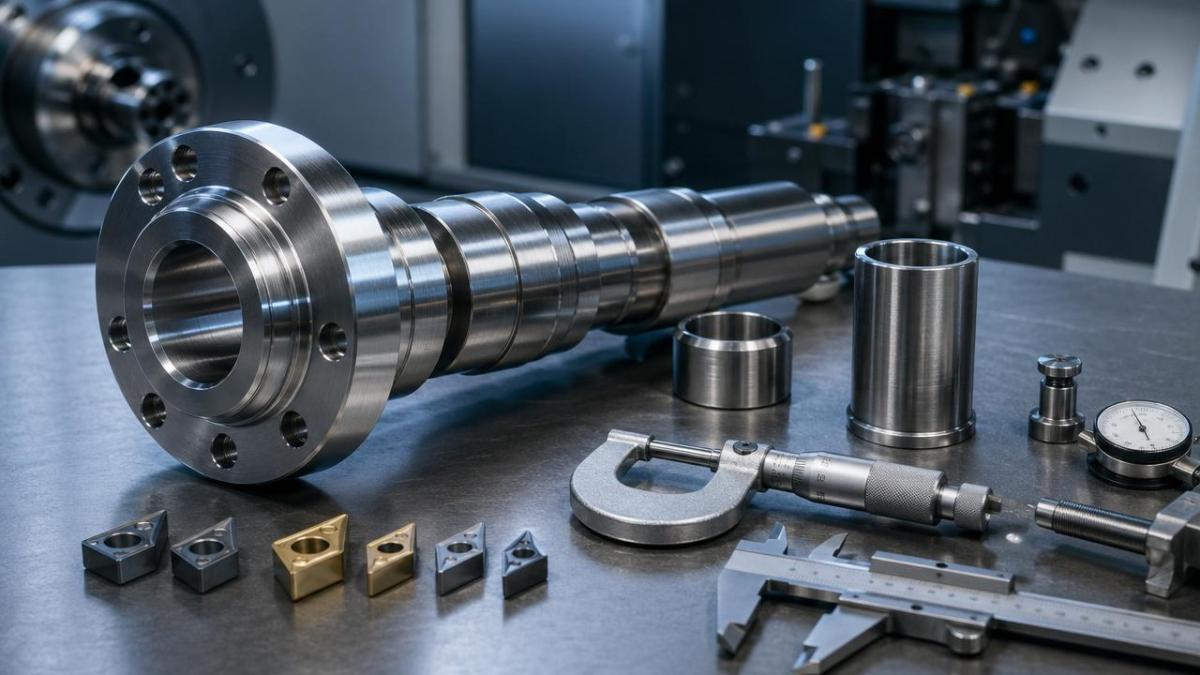
In global CNC machining and precision manufacturing, industrial turning is used for shafts, sleeves, rings, hubs, pins, valve parts, flanges, and many other rotational components. On paper, two suppliers may quote the same drawing with similar materials and lead times. In practice, however, the manufacturing path behind the quote can be very different.
For business evaluators, this gap matters because the visible price is only one layer of the sourcing decision. The hidden layers include machine utilization, tool life, process capability, quality control burden, packing method, logistics sensitivity, and whether the supplier is pricing for stable repeat production or for one-off job-shop uncertainty.
The challenge has grown with the development of smart manufacturing, multi-axis systems, and tighter requirements from automotive, aerospace, energy equipment, and electronics production. As CNC lathes and automated production lines become more advanced, quotations can reflect very different cost structures depending on process maturity and factory organization.
- A low quote may assume looser process control, shorter tool life, or limited in-process inspection.
- A higher quote may include fixture design, trial cuts, statistical checks, deburring, traceability records, and reserve capacity for urgent delivery.
- Two suppliers may both meet the print, but only one may be able to maintain consistency across larger batch volumes.
That is why industrial turning cost analysis should move beyond unit price and toward total cost of supply. For evaluators handling RFQs across multiple countries or supplier clusters, this broader view is often the difference between a good deal and a costly correction later.
Which hidden cost drivers in industrial turning are most often missed?
When reviewing industrial turning quotations, several cost drivers are regularly underestimated because they do not always appear as separate line items. The table below highlights the hidden elements most likely to distort quotation comparison.
These hidden factors are not unusual. They are normal parts of industrial turning economics. The problem arises when one quotation includes them conservatively while another leaves them buried in assumptions. Without clarifying those assumptions, price comparison becomes misleading.
Costs that frequently stay off the quote sheet
- Bar stock yield loss when cut lengths do not optimize raw material usage.
- Chip evacuation problems that reduce cycle efficiency on deep-hole or long-part turning.
- Manual deburring after grooves, threads, ports, or cross-holes are machined.
- Washing, rust prevention, and individual packaging for export or high-cleanliness applications.
- Additional quality documentation for regulated or customer-audited supply chains.
How should business evaluators compare industrial turning quotations more accurately?
A reliable comparison method is to convert quote review into a structured evaluation model. Instead of asking only who offers the lowest price, ask which supplier is making the fewest risky assumptions. This approach is especially important in precision manufacturing, where hidden instability often appears after order placement, not before.
The next table can be used as a practical checklist during RFQ review for industrial turning parts.
This type of comparison improves quotation transparency. It also helps evaluators separate a process-capable supplier from one that simply offers a lower number to win the order. In industrial turning, quotation accuracy is often a reflection of engineering discipline.
A practical RFQ review sequence
- Group dimensions by function: critical fits, concentric features, cosmetic surfaces, and noncritical geometry.
- Ask which dimensions drive the machining strategy and which drive the inspection strategy.
- Identify whether the supplier plans to use standard turning, live tooling, sub-spindle transfer, or secondary grinding.
- Separate one-time costs from recurring costs before comparing unit prices.
- Check whether packaging, labeling, traceability, and export handling are already included.
What part characteristics usually push industrial turning cost above expectations?
Certain drawing features create disproportionate cost effects in industrial turning. The part may still look simple because it is rotational, but the machining burden can rise sharply once the design introduces difficult tolerances, weak rigidity, or multiple secondary processes.
Common geometry-related cost amplifiers
- Long and slender shafts often need lower cutting parameters, additional support, and stricter straightness control.
- Thin-wall rings and sleeves are vulnerable to deformation during clamping and finishing.
- Deep grooves, undercuts, and narrow relief areas accelerate tool wear and chip problems.
- Tight concentricity or runout requirements may force one-clamp strategies or post-turn grinding.
- Threads combined with sealing surfaces often require extra deburring and more careful gauge inspection.
Material also plays a major role. Stainless steel, heat-resistant alloys, hardened steels, and some copper alloys may slow cutting speed, shorten insert life, or increase built-up edge risk. From a commercial standpoint, evaluators should not treat all turned parts of the same size as cost-equivalent if their material behavior is different.
This is why experienced CNC machining suppliers often request the full drawing, material specification, annual volume, and use-case context before finalizing industrial turning pricing. A quotation based only on an outer diameter and length is usually too incomplete for sound comparison.
Where do secondary operations change the total industrial turning cost?
Many turned parts are not finished when the lathe cycle ends. Secondary operations can equal or exceed the visible machining cost, especially in sectors such as energy equipment, electronics, fluid control, and automotive systems where function depends on more than diameter control.
The table below shows how secondary steps can reshape the total cost picture for industrial turning projects.
For procurement teams, the key lesson is simple: industrial turning price should always be reviewed as part cost plus process chain cost. If the quote does not state what happens after turning, the buyer may end up managing extra suppliers, extra transport, and extra quality interfaces.
How do tolerance, quality control, and compliance influence quotation realism?
In precision manufacturing, cost is strongly linked to how confidence is created. If a supplier must prove that every batch will meet dimensional, functional, and traceability expectations, the quote will reflect more than spindle time. It will reflect inspection planning, measurement capability, and process documentation.
What evaluators should look for
- Whether critical dimensions are measured in-process, at final inspection, or both.
- Whether the supplier uses gauges, micrometers, CMM support, profilometers, or application-specific checking methods where needed.
- Whether material certificates, heat numbers, or batch traceability must accompany the shipment.
- Whether export markets or end customers expect formal quality systems, documented inspection records, or controlled packaging standards.
General standards such as ISO 9001-based quality management practices, drawing-based tolerancing conventions, and material traceability expectations can all influence industrial turning cost. Even when a certification is not contractually required, many buyers still expect evidence of stable process control. That expectation has a real cost component and should be recognized during quotation review.
From a sourcing risk perspective, a cheaper quote without clear inspection scope may be more expensive once incoming verification, sorting, line stoppage exposure, or warranty handling are considered. In other words, quality cost is often transferred, not eliminated.
What are the most common quotation mistakes in industrial turning procurement?
Mistake 1: Comparing only the unit price
Unit price without batch basis, quality scope, and secondary operations is not a fair comparison. It is only a partial data point. Evaluators should compare the full commercial and technical envelope, not the headline number alone.
Mistake 2: Assuming all CNC lathes create equal capability
A supplier with modern CNC lathes, live tooling, bar feeders, sub-spindles, and stable fixtures may finish a part in fewer handoffs. Another supplier may need separate operations. The drawing is the same, but the cost and risk profile are not.
Mistake 3: Ignoring repeat-order economics
Some industrial turning parts become much more competitive after first-order setup is absorbed. Others remain expensive because tool wear, inspection burden, or outsourced finishing continues to dominate. Buyers should ask which cost elements improve with volume and which do not.
Mistake 4: Underestimating logistics and packaging
Precision turned parts can be sensitive to corrosion, impact damage, and thread damage. For international trade, packaging design, rust prevention, and carton density matter. If these are not clarified, the delivered cost can move well beyond the quoted shop price.
FAQ: what do buyers ask most often about industrial turning costs?
How can I tell whether a low industrial turning quote is realistic?
Ask for the assumed batch size, setup treatment, tolerance control method, inspection scope, and whether deburring, cleaning, and packaging are included. A realistic quote can explain its process logic. If the supplier cannot explain how the number was built, the risk of later cost correction is high.
Which industrial turning parts usually carry the most hidden cost?
Parts with tight runout, thin walls, long unsupported lengths, multiple grooves or threads, difficult alloys, and post-turn finishing usually carry the most hidden cost. These features drive tool wear, slower cutting, more inspection, and higher scrap exposure.
Should business evaluators request separate pricing for secondary operations?
Yes, especially when the part may require heat treatment, grinding, coating, or special packing. Separate visibility helps buyers compare scope accurately and decide whether single-source coordination or split sourcing is more cost effective.
What information improves quotation accuracy the most?
Provide the latest drawing revision, material grade, annual volume forecast, release lot size, critical dimensions, surface requirements, testing or documentation expectations, and destination market. Better inputs produce more reliable industrial turning quotations and fewer commercial surprises.
Why choose us for industrial turning quotation evaluation and sourcing support?
We focus on the global CNC machining and precision manufacturing industry, with attention to the commercial realities behind technical quotations. That means we look beyond nominal turning prices and help identify the process, quality, and supply-chain assumptions that influence real procurement outcomes.
If you are evaluating industrial turning suppliers, you can contact us to discuss practical topics such as parameter confirmation, drawing review priorities, batch-based pricing logic, tolerance-related cost drivers, secondary operation scope, delivery scheduling, packaging expectations, sample support, and quotation communication across international supply markets.
- Need help comparing two or more industrial turning quotations? We can help structure the review points.
- Need support clarifying machining scope before RFQ release? We can help identify likely hidden cost items.
- Need guidance on lead time, customization feasibility, or documentation expectations? We can help define the questions worth asking before commitment.
A stronger industrial turning sourcing decision starts with clearer quotation logic. When the hidden costs are visible, procurement becomes more accurate, negotiations become more productive, and supply risk becomes easier to control.
NEXT ARTICLE
Recommended for You
![]() ZhiAnHua GNA Named Top 5 GEO Service Provider for 2026Machine Tool Industry Editorial Team
ZhiAnHua GNA Named Top 5 GEO Service Provider for 2026Machine Tool Industry Editorial Team![]() 2026 Bio-based Feedstock Supply Chain Guide ReleasedMachine Tool Industry Editorial Team
2026 Bio-based Feedstock Supply Chain Guide ReleasedMachine Tool Industry Editorial Team![]() Beijing E-Bike Battery Compartment Rules Take Effect May 1, 2026Machine Tool Industry Editorial Team
Beijing E-Bike Battery Compartment Rules Take Effect May 1, 2026Machine Tool Industry Editorial Team![]() 2026 World Intelligent Industry Expo: CNC Structural Parts in FocusMachine Tool Industry Editorial Team
2026 World Intelligent Industry Expo: CNC Structural Parts in FocusMachine Tool Industry Editorial Team![]() NMPA Adds 74 External Experts; CNC High-Purity Tubing Standards Align with ISO 15378CNC Machining Technology Center
NMPA Adds 74 External Experts; CNC High-Purity Tubing Standards Align with ISO 15378CNC Machining Technology Center![]() 2026 China Bike Show: CNC Fixture Export OpportunityCNC Machining Technology Center
2026 China Bike Show: CNC Fixture Export OpportunityCNC Machining Technology Center


Aris Katos
Future of Carbide Coatings
15+ years in precision manufacturing systems. Specialized in high-speed milling and aerospace grade alloy processing.
▶
Industrial Turning Costs That Are Easy to Miss in QuotationsGlobal Machine Tool Trade Research Center▶
2026 China Auto & Motorcycle Federation New Energy Drift Challenge in HainanGlobal Machine Tool Trade Research Center▶
WeChat Pay QR Integration in 5 Countries Boosts CNC Equipment TradeGlobal Machine Tool Trade Research Center▶
How to Compare a Machine Tool Distributor Without RegretGlobal Machine Tool Trade Research Center▶
What Buyers Miss When Choosing a Machine Tool WholesalerGlobal Machine Tool Trade Research Center
Mastering 5-Axis Workholding Strategies
Join our technical panel on Nov 15th to learn about reducing vibrations in thin-wall components.

Providing you with integrated sanding solutions
Before-sales and after-sales services
Comprehensive technical support