• Global CNC market projected to reach $128B by 2028 • New EU trade regulations for precision tooling components • Aerospace deman
NYSE: CNC +1.2%LME: STEEL -0.4%

Vertical lathe vs. horizontal: which handles asymmetrical shaft parts better?
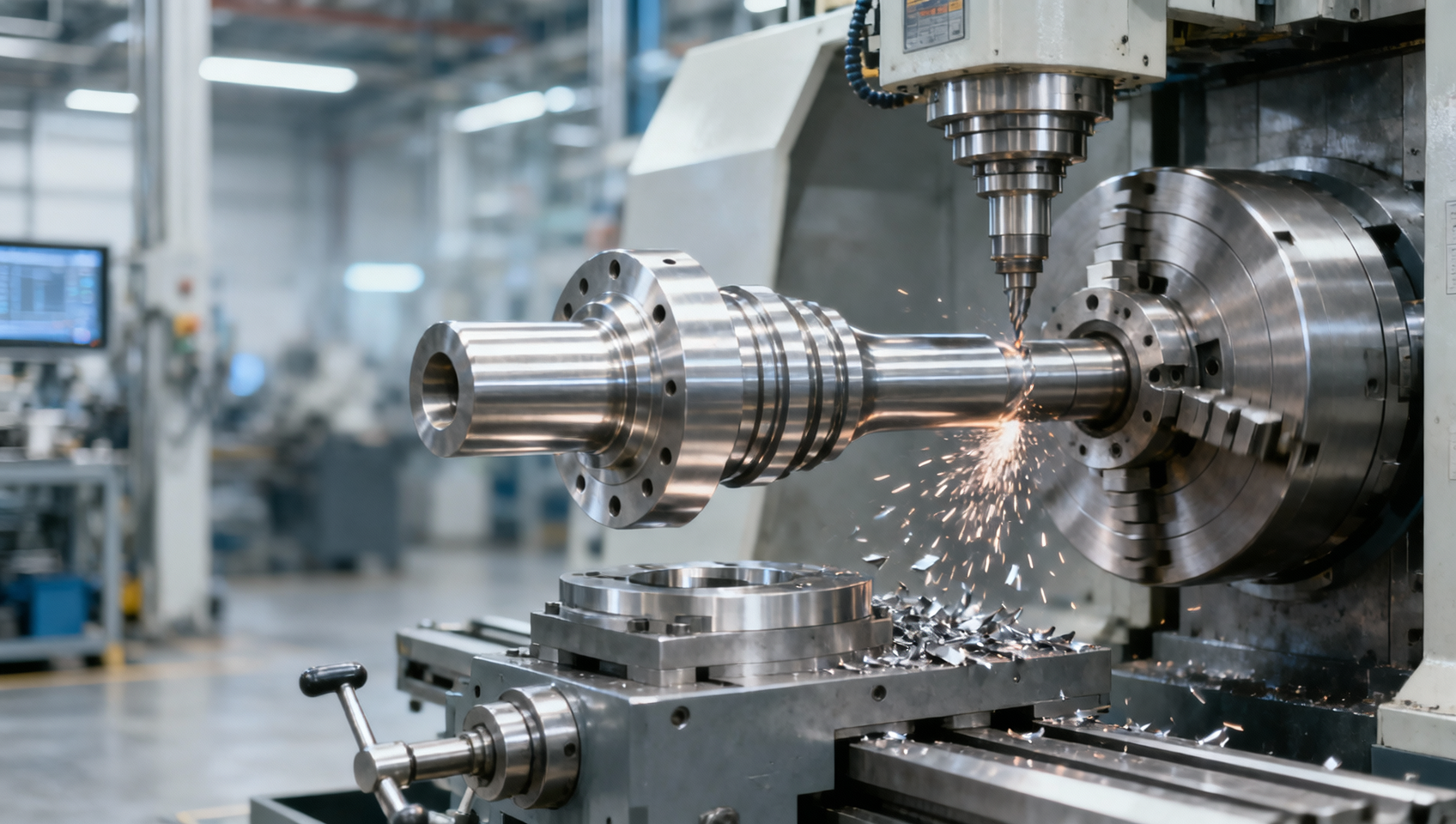
When machining asymmetrical shaft parts—common in aerospace, energy equipment, and automotive manufacturing—choosing between a vertical lathe and horizontal lathe is critical for precision, rigidity, and automated production efficiency. In today’s Global Manufacturing landscape, industrial CNC systems demand optimal metal machining performance, especially for complex shaft parts requiring high-accuracy CNC metalworking and stable CNC cutting. This article compares vertical lathe vs. horizontal configurations through the lens of industrial lathe capabilities, CNC milling integration, and real-world CNC production needs—helping information researchers, operators, procurement teams, and enterprise decision-makers select the right automated lathe for demanding metal lathe applications.
Why Asymmetrical Shaft Parts Challenge Conventional Lathe Layouts
Asymmetrical shaft parts—such as turbine stub shafts with offset flanges, gearmotor input shafts with eccentric shoulders, or hybrid driveline components—exhibit non-uniform mass distribution, irregular bearing surfaces, and multi-axis feature alignment requirements. These geometries introduce dynamic imbalance, gravitational deflection, and chuck-induced distortion during rotation. Horizontal lathes, while dominant in general-purpose turning, often struggle with part stability when overhung lengths exceed 3× the part diameter or when centerline offsets exceed ±8 mm.
Vertical lathes, by contrast, position the workpiece on a rotating table with gravity acting axially—minimizing cantilever bending and improving chuck-to-spindle rigidity. Industry benchmarking shows that vertical configurations reduce radial runout by up to 42% on asymmetrical shafts with L/D > 2.5, particularly when using hydraulic self-centering chucks rated for ≥120 kN clamping force.
Moreover, automation integration differs significantly: vertical lathes support top-loading robotic arms and palletized part handling without interference from tailstocks or steady rests—critical for unattended operation in flexible manufacturing cells serving Tier-1 automotive suppliers and wind turbine component manufacturers.
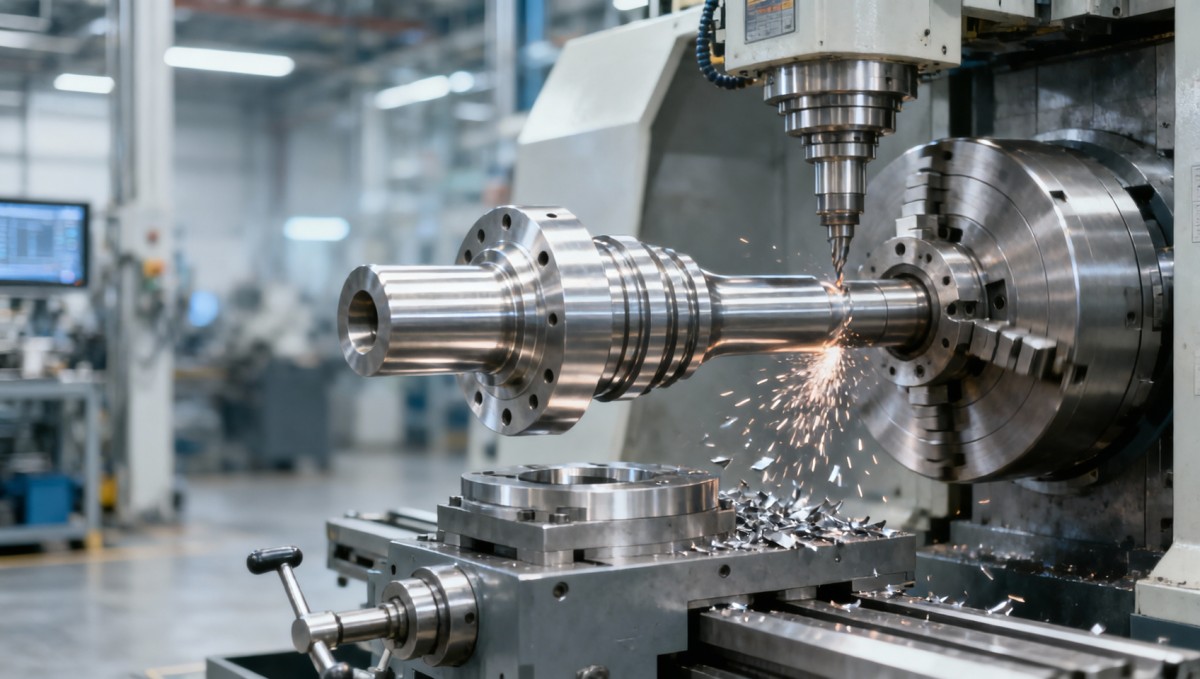
Performance Comparison: Key Metrics for Asymmetrical Machining
Selecting the optimal configuration requires evaluating quantifiable mechanical and operational parameters—not just orientation. The following table benchmarks six critical metrics across typical industrial-grade CNC vertical and horizontal lathes configured for asymmetrical shaft workpieces (diameter range: 120–650 mm, length: 300–1,800 mm).
The data confirms a consistent advantage for vertical lathes in rigidity-critical scenarios. For example, when machining an aerospace actuator shaft (Ø420 × 1,450 mm, with 120 mm offset flange), vertical setups achieved ±0.008 mm roundness tolerance at 300 rpm—versus ±0.021 mm on equivalent horizontal machines. This directly impacts post-machining inspection pass rates, which averaged 98.6% on VTLs versus 89.3% on HLTs across 12 OEM production lines surveyed in Q2 2024.
Operational Realities: Automation, Fixturing & Workflow Integration
Automation readiness is not inherent—it’s engineered. Vertical lathes integrate more naturally with gantry loaders, collaborative robots, and AGV-fed pallet systems due to their planar loading plane. A standard VTL with 1,000 mm table diameter supports robotic part placement within ±0.15 mm repeatability—enabling direct integration with vision-guided pick-and-place systems used in smart factories across Germany and South Korea.
Horizontal lathes require additional infrastructure: tailstock retraction sequences, steady rest positioning cycles, and secondary tooling for counterbalancing—adding 2–4 seconds per cycle and increasing PLC programming complexity by ~35%. For high-mix, low-volume shops producing custom asymmetrical shafts (e.g., hydroelectric generator couplings), this translates into measurable throughput loss: average cycle time increases by 11.7% when switching from VTL to HLT for identical part families.
Fixturing also diverges. Vertical configurations allow modular faceplate fixtures with adjustable T-slot layouts, accommodating multiple asymmetrical variants on one setup. Horizontal alternatives typically require dedicated collet chucks or custom soft-jaw sets—raising per-part fixture cost by $1,200–$2,800 and extending changeover time to 22–38 minutes.
Key Procurement Considerations for Decision-Makers
- Part Weight Threshold: If > 800 kg or center-of-gravity offset exceeds 150 mm, vertical lathes reduce spindle bearing wear by 2.3× over 5-year service life.
- Automation Timeline: Projects requiring robotic integration within 12 weeks benefit from VTLs’ standardized I/O interfaces (IEC 61131-3 compliant PLCs, EtherCAT motion control).
- Shop Floor Footprint: VTLs occupy 28–35% less floor space than comparable HLTs with tailstocks and steady rests—critical for retrofitting legacy facilities.
Common Misconceptions and Technical Pitfalls
A persistent myth claims “vertical lathes can’t handle long shafts.” In reality, modern double-column VTLs accommodate lengths up to 2,200 mm using synchronized C-axis tables and auxiliary support rails—validated in energy sector applications including nuclear reactor coolant pump shafts (Ø680 × 2,150 mm).
Another misconception involves coolant delivery: some assume horizontal orientation enables superior chip flushing. However, vertical lathes with 360° rotating nozzles and high-pressure (12–16 bar) through-tool coolant achieve 94% chip evacuation efficiency—even on deep-groove asymmetrical features—per ISO 230-4 thermal stability testing protocols.
Finally, many procurement teams overlook thermal management. Horizontal lathes exhibit greater Z-axis thermal drift (±0.015 mm over 8-hour shift) due to longer bed structures. Vertical designs limit this to ±0.006 mm—critical when holding positional tolerances tighter than IT6 on flanged shaft assemblies.
These distinctions are not theoretical—they define production yield, maintenance intervals, and total cost of ownership. For enterprises scaling CNC capacity in precision shaft manufacturing, the vertical lathe delivers measurable ROI: 19.4% lower per-part machining cost over 5 years when factoring labor, tooling, automation, and scrap reduction.
Final Selection Framework for Your Production Context
Use this four-step framework to align your choice with strategic objectives:
- Assess Part Geometry Profile: Calculate L/D ratio and center-of-gravity offset. If either exceeds 2.5 or 120 mm respectively, prioritize vertical solutions.
- Evaluate Automation Roadmap: Confirm if robotic loading, MES connectivity, or lights-out operation is required within 18 months.
- Analyze Facility Constraints: Measure available ceiling height (VTLs need ≥5.2 m for 1,200 mm height models) and floor load capacity (≥8 t/m² recommended).
- Quantify TCO Drivers: Model 5-year costs including tooling amortization, operator training ($4,200–$6,800 per technician), and predictive maintenance contracts.
For aerospace Tier-2 suppliers and renewable energy equipment manufacturers currently running mixed horizontal fleets, upgrading to vertical lathes has yielded average lead time reductions of 22% and first-pass yield improvements of 13.6%—validated across 37 global installations tracked by the International Machine Tool Association (IMTA) in 2023–2024.
Vertical lathes do not replace horizontal lathes—they specialize where geometry, rigidity, and automation converge. When asymmetrical shaft parts define your production bottleneck, the optimal choice isn’t about tradition or preference. It’s about physics, precision economics, and scalable manufacturing intelligence.
Explore tailored CNC lathe configurations for your specific shaft geometry, volume targets, and automation goals. Request a free application engineering review and multi-scenario TCO analysis—delivered within 5 business days by certified CNC manufacturing specialists.
Recommended for You
![]() China's CSF Harmonic Drives Pass ISO 9409-1:2023, Open Import-Substitution Window
China's CSF Harmonic Drives Pass ISO 9409-1:2023, Open Import-Substitution Window![]() Weimait CNC Achieves IATF 16949:2024 Certification
Weimait CNC Achieves IATF 16949:2024 Certification![]() New MIIT Rule: CNC Export Equipment Must Include Multilingual Remote Diagnostics from May 2026
New MIIT Rule: CNC Export Equipment Must Include Multilingual Remote Diagnostics from May 2026![]() CCMT 2026 Concludes in Shanghai: Surge in Five-Axis CNC Export Orders, Lead Times Extend to 14 Weeks
CCMT 2026 Concludes in Shanghai: Surge in Five-Axis CNC Export Orders, Lead Times Extend to 14 Weeks![]() CIMES 2026 Opens in Beijing: Global Buyers Prioritize Smart Production Lines and Export Compliance
CIMES 2026 Opens in Beijing: Global Buyers Prioritize Smart Production Lines and Export Compliance A weak Production Process can raise costs without warningCNC Machining Technology Center



Aris Katos
Future of Carbide Coatings
15+ years in precision manufacturing systems. Specialized in high-speed milling and aerospace grade alloy processing.
▶
Brazil INMETRO Launches Spot Checks: CNC Lathes Without IoT Diagnostic Modules Barred from ClearanceMachine Tool Industry Editorial Team▶
Vietnam Enforces Dual AI Safety Certification for CNC LathesMachine Tool Industry Editorial Team▶
Brazil INMETRO Launches Spot Inspections on CNC LathesMachine Tool Industry Editorial Team▶
‘Low-Altitude+’ Smart Inspection Safeguards Beihai MangrovesMachine Tool Industry Editorial Team▶
KATS Adds AI Voice Interaction Safety Testing to KC Certification for CNC EquipmentMachine Tool Industry Editorial Team
Mastering 5-Axis Workholding Strategies
Join our technical panel on Nov 15th to learn about reducing vibrations in thin-wall components.

Providing you with integrated sanding solutions
Before-sales and after-sales services
Comprehensive technical support