• Global CNC market projected to reach $128B by 2028 • New EU trade regulations for precision tooling components • Aerospace deman
NYSE: CNC +1.2%LME: STEEL -0.4%

How Industrial Robotics Is Changing Small Batch Production
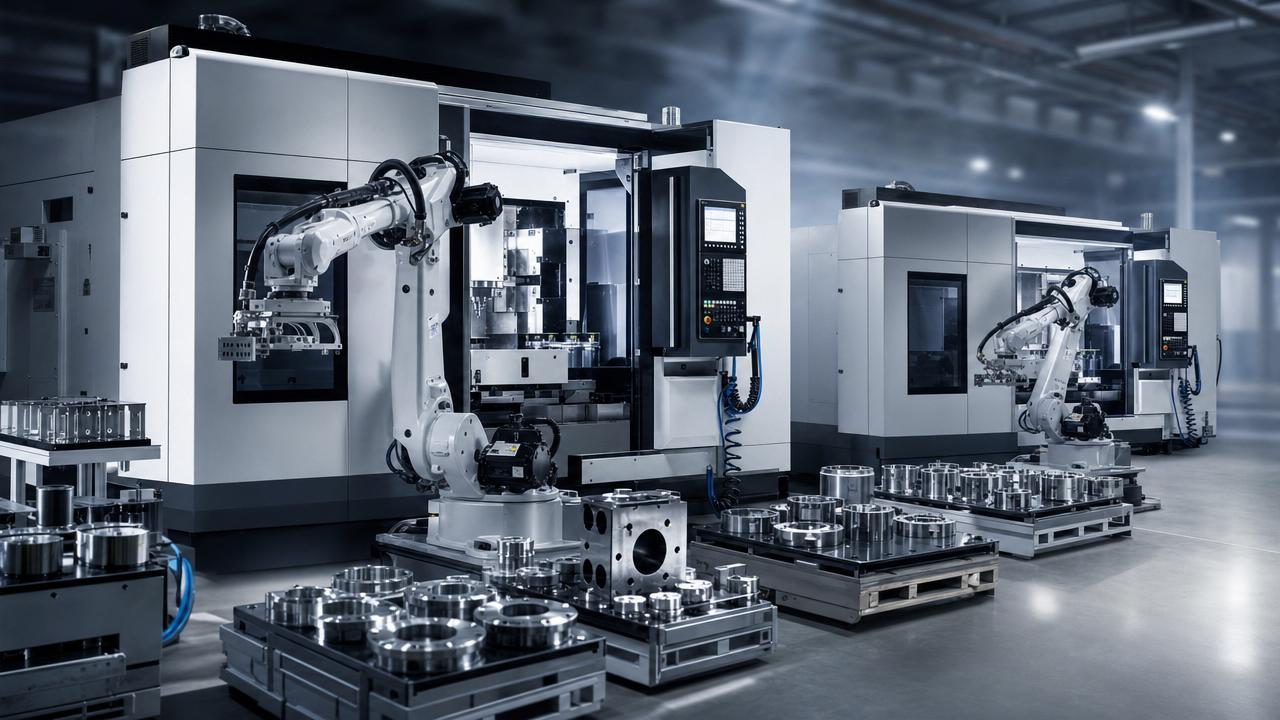
Industrial Robotics is reshaping small batch production by making flexible, high-precision manufacturing more efficient and cost-effective. For manufacturers using CNC machine tools, machining centers, and automated systems, robots now help reduce setup time, improve consistency, and support faster responses to custom orders. This shift is opening new opportunities for smart manufacturing across industries that demand both accuracy and production agility.
For information researchers, the key question is no longer whether robots belong only in high-volume factories. The more useful question is how industrial robotics changes economics, process stability, and lead-time performance when order sizes range from 5 to 500 parts, designs change often, and quality tolerances can fall within ±0.01 mm to ±0.05 mm.
In the CNC machine tool industry, small batch production has historically involved frequent fixture changes, manual loading, repeated program verification, and uneven cycle times across shifts. Industrial Robotics helps address these bottlenecks by linking machine tools, material handling, inspection points, and data feedback into a more responsive cell design.
This matters in sectors such as aerospace components, automotive prototyping, electronics housings, energy equipment parts, and precision structural components. In these environments, buyers and engineers often need shorter changeover windows, less operator dependency, and better output traceability without committing to fully dedicated mass production lines.
Why small batch production is becoming a core use case for Industrial Robotics
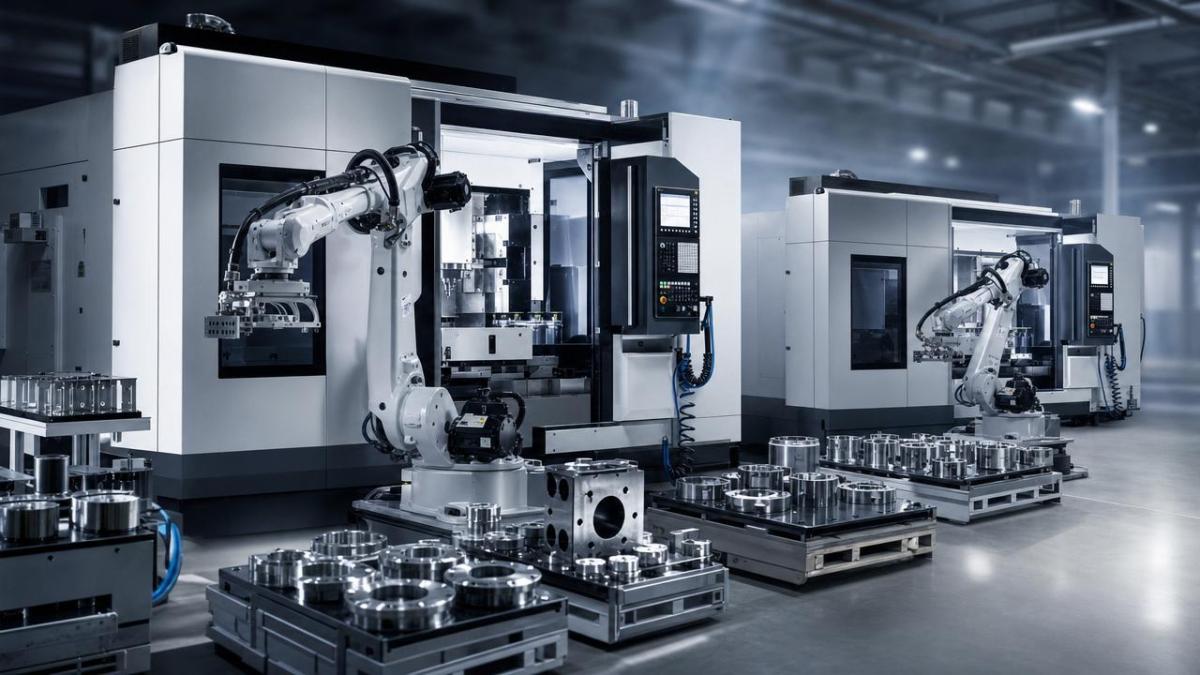
Small batch manufacturing is no longer a niche operating model. Many suppliers now receive mixed orders with 10, 20, or 100-piece runs, especially in custom machining, spare part production, trial orders, and export-oriented contract manufacturing. In this context, Industrial Robotics provides flexibility that traditional fixed automation often cannot deliver economically.
The shift from labor-heavy cells to flexible robotic cells
A typical manual CNC cell may require 2 to 3 operators per shift for loading, unloading, deburring transfer, and visual inspection. A robotic cell can reduce manual touches to 1 operator overseeing multiple machines, especially when integrated with pallet systems, automatic doors, and tool life monitoring. The result is more stable throughput over 8-hour, 16-hour, or even lights-out production windows.
For small batch work, setup time is often the true cost driver. If changeover consumes 30 to 90 minutes per order, machine utilization drops quickly. Industrial Robotics helps standardize end-of-arm tooling, part presentation, and job sequencing, which can shorten non-cutting time and improve spindle utilization across mixed production schedules.
Where the value appears first
The first gains usually appear in three areas: handling consistency, machine uptime, and process repeatability. On precision machine tools, even a 10% to 20% increase in machine loading consistency can reduce idle time significantly. For manufacturers handling high-mix aluminum, steel, or alloy parts, robotic loading also lowers the risk of surface damage caused by inconsistent manual handling.
- Reduced setup interruption across 3 to 8 job changes per shift
- Better cycle consistency for batches under 200 pieces
- Lower dependence on highly experienced loaders during night shifts
- More predictable output when multiple CNC machines share one robot
The table below shows how small batch production requirements align with different robotic deployment goals in CNC and precision manufacturing environments.
The key takeaway is that Industrial Robotics does not only reduce labor. In small batch production, its more strategic role is to protect machine time, support repeatable handling, and make short-run manufacturing more economically manageable.
How Industrial Robotics integrates with CNC machine tools and flexible manufacturing cells
For most manufacturers, the practical value of Industrial Robotics depends on integration depth. A standalone robot offers limited benefit if the CNC machine, fixture strategy, tool management, and inspection process remain disconnected. The strongest results usually come from cells designed around 4 to 6 linked functions rather than simple pick-and-place automation.
Common integration points in precision manufacturing
In a modern machining environment, robots are commonly paired with CNC lathes, vertical machining centers, horizontal machining centers, and multi-axis systems. Integration often includes automatic door control, chuck or fixture status feedback, infeed and outfeed racks, and optional probing or post-process gauging. These connections are especially useful when part families share similar handling dimensions but different machining programs.
A typical implementation may support payloads from 5 kg to 35 kg for small and medium machined parts. Reach ranges often fall between 700 mm and 1,800 mm depending on machine spacing and tray layout. For higher-mix work, quick-change grippers and modular part nests can reduce physical conversion time between jobs to 10 to 20 minutes instead of 45 to 60 minutes.
Four integration priorities that influence results
- Machine communication stability, including start/stop, door, clamp, and alarm signals
- Fixture compatibility across part families and batch sizes
- Program management for 5 to 30 recurring part numbers
- Operator interface simplicity for shift-level adjustments and recovery
The following comparison helps buyers assess which cell architecture is more suitable for small batch CNC production.
In many cases, the two-machine tending model offers the best balance for small batch manufacturing. It improves equipment utilization without locking the factory into a rigid line, which is important when customer demand changes monthly or even weekly.
Operational benefits, risks, and realistic adoption limits
Industrial Robotics can improve cost structure and process control, but its impact varies by part complexity, lot size, and internal engineering capability. Information researchers should avoid the assumption that every robotic project immediately delivers labor savings. In small batch environments, the business case is often a combined result of throughput stability, reduced scrap, and extended machine hours rather than simple headcount reduction.
Benefits that are measurable in daily operations
One measurable gain is setup discipline. When robotic handling paths, tray locations, and gripper logic are standardized, production teams often see fewer restart errors after job changes. Another benefit is consistency across shifts. A robotic cell does not vary due to fatigue over a 10-hour shift, which helps when machining thin-wall parts, precision discs, or shaft components that require stable loading orientation.
Manufacturers may also gain scheduling flexibility. If a shop can run 2 to 4 additional unattended hours per day, the same CNC asset can absorb more urgent sample orders or design revisions. This is particularly useful in export manufacturing, where customers may request low-volume qualification runs before placing larger repeat orders.
Risks that buyers should evaluate early
The main risk is poor process matching. If part variation is too high, gripping surfaces are unstable, or fixture change steps are not standardized, Industrial Robotics may add complexity rather than remove it. Another risk is underestimating engineering time. Even a compact cell may require 2 to 6 weeks for programming, signal verification, trial cutting coordination, and safety validation depending on the machine interface and part family count.
- Do not automate unstable processes before fixing fixture or tooling issues
- Check whether chip removal, coolant splash, and part cleanliness affect gripping reliability
- Confirm spare part support and service response within acceptable downtime windows
- Plan operator training for alarm recovery, recipe switching, and routine inspection
A practical rule for adoption
A useful screening rule is to start with part families that meet at least 3 conditions: repeat orders within 3 to 6 months, handling weight below the robot payload threshold, and fixture logic that can be standardized. This approach reduces commissioning risk and makes return-on-investment evaluation more reliable.
How to evaluate Industrial Robotics for procurement and implementation
For procurement teams, selecting an Industrial Robotics solution for small batch production is not just about robot brand or arm speed. The decision should cover the complete manufacturing cell, including machine compatibility, tooling, safety, software logic, maintenance planning, and future expansion. A lower initial price can become costly if changeovers remain slow or service support is weak.
Five evaluation dimensions for buyers
- Batch profile: average lot size, order frequency, and part family similarity
- Machine profile: number of CNC assets, cycle time distribution, and interface readiness
- Handling profile: part weight, geometry, surface protection needs, and orientation requirements
- Changeover profile: current setup time, target reduction, and tooling modularity
- Support profile: training depth, spare parts availability, and onsite or remote service response
The table below can be used as a practical procurement checklist for CNC-oriented robotic projects.
This checklist shows that successful adoption depends on system thinking. In flexible manufacturing, the most valuable robotic solution is the one that keeps CNC machines productive while preserving the ability to switch among different parts without excessive delay.
Implementation roadmap for lower-risk deployment
A lower-risk implementation usually follows 5 stages: process review, part family selection, cell design, offline or onsite validation, and phased production ramp-up. For many shops, a pilot covering 1 or 2 machines and 3 to 5 representative parts gives enough operational data before scaling to a wider flexible production line.
During ramp-up, teams should track at least 6 indicators: cycle consistency, machine idle minutes, setup duration, first-pass yield, alarm frequency, and recovery time. These measures provide a more realistic picture than labor cost alone and help determine whether Industrial Robotics is improving total manufacturing responsiveness.
Common misconceptions to avoid
Misconception 1: Robots only make sense for large-scale production
In reality, flexible robotic cells are increasingly useful for recurring low-volume work, especially when CNC assets are expensive and downtime is costly. The more valuable the spindle hour, the stronger the case for stable machine tending.
Misconception 2: Any robot can be added to any machine
Compatibility depends on machine access, control signals, fixture method, safety layout, and part flow. Without these elements, installation may look simple but perform poorly in real production.
Misconception 3: Automation removes the need for skilled people
Skilled staff remain essential. Their roles shift from repetitive loading toward recipe management, process optimization, quality checks, and exception handling. This is often a stronger long-term advantage than labor replacement alone.
Industrial Robotics is changing small batch production by making CNC-based manufacturing more flexible, more consistent, and better aligned with fast-changing customer demand. For researchers, buyers, and production planners, the real opportunity lies in matching robotic systems to repeatable part families, realistic changeover goals, and integrated machine tool workflows.
When evaluated carefully, robots can reduce non-cutting time, improve machine utilization, and support higher-quality output across low-volume, high-mix production. If you are exploring CNC automation, flexible machining cells, or smart factory upgrades, contact us to get a tailored solution, discuss product details, or learn more about practical Industrial Robotics strategies for precision manufacturing.
PREVIOUS ARTICLE
Recommended for You
 Zero-Point Clamping or Modular Fixtures? Choosing a Faster CNC Changeover SystemCNC Machining Technology Center
 How to Cut CNC Fixture Changeover Time Without Sacrificing Part AccuracyCNC Machining Technology Center
 When Does CNC Turning Pay Off? A Break-Even Guide by Annual Part VolumeMachine Tool Industry Editorial Team
 Machine Tool Standards by Country: What Importers Must Verify Before PurchaseManufacturing Policy Research Center
 CNC Lathe Quick Installation Guide: Alignment Checks Before First Production RunCNC Machining Technology Center
 How to Select a CNC Lathe for Small Parts Without Sacrificing Accuracy or Cycle TimeCNC Machining Technology Center

Aris Katos
Future of Carbide Coatings
15+ years in precision manufacturing systems. Specialized in high-speed milling and aerospace grade alloy processing.
▶
Global Manufacturing Trends: How Supply Chains and Regional Shifts Affect SourcingManufacturing Market Research Center▶
Small-Batch Production and Smart Manufacturing for Small Businesses: Where to Start FirstManufacturing Market Research Center▶
What Smart Manufacturing Technology for Industry 4.0 Means for Mid-Sized FactoriesManufacturing Market Research Center▶
How Smart Manufacturing Benefits Reduce Downtime and Scrap in Metal Parts ProductionManufacturing Market Research Center▶
Advanced Manufacturing Technology for Energy Equipment: Key Processes and Use CasesManufacturing Market Research Center
Mastering 5-Axis Workholding Strategies
Join our technical panel on Nov 15th to learn about reducing vibrations in thin-wall components.

Providing you with integrated sanding solutions
Before-sales and after-sales services
Comprehensive technical support