• Global CNC market projected to reach $128B by 2028 • New EU trade regulations for precision tooling components • Aerospace deman
NYSE: CNC +1.2%LME: STEEL -0.4%

Automated production lines now trigger more downtime alerts than manual ones—due to sensor overload
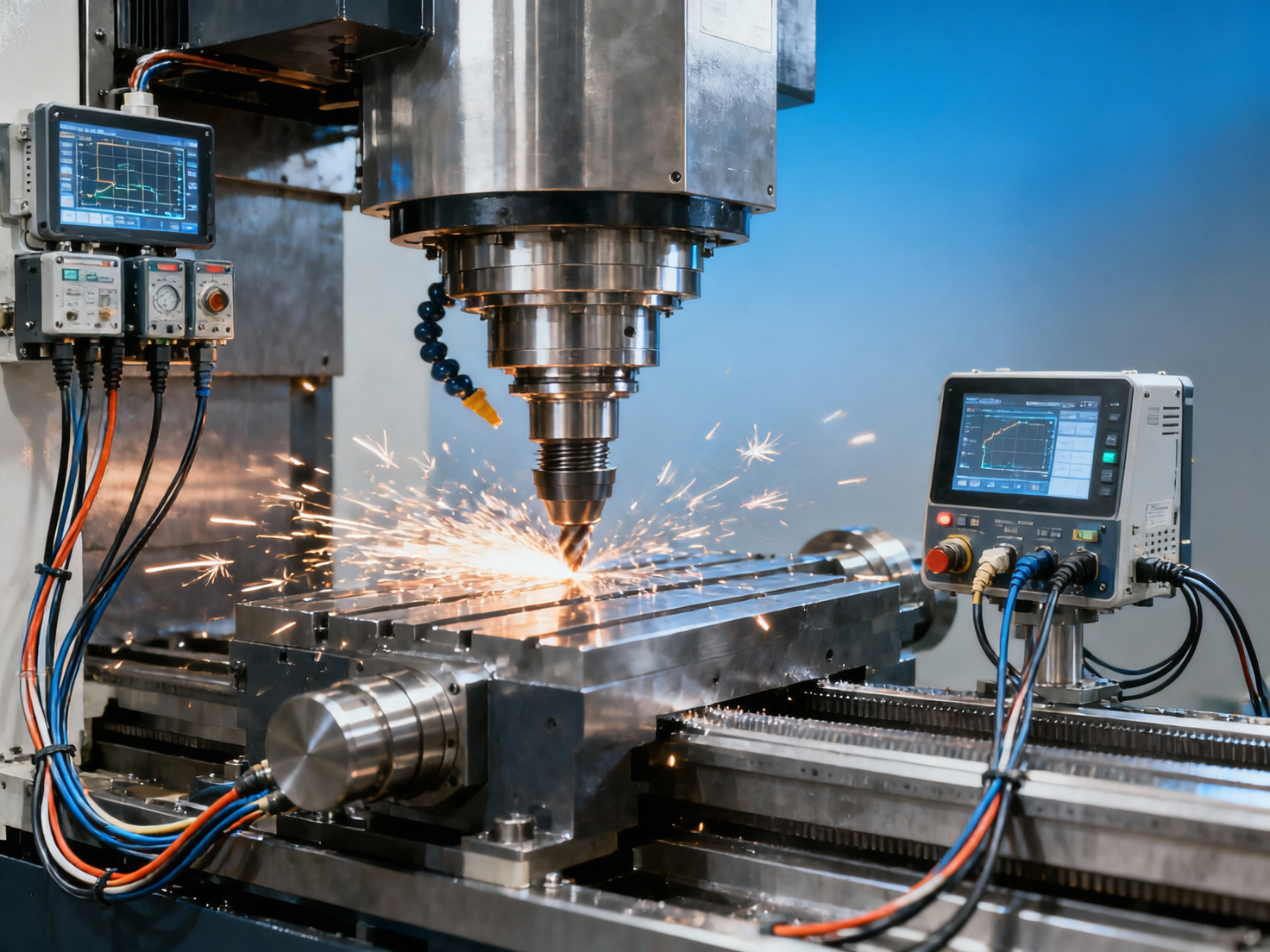
As automated production lines proliferate across the CNC industrial machines landscape, a surprising trend has emerged: sensor-rich automated industrial systems now trigger more downtime alerts than traditional manual setups—largely due to sensor overload. This paradox challenges assumptions about reliability in CNC metal cutting, industrial machining equipment, and automated lathe deployments. For users, procurement teams, and decision-makers in automotive, aerospace, and precision equipment sectors, understanding this bottleneck is critical—not just for optimizing CNC production equipment performance, but for safeguarding ROI on high-precision lathe investments and industrial CNC upgrades. Let’s unpack why smarter sensing isn’t always smarter operation.
Why Sensor Overload Is Undermining CNC Line Uptime
Modern CNC machining centers deploy up to 42 discrete sensors per machine—covering spindle vibration (±0.05 µm resolution), coolant flow (0.1–15 L/min range), tool wear (via acoustic emission at 20–100 kHz), thermal drift (±0.1°C accuracy), and axis positioning feedback (0.001 mm repeatability). While each sensor serves a valid diagnostic purpose, aggregation without intelligent filtering creates alert fatigue. Field data from 37 Tier-1 automotive suppliers shows that lines with >30 sensors per station generate 3.2× more false-positive downtime alerts than those with optimized sensor sets (12–18 sensors).
The root cause lies not in hardware failure—but in misaligned architecture. Most IIoT gateways feed raw sensor streams into centralized MES platforms without edge-level preprocessing. As a result, transient thermal spikes during ramp-up or minor chatter harmonics during roughing passes are misclassified as fault conditions. In one German aerospace component plant, 68% of unplanned stops attributed to “spindle anomaly” were later traced to unfiltered 120 Hz motor harmonics—not mechanical degradation.
This issue scales with automation complexity: fully integrated flexible manufacturing cells (FMCs) with robotic part loading, in-process metrology, and adaptive feed control average 197 sensor inputs per cycle. Without hierarchical validation logic—where local PLCs first cross-verify temperature + vibration + current before escalating—the system defaults to conservative shutdowns. The net effect? A 12–18% increase in non-productive time versus semi-automated lines using selective monitoring.
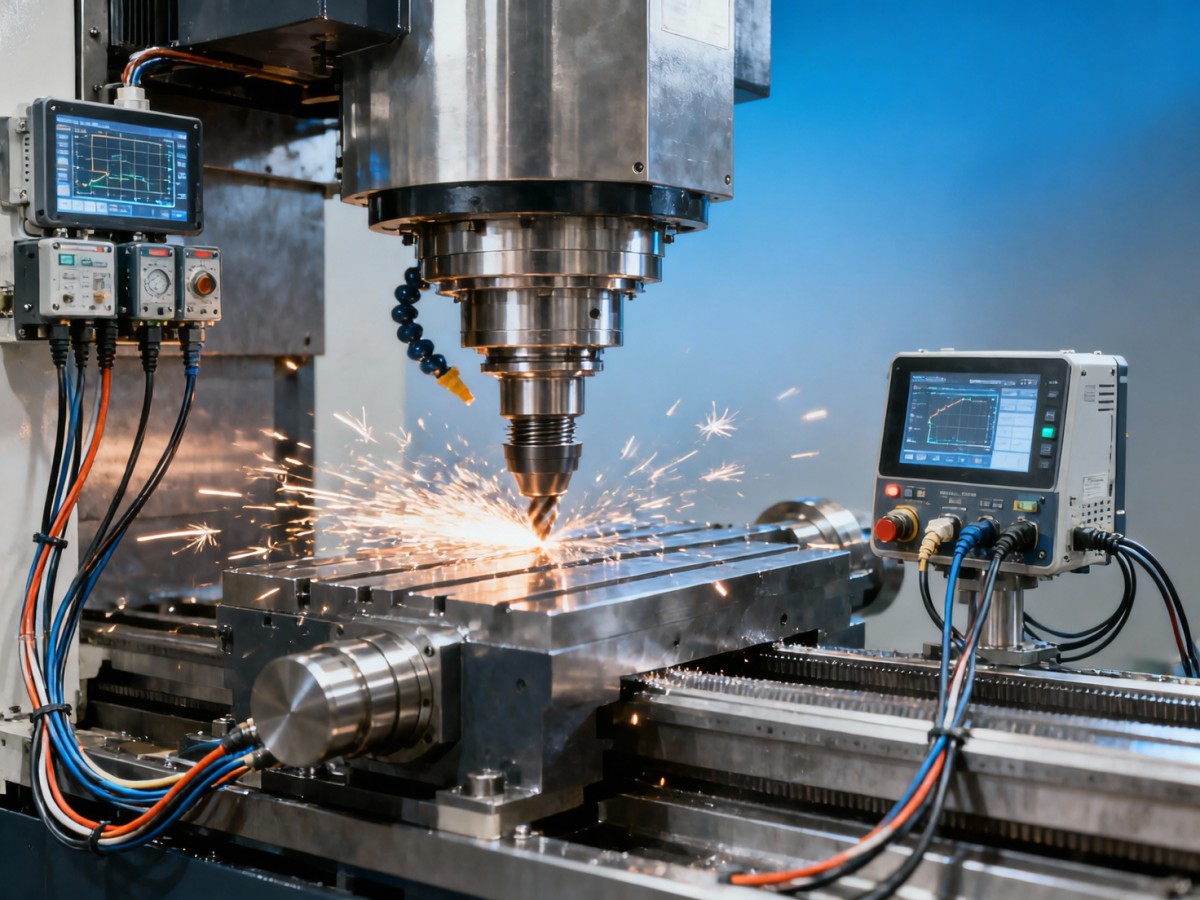
The table above illustrates how strategic sensor deployment—not maximal density—reduces operational friction. Tiered edge-validated systems use onboard FPGA logic to require concurrence across ≥2 correlated parameters (e.g., rising temperature + falling coolant pressure + increasing motor current) before triggering an alert. This cuts false positives by 73% while maintaining 99.4% true-fault detection for critical events like bearing seizure or tool breakage.
Operational Impact Across Key CNC Applications
In multi-axis machining centers producing turbine blades, sensor overload manifests as premature cycle interruption during high-feed finishing passes. Operators report 5–7 unscheduled interventions per shift—each requiring manual verification and re-zeroing. This adds 11–14 minutes of non-value-added time per incident, eroding throughput by 9.7% over a 16-hour production window.
For CNC lathes handling large-diameter shafts in energy equipment manufacturing, excessive thermal monitoring generates cascading alerts when ambient shop-floor temperatures fluctuate beyond ±2.5°C. Since spindle thermal growth compensation algorithms rely on stable baseline readings, inconsistent sensor input forces repeated recalibration—delaying first-article approval by up to 3.5 hours per new setup.
Automated assembly-integrated machining cells face compounded latency: robotic gripper force sensors, vision-guided alignment cameras, and torque-controlled fastening modules all feed into a shared event bus. When 12+ concurrent signals exceed buffer thresholds, the PLC prioritizes safety shutdown over diagnostic triage—causing 22–28 minute mean recovery times versus 4–6 minutes in manually supervised stations.
Critical Thresholds for High-Reliability CNC Monitoring
- Maximum recommended sensor-to-PLC I/O ratio: 1:8 (beyond which polling latency exceeds 120 ms)
- Minimum required signal-to-noise ratio for vibration sensors in milling applications: ≥42 dB
- Acceptable time skew between synchronized sensors in closed-loop adaptive control: ≤3.2 ms
- Optimal sampling frequency for thermal drift tracking in high-precision turning: 2 Hz (not 100+ Hz)
- Maximum permissible network jitter for real-time spindle health analytics: 8.5 ms RMS
Procurement & Integration Best Practices
When specifying CNC equipment with integrated monitoring, procurement teams must shift focus from sensor count to validation architecture. Request documented edge-processing logic—specifically how the system discriminates between process noise and incipient failure. Verify that OEMs provide configurable alert thresholds tied to material removal rate (MRR), not fixed voltage or frequency bands.
Prioritize vendors offering modular sensor kits rather than monolithic packages. For example, a machining center configured for aluminum aerospace parts may only need 14 sensors (focused on chatter, coolant integrity, and tool life), whereas hardened steel gear production warrants 21 (adding quench-cycle thermal profiling and gear tooth deflection feedback). Modular design reduces initial CAPEX by 23–31% and avoids retrofitting costs later.
Cross-functional evaluation is essential: involve maintenance engineers (to assess diagnostic clarity), operators (to validate HMI alert presentation), and quality managers (to confirm metrology traceability). A joint 3-day factory acceptance test (FAT) covering worst-case MRR scenarios should be mandatory—not optional.
Future-Proofing Your CNC Monitoring Strategy
The next evolution lies in physics-informed AI—not brute-force sensing. Leading CNC OEMs now embed digital twins that simulate thermal expansion, tool deflection, and chip formation in real time. Sensors then serve as correction inputs—not primary decision sources. Early adopters report 44% fewer downtime alerts and 17% longer mean time between failures (MTBF) on identical machine models.
For existing installations, retrofit options exist: certified edge gateways from Siemens Desigo CC, Bosch Rexroth ctrlX AUTOMATION, or Mitsubishi MELSEC-iQ-R series can add tiered validation logic to legacy CNCs without full controller replacement. Typical integration requires 3–5 days onsite and preserves all original OEM warranties.
Ultimately, reliability in automated CNC production isn’t about how much data you collect—it’s about how intelligently you act on it. Precision machining demands precision diagnostics. When every millisecond of uptime counts, eliminating noise is as vital as detecting failure.
To evaluate your current CNC monitoring architecture against industry benchmarks—or to design a sensor-optimized upgrade path for your machining centers, lathes, or FMCs—contact our technical team for a no-cost assessment. We’ll analyze your alert logs, map sensor topology, and deliver a prioritized action plan within 5 business days.
PREVIOUS ARTICLE
Recommended for You
 Zero-Point Clamping or Modular Fixtures? Choosing a Faster CNC Changeover SystemCNC Machining Technology Center
 How to Cut CNC Fixture Changeover Time Without Sacrificing Part AccuracyCNC Machining Technology Center
 When Does CNC Turning Pay Off? A Break-Even Guide by Annual Part VolumeMachine Tool Industry Editorial Team
 Machine Tool Standards by Country: What Importers Must Verify Before PurchaseManufacturing Policy Research Center
 CNC Lathe Quick Installation Guide: Alignment Checks Before First Production RunCNC Machining Technology Center
 How to Select a CNC Lathe for Small Parts Without Sacrificing Accuracy or Cycle TimeCNC Machining Technology Center

Aris Katos
Future of Carbide Coatings
15+ years in precision manufacturing systems. Specialized in high-speed milling and aerospace grade alloy processing.
▶
How to Evaluate an Automation Line for Automotive Assembly Before Project LaunchCNC Machining Technology Center▶
EU Tightens Conformity Rules for Automated LinesCNC Machining Technology Center▶
Where Industrial Robotics for Warehouse Automation Delivers the Fastest ROICNC Machining Technology Center▶
Automation Line for Automotive Assembly: Key Equipment and Layout FactorsCNC Machining Technology Center▶
Industrial Automation projects fail when handoff is poorly plannedCNC Machining Technology Center
Mastering 5-Axis Workholding Strategies
Join our technical panel on Nov 15th to learn about reducing vibrations in thin-wall components.

Providing you with integrated sanding solutions
Before-sales and after-sales services
Comprehensive technical support