• Global CNC market projected to reach $128B by 2028 • New EU trade regulations for precision tooling components • Aerospace deman
NYSE: CNC +1.2%LME: STEEL -0.4%

Why space-saving CNC manufacturing matters in small factories
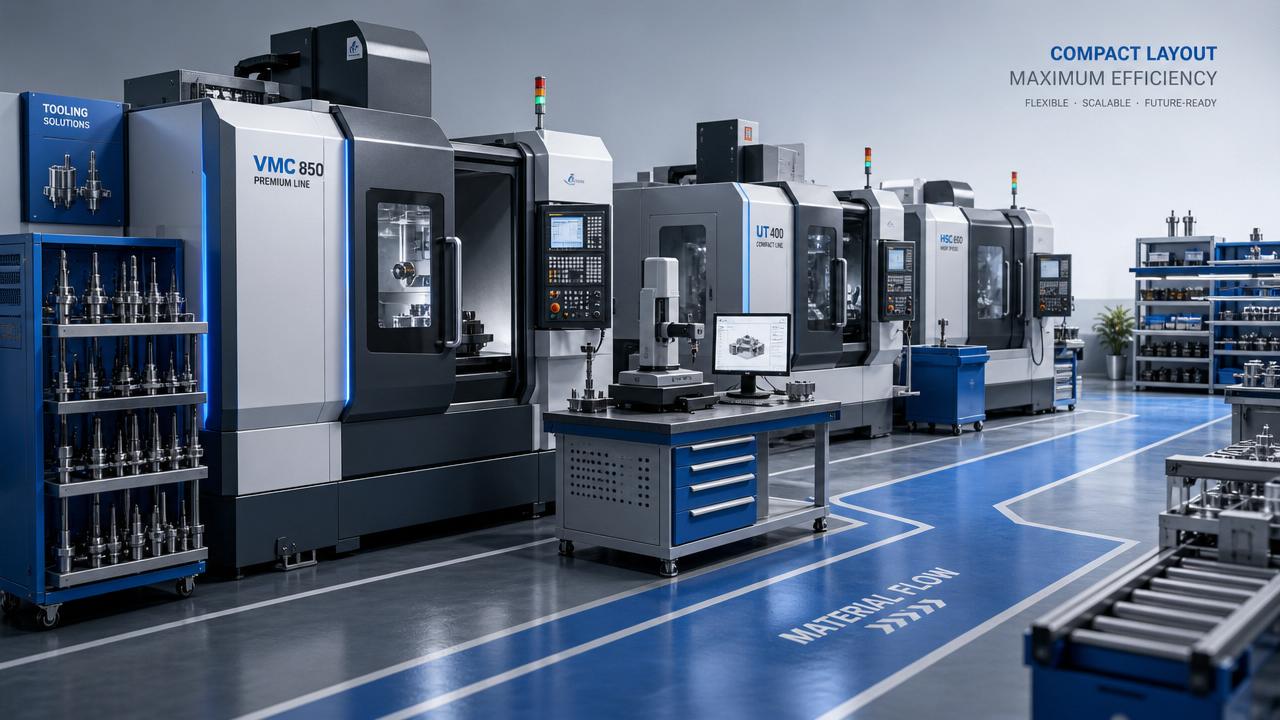
For small factories, every square meter affects productivity, cost control, and future scalability. Space-saving CNC manufacturing turns limited floor area into a competitive asset by combining compact equipment, efficient layouts, faster changeovers, and smart automation. Instead of treating space as a fixed constraint, this approach helps improve throughput, reduce handling waste, and support growth without immediate building expansion.
In modern precision manufacturing, compact production planning matters as much as spindle power or tolerance capability. Small facilities often serve mixed orders, shorter lead times, and fluctuating batch sizes. That makes space-saving CNC manufacturing especially valuable, because it supports flexible workflows while protecting machine access, operator safety, and material flow.
Why space-saving CNC manufacturing matters in small factories
Limited floor space can quietly damage output. Machines may be capable, yet poor placement causes waiting time, blocked aisles, long material travel, and delayed setups. Space-saving CNC manufacturing addresses those hidden losses through layout discipline, machine consolidation, and smarter supporting systems.
The value is not only physical compression. A smaller, better-organized CNC cell can improve machine utilization, reduce non-cutting time, simplify supervision, and lower energy demand per part. In sectors such as automotive components, electronics housings, tooling, and general metalworking, these gains directly affect margins and delivery performance.
This is why a checklist-based approach works well. It avoids abstract planning and focuses attention on measurable factors: footprint, access clearance, chip management, tool storage, loading methods, maintenance reach, and digital coordination. When these factors are reviewed together, small factories can expand effective capacity without chasing expensive building projects too early.
Use this checklist to evaluate space-saving CNC manufacturing
- Measure the real production footprint, including loading, unloading, maintenance access, coolant service, chip removal, and operator walking paths, not just the machine catalog dimensions.
- Prioritize multifunction machines that combine turning, milling, drilling, or tapping operations to reduce part transfers, staging zones, and duplicated fixtures across separate stations.
- Map material flow from receiving to finished goods, then shorten travel distance between raw stock, CNC equipment, inspection points, and packing areas.
- Reserve vertical space for tool cabinets, bar feeders, compact automation towers, and overhead utility routing to free usable floor area for movement.
- Standardize fixtures, tool holders, and work offsets so setups happen faster and require less storage space for rarely used accessories.
- Separate high-mix jobs from repeat production jobs to prevent compact cells from becoming congested with mixed tools, paperwork, and in-process parts.
- Check chip evacuation and coolant filtration early, because poor waste handling often consumes extra containers, cleanup space, and unscheduled labor.
- Adopt compact automation only where part volume, cycle time, and labor movement justify it, rather than adding robots that create new bottlenecks.
- Track spindle uptime, setup time, queue time, and floor-space output to confirm that space-saving CNC manufacturing improves actual productivity.
- Plan future expansion paths so today’s compact layout still allows another machine, loader, or inspection station without major relocation work.
Where compact CNC strategies create the most value
High-mix, low-volume production
Job shops and mixed-order plants often lose space to temporary staging, spare fixtures, and repeated setup activity. In this setting, space-saving CNC manufacturing works best when machines are grouped by process compatibility and setup resources are centralized.
A compact machining center with standardized tooling can handle multiple part families without large storage zones nearby. The goal is not to crowd equipment, but to reduce motion, confusion, and setup drift.
Repeat parts and stable batches
For stable production, compact line design can be more aggressive. Machines can be aligned for predictable loading patterns, shared inspection, and synchronized material replenishment. This improves visibility and supports leaner supervision.
In these cases, space-saving CNC manufacturing often pairs well with pallet systems, compact conveyors, or simple robotic loading. Because part variation is lower, automation occupies less coordination space.
Precision parts with strict quality control
Small factories producing aerospace fittings, medical components, or electronics parts need clear separation between machining, measurement, and cleaning. A space-saving layout must still protect process stability and traceability.
The practical solution is to place inspection close to the machine cell without blocking access. Shorter transfer distance reduces handling risk while keeping nonconforming parts from moving too far downstream.
Common oversights that reduce the benefits
Ignoring service clearance
A machine may fit on paper but fail in daily use. If maintenance panels, lubrication points, or electrical cabinets are difficult to reach, downtime increases and quick repairs become disruptive.
Overloading one compact cell
Trying to force every operation into one area can create queue buildup, operator interference, and material confusion. Space-saving CNC manufacturing should remove waste, not compress disorder.
Underestimating storage needs
Raw stock, finished parts, gauges, and backup tools still require controlled storage. Without defined locations, inventory spreads into aisles and quickly erases layout gains.
Adding automation without flow analysis
A robot or bar feeder can save labor, but it may also block access or require extra guarding space. Compact automation must be matched to part geometry, takt time, and replenishment rhythm.
Failing to use production data
Layout decisions based only on intuition often miss hidden losses. Data from machine monitoring, setup records, and part movement logs reveals where space-saving CNC manufacturing produces measurable returns.
Practical steps to implement space-saving CNC manufacturing
- Start with a current-state layout sketch showing machines, storage, utilities, aisles, inspection, and staging areas. Mark every repeated walk, delay, and blocked movement.
- Calculate output per square meter for each process area. This quickly shows which zones consume space without delivering proportional machining value.
- Pilot one compact CNC cell before changing the full workshop. Test access, safety, tool replenishment, chip control, and setup time under real orders.
- Move nonessential storage away from the machine envelope. Keep only active tools, fixtures, gauges, and material needed for current production nearby.
- Review machine selection using total footprint and process integration, not only purchase price, spindle speed, or table size.
- Recheck the layout every quarter, especially after adding new part families, automation devices, or quality checkpoints.
In many general manufacturing environments, the best results come from combining modest equipment upgrades with disciplined workflow redesign. That may include replacing two aging standalone machines with one multitasking unit, moving gauges closer to the cell, and digitizing job instructions to eliminate paper clutter.
Conclusion and next action
Space-saving CNC manufacturing matters because small factories cannot afford to waste productive area on unnecessary motion, duplicate handling, or poor layout logic. When compact machine selection, lean material flow, and practical automation work together, the same building can support higher output and better responsiveness.
The next step is simple: audit one production zone, measure its true operating footprint, and compare output against occupied space. That single review often reveals the fastest path to effective space-saving CNC manufacturing and more scalable precision production.
PREVIOUS ARTICLE
NEXT ARTICLE
Recommended for You
![]() ISO/TR 24122:2026 CNC Machine Carbon Footprint Guide PublishedManufacturing Policy Research Center
ISO/TR 24122:2026 CNC Machine Carbon Footprint Guide PublishedManufacturing Policy Research Center![]() Shenwei CNC Dual-Spindle Transfer Machine Passes TÜV Rheinland Production-Line Integration CertificationMachine Tool Industry Editorial Team
Shenwei CNC Dual-Spindle Transfer Machine Passes TÜV Rheinland Production-Line Integration CertificationMachine Tool Industry Editorial Team![]() China's CNC Machine Tool Penetration Rate Exceeds 51%Manufacturing Market Research Center
China's CNC Machine Tool Penetration Rate Exceeds 51%Manufacturing Market Research Center![]() VDMA-TÜV South Germany Releases 2026 CNC Green Procurement GuideManufacturing Policy Research Center
VDMA-TÜV South Germany Releases 2026 CNC Green Procurement GuideManufacturing Policy Research Center![]() Brazil INMETRO Enforcement: 37 CNC Lathes Rejected Over IoT ModuleManufacturing Policy Research Center
Brazil INMETRO Enforcement: 37 CNC Lathes Rejected Over IoT ModuleManufacturing Policy Research Center![]() Red Sea Crisis Escalates: Maersk Suspends CNC Equipment Bookings on Asia-Europe RoutesGlobal Machine Tool Trade Research Center
Red Sea Crisis Escalates: Maersk Suspends CNC Equipment Bookings on Asia-Europe RoutesGlobal Machine Tool Trade Research Center


Aris Katos
Future of Carbide Coatings
15+ years in precision manufacturing systems. Specialized in high-speed milling and aerospace grade alloy processing.
▶
Why space-saving CNC manufacturing matters in small factoriesCNC Machining Technology Center▶
Is space-saving CNC manufacturing worth it for small factories?CNC Machining Technology Center▶
UL Tightens AI Failure Testing for CNC Systems Starting May 22, 2026CNC Machining Technology Center▶
How CNC Programming errors lead to scrap and reworkCNC Machining Technology Center▶
How CNC milling accuracy changes with material and setupCNC Machining Technology Center
Mastering 5-Axis Workholding Strategies
Join our technical panel on Nov 15th to learn about reducing vibrations in thin-wall components.

Providing you with integrated sanding solutions
Before-sales and after-sales services
Comprehensive technical support