• Global CNC market projected to reach $128B by 2028 • New EU trade regulations for precision tooling components • Aerospace deman
NYSE: CNC +1.2%LME: STEEL -0.4%

Do Machine Tool Standards Differ Between Countries?
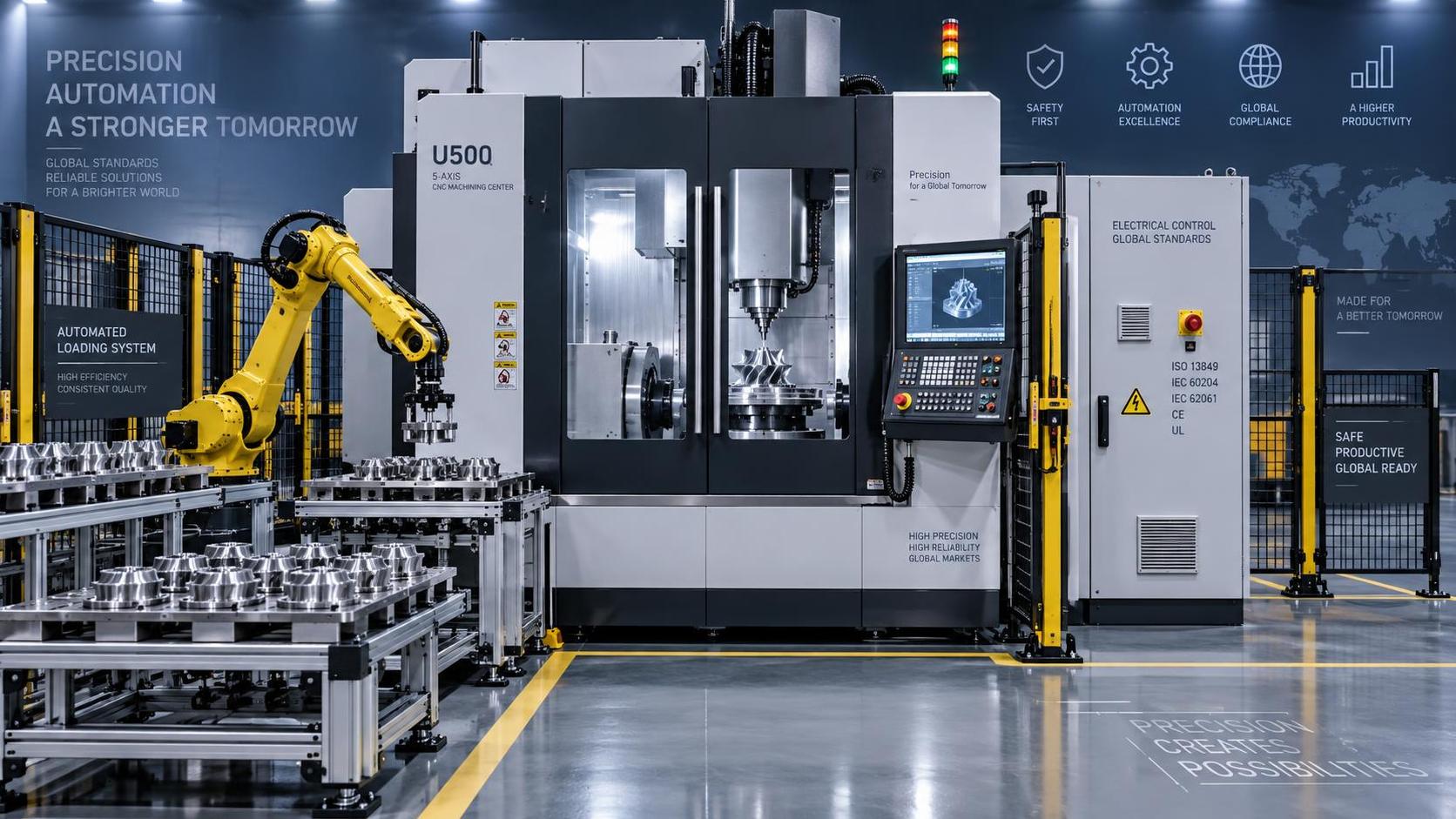
Yes. Machine tool standards do differ between countries, even though many of the underlying engineering principles are shared internationally. A CNC machining center built for one market may be mechanically capable of performing the same work in another, yet still require changes to its electrical system, guarding, documentation, control configuration, safety functions, or certification package before it can be legally sold, installed, or insured.
For a buyer importing a CNC lathe, five-axis machining center, grinder, or automated cell, the practical question is not simply whether the machine follows ISO standards. It is whether the equipment meets the rules that apply where it will be installed, operated, and maintained. The answer often depends on the destination country, the machine's automation level, the intended industry, and whether the equipment will be placed on the market as new or moved as used capital equipment.
A sensible starting point is to treat international standards as a common technical language, while treating national and regional requirements as the conditions for market access and safe operation.
International standards reduce variation, but do not eliminate it
Machine tool builders across major manufacturing countries commonly work with international standards covering areas such as machine safety, electrical equipment, control systems, testing methods, accuracy terminology, and documentation. ISO and IEC standards are especially influential because they give manufacturers, component suppliers, and users a common basis for specifying equipment.
That common basis matters. A buyer comparing machining centers from China, Germany, Japan, South Korea, or another production base can often discuss spindle speed, positioning accuracy, backlash compensation, safety interlocks, electrical cabinets, coolant systems, and control architecture using familiar technical concepts. Internationally recognized standards also make it easier to compare test reports, request equivalent components, and define acceptance conditions in a purchase contract.
However, an ISO or IEC reference in a machine specification does not automatically prove that the machine is compliant in every destination market. International standards may be adopted differently by national authorities. Some are incorporated into local standards with national deviations. Others are voluntary unless a regulation, customer requirement, insurance condition, or procurement specification makes them effectively mandatory.
The difference becomes more visible when a machine is supplied with a robot loader, bar feeder, pallet system, automatic tool-changing arrangement, mist extraction unit, or linked production line. The machine is no longer assessed only as a stand-alone cutting machine. Its interfaces, emergency-stop behavior, access points, safeguarding logic, and system-level control functions may need to be evaluated as part of an integrated installation.
Where country-level differences usually appear
Buyers sometimes focus heavily on machine geometry and cutting performance, then discover that the difficult part of an international project sits outside the cutting zone. In practice, country differences tend to appear in five areas.
1. Electrical design and power supply
Voltage, frequency, phase arrangements, plug types, grounding practices, conductor colors, and panel requirements vary by market. A machine built around one electrical convention may need a redesigned transformer, motor configuration, breaker selection, cabinet layout, or local electrical components for another country.
This is more than a commissioning inconvenience. An unsuitable electrical configuration can affect safety approval, spare-parts availability, fault diagnosis, and long-term maintenance. A machine may run after an on-site modification, but that does not necessarily mean the modification is acceptable under local electrical or workplace requirements.
Power quality also deserves attention. Facilities with unstable voltage, frequent switching events, or high electrical noise may require additional protection or conditioning. These are site issues rather than national standards issues, but they are often discovered during cross-border installations because the machine was designed for a different factory environment.
2. Safety guarding and operator access
Most industrial markets expect machine tools to protect operators from rotating parts, moving axes, ejected workpieces, hot chips, coolant, and unexpected machine movement. The details can differ in how safety rules are interpreted, documented, tested, and enforced.
For example, buyers should examine door interlocks, guard locking, emergency-stop circuits, access to maintenance zones, safe setup modes, chuck guarding, bar-feed protection, and the behavior of the machine when a protective device is opened. A manual lathe, CNC turning center, vertical machining center, and robot-fed flexible cell each present different hazards. A safety approach that is reasonable for one machine category may not be sufficient once automation is added.
Safety-rated control functions also deserve close review. A machine may have a visible emergency-stop button, but the broader question is what happens to motion, stored energy, spindle rotation, hydraulic pressure, pneumatic force, and automated restart conditions. For an integrated line, the emergency-stop response must make sense across the whole cell, not merely at one machine station.
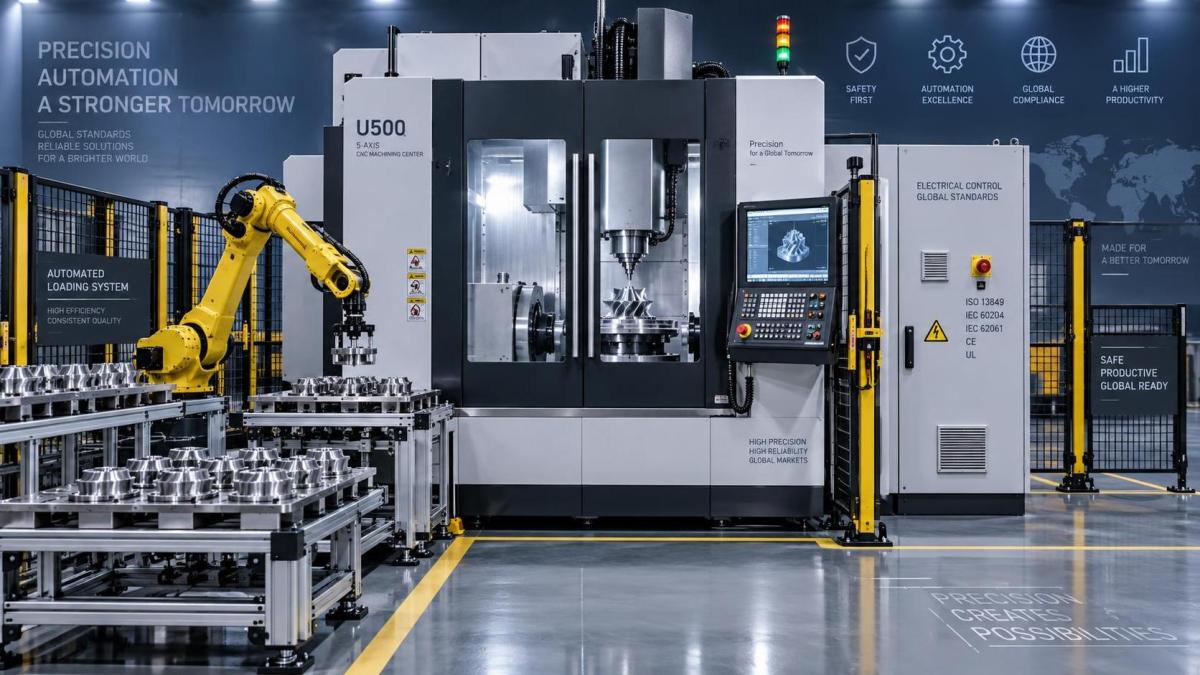
3. Certification, declarations, and technical documentation
Documentation requirements often create the largest administrative gap between countries. Some markets place strong emphasis on a formal conformity assessment process, technical files, declarations, labeling, instructions, and traceability. Others rely more heavily on domestic certification systems, local inspection practices, electrical approvals, or user-side workplace compliance.
Documentation should be treated as part of the machine deliverable. At a minimum, a buyer should establish which language versions are required for manuals, warning labels, electrical drawings, maintenance procedures, and safety instructions. Translating an operator manual after shipment may seem minor, but incomplete translations can create training problems and compliance exposure, particularly when lockout procedures, emergency actions, or service instructions are unclear.
The same applies to declarations of conformity and test records. A supplier may provide standard factory inspection documents, but the destination market or end customer may expect more specific evidence covering electrical equipment, guarding, functional safety, emissions, or installed accessories. The contract should state which documents are required before shipment and which must accompany the equipment at delivery.
4. Accuracy standards versus acceptance expectations
Machine tool accuracy is another area where terminology can appear more harmonized than the commercial reality. International test methods help define how positioning, repeatability, circular interpolation, spindle performance, and geometric accuracy can be evaluated. Yet the purchase requirement may still differ by country, customer sector, or supplier practice.
An aerospace subcontractor may require a detailed acceptance protocol and traceable measurement evidence. A general machining workshop may prioritize stable production capability on its own part family. An automotive supplier may care more about process capability, automation uptime, and tool-life consistency than a catalog positioning value. Each requirement can be valid, but they should not be confused.
Buyers should therefore avoid accepting broad claims such as “high precision” or “tested to international standards” without defining the acceptance method. The purchase specification should identify the applicable test standard or method, the machine condition during testing, the instruments or measurement process, environmental assumptions where relevant, and the action to be taken if results fall outside the agreed limit.
5. Automation, software, and connected equipment
Machine tools increasingly arrive with robots, automatic workpiece handling, pallet pools, probing systems, remote service functions, production monitoring software, and factory-network connections. These features create requirements beyond the base machine.
A robot cell may require separate assessment of safeguarding distances, fencing, scanners, interlocked access, restart prevention, and collaborative operating modes where applicable. A connected machine may also need to fit the customer's cybersecurity rules, remote-access policy, data handling requirements, and industrial network architecture. These controls are not identical in every country or enterprise, even when the CNC itself comes from a globally recognized control supplier.
For this reason, a machine tool purchase should distinguish between the machine's declared capabilities and the responsibilities for the complete automated system. If a supplier delivers the CNC machine, robot, fixtures, safety enclosure, installation, and control integration, responsibility may be relatively clear. If different parties supply those elements, the buyer needs a written division of responsibility before installation begins.
China, Germany, Japan, and South Korea: the practical comparison
These manufacturing centers share a high level of engineering capability, but their machine tools may enter export projects through different standard, documentation, and supply-chain pathways. It is risky to assume that a machine's country of manufacture predicts its quality or its suitability for a particular market. The more useful distinction is whether the delivered configuration has been designed and documented for the destination country.
German-built equipment is often specified for European industrial environments and may be supplied with extensive technical documentation and safety-related options. Japanese and South Korean machine tools may have strong global installation bases, but buyers should still verify local electrical configurations, manuals, automation interfaces, and support arrangements. Chinese manufacturers may offer highly adaptable configurations for export, though the buyer should define the target-market compliance package rather than assume that an export label covers every regulatory or end-user requirement.
A machine assembled in one country can also contain drives, controls, safety components, hydraulic units, encoders, and electrical devices sourced globally. Component origin is not the central issue. What matters is whether the complete machine, in its delivered configuration, satisfies the destination requirements and can be supported with approved replacement parts.
How to assess a machine before placing an international order
The most effective time to resolve standards questions is before a technical offer becomes a purchase order. Once a machine has been built, changes to guarding, cabinet design, safety circuits, labels, or documents can delay shipment and create avoidable rework.
- Identify the installation country and end-use environment. State where the machine will be installed, whether it will be operated as a stand-alone unit or in a production cell, and whether the end customer has its own engineering standards.
- Request a destination-specific compliance statement. Ask the supplier to identify the standards, regulations, declarations, markings, and documents included with the offered configuration. Avoid relying on a generic statement that does not name the target market.
- Review the electrical schedule early. Confirm site voltage, frequency, grounding method, main disconnect arrangement, power demand, air requirements, coolant provisions, and any transformer or power-conditioning needs.
- Define the safety scope. Clarify who supplies guarding, interlocks, chip conveyors, mist extraction, bar feeders, robots, fixtures, and safety integration. Every added device can change the risk profile.
- Write measurable acceptance criteria. Separate machine accuracy, machining results, cycle time, automation performance, and documentation completeness. A successful factory acceptance test may not prove that the final installed system meets all site obligations.
- Plan for service and replacement parts. Verify that safety components, electrical devices, control hardware, and manuals can be supported in the installation region over the operating life of the machine.
Used machines need an additional layer of care. Equipment moved across borders may have been compliant when first installed but may no longer meet the expectations applied to a new installation, a modified machine, or a newly integrated automated cell. Modifications made by a previous owner can further complicate the picture, particularly where guards, controls, or electrical cabinets have been altered without complete documentation.
Do not confuse certification with operating suitability
A certification mark, declaration, or standards reference is important, but it does not answer every operational question. A compliant machine can still be a poor fit for a factory if its chip handling is inadequate, its enclosure is unsuited to the chosen coolant, its controller cannot communicate with the required production system, or its maintenance access conflicts with the available floor layout.
Likewise, a technically capable machine may require local changes before it can be accepted by a plant safety team, insurer, customer auditor, or local authority. Compliance should be checked alongside process requirements, not after the machining decision has already been made.
For cross-border machine tool projects, the useful conclusion is straightforward: standards differ enough between countries to affect cost, lead time, installation, and risk. International standards provide an important foundation, but destination-market compliance must be specified at machine level and, where automation is involved, at system level. Buyers who define those boundaries early are far less likely to discover that a machine is exportable in theory but difficult to put into production in practice.
PREVIOUS ARTICLE
NEXT ARTICLE
Recommended for You
![]() FANUC Invests $18 Million in Largest U.S. Corporate Automation Training CenterMachine Tool Industry Editorial Team
FANUC Invests $18 Million in Largest U.S. Corporate Automation Training CenterMachine Tool Industry Editorial Team Southeast Asia Machine Tool Market: Comparing Automotive Demand by CountryManufacturing Market Research Center
![]() Zhongshan Xiaolan Machinery Exhibition Opens With Global Product DebutsMachine Tool Industry Editorial Team
Zhongshan Xiaolan Machinery Exhibition Opens With Global Product DebutsMachine Tool Industry Editorial Team Automated Production Machining: Which Parts and Batch Sizes Are a Good Fit?Machine Tool Industry Editorial Team
![]() FANUC Links FIELD System Data with Copilot to Advance Shop-Floor Data UseCNC Machining Technology Center
FANUC Links FIELD System Data with Copilot to Advance Shop-Floor Data UseCNC Machining Technology Center Smart Manufacturing for Aerospace: Building Traceability Across CNC OperationsCNC Machining Technology Center


Aris Katos
Future of Carbide Coatings
15+ years in precision manufacturing systems. Specialized in high-speed milling and aerospace grade alloy processing.
▶
Do Machine Tool Standards Differ Between Countries?Manufacturing Policy Research Center▶
METI Eases Export Rules for AI CNC ControllersManufacturing Policy Research Center▶
BIS Widens CNC Software License Exception for China University ProjectsManufacturing Policy Research Center▶
2026 China Internet Civilization Conference Highlights AI-Driven Manufacturing ComplianceManufacturing Policy Research Center▶
2026 Global Trade & Investment Summit: AI+Manufacturing, Beijing, May 18Manufacturing Policy Research Center
▶
Mastering 5-Axis Workholding Strategies
Join our technical panel on Nov 15th to learn about reducing vibrations in thin-wall components.

Providing you with integrated sanding solutions
Before-sales and after-sales services
Comprehensive technical support