• Global CNC market projected to reach $128B by 2028 • New EU trade regulations for precision tooling components • Aerospace deman
NYSE: CNC +1.2%LME: STEEL -0.4%

Why Industrial Robotics now matters in quality control
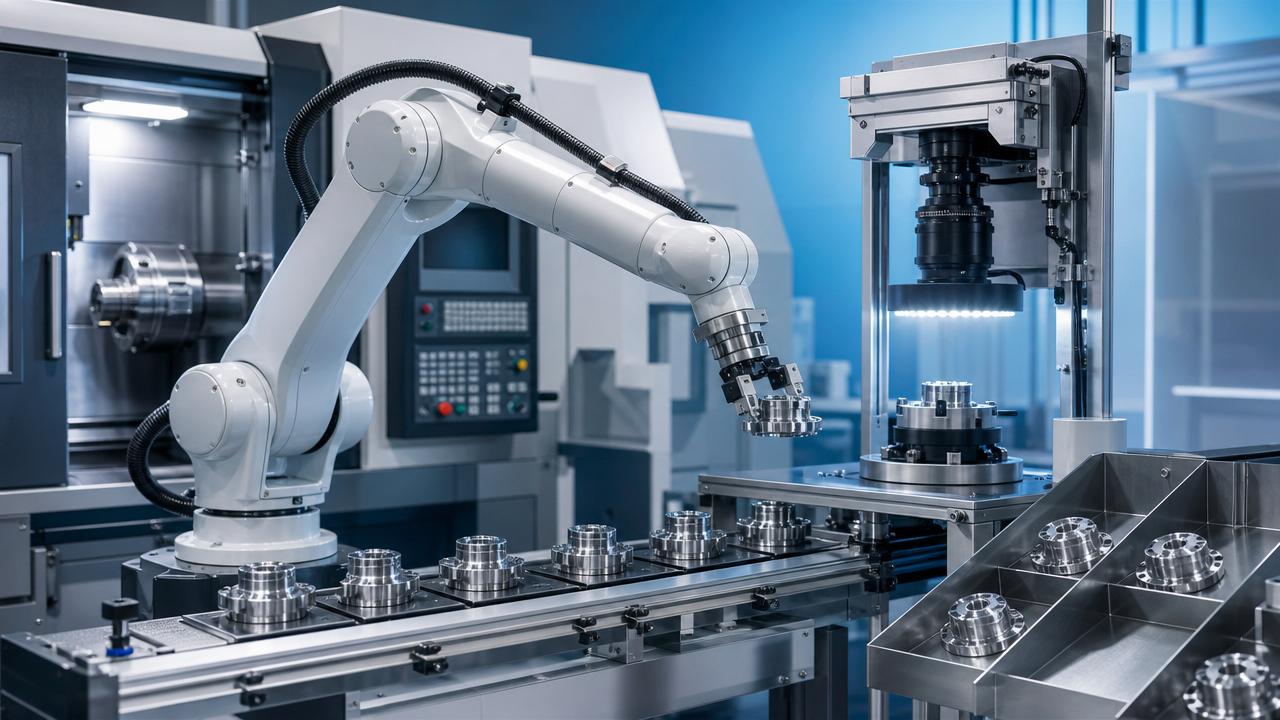
Industrial Robotics now plays a critical role in quality control, helping manufacturers detect defects faster, improve process consistency, and reduce human error across CNC machining and automated production lines. For quality control and safety managers, these systems offer not only higher inspection accuracy but also better traceability, safer workflows, and stronger support for meeting the rising standards of modern precision manufacturing.
In CNC machining, precision manufacturing, and automated assembly, quality problems rarely come from one source alone. A rejected part may be linked to tool wear, unstable loading, poor clamping force, vibration, coolant issues, or an unrecorded setup change made 2 hours earlier. Industrial Robotics matters because it connects inspection, handling, and process control into one repeatable system.
For quality control teams, that means fewer blind spots between machining and inspection. For safety managers, it means less manual contact with rotating spindles, sharp edges, hot chips, and repetitive lifting tasks. In plants running 2-shift or 3-shift schedules, robotic quality systems also reduce the variation that often appears between operators, weekends, and high-mix production batches.
The growing pressure on manufacturers is clear: tighter tolerances, faster delivery cycles, and stronger documentation requirements. In many CNC environments, dimensional tolerances of ±0.01 mm to ±0.05 mm are common, while traceability expectations now extend from raw material lot to final inspection record. That is exactly where Industrial Robotics brings measurable value.
Why Industrial Robotics has become essential in modern quality control
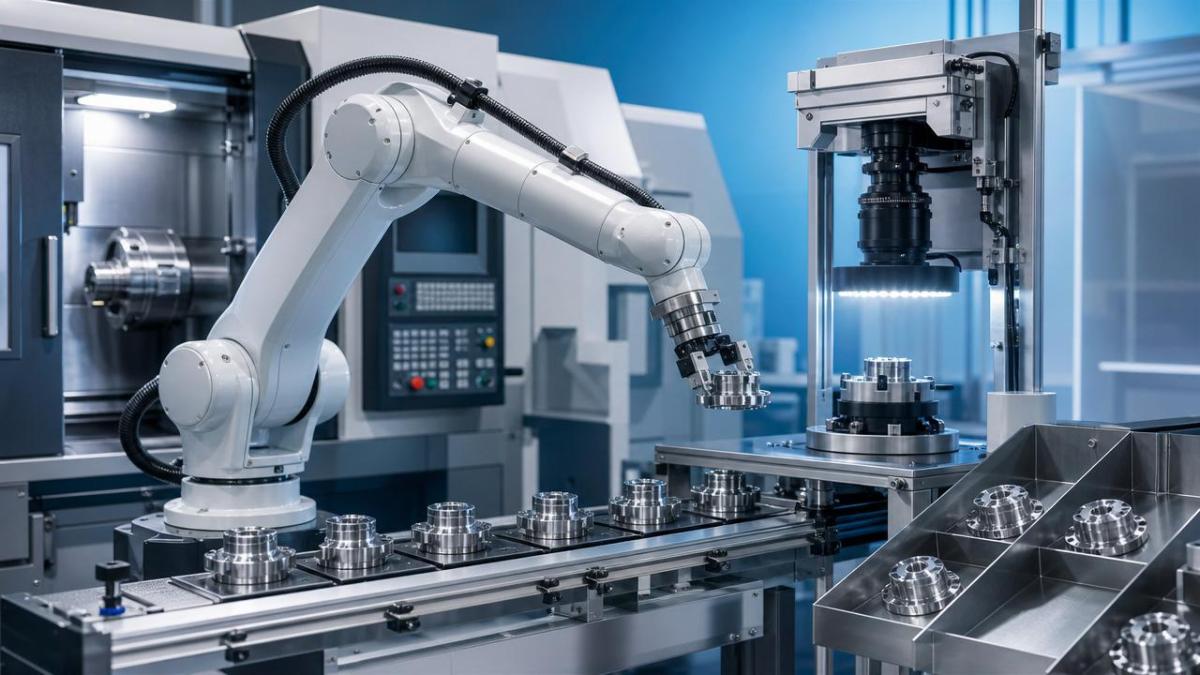
Manufacturing quality used to rely heavily on end-of-line inspection. That approach is no longer enough for CNC machine shops and automated production lines producing complex shafts, discs, housings, and structural parts. When a defect is detected only after a batch of 50 or 100 pieces is complete, scrap costs, machine downtime, and delivery risk all rise at the same time.
Industrial Robotics changes the timing of quality control. Robots can move parts between machine tools, vision systems, gauging stations, deburring cells, and marking units within seconds. This supports in-process verification instead of delayed inspection. In practical terms, a plant can detect drift after 5 pieces instead of after 50, which sharply reduces nonconforming output.
From manual sampling to continuous inspection
Many factories still use manual sampling plans such as 1 part every 20 or 30 pieces. That may work for stable, low-risk processes, but it becomes weak in multi-axis machining, unmanned night shifts, or frequent changeovers. Industrial Robotics supports continuous or near-continuous inspection by presenting each part to cameras, laser scanners, or contact probes in a consistent position.
This consistency matters because inspection accuracy is affected not only by the sensor, but also by part orientation, fixture repeatability, lighting, and cycle rhythm. A robot with repeatability in the common range of ±0.02 mm to ±0.08 mm can significantly improve the stability of visual and dimensional checks when integrated correctly with the cell.
Why this matters to QC and safety managers
- Faster defect detection before large batches are affected
- Reduced dependence on operator skill during repetitive inspection tasks
- Safer part handling around cutting zones, conveyors, and wash stations
- More complete records for first article, in-process, and final inspection
- Improved consistency across 8-hour, 12-hour, or overnight production windows
For safety teams, robotics also reduces exposure to musculoskeletal strain and line-side hazards. Heavy workpieces, sharp machined edges, oil-covered components, and repetitive pick-and-place motions are common sources of minor injuries and long-term fatigue. Replacing even 3 to 5 high-frequency manual handling steps in one cell can improve both safety performance and staffing flexibility.
Typical quality checkpoints where robots add value
The most effective robotic quality systems are not limited to final inspection. They often cover multiple checkpoints: raw part verification, workholding confirmation, in-cycle feature inspection, post-machining dimensional checks, surface defect screening, and packaging verification. This layered approach lowers escape risk and supports root-cause analysis when deviations occur.
The table below shows where Industrial Robotics is commonly used in CNC and precision manufacturing quality workflows, and what QC teams should monitor at each stage.
The key takeaway is that Industrial Robotics delivers the most value when quality control is distributed across the process rather than concentrated at the end. For plants pursuing lower scrap rates and better traceability, early-stage and in-process checks usually produce the fastest return.
Core applications in CNC machining and automated production lines
In the CNC machine tool industry, robotic quality control is not one single application. It is a group of connected functions that support dimensional compliance, surface quality, process repeatability, and safe handling. The exact configuration depends on part geometry, takt time, lot size, and risk level, but several applications appear repeatedly across automotive, aerospace, electronics, and energy equipment manufacturing.
Robotic part presentation for machine vision
Machine vision performs best when the inspected part is presented in the same orientation every time. Industrial Robotics makes that possible. Instead of relying on manual placement under variable lighting and inconsistent angles, the robot presents each workpiece at a fixed position, often within a cycle window of 5 to 20 seconds depending on size and complexity.
This is especially useful for checking holes, chamfers, threads, surface marks, missing features, and incorrect assembly orientation. For quality managers, the value is not just speed. It is repeatability. A stable presentation method reduces false rejects and lowers the time spent on re-inspection.
Automated gauging and dimensional verification
For precision discs, shafts, valve parts, housings, and structural components, dimensional verification often includes diameter, flatness, depth, concentricity, and feature position. Industrial Robotics can load parts into contact or non-contact gauging stations, then sort them automatically into pass, hold, or reject categories.
A common setup uses 3 categories for disposition and 2 levels of alarm. The first level warns of trend drift before tolerance is exceeded. The second level stops the cell when a critical threshold is crossed. That structure helps prevent one out-of-control machine from producing dozens of defective parts during unattended operation.
Robotic handling in hazardous or high-fatigue tasks
Industrial Robotics is equally important when the quality problem is linked to handling damage. Scratches, dents, edge chips, and contamination often occur between machining, washing, and packing. Robots reduce manual contact and keep handling force more consistent, especially for parts weighing 5 kg to 25 kg or for delicate finished surfaces requiring controlled placement.
From a safety standpoint, this application can be as valuable as inspection itself. It minimizes operator entry into guarded machine zones and reduces repetitive lifting frequency across hundreds of cycles per shift.
High-value use cases by production environment
Not every plant needs the same robotic quality strategy. The table below compares common environments and the most suitable deployment focus.
This comparison shows that Industrial Robotics should be matched to the production profile. A high-volume line may prioritize cycle stability and sorting speed, while a high-value low-volume line may focus more on traceability and controlled handling.
What quality and safety managers should evaluate before adoption
A robotic quality project succeeds only when the evaluation goes beyond the robot arm itself. Many deployments underperform because teams focus on payload and reach, but ignore metrology method, fixture design, operator interaction, reject flow, and data logging. For QC and safety managers, selection should be based on the full process chain.
Five critical evaluation factors
- Inspection objective: dimensional check, visual defect detection, identification, or sorting
- Part variation: size range, finish, weight, and orientation tolerance
- Cycle requirement: for example 12 seconds, 30 seconds, or 2 minutes per part
- Integration scope: CNC machine, wash unit, marking station, MES, or SPC software
- Safety method: guarding, interlock logic, collaborative mode, and recovery procedure
These five factors should be reviewed before equipment approval, not after installation. A line producing 4 part families with monthly changeovers will need a different end-effector and recipe structure than a dedicated line running one part number for 10,000 pieces per week.
Data and traceability expectations
Industrial Robotics becomes much more valuable when linked to inspection data. At minimum, most plants should expect 4 record types: part identity, inspection result, timestamp, and station status. More advanced cells may also capture image files, measurement trends, offset triggers, and reject history for each batch.
For safety and compliance, event logs should also document door interlocks, manual recovery actions, and alarm resets. This helps during audits, incident review, and containment actions after a customer complaint.
Common mistakes during specification
- Choosing a robot without considering fixture repeatability
- Assuming vision alone can replace a required dimensional gauge
- Underestimating chip, coolant, and lighting effects on sensors
- Ignoring reject buffer capacity during high-speed production
- Failing to define who owns recipe control between production and quality
Each of these issues can create delays, false alarms, or quality escapes. In many factories, the most practical path is to start with one cell, validate it over 2 to 4 weeks, then standardize the concept across similar machines or part families.
How to implement Industrial Robotics without disrupting production
Implementation should be phased and measurable. A rushed installation often creates unnecessary downtime, operator resistance, and confusion about acceptance criteria. In CNC and automated production lines, the best results usually come from a structured rollout with clear quality targets, safety checks, and responsibility ownership.
A practical 4-step deployment path
- Map the defect risk: identify the top 3 to 5 defect modes by cost, frequency, or customer impact
- Select the control point: loading, in-process inspection, post-process check, or final sort
- Run pilot validation: compare manual results with robotic results over at least 1 full production cycle
- Scale with standards: lock recipes, alarm rules, training, and maintenance intervals
This 4-step path allows teams to quantify performance before full expansion. Typical pilot metrics include false reject rate, missed defect rate, cycle impact, unplanned stoppage frequency, and response time to alarms. A realistic pilot period is often 10 to 30 production days depending on batch diversity.
Training, maintenance, and ownership
Even the best robotic cell loses value if ownership is unclear. Quality teams should define inspection limits and reaction plans. Production should own basic operation and first-level recovery. Maintenance or engineering should manage backups, calibration schedules, and spare-part strategy. Without this split, alarm handling quickly becomes inconsistent.
Routine maintenance should include sensor cleaning, gripper checks, cable inspection, and fixture verification at defined intervals such as every shift, weekly, and monthly. In coolant-heavy environments, lens contamination and chip buildup can affect inspection quality faster than many teams expect.
When a project delivers the strongest return
Industrial Robotics often delivers the strongest return where three conditions exist together: high defect cost, repetitive handling, and stable production logic. Examples include lines where one escaped defect can trigger rework across an assembly plant, or cells where manual loading creates both quality variation and safety exposure every 20 to 40 seconds.
It is also highly effective when a factory is moving toward lights-out machining, integrated MES reporting, or tighter customer traceability requirements. In these cases, the robotics investment supports not just inspection, but the wider shift toward digital and automated manufacturing control.
Questions decision-makers often ask
Is Industrial Robotics only suitable for large factories?
No. Large plants may deploy more cells, but small and mid-sized manufacturers can still benefit, especially in one high-risk area such as post-machining inspection or robotic loading for a critical CNC machine. The right starting point is not plant size, but defect cost and process repeatability.
Will robotics replace all manual inspection?
Not in every case. Some low-volume, complex, or subjective checks may still need skilled human review. The best use of Industrial Robotics is to automate repetitive, measurable, and high-frequency tasks, while freeing inspectors to focus on exceptions, root-cause work, and process improvement.
How soon should performance be reviewed after installation?
A first review is usually useful after 2 weeks, with a more complete assessment after 30 to 60 days. Early review should focus on alarm quality, operator use, and basic repeatability. Later review should examine scrap reduction, containment speed, downtime effect, and traceability completeness.
Industrial Robotics now matters in quality control because manufacturing quality is no longer just about catching defects at the end. It is about controlling variation in real time, protecting workers in hazardous environments, and building traceable, repeatable processes across CNC machining and automated production lines.
For quality control and safety managers, the most effective approach is to target the points where defects, handling risk, and data gaps intersect. With the right inspection logic, integration plan, and maintenance ownership, robotic systems can improve consistency, reduce escape risk, and support safer day-to-day operations. If you are evaluating solutions for CNC machining, precision manufacturing, or automated inspection, contact us to discuss your application, compare deployment options, and get a tailored solution for your production environment.
PREVIOUS ARTICLE
Recommended for You
![]() Vietnam Suspends CNC Equipment Import Licenses Amid New Tech RulesManufacturing Policy Research Center
Vietnam Suspends CNC Equipment Import Licenses Amid New Tech RulesManufacturing Policy Research Center![]() First Global CNC Machine Carbon Footprint Guide ReleasedManufacturing Policy Research Center
First Global CNC Machine Carbon Footprint Guide ReleasedManufacturing Policy Research Center![]() Japan METI Launches CNC Green Upgrade SubsidyManufacturing Market Research Center
Japan METI Launches CNC Green Upgrade SubsidyManufacturing Market Research Center![]() Brazil INMETRO Mandates IoT Modules for CNC Lathes from July 2026Manufacturing Policy Research Center
Brazil INMETRO Mandates IoT Modules for CNC Lathes from July 2026Manufacturing Policy Research Center![]() EU Launches Anti-Subsidy Investigation on Chinese Laser Cutting Heads and High-Power Fiber LasersManufacturing Policy Research Center
EU Launches Anti-Subsidy Investigation on Chinese Laser Cutting Heads and High-Power Fiber LasersManufacturing Policy Research Center![]() Red Sea Crisis Deepens: Suez Canal CNC Ship Delays Hit 11.4 DaysGlobal Machine Tool Trade Research Center
Red Sea Crisis Deepens: Suez Canal CNC Ship Delays Hit 11.4 DaysGlobal Machine Tool Trade Research Center


Aris Katos
Future of Carbide Coatings
15+ years in precision manufacturing systems. Specialized in high-speed milling and aerospace grade alloy processing.
▶
How to judge if an Automated Production Line fits your plantMachine Tool Industry Editorial Team▶
Industrial Robotics can raise output, but where is the risk?Machine Tool Industry Editorial Team▶
How to judge if an Automated Production Line will pay offMachine Tool Industry Editorial Team▶
How Industrial Robotics is changing factory ROI in 2026Machine Tool Industry Editorial Team▶
Hainan Sanya AI Tech Conference Launches, Embodied AI Production Lines Accelerate Global DeploymentMachine Tool Industry Editorial Team
Mastering 5-Axis Workholding Strategies
Join our technical panel on Nov 15th to learn about reducing vibrations in thin-wall components.

Providing you with integrated sanding solutions
Before-sales and after-sales services
Comprehensive technical support