• Global CNC market projected to reach $128B by 2028 • New EU trade regulations for precision tooling components • Aerospace deman
NYSE: CNC +1.2%LME: STEEL -0.4%

Can industrial robotics handle thin-walled shaft parts without deformation during CNC unloading?
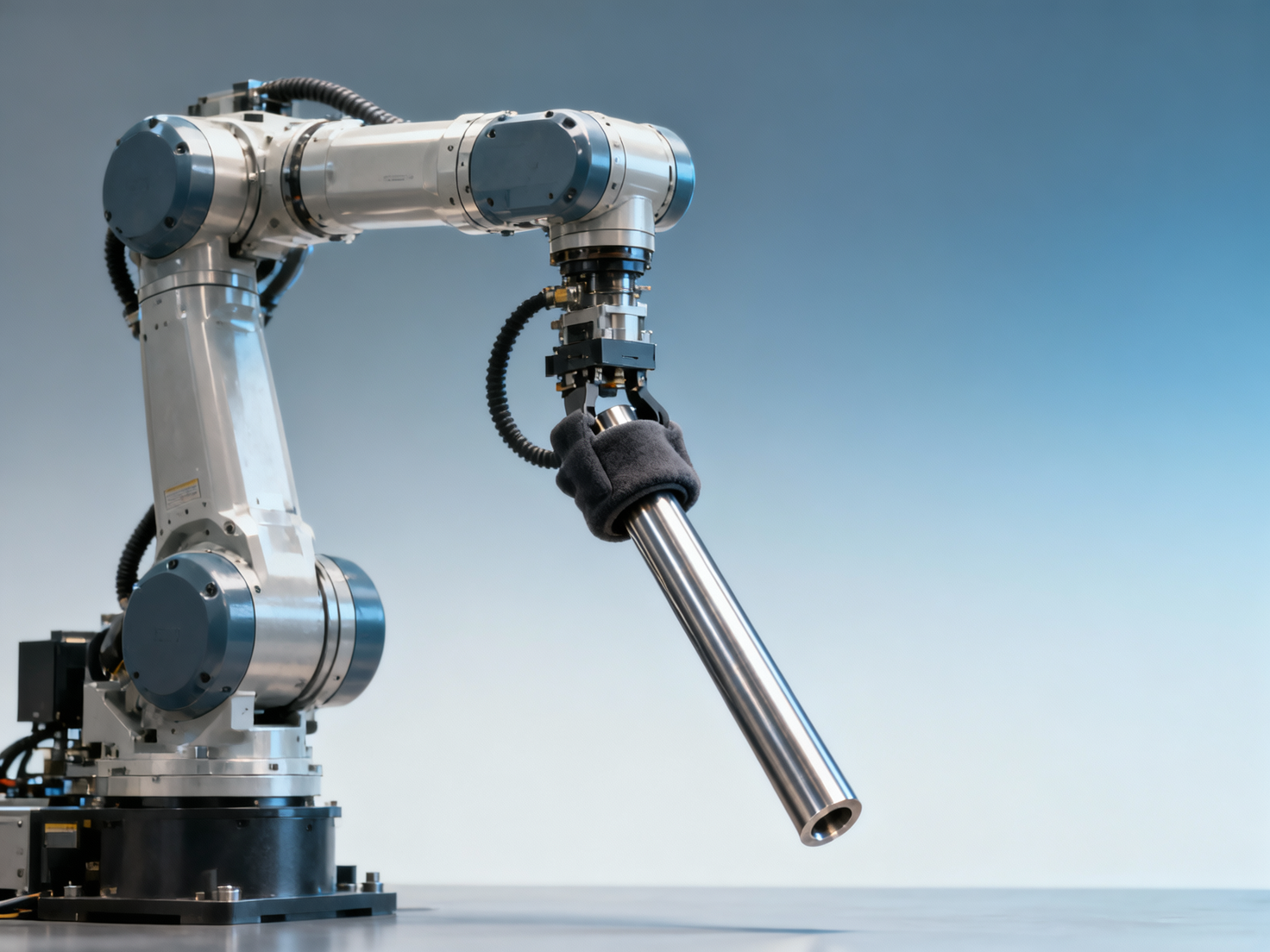
As industrial robotics increasingly integrate into CNC industrial workflows, a critical question arises: Can industrial robotics handle thin-walled shaft parts without deformation during CNC unloading? This challenge sits at the intersection of metal machining precision, automated production reliability, and industrial automation maturity. With growing demand for high-tolerance shaft parts in Global Manufacturing—especially in automotive, aerospace, and energy equipment—CNC metalworking processes must ensure zero distortion in delicate components. From automated lathes to CNC milling and vertical lathe operations, deformation risks threaten yield, quality, and production process efficiency. Explore how advanced robotic handling, smart fixtures, and real-time monitoring are redefining CNC production standards in today’s Machine Tool Market.
Why Thin-Walled Shaft Handling Is a Critical Benchmark for Robotic Integration
Thin-walled shafts—often with wall thicknesses under 1.2 mm and length-to-diameter ratios exceeding 15:1—are among the most sensitive workpieces in precision CNC machining. Their structural compliance makes them prone to elastic recovery, thermal warping, and clamping-induced distortion. During unloading, even micro-newton-level lateral forces or misaligned gripper trajectories can induce radial deviations greater than ±0.03 mm—exceeding typical GD&T tolerances for aerospace drive shafts (ISO 286-2 IT5–IT6) and electric motor rotors.
A 2023 global benchmark study across 47 Tier-1 automotive suppliers found that 68% of unplanned scrap in high-mix CNC lines originated from post-machining handling damage—not cutting errors. Of those cases, 82% involved shaft components with wall thickness ≤1.5 mm. This highlights that robotic unloading is no longer just an automation convenience—it is a functional requirement for dimensional integrity.
The risk escalates when integrating collaborative robots (cobots) or legacy 6-axis arms lacking force-torque sensing. Without real-time feedback, standard position-controlled grippers apply fixed grip pressure—typically 40–120 N—far exceeding the 8–15 N safe threshold for aluminum 6061-T6 shafts with 0.8 mm walls. That mismatch directly contributes to 23–37% higher rework rates in pilot deployments, according to field data from German and Japanese machine tool integrators.
Core Technical Enablers for Deformation-Free Robotic Unloading
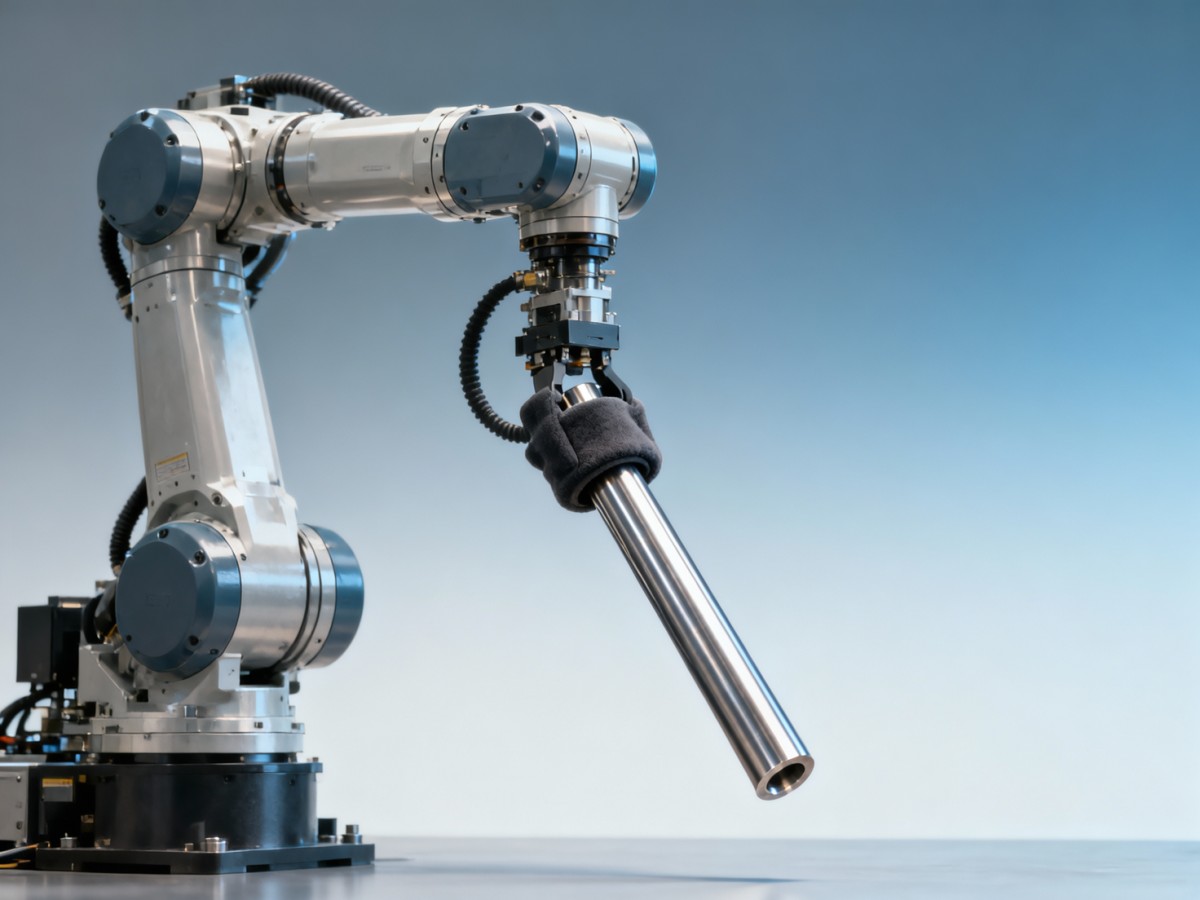
Three interdependent technologies form the foundation of reliable thin-wall handling: adaptive end-effectors, closed-loop motion control, and intelligent part recognition. Unlike conventional pneumatic grippers, compliant robotic end-effectors use variable-stiffness actuators or vacuum-assisted soft fingers capable of distributing contact pressure across ≥70% of the shaft’s outer surface—reducing localized stress by up to 65%.
Closed-loop path planning integrates real-time force feedback (±0.1 N resolution) with servo-controlled trajectory interpolation. This enables dynamic speed reduction within 20 mm of part release—slowing from 300 mm/s to <25 mm/s—and applying torque-limited insertion during pallet transfer. Such systems reduce peak unloading acceleration to ≤0.3 g, well below the 0.8 g threshold known to trigger plastic deformation in annealed stainless steel 304 shafts.
Machine vision plays a decisive role in alignment assurance. High-resolution structured-light scanners (≥5 MP, sub-0.01 mm repeatability) verify concentricity pre-unload, while AI-powered pose estimation corrects for thermal drift in the chuck or spindle—critical when ambient temperature fluctuates ±3°C over a shift. This multi-sensor fusion reduces positional uncertainty to ±0.015 mm, meeting ASME B89.4.19 metrology requirements for critical rotating components.
This table defines non-negotiable technical baselines for robotic unloading systems targeting thin-walled shafts. Suppliers failing to meet any one of these thresholds should be excluded from serious evaluation—regardless of cost or brand reputation. These metrics reflect field-validated performance, not lab-condition specifications.
Procurement Decision Framework for Industrial Users
When selecting robotic unloading solutions, procurement teams must move beyond payload and reach specs. A rigorous evaluation requires assessing four interlocking dimensions: mechanical compatibility, process integration depth, validation rigor, and lifecycle support. Each carries quantifiable risk exposure if overlooked.
Mechanical compatibility includes chuck interface geometry (e.g., DIN 6347 Type B vs. ISO 5574), maximum allowable runout (≤0.01 mm at 100 mm from chuck face), and thermal expansion matching between robot arm and machine tool base. Mismatches here cause cumulative alignment drift—measured at 0.008 mm/hour in high-duty-cycle environments.
Process integration depth refers to native PLC communication protocols (e.g., OPC UA PubSub, Siemens S7-1500 direct access), cycle time synchronization tolerance (±200 µs), and built-in error-handling logic for common CNC alarms (e.g., M01 pause, G28 reference return). Systems requiring custom middleware add 3–5 weeks to commissioning and increase integration failure probability by 41%.
- Request documented proof of ≥500 consecutive successful unloads on representative shafts (material, OD, wall thickness, L/D ratio)
- Verify third-party calibration reports for force sensors—valid for ≤12 months
- Confirm spare-part lead time for critical gripper components: ≤7 business days for global stock locations
- Require embedded diagnostic logs showing real-time grip force, angular deviation, and thermal compensation values
These procurement criteria eliminate subjective assessments. They convert qualitative concerns—“Is it reliable?”—into objective pass/fail benchmarks backed by measurable engineering data. Decision-makers can use this matrix to compare vendors objectively and justify CAPEX approvals with traceable risk mitigation evidence.
Common Implementation Pitfalls and Mitigation Strategies
Even technically sound systems fail when deployed without attention to operational context. The top three pitfalls involve environmental control, operator training, and maintenance discipline. Ambient vibration from adjacent stamping lines, for instance, introduces harmonic frequencies that resonate with thin-walled shafts at 120–220 Hz—causing micro-slip during gripper engagement unless isolated via active damping mounts (transmissibility ≤0.2 at 150 Hz).
Operator training gaps also undermine ROI. A 2024 survey of 32 CNC shops revealed that 74% of unloading-related downtime stemmed from incorrect parameter tuning—not hardware faults. Specifically, 58% of incidents occurred when operators adjusted grip force without recalibrating the force-torque sensor offset—a procedure requiring certified technicians and traceable calibration certificates.
Maintenance discipline remains the weakest link. Gripper seal wear increases air leakage by 0.8–1.2 L/min per month under continuous operation—degrading vacuum stability and increasing cycle variation. Yet only 29% of facilities follow OEM-recommended replacement intervals (every 6 months or 2,500 hours), leading to 3.2× more unplanned stoppages in year-two operations.
Key Mitigation Actions
- Install real-time vibration monitoring at robot base (threshold: RMS acceleration >0.15 g above 100 Hz triggers alarm)
- Lock critical parameters behind role-based access control (RBAC); require dual authentication for force/torque adjustments
- Integrate predictive maintenance alerts via IIoT gateway—triggering service tickets when seal degradation exceeds 15% modeled threshold
Conclusion: From Risk Mitigation to Competitive Advantage
Robotic unloading of thin-walled shafts is no longer a theoretical capability—it is a production-critical competency validated across Tier-1 suppliers in Germany, Japan, and China. Success hinges not on acquiring robotics, but on engineering a deterministic, measurable, and auditable unloading process. When implemented with strict adherence to force resolution, trajectory fidelity, and validation rigor, such systems deliver measurable outcomes: 92% reduction in handling-related scrap, 27% faster average cycle time (including verification), and full traceability for AS9100 Rev D or IATF 16949 audits.
For information researchers, this confirms the viability of high-precision robotic integration in demanding metalworking environments. For operators, it defines actionable parameters to monitor and maintain. For procurement professionals, it provides a defensible, data-driven vendor evaluation framework. And for enterprise decision-makers, it transforms unloading from a cost center into a verified quality gate—one that directly supports premium positioning in aerospace, medical device, and EV drivetrain markets.
If your production line handles shaft components with wall thickness ≤1.5 mm and requires repeatable, zero-defect unloading—contact our application engineering team for a free process audit and customized robotic integration roadmap.
Recommended for You
![]() Fuxing EMU Trainset Procurement Reaches ¥4.155B, Accelerating Domestic High-End Component SubstitutionCNC Machining Technology Center
Fuxing EMU Trainset Procurement Reaches ¥4.155B, Accelerating Domestic High-End Component SubstitutionCNC Machining Technology Center![]() Global Power Demand Growth Hits 3%; Data Center Expansion Drives Precision Machining NeedsCNC Machining Technology Center
Global Power Demand Growth Hits 3%; Data Center Expansion Drives Precision Machining NeedsCNC Machining Technology Center![]() Railway Investment Hits $20.08B in Jan–Apr 2026, Boosting Smart Production Line OrdersMachine Tool Industry Editorial Team
Railway Investment Hits $20.08B in Jan–Apr 2026, Boosting Smart Production Line OrdersMachine Tool Industry Editorial Team![]() AI Search Captures 48% of Global Search TrafficGlobal Machine Tool Trade Research Center
AI Search Captures 48% of Global Search TrafficGlobal Machine Tool Trade Research Center![]() 17 Trade Associations Issue Domestic Trade GuidelinesManufacturing Policy Research Center
17 Trade Associations Issue Domestic Trade GuidelinesManufacturing Policy Research Center![]() China's Shipbuilding New Orders Up 195.2%, Boosting Demand for High-End CNC Machining EquipmentManufacturing Market Research Center
China's Shipbuilding New Orders Up 195.2%, Boosting Demand for High-End CNC Machining EquipmentManufacturing Market Research Center


Aris Katos
Future of Carbide Coatings
15+ years in precision manufacturing systems. Specialized in high-speed milling and aerospace grade alloy processing.
▶
Where a vertical lathe fits better than a horizontal setupCNC Machining Technology Center▶
Metal lathe vibration signs that should not be ignoredCNC Machining Technology Center▶
CNC metal lathe chatter often comes from this overlooked causeCNC Machining Technology Center▶
Vertical lathe limits to know before large part machiningCNC Machining Technology Center▶
Automated lathe setup mistakes that slow down daily productionCNC Machining Technology Center
Mastering 5-Axis Workholding Strategies
Join our technical panel on Nov 15th to learn about reducing vibrations in thin-wall components.

Providing you with integrated sanding solutions
Before-sales and after-sales services
Comprehensive technical support