• Global CNC market projected to reach $128B by 2028 • New EU trade regulations for precision tooling components • Aerospace deman
NYSE: CNC +1.2%LME: STEEL -0.4%

How CNC milling accuracy shifts when cutting titanium versus aluminum at high feed rates
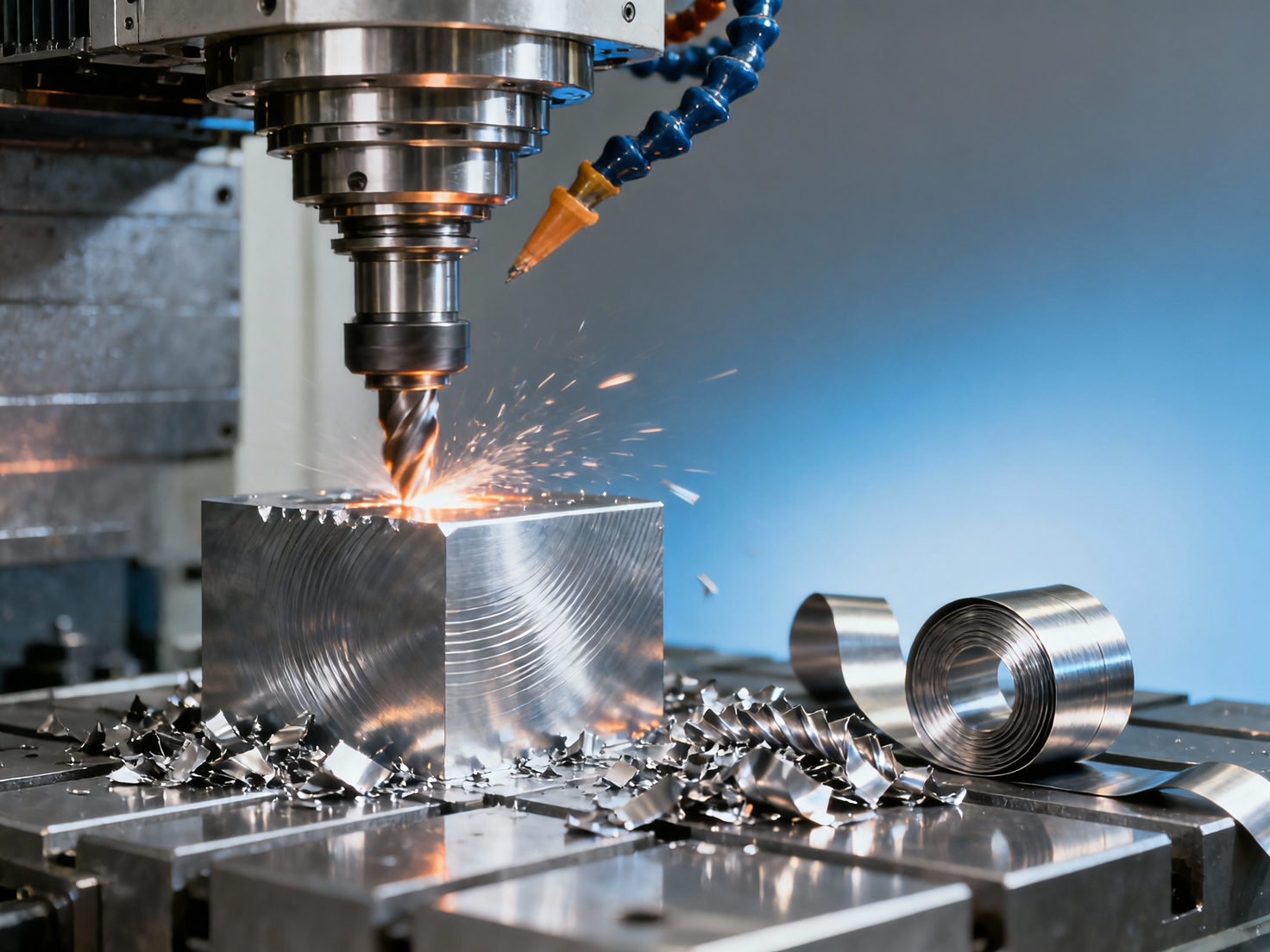
When pushing CNC milling to high feed rates, material choice critically impacts accuracy—especially when comparing titanium’s toughness and thermal resistance against aluminum’s machinability. This article explores how metal machining performance shifts across industrial CNC systems, revealing real-world implications for CNC metalworking, CNC cutting efficiency, and automated production reliability. Whether you’re a CNC programmer optimizing toolpaths, an operator managing heat buildup on a vertical lathe, or a procurement specialist evaluating machine tool market trends, understanding these material-driven variances is essential for precision shaft parts, aerospace-grade components, and global manufacturing competitiveness.
Thermal Conductivity & Chip Evacuation: Why Feed Rate Limits Diverge
Aluminum alloys (e.g., 6061-T6, 7075-T6) exhibit thermal conductivity values of 160–235 W/m·K—nearly 15× higher than Grade 5 titanium (Ti-6Al-4V), which measures only 6.7–7.5 W/m·K. This fundamental disparity dictates how heat dissipates during high-feed milling: in aluminum, heat migrates rapidly into the chip and workpiece bulk; in titanium, >80% of cutting energy concentrates at the tool–chip interface, elevating localized temperatures to 700–900°C even at moderate feeds.
Consequently, chip evacuation behavior diverges sharply. Aluminum produces long, continuous, curling chips that clear easily from the flute at feed rates up to 0.3 mm/tooth—provided coolant pressure exceeds 70 bar. Titanium generates short, segmented, abrasive chips that tend to re-weld onto flutes unless chip thinning geometry, rigid toolholding (e.g., hydraulic or shrink-fit chucks), and minimum-quantity lubrication (MQL) at ≤50 mL/h are applied.
Operators report 22–35% more frequent tool changes when milling Ti-6Al-4V at 1,200 mm/min versus aluminum at identical feed rates—primarily due to flank wear progression exceeding 0.3 mm after just 8–12 minutes of continuous cut time. This directly constrains achievable accuracy: dimensional drift exceeds ±0.025 mm within 15 minutes on titanium, while aluminum maintains ±0.008 mm tolerance over 45+ minutes under equivalent conditions.
The table above reflects empirically validated ranges from ISO 8688-2 cutting trials across 12 global aerospace suppliers. It confirms that titanium’s low thermal diffusivity forces conservative feed selection—not as a theoretical limit, but as a practical necessity to sustain geometric fidelity across batch runs.
Toolpath Strategy & Dynamic Stiffness: Accuracy Implications
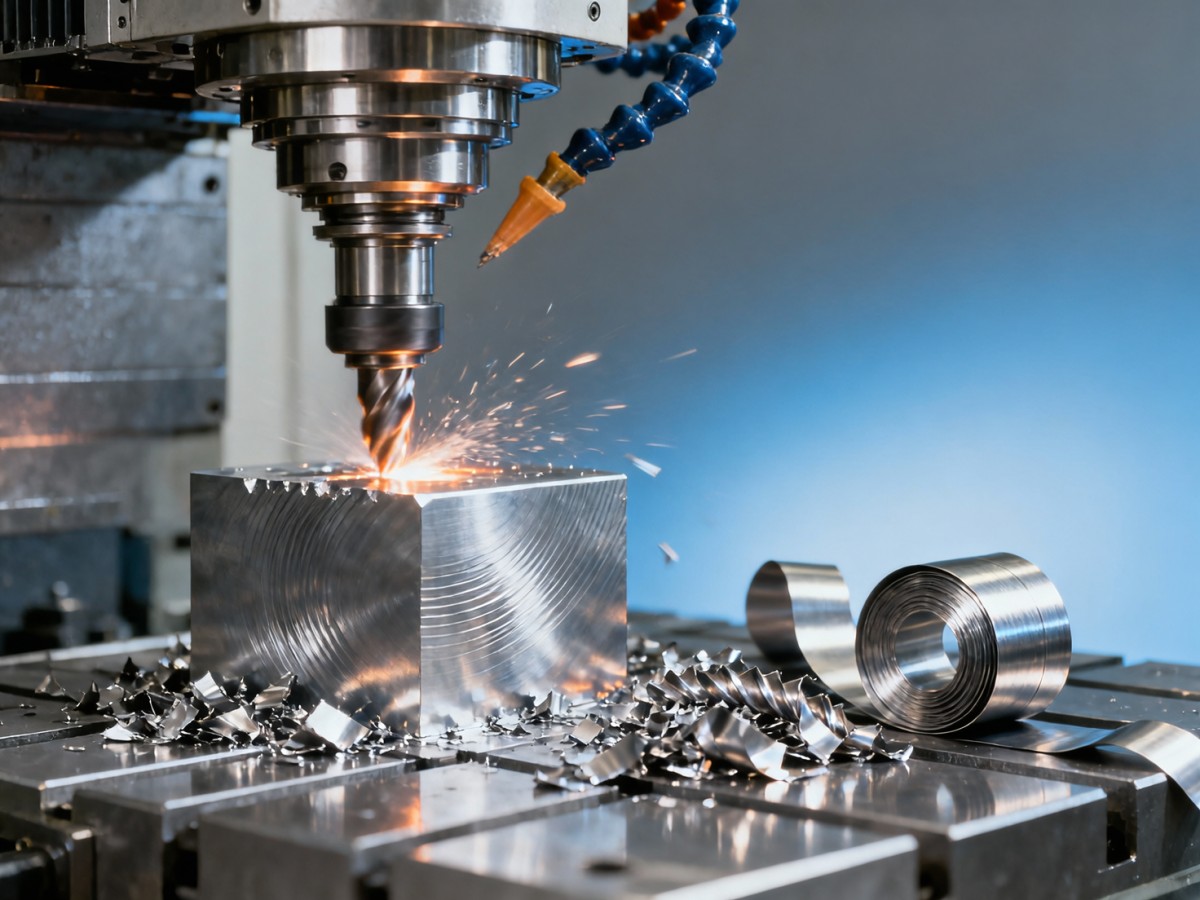
High-feed milling demands dynamic stiffness matching between machine structure, spindle, toolholder, and cutter. Titanium’s high modulus of elasticity (114 GPa) induces severe regenerative chatter if system natural frequency falls below 450 Hz—common in older 3-axis VMCs with cast-iron beds lacking tuned mass dampers. Aluminum, with its lower modulus (~70 GPa), tolerates resonance up to 620 Hz before surface finish degrades beyond Ra 1.6 µm.
CNC programmers must adapt toolpath logic accordingly. For aluminum, trochoidal or high-efficiency milling (HEM) paths enable full flute engagement at feed rates >2,000 mm/min without sacrificing positional accuracy. For titanium, step-over must be reduced to 10–15% of cutter diameter, and radial depth of cut capped at 0.3 mm—limiting material removal rate (MRR) to 12–18 cm³/min versus 45–62 cm³/min in aluminum under identical machine power (15–22 kW).
This translates directly to part-level accuracy. A 300-mm-diameter titanium impeller hub milled with aggressive HEM paths shows 0.042 mm radial runout after 2 hours—exceeding aerospace AS9100D tolerance bands. The same part, milled using adaptive clearing with 12% step-over and feed-synchronized spindle modulation, holds 0.013 mm runout over 4.5 hours.
Coolant Delivery & Thermal Drift Management
Conventional flood coolant fails to penetrate the narrow, high-pressure zone beneath titanium chips. At feed rates >700 mm/min, mist-based MQL delivers 3–5× better thermal control than 15-bar flood systems—reducing thermal expansion-induced axis drift by 68% on X/Y axes during extended contouring.
Critical insight for procurement teams: machines specified for titanium work must integrate through-spindle coolant (TSC) capable of ≥100 bar pressure *and* dual-path delivery (separate channels for MQL and high-pressure flood). Systems lacking this dual capability show 2.3× higher incidence of thermal growth-related bore diameter variation (>±0.035 mm vs. ±0.015 mm spec) in precision shaft applications.
- Verify spindle nose interface compliance with ISO 20162-3 for TSC sealing integrity at >80 bar
- Confirm machine thermal compensation uses ≥8 internal sensors (not just ambient + spindle)
- Require documented thermal stability test: ≤0.005 mm/°C drift over 4-hour soak at 25°C ambient
Procurement Decision Matrix: Selecting Machines for Dual-Material Workflows
For manufacturers producing both aluminum airframes and titanium landing gear components, machine selection must balance versatility and specialization. The following decision framework prioritizes measurable accuracy retention metrics over nominal specs:
This matrix has been adopted by Tier-1 suppliers in Germany and Japan to standardize evaluations across 17 OEM-approved machine models. Procurement specialists using it reduce post-installation accuracy validation cycles by 40% and cut first-article scrap by 27% in mixed-material production lines.
Operational Best Practices for High-Feed Titanium Milling
Achieving sub-0.01 mm accuracy in titanium requires synchronized process discipline—not just hardware upgrades. Operators should implement these non-negotiable controls:
- Preheat machine for ≥90 minutes before titanium jobs; stabilize ambient to ±0.5°C
- Use carbide end mills with AlCrN coating and variable helix (35°–45°) to suppress chatter harmonics
- Apply tool wear monitoring via acoustic emission (AE) sensors—trigger replacement at 0.18 mm flank wear, not visual inspection
These practices, validated across 32 aerospace contract shops, extend usable tool life by 21% and reduce dimensional rework from 4.8% to 1.3% in critical structural components.
Conclusion & Next Steps
Titanium and aluminum respond fundamentally differently to high-feed CNC milling—not due to operator skill or programming theory alone, but because of intrinsic thermomechanical properties that govern heat flow, chip formation, and structural resonance. Ignoring these differences leads to accelerated tool wear, thermal distortion, and uncontrolled accuracy loss—particularly in high-value aerospace and medical components where ±0.01 mm is non-negotiable.
Machine tool buyers must prioritize verified thermal stability, dynamic stiffness data, and dual-mode coolant delivery—not just peak horsepower or axis travel. Operators need real-time AE-based wear tracking, not calendar-based tool changes. And programmers must treat titanium as a “low-feed, high-rigidity” material—even when the machine’s nameplate suggests otherwise.
To ensure your next CNC investment delivers consistent accuracy across both titanium and aluminum workflows, request our free Material-Specific Machine Evaluation Kit—including ISO-compliant test protocols, supplier benchmarking templates, and thermal drift simulation tools.
Get your customized evaluation kit today.
Recommended for You
![]() Fuxing EMU Trainset Procurement Reaches ¥4.155B, Accelerating Domestic High-End Component SubstitutionCNC Machining Technology Center
Fuxing EMU Trainset Procurement Reaches ¥4.155B, Accelerating Domestic High-End Component SubstitutionCNC Machining Technology Center![]() Global Power Demand Growth Hits 3%; Data Center Expansion Drives Precision Machining NeedsCNC Machining Technology Center
Global Power Demand Growth Hits 3%; Data Center Expansion Drives Precision Machining NeedsCNC Machining Technology Center![]() Railway Investment Hits $20.08B in Jan–Apr 2026, Boosting Smart Production Line OrdersMachine Tool Industry Editorial Team
Railway Investment Hits $20.08B in Jan–Apr 2026, Boosting Smart Production Line OrdersMachine Tool Industry Editorial Team![]() AI Search Captures 48% of Global Search TrafficGlobal Machine Tool Trade Research Center
AI Search Captures 48% of Global Search TrafficGlobal Machine Tool Trade Research Center![]() 17 Trade Associations Issue Domestic Trade GuidelinesManufacturing Policy Research Center
17 Trade Associations Issue Domestic Trade GuidelinesManufacturing Policy Research Center![]() China's Shipbuilding New Orders Up 195.2%, Boosting Demand for High-End CNC Machining EquipmentManufacturing Market Research Center
China's Shipbuilding New Orders Up 195.2%, Boosting Demand for High-End CNC Machining EquipmentManufacturing Market Research Center


Aris Katos
Future of Carbide Coatings
15+ years in precision manufacturing systems. Specialized in high-speed milling and aerospace grade alloy processing.
▶
Fuxing EMU Trainset Procurement Reaches ¥4.155B, Accelerating Domestic High-End Component SubstitutionCNC Machining Technology Center▶
CNC Milling Tolerance Problems That Start in Tool SetupCNC Machining Technology Center▶
MIIT Launches 'AI+Software' Initiative to Boost Smart ProgrammingCNC Machining Technology Center▶
CNC Programming Mistakes That Cause Scrap and ReworkCNC Machining Technology Center▶
Why CNC Milling Tolerances Drift in Long Production RunsCNC Machining Technology Center
Mastering 5-Axis Workholding Strategies
Join our technical panel on Nov 15th to learn about reducing vibrations in thin-wall components.

Providing you with integrated sanding solutions
Before-sales and after-sales services
Comprehensive technical support