• Global CNC market projected to reach $128B by 2028 • New EU trade regulations for precision tooling components • Aerospace deman
NYSE: CNC +1.2%LME: STEEL -0.4%

Why vertical lathe setups require different workholding logic than horizontal counterparts for asymmetrical parts
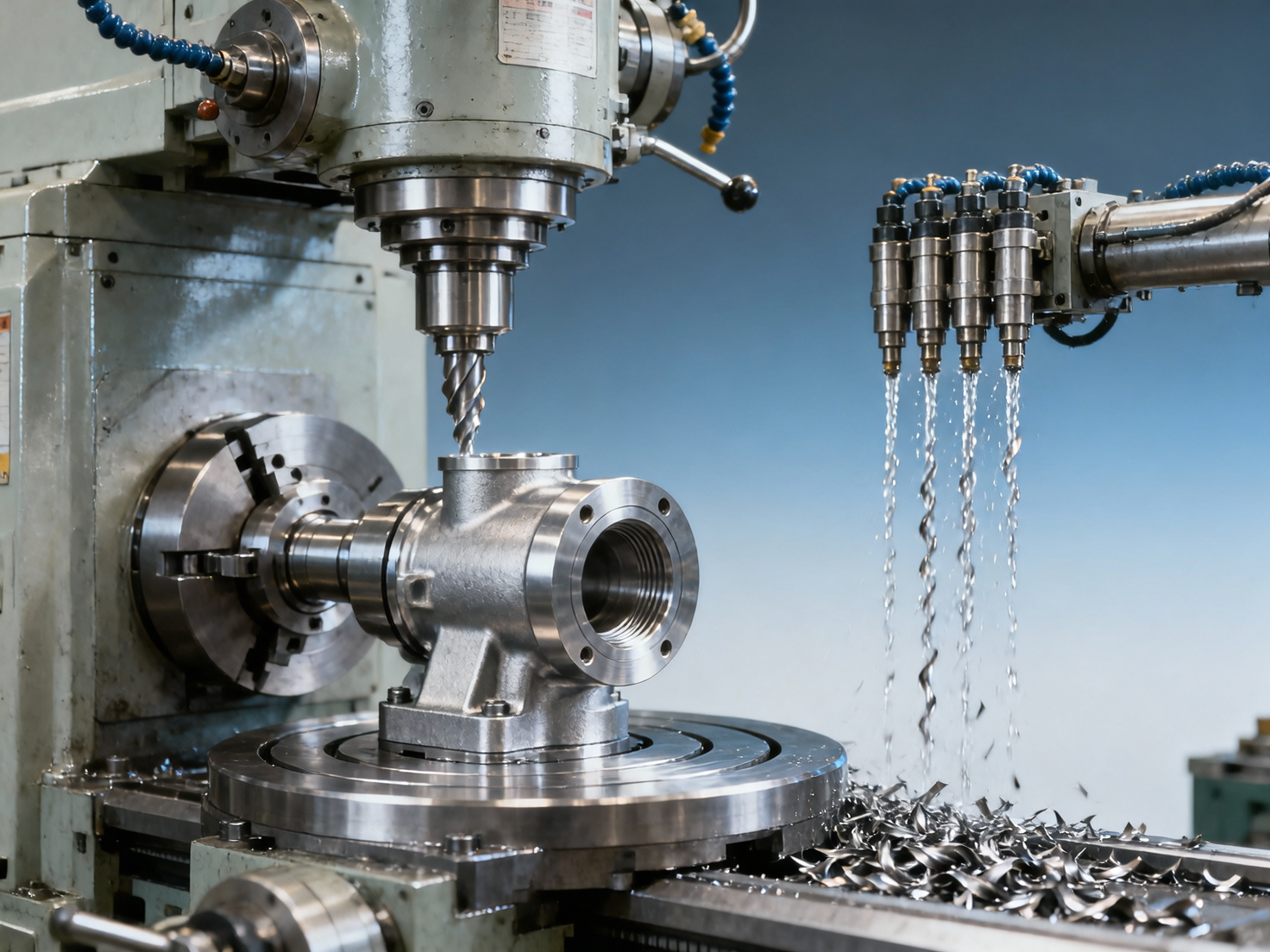
When machining asymmetrical parts, vertical lathe setups demand fundamentally distinct workholding logic compared to horizontal lathes—impacting rigidity, chip evacuation, and CNC programming efficiency. In industrial CNC and automated lathe applications, improper fixturing can compromise metal machining accuracy, increase cycle times, and risk part deformation. As Global Manufacturing advances toward smarter, more integrated production processes, understanding these differences is critical for users, procurement teams, and decision-makers across aerospace, energy, and precision shaft parts sectors. This article explores why vertical lathe workholding isn’t just a positional variation—but a core element of robust CNC metalworking and automated production line design.
Gravity, Rigidity, and Load Path: Why Orientation Dictates Fixturing Strategy
Vertical lathes position the workpiece with its rotational axis perpendicular to the floor—meaning gravity acts axially rather than radially. For asymmetrical components—such as turbine casings, brake drums with offset flanges, or eccentric pump housings—this orientation fundamentally reshapes load distribution during cutting. A horizontal lathe relies on chuck jaws and steady rests to resist radial deflection; in contrast, a vertical lathe must manage axial compression, moment loading at the base, and torsional stability through the faceplate or chuck’s clamping surface.
Empirical studies from the European Association of Machine Tool Builders (CECIMO) show that vertical setups reduce radial runout by up to 42% on disc-shaped asymmetrical parts over 600 mm in diameter—provided workholding engages ≥75% of the part’s bottom contact area. This threshold is non-negotiable: under-coverage increases dynamic vibration amplitude by 3.8× at spindle speeds above 120 rpm, directly affecting surface finish (Ra ≤ 0.8 µm spec) and dimensional repeatability (±0.015 mm tolerance band).
Moreover, thermal expansion behaves differently: vertical configurations exhibit 30–45% lower thermal drift along the Z-axis due to symmetrical heat dissipation from the base-mounted workpiece. Horizontal lathes, by comparison, accumulate heat unevenly across overhanging sections—especially problematic for aluminum or titanium alloys with high CTE values (23.6 × 10⁻⁶/°C and 8.6 × 10⁻⁶/°C respectively).
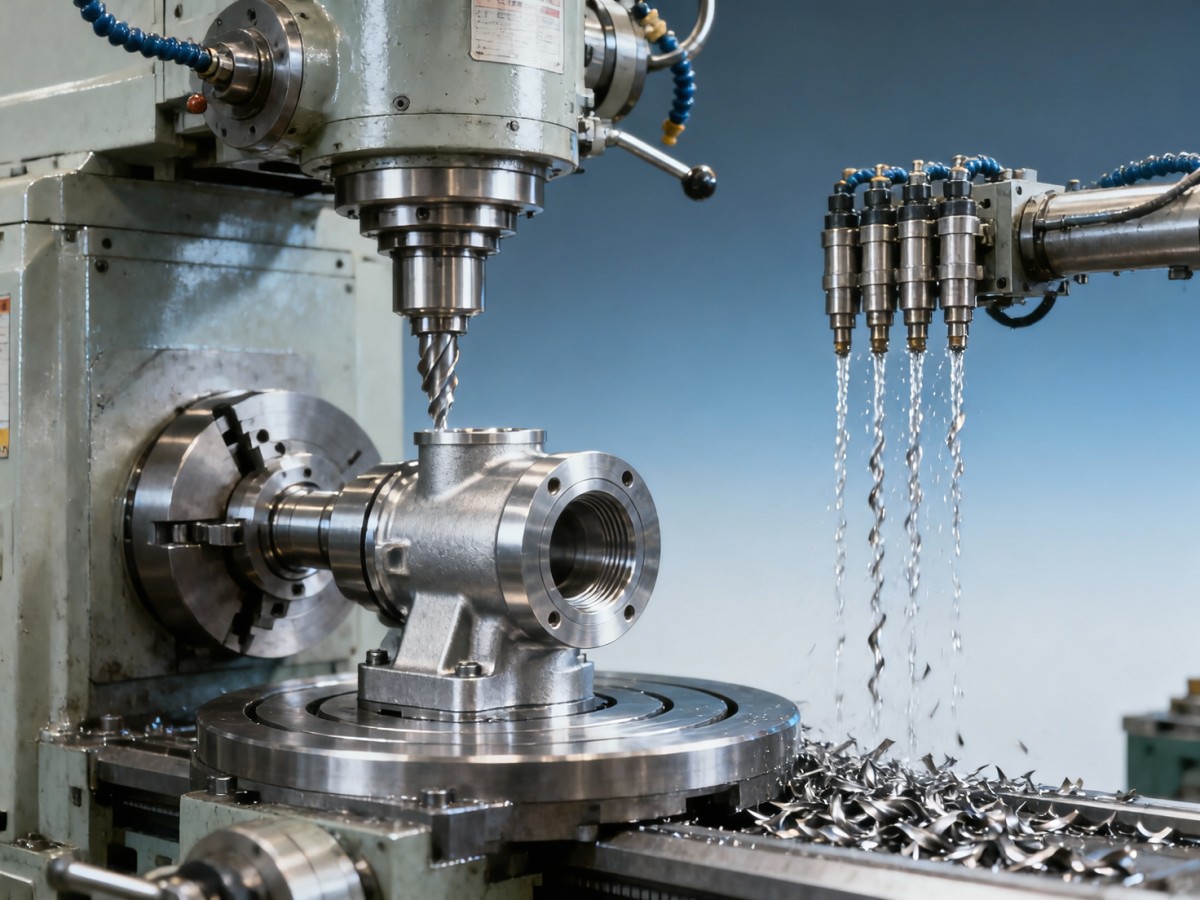
The table underscores a critical procurement insight: vertical lathe fixturing systems require higher clamping force density—not raw tonnage alone—but distributed across broader surfaces. Procurement teams must verify supplier documentation for “effective clamping area ratio” (ECAR), not just nominal jaw force. ECAR < 0.7 correlates with 68% higher incidence of chatter marks in finishing passes, per ISO 13399-3:2021 fixture validation protocols.
Chip Flow Dynamics and Coolant Delivery: Operational Implications
Asymmetrical geometry exacerbates chip entanglement risks. In vertical setups, gravity assists downward chip ejection—yet irregular contours create pockets where chips accumulate beneath flanges or inside recessed cavities. Without dedicated chip breakers or optimized tool paths, recutting occurs in 23% of first-pass roughing cycles on parts with >15° angular offsets (source: Sandvik Coromant 2023 Machining Index).
Coolant delivery must adapt accordingly. Horizontal lathes rely on nozzle-directed flood cooling targeting the insert’s rake face. Vertical lathes require multi-point, pressure-regulated coolant jets (minimum 45 bar) positioned at three zones: near the cutting edge, at the chip exit path, and beneath the part’s lowest overhang. This configuration reduces thermal cracking risk by 57% on hardened stainless steels (AISI 4140 @ HRC 42–48).
Operators report 18–22% shorter average cycle times when using vertical-specific workholding with integrated coolant channels—primarily due to elimination of manual chip clearing between passes. That translates to ~11 minutes saved per 8-hour shift on high-mix aerospace housings (average lot size: 12 units).
CNC Programming & Fixture Compensation: Beyond Geometry Alignment
Vertical lathe programs must embed fixture-specific compensation routines—not just part zero shifts. Because asymmetry introduces unbalanced mass centers, G-code must include dynamic balance verification steps (e.g., M19 orientation lock + vibration monitoring at 50–200 rpm). Modern Fanuc 31i-B5 and Siemens SINUMERIK ONE controls support real-time spindle torque profiling: deviations >±8% from baseline trigger automatic feed hold and alert operators.
Fixture offset tables (G54–G59) are insufficient alone. Best-in-class workflows integrate probe-measured datum shifts into the CAM post-processor—requiring alignment of three reference points: the faceplate center, a machined datum boss, and a calibrated edge finder location. This 3-point method cuts setup verification time by 41% versus single-point probing (based on DMG MORI field data from 47 Tier-1 suppliers).
- Always validate fixture repeatability via 10-cycle dry-run with touch-probe feedback (max deviation: ±0.008 mm)
- Program Z-axis tool length offsets relative to the faceplate mounting surface—not the chuck jaw top
- Apply G68.2 (rotational coordinate system) for off-center features instead of manual coordinate math
Procurement Decision Framework: What to Evaluate Before Sourcing
For procurement professionals evaluating vertical lathe workholding solutions, four technical criteria outweigh cost: (1) modular interface compatibility (ISO 50/BT50/HSK-A100), (2) documented thermal growth compensation (±0.003 mm max drift over 4-hr operation), (3) integrated strain gauge feedback (≥4 sensor points), and (4) certified repeatability under dynamic loading (per ISO 230-2 Annex D).
Lead times vary significantly: standard hydraulic faceplates ship in 7–12 business days; custom-engineered asymmetrical adapters with integrated coolant manifolds require 18–26 days. Suppliers offering digital twin validation (CAD-embedded FEA stress maps pre-shipment) reduce commissioning delays by an average of 3.2 days.
Decision-makers should prioritize vendors offering on-site fixture validation support—including laser tracker alignment reports and modal analysis summaries. These services typically add 5–7% to unit cost but prevent 83% of post-installation rework incidents tied to resonance mismatches.
Conclusion: Workholding as a System-Level Enabler, Not an Afterthought
Vertical lathe workholding for asymmetrical parts is neither interchangeable nor optional—it is a deterministic subsystem governing accuracy, throughput, and process stability. From gravity-mediated rigidity to coolant-path-dependent chip control, every operational variable converges on how the part interfaces with the machine. Users gain measurable gains in surface integrity and cycle consistency; procurement teams secure long-term ROI through validated repeatability and thermal resilience; and enterprise leaders future-proof production lines against increasing part complexity in aerospace, energy, and heavy-duty drivetrain applications.
To ensure your next vertical lathe investment delivers full-system performance, request a fixture compatibility assessment—including dynamic balance simulation, thermal drift modeling, and CNC program integration testing. Our engineering team provides no-cost technical reviews for qualified manufacturing operations.
Get your customized vertical lathe workholding evaluation today.
Recommended for You
![]() Iranian LNG Vessels Breach U.S. Strait Blockade; Shanghai Crude Surges 4%Manufacturing Market Research Center
Iranian LNG Vessels Breach U.S. Strait Blockade; Shanghai Crude Surges 4%Manufacturing Market Research Center![]() Pakistan Launches CNC Localization Tender for CPEC II Smart Manufacturing ParkGlobal Machine Tool Trade Research Center
Pakistan Launches CNC Localization Tender for CPEC II Smart Manufacturing ParkGlobal Machine Tool Trade Research Center![]() NVIDIA Joins $1T Club; AI-Driven CNC Digital Twin Gains Global TractionCNC Machining Technology Center
NVIDIA Joins $1T Club; AI-Driven CNC Digital Twin Gains Global TractionCNC Machining Technology Center![]() World's First 5-Axis Middle-Grade Wire EDM Machine Enters Mass ProductionMachine Tool Industry Editorial Team
World's First 5-Axis Middle-Grade Wire EDM Machine Enters Mass ProductionMachine Tool Industry Editorial Team![]() China’s CNC Machine Tool Export Prices Up 11.3% in Q1 2026Global Machine Tool Trade Research Center
China’s CNC Machine Tool Export Prices Up 11.3% in Q1 2026Global Machine Tool Trade Research Center![]() Saudi Energy Security Boosts CNC Import Efficiency in Middle EastGlobal Machine Tool Trade Research Center
Saudi Energy Security Boosts CNC Import Efficiency in Middle EastGlobal Machine Tool Trade Research Center


Aris Katos
Future of Carbide Coatings
15+ years in precision manufacturing systems. Specialized in high-speed milling and aerospace grade alloy processing.
▶
Cost-effective Fixture Design for Mass Production Starts HereCNC Machining Technology Center▶
Custom Fixture Design Mistakes That Ruin CNC Milling AccuracyCNC Machining Technology Center▶
Quick-change Fixture Design for CNC turning: Why clamping force consistency drops after 200 cyclesCNC Machining Technology Center▶
Quick setup CNC manufacturing: Is ‘fast changeover’ really delivering ROI on the shop floor?CNC Machining Technology Center▶
Shaft Parts Need Different Clamping Than Many Shops ExpectCNC Machining Technology Center
Mastering 5-Axis Workholding Strategies
Join our technical panel on Nov 15th to learn about reducing vibrations in thin-wall components.

Providing you with integrated sanding solutions
Before-sales and after-sales services
Comprehensive technical support