• Global CNC market projected to reach $128B by 2028 • New EU trade regulations for precision tooling components • Aerospace deman
NYSE: CNC +1.2%LME: STEEL -0.4%

Choosing a Shaft Parts Manufacturer in Japan: Quality, Capacity and Lead Times
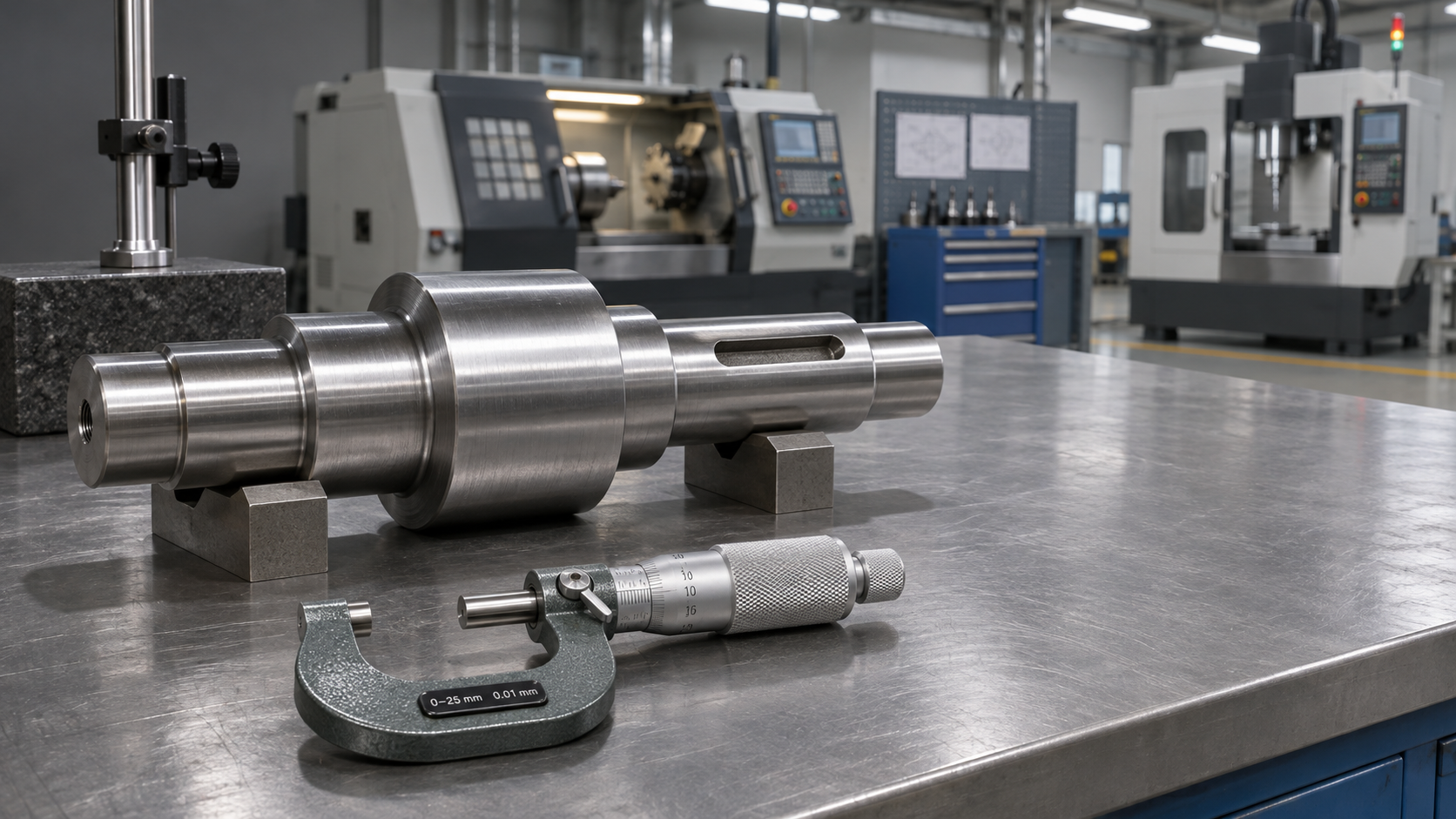
When choosing a Shaft Parts Manufacturer in Japan, start with the features that control how the shaft fits and runs, then assess whether the supplier can produce and inspect those features at the required volume. A competitive unit price is useful only if it includes the necessary processes, documentation and delivery terms. An apparently cheaper quotation can become expensive when grinding, heat treatment, inspection or freight is added later.
The right supplier also depends on the order. A manufacturer suited to a small batch of complex, multi-axis shafts may not be the best fit for repeat production of a simpler component. Compare suppliers against the drawing, the production plan and the consequences of a late or nonconforming shipment.
Start with the shaft’s functional requirements
A shaft drawing can contain dozens of dimensions, but they rarely carry the same risk. Identify the surfaces and features that determine assembly and performance: bearing journals, seal surfaces, gear or coupling locations, threads, splines and shoulders. Explain how the part is supported and what it connects to, particularly when runout, surface finish or alignment affects operation.
For example, a bearing journal may require a controlled diameter and surface finish, while the relationship between that journal and another feature can affect how smoothly an assembly rotates. A supplier needs to understand the specified datum references and inspection method, not just the nominal dimensions. If the drawing calls for runout, establish which surface is the datum and how the part will be supported during measurement.
Share the complete technical package before requesting a firm quotation. This normally includes the current drawing revision, material specification, required heat treatment or coating, quantities and any applicable inspection requirements. For a replacement part, a physical sample can help explain the application, but it should not silently replace an approved drawing: a worn sample may no longer represent the intended dimensions.
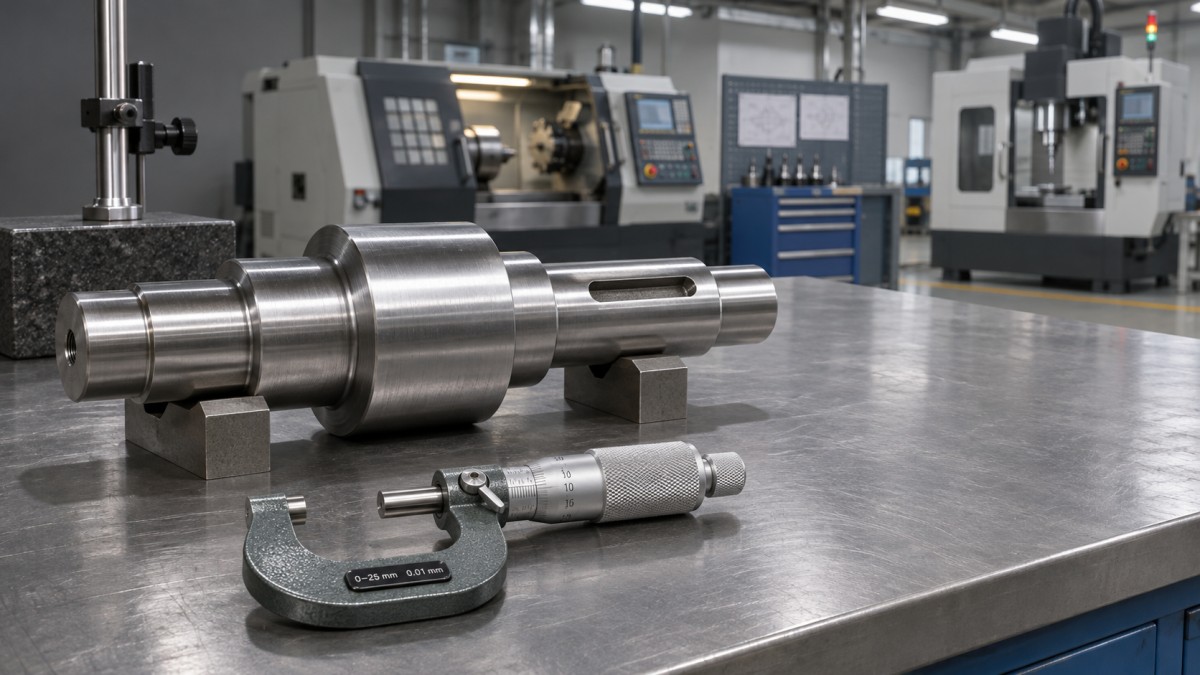
Match machining capability to the complete process
Many shafts begin on a CNC lathe, but turning alone may not produce every required feature. Depending on the design, the route may include milling keyways, drilling cross-holes, cutting splines, heat treatment, cylindrical grinding, coating and final inspection. Ask each manufacturer to describe the proposed process sequence and identify which operations are performed in-house and which are subcontracted.
This matters because the order of operations affects both quality and schedule. Heat treatment can change a part’s dimensions or straightness, so a precision bearing surface may need finishing afterward. A supplier that turns the shaft but relies on an external grinder can still be a good choice; the purchasing question is who controls the handoff, inspection and recovery if the finished part fails.
Machine lists are a starting point, not proof that a supplier can make a particular shaft. Ask about the practical diameter and length range for the proposed operation, workholding for slender parts, and experience with the specified material. Long, thin shafts may deflect during machining or measurement, making support and process control as important as machine capacity.
For complex shafts with off-center holes or milled features, a multi-axis machine may reduce setups and help control relationships between features. That does not automatically make it the lowest-cost option: a simpler route can be appropriate when tolerances, batch size and delivery requirements permit it.
Evaluate quality through evidence, not labels alone
Ask for a proposed inspection plan that connects critical drawing characteristics to measuring equipment, sampling frequency and recorded results. A supplier may use micrometers for journal diameters, surface-measuring equipment for finish, and suitable fixtures or coordinate measuring equipment for positional features. The important point is whether the method can assess the requirement as specified, including its datum and measurement conditions.
For a first order, agree on what the initial sample submission will contain. Depending on the application, this may include a dimensional report, material and heat-treatment records, and results for specified hardness or surface treatment. Decide who approves the sample and whether production can begin before that approval. An initial sample shows that the proposed process can produce a conforming part; it does not by itself establish repeatability across future batches.
For repeat production, discuss process controls as well as final inspection. Ask how the manufacturer handles tool wear, gauge calibration, identification of material batches and segregation of nonconforming parts. Where traceability is necessary, define whether records must link individual shafts or production lots to material and processing records. That level of control has a cost, so align it with the application rather than applying it indiscriminately.
A quality certification can be useful evidence of a management system, but it does not replace part-specific review. The supplier should be able to explain how the drawing requirements will be translated into production and inspection instructions, including any work carried out by outside processors.
Can the supplier support the required capacity?
Ask for capacity in terms of your actual order pattern: prototype quantities, the expected release schedule, batch sizes and foreseeable demand changes. A shop may have enough machines overall but limited access to the specific grinder, inspection fixture or heat-treatment subcontractor needed for your part. Capacity for a first batch and capacity for recurring orders are separate questions.
Discuss competing work and bottlenecks without assuming that an estimate of spare capacity is a guaranteed reservation. If continuity matters, agree on a forecast, how orders are released against it and whether material or machine time will be reserved. For a critical component, consider qualifying an alternative source where the design, approval process and purchasing agreement allow it.
Capacity should also cover recovery. Ask what happens if a batch needs rework, an outside process is delayed or a machine becomes unavailable. A clear escalation contact and an agreed notification point make a production issue easier to manage than a delivery-date promise alone.
Compare lead times from the same starting point
Lead-time quotations are difficult to compare unless they begin and end at the same milestones. One supplier may count from purchase-order acceptance; another may start after drawing approval or material arrival. Similarly, “delivery” may mean shipment from the factory rather than arrival at your receiving site.
Request a schedule that separates the main stages:
- Order review and engineering: drawing questions, manufacturability review and approval of any proposed changes.
- Material procurement: availability of the specified grade and form, including required material documentation.
- Manufacturing and outside processing: machining, heat treatment, grinding, coating and any transport between facilities.
- Inspection and release: completion of reports, sample approval when required, packing and dispatch.
- Transport to destination: freight arrangements, export and import handling, and delivery to the agreed location.
For a new shaft, the first-order schedule may include tooling, programming and sample approval that are reduced on later orders. Conversely, repeat orders can still be delayed by material availability or a crowded outside process. Ask for both an initial and a repeat-order lead time, with the assumptions behind each.
If delivery is critical, discuss partial shipments and the minimum quantity needed to keep assembly running. Confirm whether split deliveries change inspection, packing or freight charges, and whether the supplier can maintain traceability across releases.
Look beyond the quoted piece price
A useful cost comparison puts suppliers on the same scope. Ask for the price basis at the intended batch size and annual volume, then separate recurring charges from one-time costs such as programming, fixtures, gauges or sample production. A low piece price based on a larger batch may increase inventory and cash tied up in stock.
Use the agreed delivery terms to establish where responsibility and risk transfer, rather than treating a factory-gate price as the landed cost. Currency, payment terms and exchange-rate movements can also affect the final comparison when buying across borders.
There may be an opportunity to reduce cost through design review. A tighter tolerance on every surface, an unnecessarily demanding finish or a difficult-to-source material can add operations and inspection time. Ask suppliers to identify cost drivers, but route any change through the design authority: a relaxed tolerance is only a saving if the shaft still performs its function.
Make the request for quotation easy to compare
Send the same controlled information to each shortlisted supplier and ask for deviations to be stated explicitly. In addition to the drawing and specifications, include the destination, required delivery date, estimated order pattern, packaging needs and required records. Identify critical characteristics and disclose any planned customer approval or inspection before shipment.
Ask suppliers to return their proposed process route, subcontracted operations, inspection approach, price breakdown and lead-time assumptions. Request a clear response to any requirement they cannot meet as written. A detailed technical question from a supplier can be a useful signal: it exposes an ambiguity while there is still time to resolve it before production.
Before placing a production order, close the gaps between the quotations and document the agreed drawing revision, scope, acceptance criteria and delivery milestones. If the application warrants a trial batch, define how it will be inspected and approved, then use the result to confirm the production plan and remaining commercial terms.
Recommended for You
![]() Chinese Five-Axis Machine Tool Prices Reach Around 40,000 YuanMachine Tool Industry Editorial Team
 Choosing a Machine Tool Exporter: Delivery, Warranty and Support ChecksGlobal Machine Tool Trade Research Center
![]() US Lawmakers Warn China Has Overtaken US in Four Manufacturing SectorsManufacturing Policy Research Center
 What Is CNC Cutting? How It Works and Which Materials It Can CutCNC Machining Technology Center
![]() Philadelphia Fed Manufacturing Index Falls to 6.3, a Six-Month LowManufacturing Market Research Center
 Choosing a Shaft Parts Manufacturer in Japan: Quality, Capacity and Lead TimesGlobal Machine Tool Trade Research Center


Aris Katos
Future of Carbide Coatings
15+ years in precision manufacturing systems. Specialized in high-speed milling and aerospace grade alloy processing.
▶
Choosing a Machine Tool Exporter: Delivery, Warranty and Support ChecksGlobal Machine Tool Trade Research Center▶
Choosing a Shaft Parts Manufacturer in Japan: Quality, Capacity and Lead TimesGlobal Machine Tool Trade Research Center▶
Machine Tool Prices: What to Budget Beyond the Purchase PriceGlobal Machine Tool Trade Research Center▶
What proves a precision tool factory in China can hold tolerances?Global Machine Tool Trade Research Center▶
How to Evaluate a Machine Tool Factory Before Sourcing CNC EquipmentGlobal Machine Tool Trade Research Center
▶
Mastering 5-Axis Workholding Strategies
Join our technical panel on Nov 15th to learn about reducing vibrations in thin-wall components.

Providing you with integrated sanding solutions
Before-sales and after-sales services
Comprehensive technical support