• Global CNC market projected to reach $128B by 2028 • New EU trade regulations for precision tooling components • Aerospace deman
NYSE: CNC +1.2%LME: STEEL -0.4%

How Can You Reduce Fixture Changeover Time on CNC Production Lines?
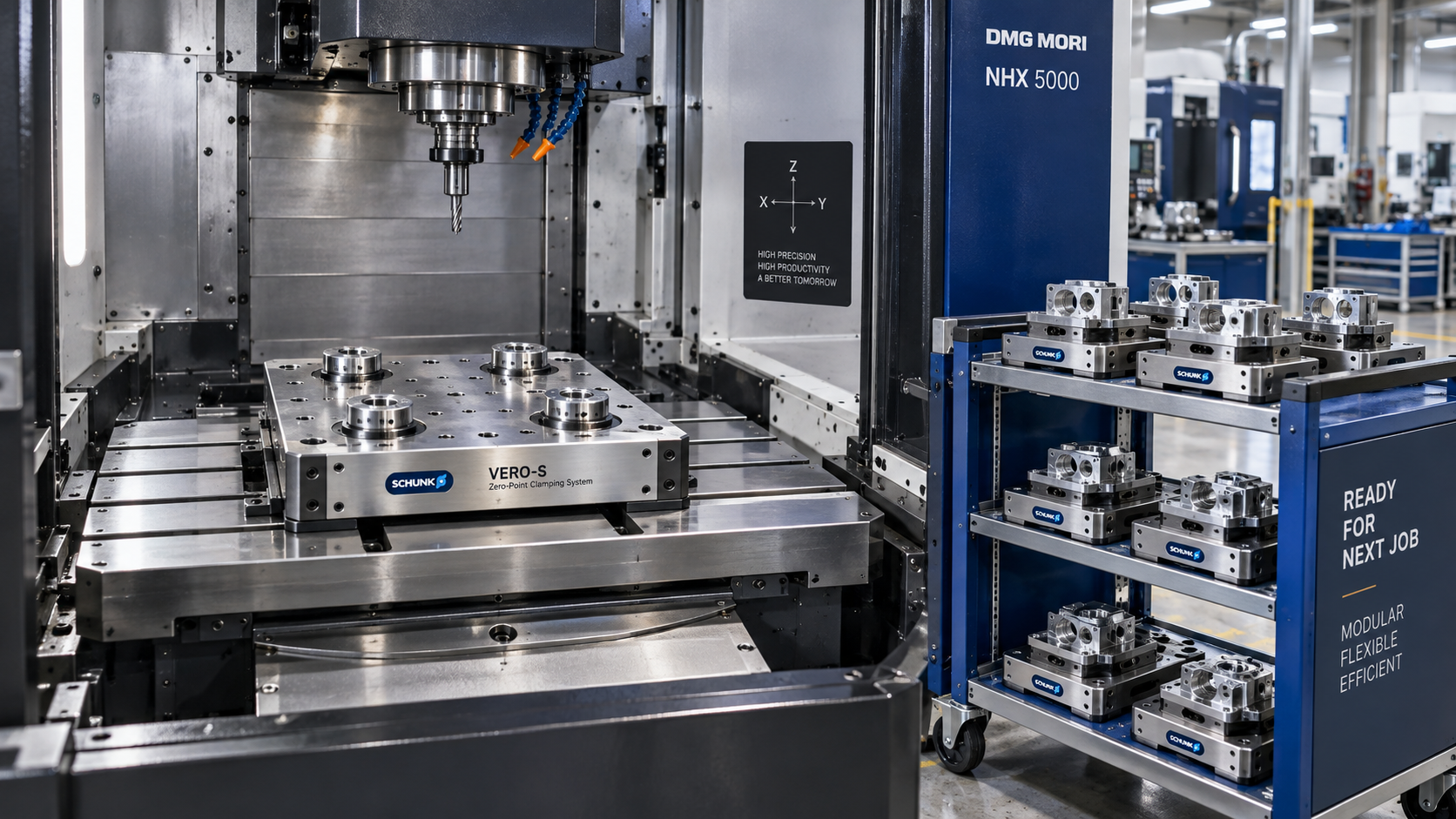
The last part of a batch leaves the machine, but the next job cannot begin. An operator is searching for mounting bolts, another is checking fixture height, and someone is waiting for inspection to approve a trial part. None of these activities cuts metal, yet together they can consume a significant share of available production time.
For manufacturers investigating how to reduce fixture changeover in CNC production lines, the most effective approach is to move preparation outside machine downtime, make fixture interfaces repeatable, and control the checks required before production restarts. Quick-change hardware can support that approach, but it cannot compensate for missing tools, uncertain offsets, or inconsistent setup instructions.
The following questions address the practical decisions behind faster changeovers—from measuring the real delay to choosing clamping systems and validating the first part.
What should count as fixture changeover time?
Use the interval from the last conforming part of the outgoing job to the first conforming part of the incoming job as the primary production measure. This captures more than the time spent physically exchanging fixtures. Cleaning, alignment, program selection, offset verification, trial machining, and inspection all affect when useful production resumes.
Also record machine downtime separately. Some preparation and inspection activities can overlap with machining, so the two measures are not always identical. Tracking both prevents a team from celebrating a faster fixture swap while overlooking a longer approval queue.
Observe several actual changeovers across different shifts and part families. Break each one into tasks and note whether the operator is working, walking, searching, waiting, or repeating a check. Include delays caused by unavailable lifting equipment, unclear instructions, and missing fixture components.
Measure the complete transition, not just the most visible task. The bottleneck may be a manual alignment step, but it may also be ten minutes spent finding the correct setup sheet.
Which setup tasks can move outside machine downtime?
The central principle of single-minute exchange of die, commonly called SMED, is to separate internal tasks that require a stopped machine from external tasks that can happen while production continues. The term does not mean every CNC changeover will take less than ten minutes.
For fixture changes, useful external preparation includes:
- Assembling jaws, stops, supports, and locating elements on a spare fixture.
- Checking fixture condition and confirming that all required hardware is present.
- Preparing cutting tools and measuring tool lengths on a presetter.
- Staging material, gauges, setup documentation, and approved CNC programs.
- Cleaning accessible mating surfaces on the incoming fixture.
- Confirming that handling equipment and qualified personnel will be available.
A dedicated staging cart can make this preparation visible. Instead of discovering a missing stop after the machine stops, the operator checks the kit beforehand. Give each kit a clear identity tied to the part, fixture revision, and machine assignment.
Do not treat external preparation as free labor. It still consumes resources. Its value comes from overlapping that work with productive machining and reducing interruptions at the machine.
How do quick-change fixtures and zero-point clamping reduce setup time?
Conventional fixtures may require multiple bolts, manual positioning, and repeated indicating. Quick-change systems reduce those operations by providing a standardized connection between the machine and the fixture.
Zero-point clamping typically uses locating and clamping elements to pull a fixture plate or pallet into a defined reference position. With a suitable installation and clean interfaces, the operator can exchange a prepared fixture without rebuilding its location from scratch.
The biggest benefit is often not faster fastening alone. It is reducing the uncertainty that triggers repeated alignment checks. A fixture assembled and qualified offline can return to a known machine interface, subject to the verification requirements of the process.
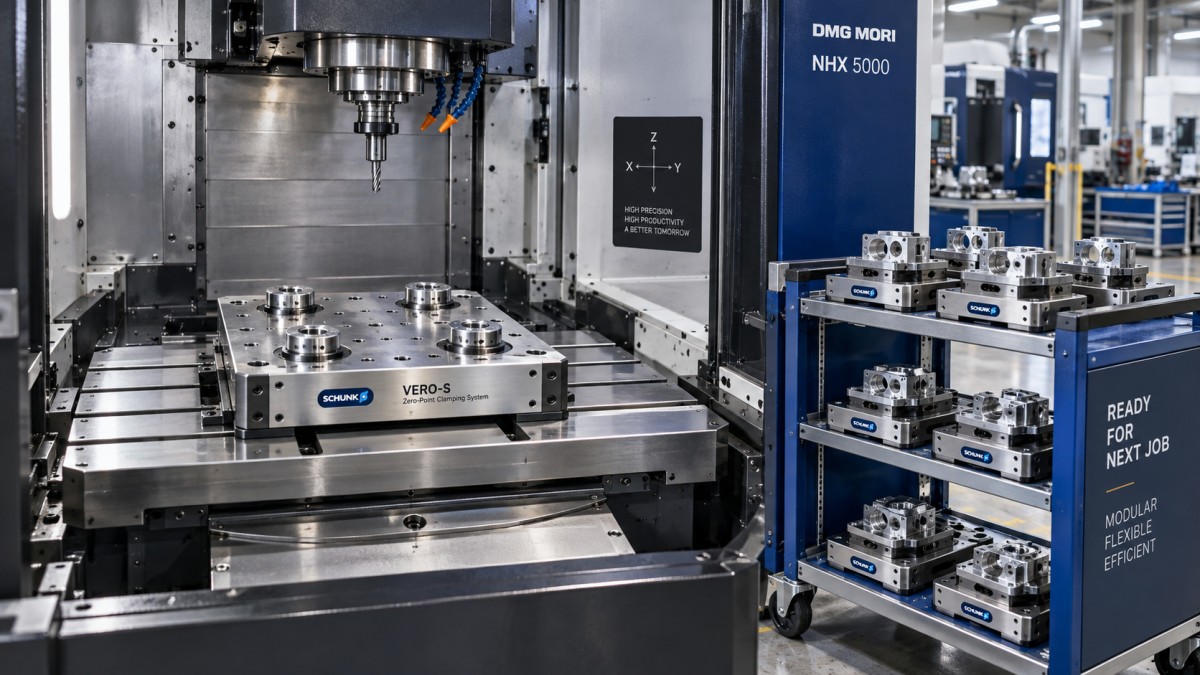
Selection still requires an engineering review. Consider cutting forces, overturning moments, payload, fixture overhang, coolant exposure, chip contamination, and available machine travel. Added plates and clamping modules can reduce usable Z-axis clearance or affect access on a five-axis machine.
For automated use, evaluate clamp-state monitoring, suitable retention behavior if actuation pressure is lost, and controls that prevent machining before secure clamping is confirmed. Published interface repeatability is not the same as finished-part accuracy; the complete fixture, workpiece, machine, and thermal conditions all contribute.
Should you replace the whole fixture or only the part-specific elements?
That depends on how much the workholding arrangement changes between jobs. Similar components may share a common base, allowing operators to exchange only jaws, nests, or locating inserts. More varied parts may justify complete fixture pallets prepared away from the machine.
Standardization does not mean forcing every part onto the same fixture. It means using consistent interfaces wherever practical while preserving the support and accessibility each machining process needs.
How can you avoid re-establishing work offsets after every change?
Build a documented relationship between the machine interface, fixture datum, and workpiece datum. If that relationship remains stable, the changeover can use an approved offset strategy rather than starting with manual indication each time.
Offline fixture presetting can help establish these relationships, provided the measuring station and machine use compatible references. On-machine probing can then verify seating or locate the workpiece datum through a controlled routine.
Keep three concepts separate: fixture interface repeatability, workpiece locating repeatability, and work offset accuracy. A fixture may dock consistently while castings vary against their locators or a thin-walled component deforms under clamping.
Setup documentation should identify the required offset register, datum features, probing routine, and acceptable results. Where practical, link these to the fixture ID and program revision. Avoid relying on handwritten values that operators copy between jobs.
Probing should have defined limits and a clear response to failure. An unexpected result should trigger investigation, not automatic compensation that could conceal debris, incorrect loading, or a damaged locator.
What accuracy and safety checks must remain?
Faster changeovers should remove unnecessary work, not safeguards. A chip trapped beneath a locating surface can undermine an otherwise repeatable system. Excessive clamping force may distort a part; insufficient force may allow movement during cutting.
Before restart, the controlled procedure should address:
- Cleanliness and condition of locating and clamping interfaces.
- Correct fixture identity, orientation, and secure attachment.
- Specified fastening torque or verified clamping actuation.
- Correct program, tools, offsets, and applicable revisions.
- Clearance from fixtures, clamps, probes, and machine components.
- Required first-part inspection and approval.
Use approved reduced-speed, single-block, or clearance-check procedures where appropriate to the machine and job. Fixture handling must also follow the site’s energy-isolation, lifting, and machine-access procedures. Never bypass an interlock to make a changeover faster.
A useful distinction is between a proven repeat setup and a new or modified setup. The latter normally requires more extensive validation. Any reduction in recurring checks should follow documented evidence and applicable quality requirements, especially in regulated or customer-controlled production.
How do you reduce changeover time across an entire CNC line?
A faster change at one machining center may deliver little benefit if another station remains unavailable. On linked production lines, coordinate fixtures with tooling, robot grippers, inspection programs, material flow, and downstream operations.
Map the transition across all affected stations. Identify which tasks can run in parallel and which must follow a strict sequence. The station that completes its changeover last may determine when the line can produce again.
For robotic loading, fixture changes may also require new gripper fingers, revised loading positions, and checks of approach paths. A mechanically compatible pallet does not automatically make a new part safe for unattended handling.
Stage complete job-change kits by station and assign ownership before the outgoing batch ends. Small buffers can sometimes support a staggered transition, but assess traceability, work-in-process limits, and product-mix risks before using them. Otherwise, the line may gain apparent uptime while creating confusion between jobs.
When is automation worth considering?
Pallet changers, pallet pools, and robotic fixture handling are most useful when they eliminate a recurring capacity constraint. They are less attractive when changeovers are rare or the machine already waits primarily for material, tools, or inspection.
Evaluate the complete operating cost: pallets, duplicate fixtures, integration, sensors, maintenance, floor space, operator training, and recovery from faults. In high-mix production, offline preparation may offer substantial improvement before robotic handling becomes necessary.
A practical sequence is to stabilize manual changeovers, standardize interfaces, introduce reliable identification and verification, then automate the repeatable tasks. Automation should reproduce a controlled process—not move an inconsistent one faster.
Leave a workable recovery path. Operators need clear instructions for a failed clamp confirmation, unreadable fixture ID, or interrupted pallet transfer. Unplanned recovery time belongs in the investment assessment.
How can you estimate savings without relying on supplier claims?
Use measured performance from your own production mix. Compare the current changeover with a realistic proposed sequence, then validate the estimate through a representative trial.
Annual machine hours released = time saved per changeover × annual changeovers ÷ 60, when time saved is expressed in minutes.
For illustration, reducing a changeover from 40 minutes to 25 minutes across 300 annual changes would release 75 machine hours. That is a calculation example, not a predicted result for any particular fixture system.
Released hours are not automatically financial savings. Their value depends on whether the machine is capacity-constrained, demand exists, and the extra time becomes productive output. Include added preparation labor, maintenance, inspection, and fixture inventory in the business case.
Track first-pass acceptance, scrap, setup labor, and changeover variation alongside average duration. A shorter average with frequent failed first parts is not a reliable improvement.
What should a team change first?
Start with one recurring part family and the delay that appears most often. Film or observe the process under approved site rules, separate preparation from machine-only work, and trial a staged fixture kit with a clear setup checklist.
If manual alignment remains the dominant delay, evaluate repeatable locating interfaces or zero-point clamping. If waiting dominates, fix scheduling, tool availability, or inspection coordination before buying hardware.
The strongest changeover process feels predictable to the operator: the incoming fixture is ready, the references are known, and the restart checks have a clear purpose. That predictability—not simply a faster clamp—is what makes shorter fixture changeovers sustainable.
PREVIOUS ARTICLE
NEXT ARTICLE
Recommended for You
![]() White House Section 232 Ruling: No New Machine Tool or Robot Tariffs, Calls for TalksManufacturing Policy Research Center
 How to Integrate Warehouse Palletizing Robots with Minimal DowntimeMachine Tool Industry Editorial Team
![]() AI Investment Lifts US September Equipment Demand; Core Capital Goods Orders Rise 0.5%Manufacturing Market Research Center
 Why Heavy Machinery Shafts Fail Under Cyclic Loads and How to Prevent ItCNC Machining Technology Center
![]() JTEKT Introduces G5 Series Large CNC Cylindrical Grinder, Sales Begin October 26, 2026Machine Tool Industry Editorial Team
 Shaft Parts for Heavy Machinery: Selecting Materials for High Shock LoadsCNC Machining Technology Center



Aris Katos
Future of Carbide Coatings
15+ years in precision manufacturing systems. Specialized in high-speed milling and aerospace grade alloy processing.
▶
How Can You Reduce Fixture Changeover Time on CNC Production Lines?Machine Tool Industry Editorial Team▶
KATS Expands CE Recognition for CNC Clamping SystemsMachine Tool Industry Editorial Team▶
How to Evaluate a Tooling System for Precision Machining: 7 Key Specs That MatterMachine Tool Industry Editorial Team▶
ITC Opens 337 Probe Into Chinese CNC Tool CoatingsMachine Tool Industry Editorial Team▶
Vietnam Ends 5% Tariff on Chinese CNC Tool ImportsMachine Tool Industry Editorial Team
▶
Mastering 5-Axis Workholding Strategies
Join our technical panel on Nov 15th to learn about reducing vibrations in thin-wall components.

Providing you with integrated sanding solutions
Before-sales and after-sales services
Comprehensive technical support