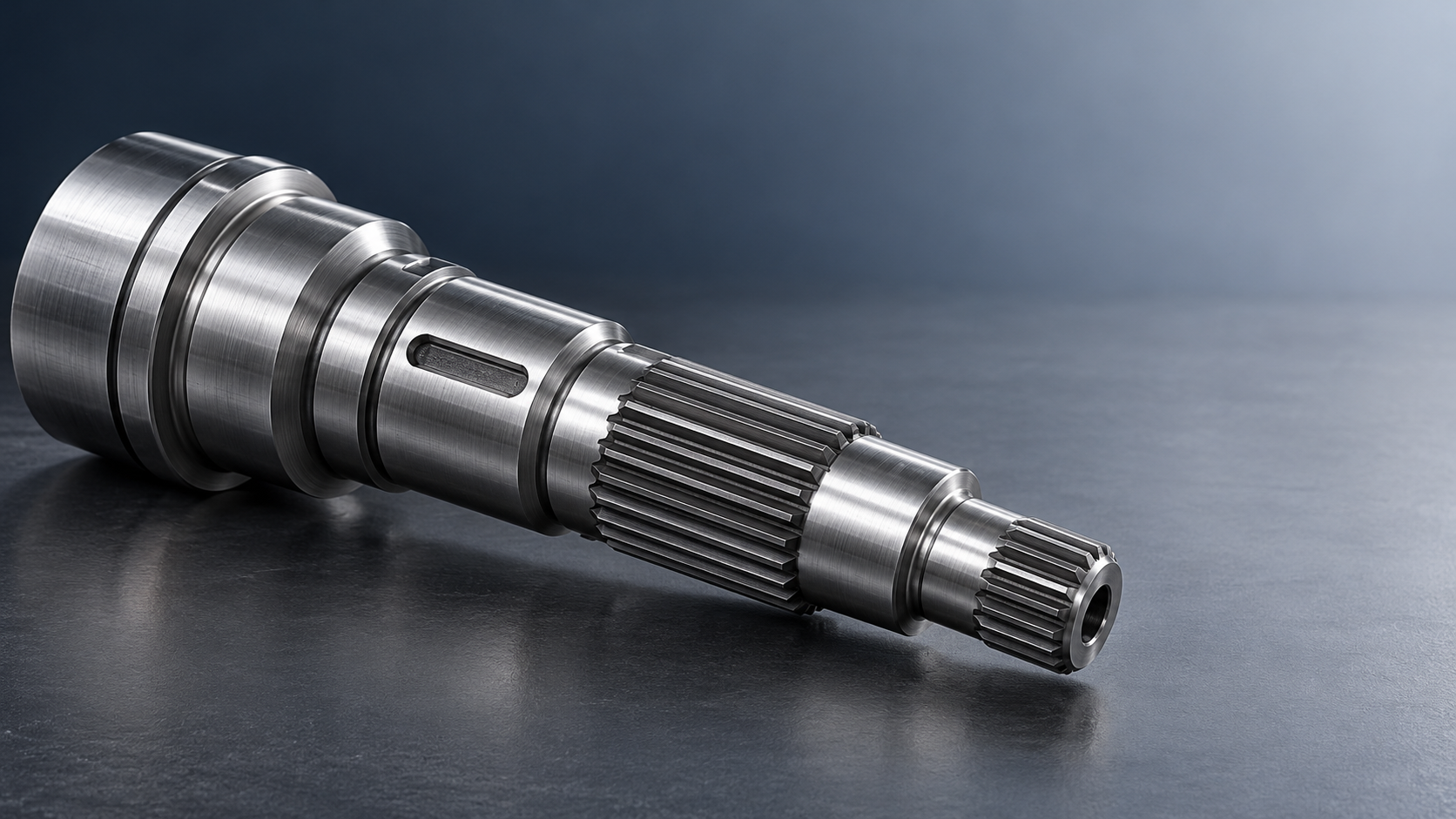
A shaft that meets static strength requirements can still fail under sudden torque spikes, impact loading, or repeated reversals, especially near keyways and shoulders.
For shaft parts for heavy machinery, start with quenched and tempered alloy steels, then evaluate toughness, section hardenability, fatigue resistance, and manufacturing consistency together.
AISI 4140 often provides a practical baseline. Larger sections, lower temperatures, or more demanding impact conditions may justify nickel-containing grades such as AISI 4340.
The right choice depends on verified properties in the finished section. This guide explains how to compare candidates, specify treatment, and assess supplier evidence.
What loads must the shaft survive?
Before comparing steel grades, define the loading events that matter: equipment stalls, bucket strikes, drivetrain backlash, emergency stops, and sudden engagement under load.
Record nominal torque, credible peak torque, bending moments, rotational speed, and load reversals. Include bearing reactions and external loads from gears, pulleys, or couplings.
A single overload can cause yielding or fracture. Repeated shocks can initiate fatigue cracks even when individual events remain below the material’s yield strength.
Combined bending and torsion often make the critical location a shoulder, spline root, or keyway rather than the shaft’s largest or most accessible diameter.
Establish minimum operating temperature and environmental exposure early. A steel that performs acceptably indoors may lose necessary toughness during cold starts or winter operation.
Where measured load histories are unavailable, document assumptions and investigate comparable equipment. An unexplained service factor provides little confidence when occasional impacts dominate failure.
Use a suitable combined-stress assessment and fatigue method. Check overload yielding separately, because adequate fatigue life does not automatically demonstrate resistance to exceptional events.
Which steel grades deserve a place on the shortlist?
Medium-carbon alloy steels are common candidates because quenching and tempering can produce useful strength while retaining toughness. Their suitability depends strongly on section size.
AISI 4140 is widely used for industrial shafts because chromium and molybdenum improve hardenability compared with plain carbon steels, supporting practical strength and wear performance.
AISI 4340 adds nickel and generally offers greater hardenability, making it attractive for larger sections and demanding toughness requirements when processed to suitable conditions.
European grades such as 42CrMo4 and 34CrNiMo6 also appear in shaft specifications. Compare their governing standards and chemistry rather than assuming direct interchangeability.
Plain carbon steel can remain economical where loading and geometry permit. It becomes less attractive when thick sections require consistently high strength through the core.
Do not rank candidates using tensile strength alone. A higher-strength condition may reduce damage tolerance, particularly where notches, low temperatures, or manufacturing defects are present.
For critical applications, steel cleanliness and processing history also matter. Nonmetallic inclusions and internal discontinuities can initiate fatigue cracks despite acceptable chemistry and hardness.
Can heat treatment deliver the required properties through the section?
Hardenability describes the ability to develop hardness through a section during quenching. It differs from the maximum hardness a steel can achieve near its surface.
This distinction becomes decisive in large shafts. Surface hardness may meet specification while the center develops a different microstructure with lower strength or inconsistent properties.
Ask the supplier to connect grade selection, starting condition, section dimensions, quench method, and tempering practice to achievable properties at the specified test location.
Quenching and tempering typically establish the core condition for shock-loaded shafts. Tempering must balance strength with toughness instead of pursuing the highest possible hardness.
A universal hardness target is inappropriate. Select an allowable range from stress analysis, required toughness, section response, and available fatigue data for the treatment condition.
Impact-test requirements should state the test method, specimen size, orientation, sampling location, temperature, and acceptance criteria. Results without these details are difficult to compare.
Charpy testing supports material screening and production control, but it does not directly establish shaft fatigue life or replace fracture-mechanics assessment where crack tolerance matters.
For especially critical parts, consider whether representative prolongations, qualified process records, or additional section-specific evidence are needed to establish confidence in the shaft’s core properties.
When does surface hardening help—and where can it create problems?
Induction hardening can improve wear resistance and surface fatigue performance at journals or selected features while preserving a tempered core, provided the process is controlled.
Its effectiveness depends on case depth, hardness profile, transition placement, and residual stress. An abrupt transition near a highly stressed feature deserves particular scrutiny.
Carburizing suits certain integrated gear shafts and splined components, but case depth and core properties must match contact loading, bending stress, and impact severity.
Nitriding can provide a hard surface with relatively limited distortion. However, its comparatively shallow hardened layer does not compensate for inadequate core strength or toughness.
Surface treatment should answer a defined failure mechanism. Increasing surface hardness offers limited benefit when the actual problem is bending fatigue at a geometric discontinuity.
Require a treatment drawing that identifies hardened zones, protected regions, finish allowances, and inspection locations. This reduces ambiguity between design intent and shop execution.
Could geometry and machining matter more than a stronger alloy?
Material upgrades cannot reliably overcome severe stress concentrations. Small shoulder radii, sharp keyway ends, poorly blended reliefs, and abrupt diameter changes can dominate fatigue behavior.
Review these features before choosing a more expensive grade. Increasing a fillet radius or revising a connection may improve durability more efficiently than raising strength.
Evaluate spline load distribution, coupling alignment, bearing fits, and fretting exposure. Local contact damage can initiate cracks even when nominal shaft stresses appear acceptable.
Surface finish requirements should follow function and stress sensitivity. A fatigue-critical fillet needs different attention from a lightly loaded surface used only for clearance.
Plan CNC machining around the heat-treatment sequence. Rough machining before treatment can reduce stock removal later, but sufficient allowance must remain for distortion correction.
Finish turning or grinding hardened surfaces requires controlled parameters and suitable tooling. Grinding burn, chatter marks, and tool damage can undermine an otherwise sound material.
Straightening after heat treatment also needs a qualified procedure. Excessive correction can introduce undesirable stresses or damage, especially in highly hardened regions and slender sections.
What evidence should technical evaluators request from suppliers?
A quotation stating only “4140, heat treated” leaves major uncertainties. The purchase specification should define the material standard, delivery condition, treatment, and required mechanical properties.
Request traceability from the steel heat through forging or bar supply, heat treatment, machining, and inspection. Certificates should clearly correspond to the delivered components.
For heavily loaded shafts, specify ultrasonic examination where internal soundness matters. Select the inspection procedure, coverage, and acceptance criteria to suit the product form.
Magnetic particle inspection can reveal surface and near-surface discontinuities in ferromagnetic steels. Define when it occurs, particularly after heat treatment and final fatigue-critical machining.
Agree on dimensional inspection for runout, straightness, bearing seats, and spline geometry. Material compliance cannot compensate for misalignment that increases service bending loads.
Ask how the supplier controls furnace uniformity, quench conditions, tempering records, and hardness variation. Relevant production evidence is more useful than general capability claims.
Where consequences justify it, qualify the first article through representative mechanical tests or component testing. Define acceptance before production rather than interpreting results afterward.
How should cost and performance guide the final selection?
Compare total manufacturing cost, including raw material, heat treatment, machining time, distortion correction, inspection, and scrap. Alloy price alone can misrepresent the economic choice.
A more hardenable steel may justify its premium when a large section otherwise requires an aggressive quench or struggles to achieve reliable core properties.
Conversely, choosing a premium alloy without a demonstrated need can increase procurement difficulty and machining cost while leaving the governing geometric failure mechanism unchanged.
Consider service economics alongside production cost. For equipment with expensive downtime, modest increases in material qualification or inspection may offer substantial lifecycle value over time.
For a moderately sized shaft with controlled temperatures and occasional overloads, begin by evaluating 4140 in a specified quenched and tempered condition against calculated requirements.
For a larger shaft exposed to cold starts and severe reversals, investigate a nickel-containing grade, supported by section-specific strength and toughness evidence before approval.
If wear concentrates on splines or journals, evaluate selective surface hardening separately. Preserve the core properties required for impact resistance and verify the treatment transitions.
Choose a verified material condition, not just a grade name
The strongest selection for shaft parts for heavy machinery combines adequate overload capacity, fatigue resistance, service-temperature toughness, and reliable properties throughout the critical section.
Approve the grade together with its heat treatment, geometry, surface requirements, and inspection plan. Each element influences whether the shaft survives the actual loading environment.
When comparing suppliers, prioritize evidence that connects their manufacturing process to your acceptance criteria. That connection turns an attractive material specification into a defensible engineering decision.