• Global CNC market projected to reach $128B by 2028 • New EU trade regulations for precision tooling components • Aerospace deman
NYSE: CNC +1.2%LME: STEEL -0.4%

What Production Volume Justifies a CNC Turning Investment?
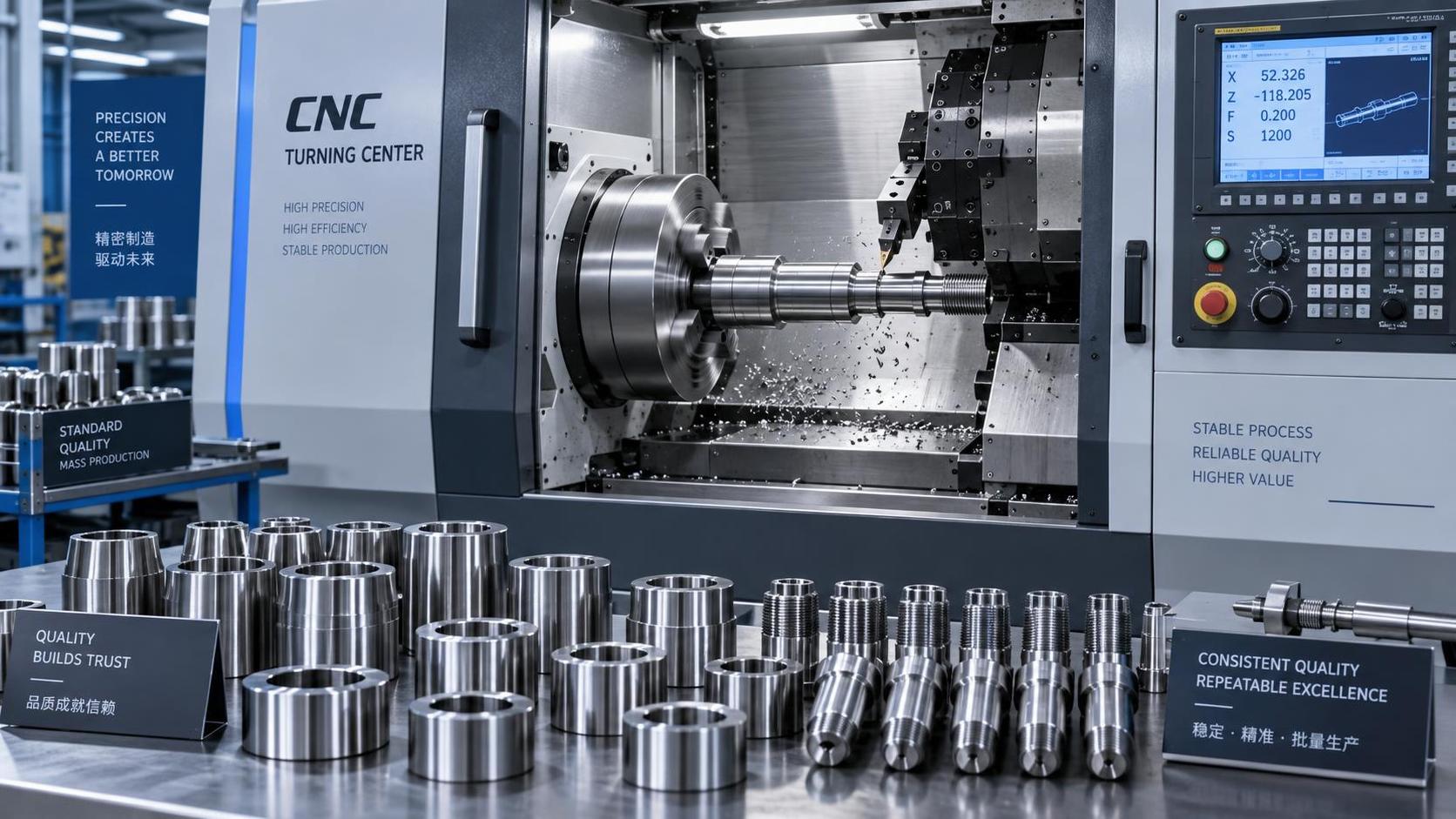
A CNC turning investment is often justified when recurring work creates enough annual spindle demand to recover the machine, tooling, workholding, programming, inspection, installation, and support costs within the business's required payback period. There is no universal part-count threshold. A simple steel spacer made in long batches can support the investment at a lower volume than a low-volume titanium shaft with multiple diameter changes, tight concentricity requirements, and frequent inspection. The useful question is: how many productive machine hours, repeat setups, and avoided outside-processing costs will the work generate over a realistic planning horizon?
Production volume matters because it determines how often fixed costs are spread across parts. Yet volume alone can be misleading. A part ordered in high quantities once and never repeated does not create the same case as a component released in smaller but predictable monthly batches. CNC turning is most persuasive when demand is repeatable, the routing is stable, and the machine can also absorb related turned work between scheduled runs.
Start with annual productive hours, not an arbitrary quantity
Part quantity has no meaning until it is connected to cycle time. Ten thousand small bushings with a short cutting cycle may occupy far fewer machine hours than several hundred precision shafts requiring facing, roughing, finishing, grooving, threading, drilling, and secondary operations. The investment case begins by estimating the annual hours that would actually be cut on the proposed machine.
A practical calculation uses the planned annual quantity, average cycle time, expected setup time, and a realistic allowance for loading, tool changes, probing, inspection, and stoppages. Separate the figures rather than treating all elapsed time as cutting time. A machine that appears to have ample theoretical capacity can become constrained when dozens of short orders each require jaws, tools, programs, first-off inspection, and part handling.
For each candidate component, record:
- Annual demand, batch frequency, and whether releases are predictable or sporadic.
- Current total lead time, including queue time at subcontractors or shared equipment.
- Cycle time by operation, with manual intervention shown separately from automatic cutting.
- Setup duration, number of tools, fixture changes, and first-article approval effort.
- Scrap, rework, or sorting associated with dimensional variation, surface damage, or runout.
- The material form and stock allowance, because bar-fed work and cut blanks produce very different handling costs.
Once annual productive hours are visible, compare them with the usable capacity of a machine under the intended shift pattern. Usable capacity should be lower than calendar time. Scheduled maintenance, tool setting, program prove-out, quality holds, operator breaks, material changes, and unplanned interruptions all consume time. Planning from an ideal capacity figure creates a false impression that a single machine can cover a workload with no room for disruption.
When the calculation shows only occasional use for one part family, purchasing a dedicated turning center is usually difficult to support unless the work has unusual strategic value. When it shows a substantial, recurring block of turning time plus a pipeline of compatible work, the analysis becomes stronger. Compatibility matters: similar chuck sizes, bar diameters, material types, and tolerance requirements allow one machine to serve multiple components without excessive changeover.
Repeatability changes the economics of lower volumes
Low annual volume does not automatically rule out CNC turning. A recurring component with a locked program, documented tooling, repeatable jaws, and proven inspection method can be restarted efficiently months after the previous run. The setup knowledge remains available instead of being recreated from memory. That benefit is especially meaningful for parts with several critical diameters, threads, seal lands, bearing fits, or features that must remain concentric to a common datum.
Conversely, a larger annual quantity can still be poor CNC investment work when the part design changes often, releases are irregular, and each order requires new fixturing or engineering clarification. The apparent volume may be high, but the process is effectively a series of separate jobs. In that situation, setup and programming costs dominate, and flexible subcontract capacity or existing shared machinery may remain the better route.
Batch size should therefore be assessed beside annual quantity. A part made in a few long runs favors automated feeding, stable tool life, and reduced per-part handling. The same annual volume split into many small releases may justify CNC control for accuracy and repeatability, but it may not justify a high-specification automated cell. A standard turning center with quick-change jaws and organized preset tooling can fit that pattern better than a machine selected mainly for unattended production.
Compare the full current cost with the full internal cost
The comparison should not stop at a quoted outside price or a direct labor rate. The current route often contains costs that are hidden because they sit in different departments or suppliers. These include transport, receiving inspection, expediting, purchase administration, packaging damage, safety stock held against long lead times, and production delays when a late turned component prevents assembly from starting.
Internal cost must be treated with equal discipline. It includes machine depreciation or financing, installation, power, coolant, cutting tools, inserts, toolholders, jaws or collets, bar feeders where required, chip handling, metrology, preventive maintenance, programming, training, and labor for loading and inspection. A technically capable turning center is not necessarily a lower-cost choice if its supporting equipment is missing or if the selected configuration is far larger than the work demands.
Separate fixed and variable costs. Fixed costs are spread across the annual workload and decline per part as productive hours increase. Variable costs remain tied to each component: material, inserts, consumables, labor time, and inspection effort. This distinction reveals why volume creates a threshold. The point is reached when the accumulated savings from lower variable cost, reduced outside spend, improved throughput, or less rework adequately offsets the annualized fixed cost of owning the capability.
A simple comparison can be organized as follows:
A result that is only marginally favorable deserves stress testing. Recalculate with lower demand, longer setups, reduced tool life, and realistic maintenance allowances. If the justification disappears after a modest change in one assumption, the investment depends on a narrow operating condition. That does not make it invalid, but it calls for a staged approach, a broader part-family plan, or a different machine specification.
Cycle time is valuable only when it removes a real constraint
Fast cycle time is often used as a reason to buy CNC equipment, but its value differs by situation. Reducing a cycle from several minutes to fewer minutes has a clear financial effect when demand is high enough to consume the saved capacity or when a late operation is constraining downstream assembly. It has little direct value when the machine spends most of the week waiting for material or orders.
Look for work where CNC turning changes the operating pattern, not merely the cutting speed. Examples include a shaft that currently requires repeated manual diameter checks, a disc that needs a consistent groove depth across recurring batches, or a threaded part where manual measurement and adjustment interrupt every run. CNC control can reduce variability, preserve dimensional relationships, and allow tool offsets to correct predictable wear before parts drift out of tolerance.
For complex rotational parts, combining operations often carries more weight than reducing one turning pass. A machine with live tooling, a subspindle, or appropriate bar-feeding capability may complete cross holes, flats, milled features, or back-working without separate transfer and re-clamping. The resulting saving includes handling, setup, transport between operations, and the risk of losing concentricity. However, these capabilities add capital cost and programming complexity. They should be selected only where the part mix repeatedly uses them.
Tolerance and quality requirements can justify earlier investment
Volume thresholds fall when quality problems are expensive. Parts with close bearing fits, sealing diameters, fine threads, controlled surface finish, or strict runout requirements may need frequent manual adjustment when produced on less capable equipment. Small deviations can lead to rejected assemblies, leakage, vibration, shortened component life, or extensive sorting. The cost of one defect is not limited to the raw part when it is discovered after assembly.
CNC turning improves process control when the workholding, tooling, program, and measurement system are designed as one process. It does not automatically solve a poor datum strategy or unstable material condition. A long slender shaft can still deflect under cutting pressure. A thin-walled ring can distort after chucking. A free-machining alloy and a tough stainless grade can require different insert geometry, speeds, feeds, coolant delivery, and tool-change intervals even when their drawings appear similar.
Before assigning a quality value to the machine, identify the actual source of variation. If the problem is runout from inconsistent raw stock, better programming alone will not remove it. If chatter occurs because the part extends too far from the chuck, tailstock support, a steady rest, revised jaws, or a different operation sequence may be needed. If the diameter drifts near the end of a batch, tool wear monitoring and offset discipline are more relevant than a tighter machine specification.
Choose the machine around the work envelope, not the largest expected order
An oversized machine raises purchase, floor-space, energy, and tooling costs without necessarily improving the economics of small turned components. Select spindle bore, chuck capacity, bar capacity, spindle power, axis travel, control functions, and automation level from the recurring part family. Include the largest plausible diameter and length, but do not size the machine around an exceptional component that appears once a year unless that component carries enough value to support the decision.
Workholding deserves the same attention as the turning center. Three-jaw chucks are versatile, but soft jaws, collets, mandrels, expanding arbors, or dedicated fixtures may be required to protect finished diameters and maintain repeatable location. A part that needs extensive jaw machining at every changeover may favor a different batch strategy. Bar-fed parts need a review of bar straightness, remnant length, guide-channel condition, and safe management of short offcuts.
Automation should follow a demonstrated need. A bar feeder can be compelling for high quantities of shaft-like parts that run from standard bar stock. A parts catcher, conveyor, or robot may be useful when manual unloading limits spindle utilization or creates surface-damage risk. Adding automation to low-mix, high-volume work is very different from adding it to varied short runs. In the second case, the time required to change grippers, trays, and validation routines can erase the expected unattended-time gain.
Build the decision from a part-family forecast
The strongest CNC turning investment cases rarely rest on one component number. Group parts by material, diameter range, length, workholding method, tolerance level, and operation content. Then map their expected annual hours onto the proposed machine. This exposes whether the purchase is supported by a durable family of work or by a single order assumption.
Include existing work currently produced manually, subcontracted work with recurring delays, and realistic near-term designs that fit the same envelope. Exclude speculative volume that has no defined drawing, release pattern, or commercial basis. A conservative forecast is more useful than an impressive but fragile utilization figure.
The investment becomes credible when it provides a clear answer to three linked questions: how much recurring spindle time will be used, what total cost or operational constraint will be removed, and how will the machine remain loaded when the primary part is between releases. When those answers are supported by route data rather than part-count intuition, production volume becomes a measurable justification instead of a guess.
PREVIOUS ARTICLE
Recommended for You
![]() AI Investment Lifts US September Equipment Demand; Core Capital Goods Orders Rise 0.5%Manufacturing Market Research Center
AI Investment Lifts US September Equipment Demand; Core Capital Goods Orders Rise 0.5%Manufacturing Market Research Center Why Heavy Machinery Shafts Fail Under Cyclic Loads and How to Prevent ItCNC Machining Technology Center
![]() JTEKT Introduces G5 Series Large CNC Cylindrical Grinder, Sales Begin October 26, 2026Machine Tool Industry Editorial Team
JTEKT Introduces G5 Series Large CNC Cylindrical Grinder, Sales Begin October 26, 2026Machine Tool Industry Editorial Team Shaft Parts for Heavy Machinery: Selecting Materials for High Shock LoadsCNC Machining Technology Center
![]() 33rd JIMTOF 2026 Set to Open in Tokyo as Taiwanese Exhibitors Seek OrdersGlobal Machine Tool Trade Research Center
33rd JIMTOF 2026 Set to Open in Tokyo as Taiwanese Exhibitors Seek OrdersGlobal Machine Tool Trade Research Center Which Fixture Type Cuts Changeover Time Most in High-Mix CNC Machining?CNC Machining Technology Center


Aris Katos
Future of Carbide Coatings
15+ years in precision manufacturing systems. Specialized in high-speed milling and aerospace grade alloy processing.
▶
When does a legacy CNC upgrade cost less than machine replacement?Manufacturing Market Research Center▶
What Production Volume Justifies a CNC Turning Investment?Manufacturing Market Research Center▶
What to check before investing in Industrial RoboticsManufacturing Market Research Center▶
What to check before investing in Industrial RoboticsManufacturing Market Research Center▶
Is Industrial Automation worth it for rising labor costsManufacturing Market Research Center
▶
Mastering 5-Axis Workholding Strategies
Join our technical panel on Nov 15th to learn about reducing vibrations in thin-wall components.

Providing you with integrated sanding solutions
Before-sales and after-sales services
Comprehensive technical support