• Global CNC market projected to reach $128B by 2028 • New EU trade regulations for precision tooling components • Aerospace deman
NYSE: CNC +1.2%LME: STEEL -0.4%

Which Fixture Type Cuts Changeover Time Most in High-Mix CNC Machining?
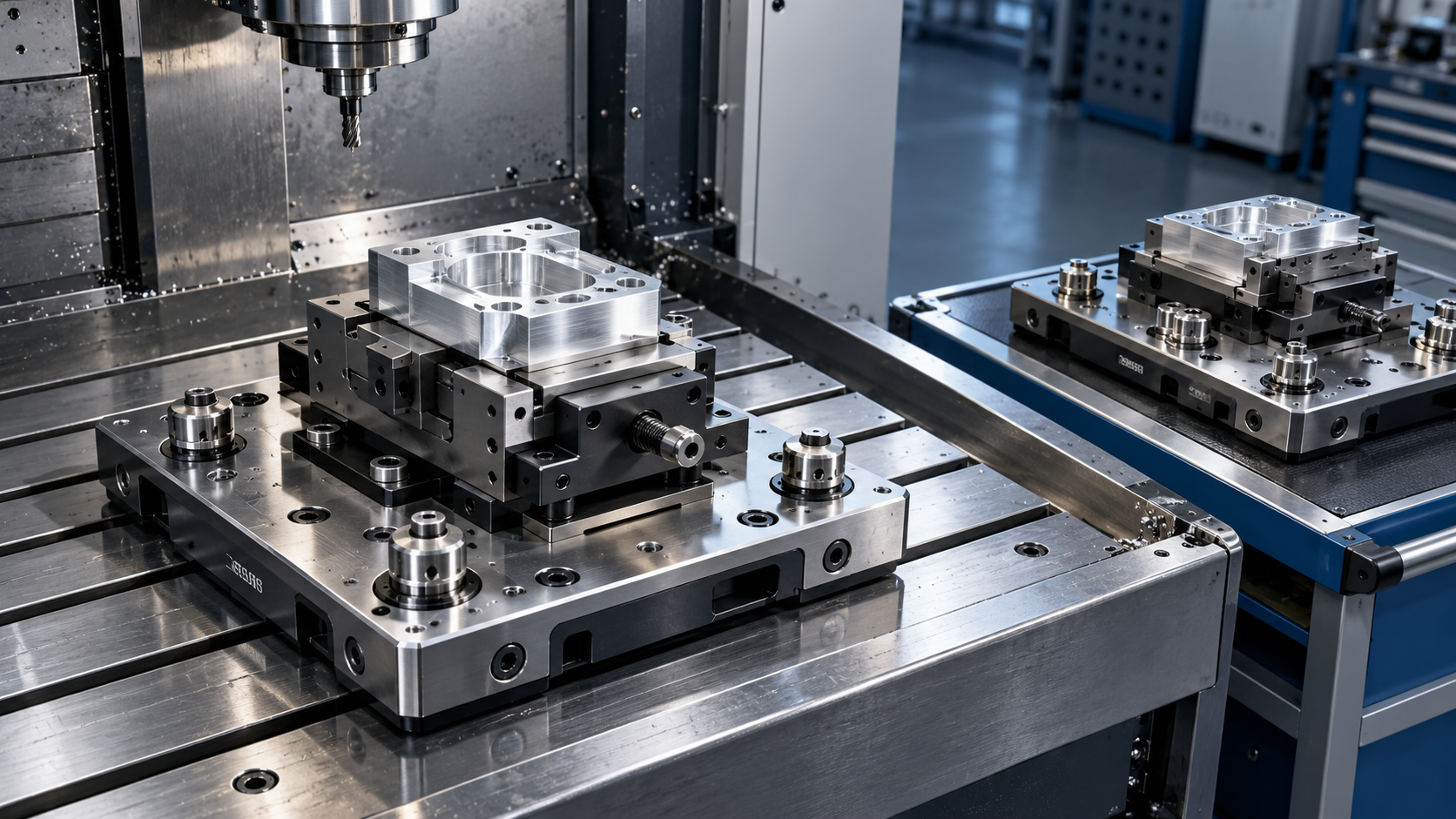
Zero-point clamping paired with offline-prepared fixture pallets is the strongest choice when changeovers involve removing, relocating, and requalifying complete fixtures. It replaces repeated table alignment with a repeatable mechanical interface and moves fixture preparation away from the machine. However, when successive jobs fit the same vise envelope, quick-change jaws can deliver a shorter overall changeover with less equipment and preparation.
The deciding factor is not how quickly a clamp closes. It is how much work remains between the last acceptable part of one job and the first acceptable part of the next. A fixture that exchanges in seconds offers limited benefit if the next workpiece still requires lengthy alignment, offset establishment, or first-piece correction.
Measure the changeover that actually interrupts production
A useful comparison starts with the complete last-good-part-to-first-good-part interval. Within that interval, separate fixture-related downtime from tool changes, program loading, material handling, and inspection. Otherwise, a workholding upgrade may receive credit—or blame—for activities it does not control.
The fixture-related portion includes unloading the previous setup, cleaning locating surfaces, exchanging workholding, establishing the workpiece datum, checking clearance, and completing any necessary proving cuts. Offline assembly belongs in the labor calculation, but it should not count as machine downtime when it happens while another job is running.
This distinction explains why two systems with similar exchange times can produce very different results. A modular fixture assembled directly on the machine may use fast clamps yet require substantial positioning work. The same fixture, assembled and checked on a transferable pallet, can leave only cleaning, docking, and verification to be completed at the machine.
Record both elapsed downtime and total labor. Moving preparation offline can recover spindle capacity without reducing labor by the same amount. That can still be valuable at a constrained machine, but it is a different benefit from eliminating setup work.
The choices are different layers of the workholding system
Zero-point systems, modular fixtures, and quick-change vises are not mutually exclusive alternatives. A zero-point receiver locates and retains a transferable fixture. A modular system determines how locators, supports, and clamps are arranged around the workpiece. A vise provides the actual workpiece grip. One setup can contain all three.
Hydraulic or pneumatic actuation is another layer, not a complete answer. It can shorten workpiece clamping, but a rapidly actuated fixture may still take considerable time to align on the table. Likewise, manual actuation does not prevent a locating interface from delivering a fast, repeatable exchange.
Where zero-point pallets create the largest reduction
A zero-point system uses locating and retention features to return a fixture carrier to a defined position. Its main contribution is replacing repeated manual alignment with a controlled docking operation. The strongest application is a machine alternating between substantially different setups: a vise assembly, a supported plate fixture, and an angle fixture, for example.
Without a transferable interface, each exchange can require removing bolts, handling loose hardware, indicating reference surfaces, and re-establishing coordinates. With prepared pallets, those assemblies remain intact between runs. The machine receives a known setup rather than a collection of components that must be rebuilt.
The time saving comes from preserving a qualified setup, not merely from shortening the locking action. Stored fixture identity, work-offset conventions, jaw configurations, and program revisions must remain linked. A repeatably mounted pallet carrying the wrong fixture revision is still an incorrect setup.
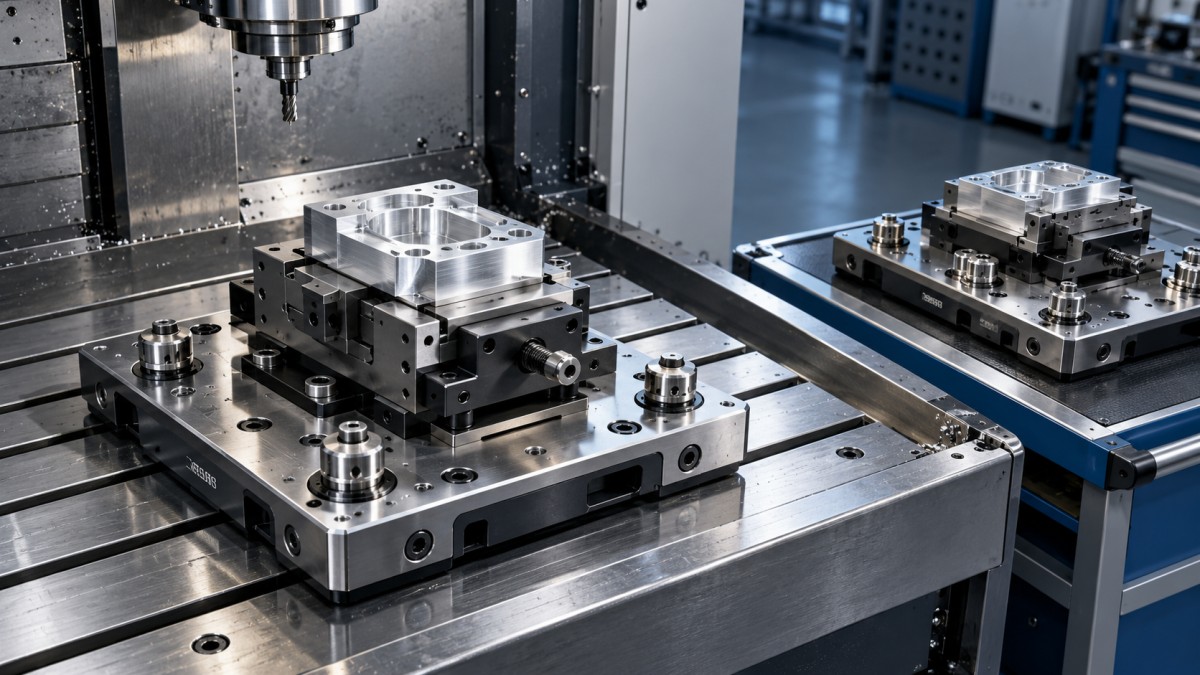
Offline preparation also needs a credible reference. A preparation station that reproduces the pallet datum allows fixture assembly and selected dimensional checks away from the machine. However, an external measurement does not automatically become a valid machine offset. The relationship between the preparation reference, pallet datum, and machine coordinate system must be established.
A pallet system also needs enough carriers to support the intended workflow. If the only available carrier must be stripped and rebuilt after every run, much of the offline-preparation advantage disappears. Carrier quantity should follow the actual job queue and setup reuse, rather than an assumption that every part number needs a permanent pallet.
When quick-change jaws are the better answer
For a family of prismatic parts held in the same vise, exchanging a complete pallet can be unnecessary. If the vise body remains aligned and the next job requires only a different qualified jaw set, quick-change jaws preserve the machine interface while changing the workpiece-specific contact geometry.
This approach is particularly attractive when parts share compatible gripping depth, cutting-force requirements, and access directions. Standardized stops and identified jaw sets can reduce the setup to cleaning, installing the jaws, loading the workpiece, and confirming the relevant datum.
The boundary is part geometry. Thin walls, irregular castings, extensive underside access, or demanding five-axis tool access may require supports and clamps that a vise cannot provide efficiently. Forcing those parts into a common vise architecture can introduce distortion, inaccessible features, or additional operations.
Jaw preparation also matters. A saved, qualified soft-jaw set can support a fast repeat setup. New soft jaws that must be machined and checked on the production machine cannot provide the same benefit. Removable jaws should therefore be assessed for reseating accuracy and gripping performance, not simply exchange convenience.
Modularity reduces preparation effort, but not necessarily downtime
Modular plates, locating elements, risers, and clamps are useful when the next job is unfamiliar and dedicated tooling would be difficult to justify. Their advantage is reconfiguration: components can be reused across different workpieces without manufacturing an entirely new fixture.
That flexibility does not guarantee a short changeover. A fixture assembled from a drawing on the machine table still requires assembly, positioning, tightening, and verification. The machine becomes the fixture-building station.
For genuinely low-repeat work, this may remain the most economical arrangement. Investing in a permanent fixture for every one-off part can create cost without sufficient reuse. The relevant comparison is the preparation effort across the expected production history, not the fastest possible exchange for a job that may never return.
Where recurring and unfamiliar work coexist, modular fixtures on standardized carriers offer a useful compromise. Recurring configurations can remain assembled; temporary configurations can be built offline and dismantled after use. Documented layouts, locator heights, clamp positions, and tightening requirements determine how reliably those configurations can be reproduced.
Repeatability must be assessed through the complete datum chain
A published locating-repeatability figure for a receiver is not a guarantee of finished-part accuracy. The complete chain includes the machine, receiver installation, carrier, fixture structure, workpiece locators, and the workpiece itself. Clamping deformation and cutting loads add further influences.
Angular variation deserves particular attention on tall fixtures. A small orientation change at the interface creates a larger positional displacement at a feature farther from that interface. Evaluating only a point close to the pallet surface can therefore miss errors relevant to the cutting zone.
Workpiece seating can also dominate the result. Returning the fixture accurately does not compensate for burrs, variable stock, inconsistent contact with stops, or chips under the component. The fixture-to-machine datum and the part-to-fixture datum must be evaluated separately.
Verification requirements should follow the tolerance and failure risk. A proven repeat setup may need only targeted seating and datum checks; a new setup may still require probing, clearance confirmation, and first-piece inspection. Repeatable locating should reduce unnecessary re-establishment, not justify removing essential checks.
Machine compatibility can reverse the ranking
Added stack height can make a nominally faster system unsuitable. Receivers, pallets, risers, and workholding consume vertical space and can reduce tool clearance. On a five-axis machine, their combined envelope also affects rotary travel, spindle approach, and collision exposure.
Evaluate the complete assembly at the required machining orientations. Table load capacity alone is insufficient: fixture mass, center of gravity, overhang, and machining forces affect rotary-axis loading and interface moments. Retention force should not be treated as interchangeable with allowable cutting load or resistance to overturning.
Handling can erase exchange-time gains. A pallet too heavy for convenient manual movement may require a hoist, cart, or pallet changer. Its positioning, connection points, and access route become part of changeover time. Automated pallet exchange can further reduce machine interruption, but requires compatible handling equipment and staging capacity.
Chips and coolant introduce another practical constraint. Locating faces and locking features must be accessible for cleaning and protected during machining. Where a utility-operated system is proposed, verify its locking behavior, loss-of-pressure response, and means of confirming secure engagement. Fast release is irrelevant if reliable seating cannot be established.
Compare complete changeovers before committing
A representative trial should include more than the easiest repeat job. Use a recurring vise-held part, a change between substantially different fixtures, and a setup requiring fresh configuration. Record cleaning, handling, exchange, datum verification, prove-out, and first-piece correction separately.
Repeat the exchange enough to expose variation rather than relying on one successful demonstration. Check location near the actual machining features, not only at the carrier datum. Include the operator actions and lifting arrangements that production will use.
An illustrative calculation shows why process boundaries matter. Suppose a fixture-related changeover occupies 30 minutes, and a prepared-pallet workflow reduces that interval to 10 minutes. At three changes per day over 220 operating days, the calculated recovery is 220 machine hours annually. These are hypothetical planning inputs, not a performance benchmark.
That recovered time has financial value only to the extent it can support useful production or avoid a real cost. Evaluation should include receivers, carriers, preparation stations, fixture duplication, handling equipment, maintenance, and storage. If preparation is transferred offline rather than eliminated, retain that labor in the comparison.
Choose zero-point pallets when complete-fixture replacement and requalification dominate downtime; choose quick-change jaws when the vise can remain and only the gripping geometry changes. Use modular workholding to address geometric variety, preferably outside the machine when capacity is constrained. The best-performing solution is the one that leaves the fewest necessary tasks on the stopped machine while preserving workpiece location, rigidity, access, and process control.
NEXT ARTICLE
Recommended for You
![]() 33rd JIMTOF 2026 Set to Open in Tokyo as Taiwanese Exhibitors Seek OrdersGlobal Machine Tool Trade Research Center
 Which Fixture Type Cuts Changeover Time Most in High-Mix CNC Machining?CNC Machining Technology Center
![]() FANUC Invests $18 Million in Largest U.S. Corporate Automation Training CenterMachine Tool Industry Editorial Team
 Southeast Asia Machine Tool Market: Comparing Automotive Demand by CountryManufacturing Market Research Center
![]() Zhongshan Xiaolan Machinery Exhibition Opens With Global Product DebutsMachine Tool Industry Editorial Team
 Automated Production Machining: Which Parts and Batch Sizes Are a Good Fit?Machine Tool Industry Editorial Team


Aris Katos
Future of Carbide Coatings
15+ years in precision manufacturing systems. Specialized in high-speed milling and aerospace grade alloy processing.
▶
Which Fixture Type Cuts Changeover Time Most in High-Mix CNC Machining?CNC Machining Technology Center▶
How to Design Cost-Effective Fixtures That Maintain Cycle Time in Mass ProductionCNC Machining Technology Center▶
Zero-Point Clamping or Modular Fixtures? Choosing a Faster CNC Changeover SystemCNC Machining Technology Center▶
How to Cut CNC Fixture Changeover Time Without Sacrificing Part AccuracyCNC Machining Technology Center▶
Can One Fixture Handle Multiple Part Geometries Efficiently?CNC Machining Technology Center
▶
Mastering 5-Axis Workholding Strategies
Join our technical panel on Nov 15th to learn about reducing vibrations in thin-wall components.

Providing you with integrated sanding solutions
Before-sales and after-sales services
Comprehensive technical support