• Global CNC market projected to reach $128B by 2028 • New EU trade regulations for precision tooling components • Aerospace deman
NYSE: CNC +1.2%LME: STEEL -0.4%

When does a legacy CNC upgrade cost less than machine replacement?
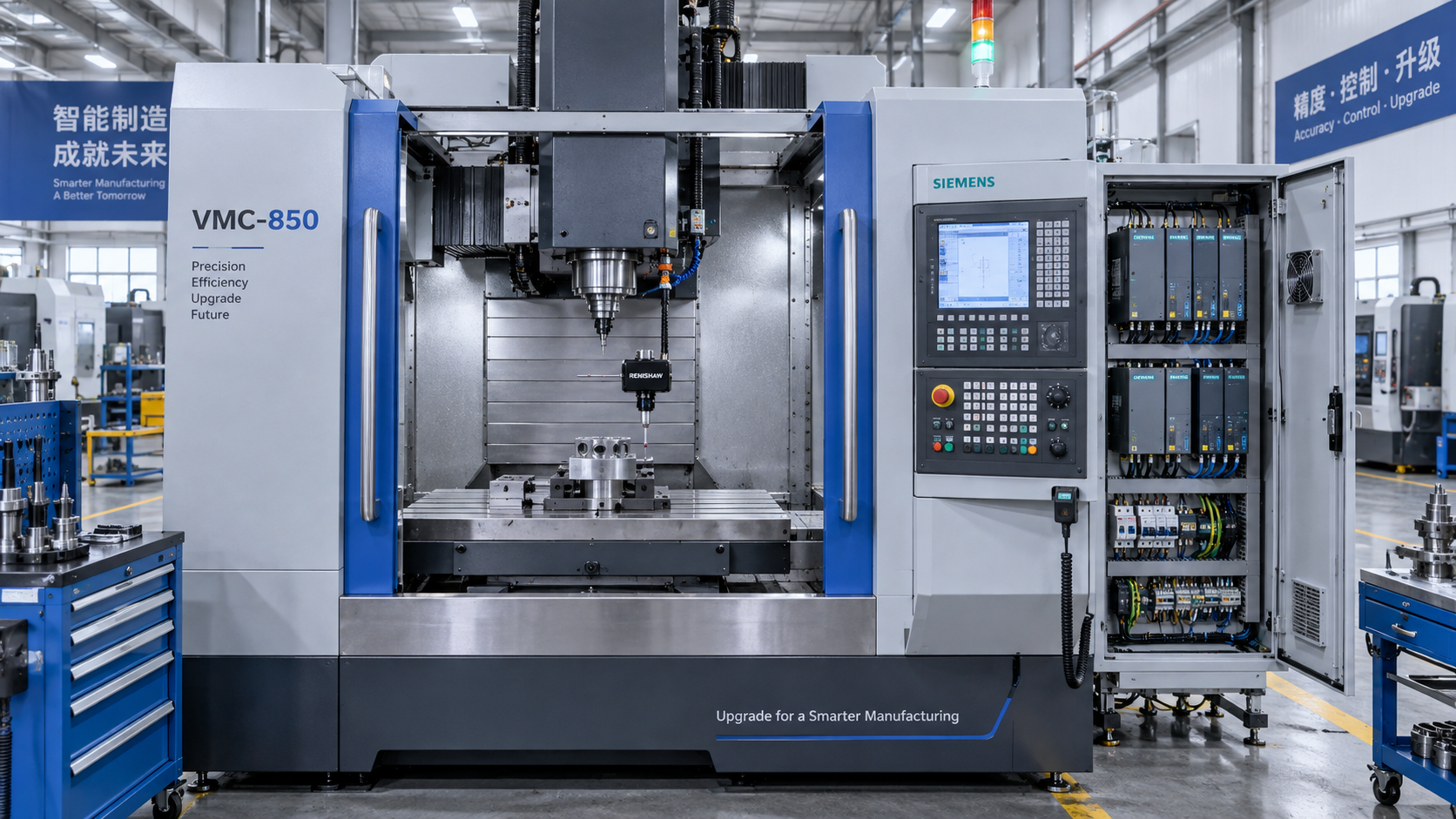
A legacy CNC upgrade costs less than machine replacement when the existing machine is mechanically sound, the retrofit resolves the main production constraints, and the savings remain intact after installation, downtime, maintenance, and future repairs are included. A lower equipment quote alone does not establish a better investment.
The strongest upgrade candidates have useful capacity left in their structure, spindle, and motion systems but face problems with obsolete controls, unreliable electronics, or limited connectivity. Replacement becomes more attractive when mechanical deterioration, insufficient capacity, or changing part requirements would remain expensive problems after the upgrade.
The decision should compare the cost of delivering the required production over a common planning period. That makes remaining service life, usable output, and implementation risk as important as the initial purchase price.
Establish whether the machine is worth retaining
Before requesting a control retrofit quote, establish what causes the machine’s current losses. Controller faults, unavailable electronic components, and difficult program transfer can make an otherwise capable machine unreliable. Worn guideways, damaged ballscrews, spindle problems, and unstable geometry require a different scope of work.
A new control can improve programming, diagnostics, and motion management, but it cannot restore mechanical rigidity or eliminate physical wear. Compensation may address some measured positioning errors within limits; it does not replace repairing damaged components.
The condition assessment should connect inspection results with actual production requirements. Positioning measurements are useful, but so are representative parts machined under normal cutting loads. A machine may meet a basic positioning check yet struggle with surface finish, thermal stability, or repeatability during a full production shift.
Ask for documented findings on:
- Machine geometry, axis backlash, guideway condition, lubrication, and structural damage.
- Spindle condition, toolholding, tool changer reliability, and relevant auxiliary systems.
- The causes of recent stoppages, scrap, rework, and maintenance spending.
- Whether the machine can meet future part tolerances, cutting loads, and production volume after the proposed work.
The output should be a defined repair and upgrade scope, with unresolved conditions identified before approval. If major mechanical work is needed, compare the complete rebuild and retrofit package with replacement. Approving the controls first and discovering the rebuild requirement during installation can erase the expected savings.
Compare complete installed costs on both sides
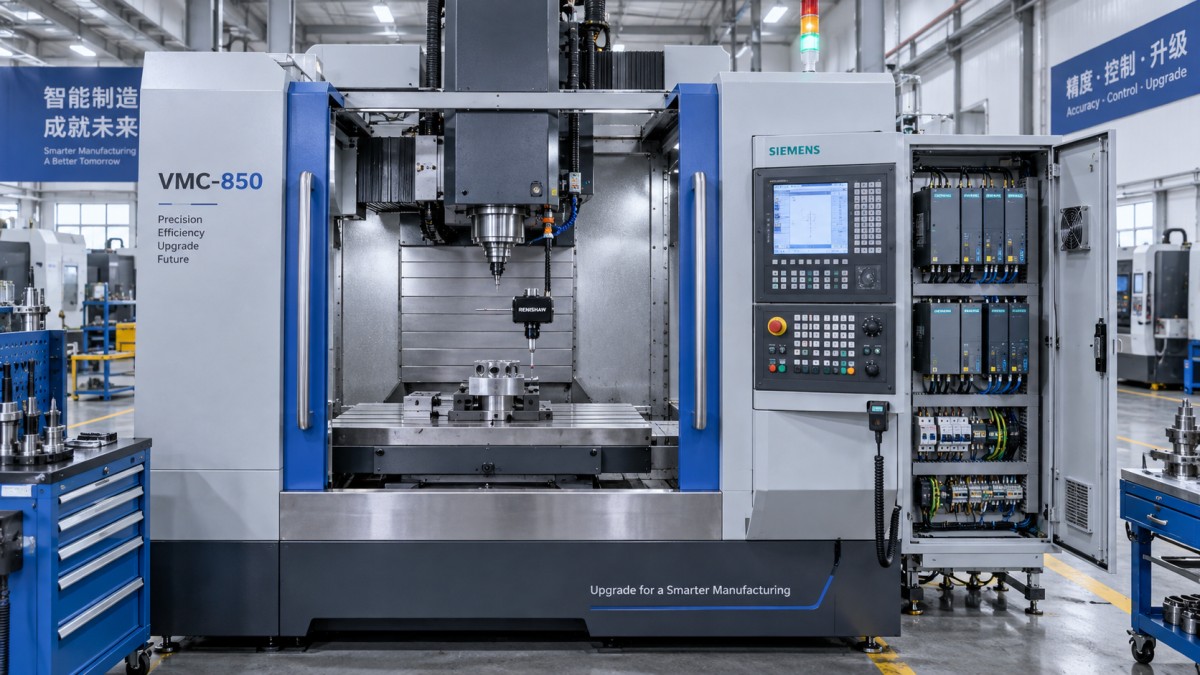
Retrofit quotations vary in what they include. One supplier may quote a controller and engineering package, while another includes drives, motors, cabinet work, commissioning, and production acceptance. The totals are not comparable until the boundaries match.
Existing drives and motors may be reusable, but compatibility needs an engineering assessment. Feedback devices, electrical interfaces, and support availability can make reuse impractical. Savings based on retaining components should appear in the agreed design, rather than remain an assumption.
Replacement quotations also need expansion beyond the machine price. Delivery, rigging, foundations, utilities, tooling, software, training, and production qualification can materially affect the investment.
Request explicit inclusions, exclusions, and responsibility boundaries. Program conversion, for example, may mean transferring files or proving that the converted programs produce acceptable parts. Those are different deliverables with different costs.
For machines connected to robots, pallet systems, or automated handling, include interface engineering and commissioning. Emergency stops, guarding, interlocks, and machine sequencing must function as an integrated system. An upgrade quote that covers only the CNC cabinet can leave substantial work outside the budget.
Use a common production requirement and planning period
A useful comparison starts with the same part mix, quality requirements, operating schedule, and planning horizon. Comparing an upgraded machine that meets current demand with a replacement configured for a much broader application can obscure the cost of solving today’s problem.
Build a cash-flow model for each option that includes the installed investment, transition costs, operating and maintenance costs, expected major repairs, and residual value. Discount future cash flows using the business’s established investment method. Keep tax and depreciation effects consistent with its accounting assumptions.
The relevant comparison is the present value of the cash required to deliver the same acceptable production. If replacement produces a different level of output, show the value of that difference separately.
Remaining service life deserves particular attention. A retrofit may cost less initially but require another capital purchase within the planning period. Include that later expenditure and its associated disruption. Conversely, a replacement expected to remain useful beyond the period should receive an appropriate residual value; ignoring that can unfairly favor the upgrade.
Book value is not a measure of future usefulness. A fully depreciated machine can remain productive, while a machine with a substantial accounting value can be costly to retain. The original purchase price is a sunk cost. Relevant disposal proceeds, tax effects, future spending, and production consequences belong in the decision.
Price downtime according to its effect on the business
The same shutdown can have very different financial consequences depending on scheduling flexibility. If stock can be built ahead or work transferred to another machine, the main costs may be overtime, extra handling, or temporary inventory. If the machine is a bottleneck with no substitute, interruption may reduce shipments or require outsourcing.
Use the actual consequence rather than multiplying every downtime hour by an internal machine rate. Internal rates often include overhead that continues during the shutdown. For permanently lost sales, lost contribution may be appropriate. For work recovered later, recovery costs and delivery consequences provide a better basis.
Avoid counting the same loss twice. Outsourcing costs and lost contribution should not both be charged to production that the subcontractor successfully delivers.
A retrofit usually takes the existing machine out of service during conversion. Replacement may permit installation and process proving while the old machine continues operating, provided floor space and utilities allow it. Where replacement must occupy the same footprint, removal and installation can create a longer interruption.
Supplier schedules should distinguish installation completion, technical commissioning, and stable production. A machine that powers up and completes test movements is not necessarily ready to produce saleable parts. Include time for program debugging, operator familiarization, first-article approval, and any customer qualification required for the work.
Credit productivity gains only when they create usable value
A replacement machine may offer faster acceleration, shorter tool changes, greater spindle capability, or better automation access. Those features create financial value when they improve the actual process and the business can use the additional capacity.
If demand is limited, extra output capability may have little immediate value. If another operation constrains the production line, faster machining may simply move work into a queue. On a bottleneck machine serving confirmed demand, however, higher throughput can justify replacement even when its acquisition cost is greater.
Evaluate cycle time using representative parts, including loading, probing, tool changes, inspection, and expected stoppages. A faster rapid traverse does not translate directly into the same reduction in total cycle time.
Apply similar discipline to labor savings. Automation can reduce attendance requirements, but cash savings depend on whether staffing, overtime, or outsourced work actually changes. Freed operator time may still be valuable if it supports additional production; the business case should explain how that time will be used.
An upgraded control can also provide easier troubleshooting, better program handling, or production data access. Describe the operational mechanism behind each benefit. Connectivity creates value when it supports decisions or reduces work, not simply because data becomes available.
Test the savings against repair and support exposure
A retrofit renews only the components included in its scope. Retained spindles, hydraulics, tool changers, motors, and mechanical assemblies continue to carry their existing condition and support risks. Warranty coverage should identify which systems are covered and how faults involving both new and retained components will be handled.
Support arrangements matter beyond the hardware brand. Obtain clear terms for service response, spare parts, software licenses, configuration backups, and access to PLC logic and electrical documentation. A machine with modern electronics can still be difficult to maintain if essential configuration knowledge remains with one integrator.
Prepare a base case and a downside case using the condition assessment and supplier scope. The downside case might include a longer commissioning period, a plausible major repair, or slower production recovery. Treat identified repairs explicitly rather than hiding them inside a general contingency.
The useful question is how much adverse cost the upgrade can absorb before replacement becomes financially preferable. If one credible repair or a modest shutdown extension consumes the entire advantage, the lower quote offers limited protection. Replacement also needs sensitivity analysis for installation delays, integration difficulties, and productivity gains that fall short of expectations.
When the upgrade has the stronger case
A legacy CNC upgrade is most compelling when the machine already performs the required physical work, its main constraints are in the controls or electronics, and the retained assemblies have a credible remaining service life. The work should have a defined scope, manageable downtime, and support arrangements that fit the production schedule.
Consider a machining center producing an established family of parts. If it holds the required tolerances but suffers recurring controller faults and difficult program management, a control retrofit may address the principal losses while preserving suitable fixtures and a proven process.
The judgment changes if that machine also needs extensive mechanical restoration, cannot meet new tolerances under cutting load, or lacks the spindle capability and working envelope for future parts. In that situation, a control upgrade leaves substantial production constraints unresolved. Replacement may deliver lower cost per accepted part despite requiring more capital upfront.
Before approving either route, require a documented condition assessment, matched installed-cost proposals, and a lifecycle comparison with explicit downtime and productivity assumptions. The contract should define acceptance using representative parts, required quality, relevant cycle times, and automation functions.
Where practical, link payment milestones to those deliverables and specify responsibility for conversion faults and production handover. The upgrade earns approval when it provides enough dependable production life to recover its complete cost and retains a meaningful financial advantage under credible adverse conditions.
PREVIOUS ARTICLE
NEXT ARTICLE
Recommended for You
![]() Mitsubishi Electric Announces Physical AI System Linking Humanoid Robots and CNC MachinesMachine Tool Industry Editorial Team
 Precision Machining for Defense: Supplier Quality and Traceability ChecksManufacturing Market Research Center
![]() Nidec Machine Tool Launches MVR-5X Five-Axis Gantry MachineMachine Tool Industry Editorial Team
 Choosing a Precision Disc Parts Manufacturer in China: Tolerances and Quality ChecksManufacturing Market Research Center
![]() Siemens Executive Says AI Could Raise Factory Automation to 80%Manufacturing Market Research Center
 Choosing Automated Machine Tools for High-Mix, Low-Volume ProductionMachine Tool Industry Editorial Team


Aris Katos
Future of Carbide Coatings
15+ years in precision manufacturing systems. Specialized in high-speed milling and aerospace grade alloy processing.
▶
When does a legacy CNC upgrade cost less than machine replacement?Manufacturing Market Research Center▶
What Production Volume Justifies a CNC Turning Investment?Manufacturing Market Research Center▶
What to check before investing in Industrial RoboticsManufacturing Market Research Center▶
What to check before investing in Industrial RoboticsManufacturing Market Research Center▶
Is Industrial Automation worth it for rising labor costsManufacturing Market Research Center
▶
Mastering 5-Axis Workholding Strategies
Join our technical panel on Nov 15th to learn about reducing vibrations in thin-wall components.

Providing you with integrated sanding solutions
Before-sales and after-sales services
Comprehensive technical support