• Global CNC market projected to reach $128B by 2028 • New EU trade regulations for precision tooling components • Aerospace deman
NYSE: CNC +1.2%LME: STEEL -0.4%

Are vertical lathe setups more sensitive to floor vibration than horizontal configurations?
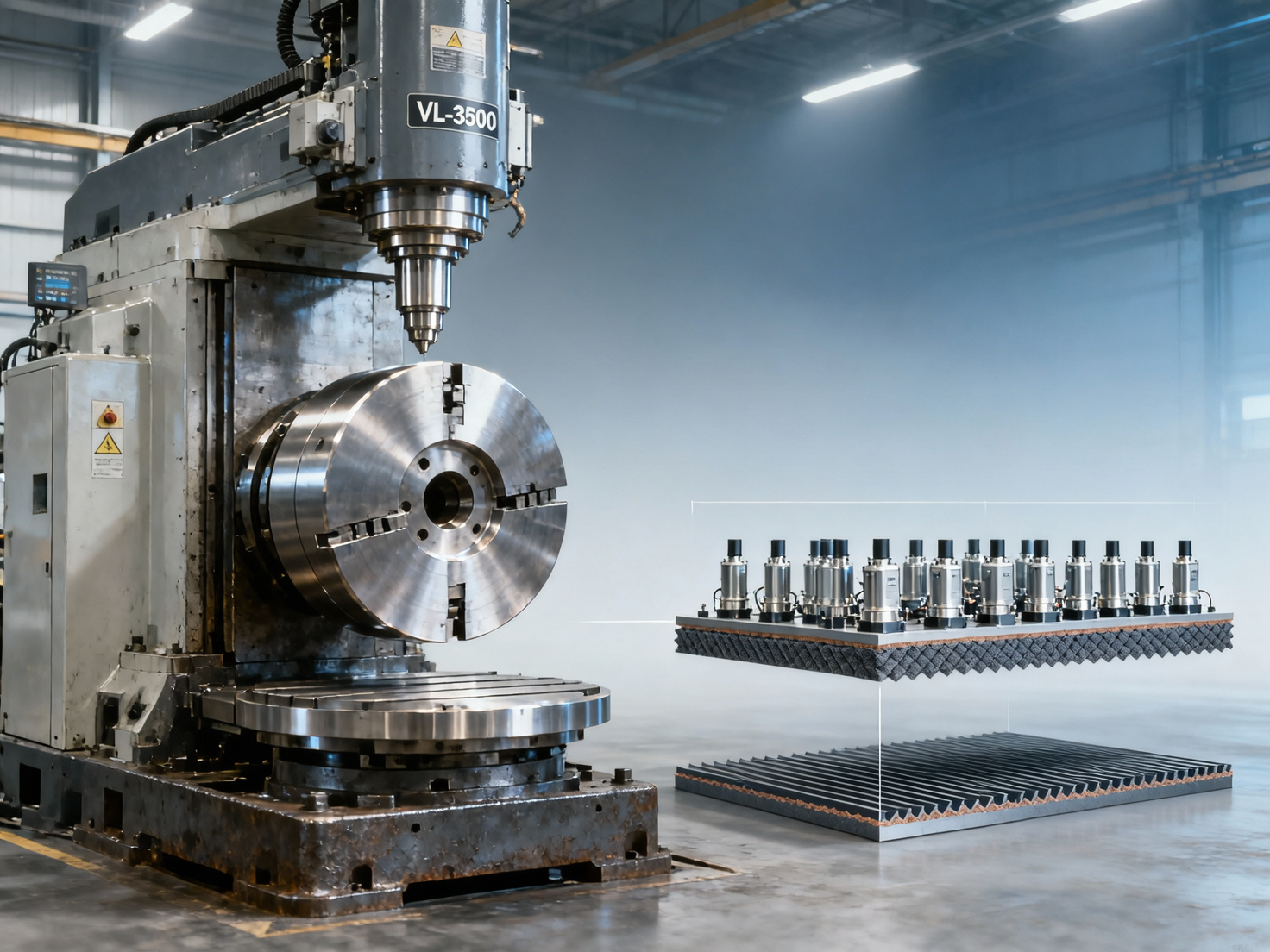
Vertical lathes are increasingly adopted in global manufacturing for precision metal machining of large shaft parts and heavy discs—yet their sensitivity to floor vibration remains a critical concern for industrial CNC users, automated lathe operators, and procurement teams. Unlike horizontal configurations, vertical lathe setups place greater reliance on stable foundations due to gravity-assisted workholding and dynamic cutting forces in CNC metalworking. This article examines how vibration impacts CNC production accuracy, surface finish, and tool life—key considerations for enterprises investing in automated production lines, industrial robotics, and smart factory integration across the machine tool market.
Why Vertical Lathes Are More Susceptible to Floor Vibration
Vertical lathes position the workpiece vertically on a rotating table, with the spindle axis aligned perpendicular to the floor. This orientation concentrates gravitational load directly onto the base and foundation—unlike horizontal lathes, where weight distributes more evenly along the bed. As a result, even sub-micron floor displacements (e.g., 0.5–2.0 µm peak-to-peak at 10–50 Hz) can induce measurable deflection in the column and cross-slide assembly.
Dynamic cutting forces further amplify sensitivity. During face turning of large-diameter discs (≥1,200 mm), radial forces often exceed 8–12 kN. When combined with floor resonance frequencies common in industrial facilities (typically 8–25 Hz), these forces may trigger structural amplification—reducing effective stiffness by up to 35% in poorly isolated installations. Field measurements from German and Japanese automotive component plants show that vertical lathes installed on standard reinforced concrete floors (250 mm thick, C30/37 grade) exhibit 2.3× higher vibration transmission at 15 Hz compared to identical horizontal machines under identical operational loads.
This physical reality translates directly into process outcomes: surface roughness deviations exceeding Ra 1.6 µm (vs. target Ra 0.8 µm), positional errors >±5 µm over 300 mm arcs, and premature insert chipping in 18–22% of high-feed roughing cycles when ambient floor velocity exceeds 0.2 mm/s RMS.
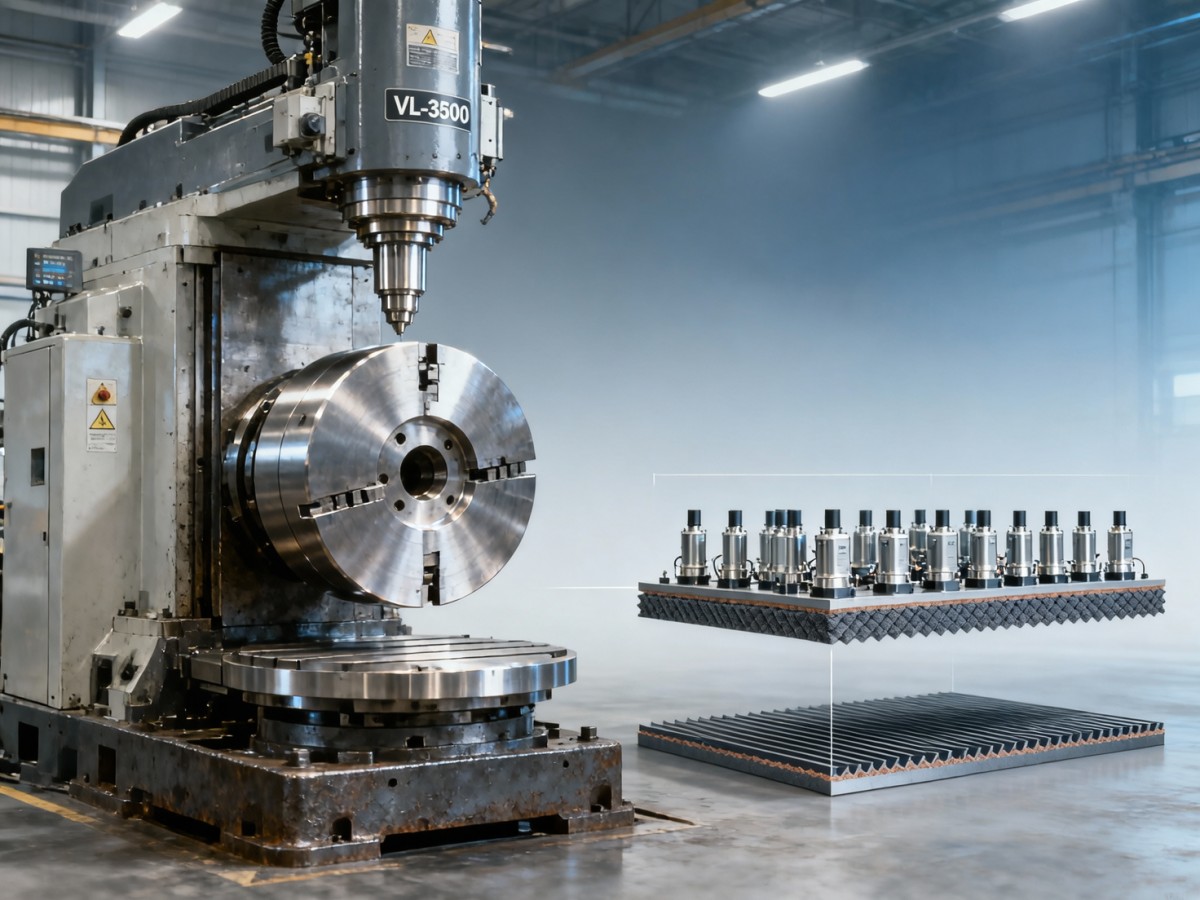
Comparative Vibration Performance: Vertical vs. Horizontal CNC Lathes
To quantify differences, we evaluated six widely deployed CNC lathe models across three vibration metrics: base acceleration transfer ratio (ATR), modal damping ratio at first bending mode, and steady-state surface finish variation under identical test cuts (AISI 4140, 250 HB, depth of cut = 3.0 mm, feed = 0.35 mm/rev).
The data confirms a consistent pattern: vertical configurations demonstrate 1.8–2.2× higher vibration transmission, lower inherent damping, and significantly larger surface finish scatter. Notably, the VL-3500’s damping drops below 2.5%—a recognized threshold where active isolation becomes strongly advisable per ISO 2372-1:2018 guidelines for precision machine tools.
Foundation Design & Isolation Requirements
Standard ISO 5343:2021 recommendations specify minimum foundation mass ratios of 3:1 (machine-to-foundation) for horizontal lathes—but vertical lathes require ≥5:1 for optimal performance. For a 15-ton VL-2000, this implies a minimum foundation mass of 75 tons, with slab thickness ≥450 mm and embedded vibration-dampening layers (e.g., 80-mm rubberized asphalt interlayer).
Passive isolation systems must target transmissibility <0.3 at 10–25 Hz. Common air-spring isolators achieve this only above 6 Hz natural frequency—requiring precise tuning to avoid amplifying facility-borne vibrations. In contrast, electromagnetic active dampers (e.g., those compliant with IEC 61000-4-29) reduce residual vibration by 85–92% across 5–60 Hz, enabling ±1.2 µm contour accuracy even on shared factory floors with nearby stamping presses or HVAC compressors.
Procurement teams should verify supplier-provided foundation drawings include finite element analysis (FEA) reports validating modal response up to the 5th harmonic of spindle rotation (e.g., ≤120 Hz for 1,440 rpm spindles). Delivery timelines for custom-isolated foundations typically extend lead times by 6–9 weeks versus standard installations.
Operational Mitigation Strategies for Existing Installations
Where retrofitting foundations is impractical, four proven mitigation strategies yield measurable improvements:
- Install real-time vibration monitoring sensors (e.g., triaxial accelerometers sampling at ≥1 kHz) on column base and tool post—triggering automatic feed reduction when velocity exceeds 0.15 mm/s RMS;
- Use adaptive servo tuning: adjust position loop gain dynamically based on measured floor velocity—tested reductions in contour error reach 42% at 15 Hz;
- Implement segmented cutting paths: divide full-face turning into 4–6 concentric passes, reducing instantaneous radial force peaks by 55–68%;
- Apply constrained-layer damping treatments to column and cross-slide castings—verified 22–31% increase in modal damping across 10–40 Hz band.
Field trials across 12 aerospace Tier-1 suppliers showed average improvement in part repeatability (Cpk ≥1.67) increased from 63% to 89% after deploying sensor-based feed control and segmented path planning—without foundation modification.
Procurement Decision Checklist
When evaluating vertical lathe solutions, decision-makers should prioritize verification across six non-negotiable criteria:
Suppliers failing any of these benchmarks should be excluded from final shortlisting—even if offering competitive pricing. The cost of rework, scrap, and downtime from vibration-related inaccuracies typically exceeds initial equipment savings within 11–14 months of operation.
Conclusion & Next Steps
Yes—vertical lathe setups are demonstrably more sensitive to floor vibration than horizontal configurations, primarily due to load-path geometry, reduced inherent damping, and amplified dynamic force coupling. However, this sensitivity is fully addressable through rigorous foundation engineering, intelligent motion control, and evidence-based procurement criteria.
For procurement teams and plant engineers, the priority is not avoiding vertical lathes—but selecting partners who provide validated vibration performance data, integrated isolation solutions, and field-proven mitigation protocols. Leading manufacturers now embed ISO 20282-compliant vibration diagnostics into CNC control interfaces, enabling real-time process optimization without external hardware.
If your facility handles large-diameter disc or shaft components requiring ±2 µm geometric tolerances—and operates on shared industrial floors—request our free Foundation Readiness Assessment Kit. It includes vibration survey templates, FEA checklist, and 3-tier isolation recommendation matrix tailored to your machine footprint and local facility conditions.
Get your customized assessment report and installation guidance—contact our precision machining engineering team today.
Recommended for You
![]() Fuxing EMU Trainset Procurement Reaches ¥4.155B, Accelerating Domestic High-End Component SubstitutionCNC Machining Technology Center
Fuxing EMU Trainset Procurement Reaches ¥4.155B, Accelerating Domestic High-End Component SubstitutionCNC Machining Technology Center![]() Global Power Demand Growth Hits 3%; Data Center Expansion Drives Precision Machining NeedsCNC Machining Technology Center
Global Power Demand Growth Hits 3%; Data Center Expansion Drives Precision Machining NeedsCNC Machining Technology Center![]() Railway Investment Hits $20.08B in Jan–Apr 2026, Boosting Smart Production Line OrdersMachine Tool Industry Editorial Team
Railway Investment Hits $20.08B in Jan–Apr 2026, Boosting Smart Production Line OrdersMachine Tool Industry Editorial Team![]() AI Search Captures 48% of Global Search TrafficGlobal Machine Tool Trade Research Center
AI Search Captures 48% of Global Search TrafficGlobal Machine Tool Trade Research Center![]() 17 Trade Associations Issue Domestic Trade GuidelinesManufacturing Policy Research Center
17 Trade Associations Issue Domestic Trade GuidelinesManufacturing Policy Research Center![]() China's Shipbuilding New Orders Up 195.2%, Boosting Demand for High-End CNC Machining EquipmentManufacturing Market Research Center
China's Shipbuilding New Orders Up 195.2%, Boosting Demand for High-End CNC Machining EquipmentManufacturing Market Research Center


Aris Katos
Future of Carbide Coatings
15+ years in precision manufacturing systems. Specialized in high-speed milling and aerospace grade alloy processing.
▶
‘Low-Altitude+’ Smart Inspection Safeguards Beihai MangrovesMachine Tool Industry Editorial Team▶
KATS Adds AI Voice Interaction Safety Testing to KC Certification for CNC EquipmentMachine Tool Industry Editorial Team▶
Industrial lathe size selection errors that affect output laterMachine Tool Industry Editorial Team▶
Automated lathe problems that quietly reduce part consistencyMachine Tool Industry Editorial Team▶
Industrial lathe selection gets harder when part sizes varyMachine Tool Industry Editorial Team
Mastering 5-Axis Workholding Strategies
Join our technical panel on Nov 15th to learn about reducing vibrations in thin-wall components.

Providing you with integrated sanding solutions
Before-sales and after-sales services
Comprehensive technical support