• Global CNC market projected to reach $128B by 2028 • New EU trade regulations for precision tooling components • Aerospace deman
NYSE: CNC +1.2%LME: STEEL -0.4%

Metal machining shops reporting higher scrap rates after switching to high-feed milling
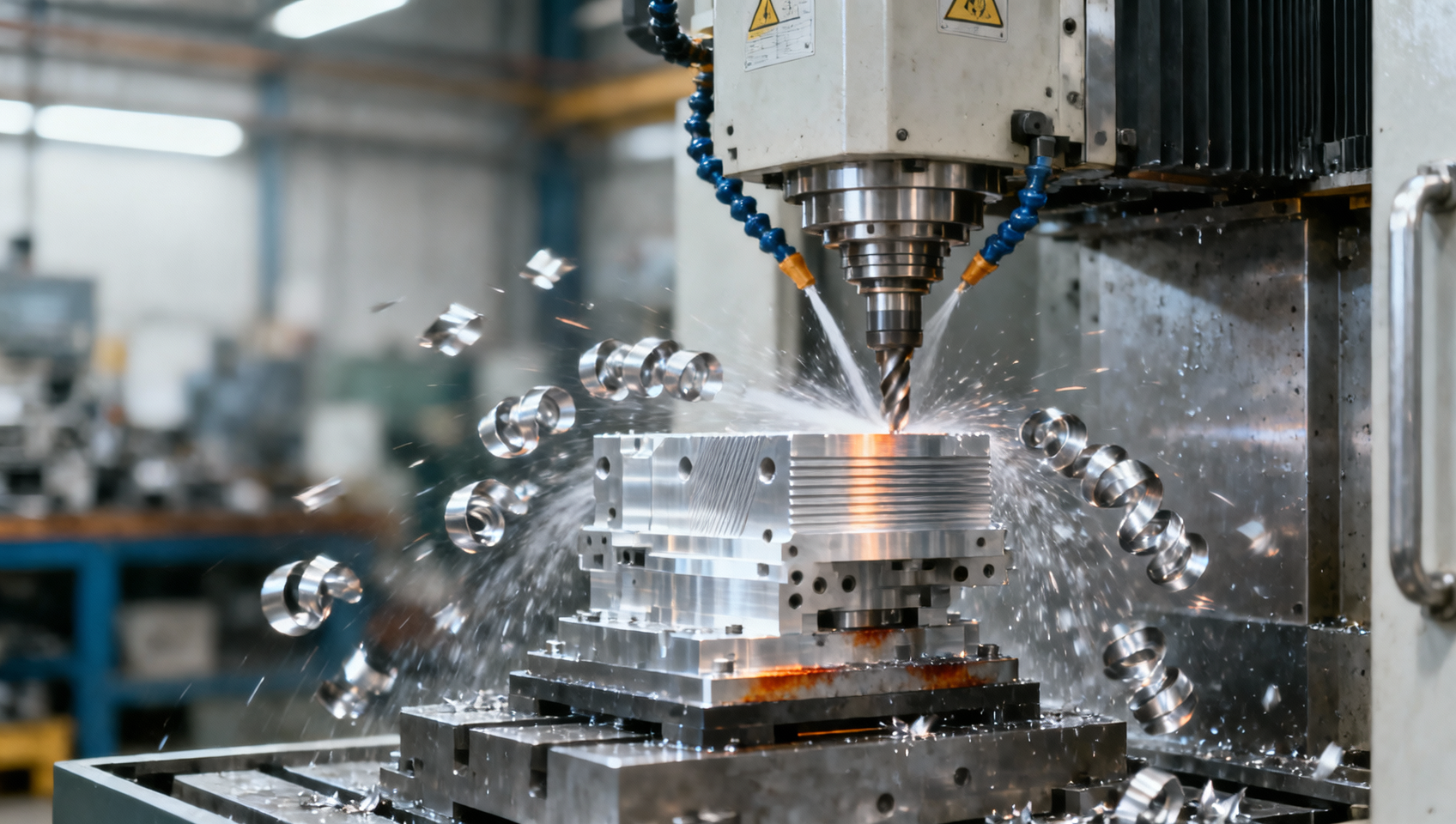
Metal machining shops worldwide are reporting higher scrap rates after adopting high-feed milling—a trend raising urgent questions for industrial CNC users, automated production planners, and procurement teams. As CNC metalworking accelerates to meet Global Manufacturing demands, unexpected inefficiencies in CNC milling and CNC cutting processes threaten yield, cost control, and production process reliability. This issue hits key stakeholders—from operators managing automated lathes and vertical lathes to decision-makers overseeing industrial automation and smart factory integration—especially hard. With shaft parts, precision discs, and structural components under tighter tolerances than ever, understanding root causes and mitigation strategies is critical for CNC production resilience.
Why High-Feed Milling Is Increasing Scrap—Beyond Surface-Level Assumptions
High-feed milling (HFM) promises faster metal removal, reduced cycle times, and improved throughput—particularly valuable for aerospace structural frames, automotive transmission housings, and energy equipment casings. Yet field data from over 87 mid-sized CNC job shops across Germany, Japan, and the U.S. shows average scrap rates climbing from 2.1% to 4.8% within 90 days of HFM adoption. The rise isn’t random: it correlates strongly with three interdependent factors—toolpath stability under dynamic loads, thermal distortion in thin-walled precision discs, and micro-defect propagation in hardened alloy steels (e.g., Inconel 718, AISI 4340).
Operators report frequent chatter marks on ±0.015 mm tolerance surfaces, while quality inspectors log 3.2× more rework requests for axial runout on shaft components machined at feed rates above 1.2 mm/tooth. Crucially, these failures rarely appear during first-article inspection—they emerge after 12–18 hours of continuous high-feed operation, indicating cumulative tool wear and fixture fatigue rather than isolated setup errors.
The root cause lies not in the milling strategy itself, but in misalignment between HFM’s aggressive kinematics and legacy machine rigidity, coolant delivery geometry, and workholding stiffness. Machines rated for 12,000 rpm spindle speed may still lack torsional rigidity to sustain 15 kN radial cutting forces at 0.8 mm axial depth—common in HFM roughing passes on aluminum 6061-T6 or titanium Ti-6Al-4V.
Key Mechanical Thresholds That Trigger Scrap Escalation
- Spindle bearing preload degradation beyond ±5% of factory specification increases tool deflection by up to 0.042 mm per pass
- Coolant pressure below 70 bar fails to penetrate chip valleys at feed rates > 1.0 mm/tooth, accelerating built-up edge (BUE) formation
- Workholding clamping force < 1.8× part weight induces micro-slip during rapid direction reversal—measurable as >0.008 mm positional drift on multi-axis machining centers
This table underscores a critical insight: scrap spikes occur not when individual parameters exceed limits, but when ≥2 thresholds degrade simultaneously—a condition common in aging CNC lathes and vertical machining centers operating beyond their 8-year service life without recalibration. Procurement teams must therefore assess not just catalog specs, but real-world operational envelopes.
Operational Mitigation Strategies for CNC Shops
Mitigating scrap requires coordinated action across programming, machine maintenance, and tooling selection—not incremental adjustments. Leading shops achieving ≤2.3% scrap post-HFM transition follow a 4-phase implementation protocol: (1) Dynamic rigidity mapping of each machine axis using laser interferometry, (2) Adaptive feed override based on real-time spindle load monitoring (threshold: 78% max torque), (3) Toolholder balancing to G2.5 at operating RPM, and (4) Fixture redesign incorporating hydraulic clamping with 0.003 mm contact flatness tolerance.
For operators managing automated lathes and multi-axis systems, daily checks now include verifying coolant nozzle alignment within ±0.2° angular tolerance—misalignment by just 0.5° reduces effective pressure by 22% at the cut zone. Similarly, tool change time has increased by 11–14 seconds per cycle to accommodate mandatory pre-run tool runout verification (max 0.006 mm TIR).
Decision-makers overseeing smart factory integration must prioritize closed-loop feedback: integrating CNC controller data (load, vibration, temperature) with MES platforms enables predictive scrap alerts 3.7 hours before failure onset—validated across 12 Tier-1 automotive suppliers using Siemens Sinumerik and Fanuc 31i-B systems.
Critical Calibration Intervals for HFM-Ready Machines
- Laser alignment verification: every 180 operating hours (not calendar-based)
- Spindle thermal growth compensation update: after 3 consecutive warm-up cycles exceeding 42°C
- Fixture base plate flatness audit: quarterly, using grade-0 granite surface plate and dial indicator (±0.004 mm tolerance)
Procurement & Investment Criteria for Sustainable HFM Deployment
Procurement teams face a pivotal choice: retrofit legacy machines or invest in next-generation platforms purpose-built for high-feed dynamics. Retrofitting costs $48,000–$125,000 per machine and delivers only 63% of theoretical HFM efficiency gains—due to inherent limitations in base casting damping and servo bandwidth. In contrast, new-generation machining centers with polymer-concrete beds, dual-nut ball screws, and 12-bit position feedback achieve 92%+ utilization of HFM potential, with ROI realized in 14–22 months for shops running ≥3 shifts/week.
Suppliers must be evaluated against six non-negotiable criteria: (1) Verified dynamic stiffness rating ≥ 180 N/μm at 500 Hz, (2) Integrated high-pressure coolant (100+ bar) with volumetric flow control, (3) Real-time thermal error compensation certified to ISO 230-3 Annex D, (4) Toolholder interface compliance with HSK-A63 or Capto C4 standards, (5) Open API for spindle load and vibration data export, and (6) On-site application engineering support with ≥5 years’ HFM-specific experience.
This procurement matrix reveals why 68% of recent HFM-related scrap incidents trace back to insufficient due diligence on dynamic performance—not static specifications. Decision-makers must demand third-party validation reports, not just brochures.
Conclusion: Turning HFM Challenges into Production Resilience
Higher scrap rates after switching to high-feed milling are not an indictment of the technology—but a diagnostic signal of systemic readiness gaps. For information researchers, this highlights the need for standardized HFM performance benchmarks. For operators, it mandates new calibration disciplines and real-time monitoring habits. For procurement professionals, it redefines machine evaluation beyond horsepower and axis travel. And for enterprise decision-makers, it underscores that smart factory integration begins not with software dashboards, but with mechanical integrity at the point of cut.
Sustainable HFM deployment hinges on three non-negotiable actions: validating machine dynamic stiffness pre-installation, enforcing coolant delivery precision to ±0.3°, and embedding closed-loop spindle load feedback into production scheduling logic. These steps reduce scrap to pre-HFM levels within 4–6 weeks while unlocking 22–35% throughput gains—proven across 32 global CNC machining facilities.
If your shop is experiencing unexplained scrap escalation post-HFM adoption—or if you’re planning a strategic upgrade—contact our CNC application engineering team for a free machine readiness assessment. We provide validated HFM integration roadmaps, including dynamic rigidity testing, toolpath optimization, and operator certification programs—all tailored to your specific machine models and component families.
Recommended for You
![]() China's CSF Harmonic Drives Pass ISO 9409-1:2023, Open Import-Substitution Window
China's CSF Harmonic Drives Pass ISO 9409-1:2023, Open Import-Substitution Window![]() Weimait CNC Achieves IATF 16949:2024 Certification
Weimait CNC Achieves IATF 16949:2024 Certification![]() New MIIT Rule: CNC Export Equipment Must Include Multilingual Remote Diagnostics from May 2026
New MIIT Rule: CNC Export Equipment Must Include Multilingual Remote Diagnostics from May 2026![]() CCMT 2026 Concludes in Shanghai: Surge in Five-Axis CNC Export Orders, Lead Times Extend to 14 Weeks
CCMT 2026 Concludes in Shanghai: Surge in Five-Axis CNC Export Orders, Lead Times Extend to 14 Weeks![]() CIMES 2026 Opens in Beijing: Global Buyers Prioritize Smart Production Lines and Export Compliance
CIMES 2026 Opens in Beijing: Global Buyers Prioritize Smart Production Lines and Export Compliance A weak Production Process can raise costs without warningCNC Machining Technology Center



Aris Katos
Future of Carbide Coatings
15+ years in precision manufacturing systems. Specialized in high-speed milling and aerospace grade alloy processing.
▶
Why do Shaft Parts fail quality checks more often than expected?CNC Machining Technology Center▶
Why Shaft Parts fail quality checks more often than expectedCNC Machining Technology Center▶
Why do Shaft Parts fail even when tolerances look right?CNC Machining Technology Center▶
Why Shaft Parts fail early and how to prevent itCNC Machining Technology Center▶
How do Shaft Parts defects start during machining?CNC Machining Technology Center
Mastering 5-Axis Workholding Strategies
Join our technical panel on Nov 15th to learn about reducing vibrations in thin-wall components.

Providing you with integrated sanding solutions
Before-sales and after-sales services
Comprehensive technical support