• Global CNC market projected to reach $128B by 2028 • New EU trade regulations for precision tooling components • Aerospace deman
NYSE: CNC +1.2%LME: STEEL -0.4%

Can industrial automation control system for CNC machines integrate legacy PLCs without full network overhaul?
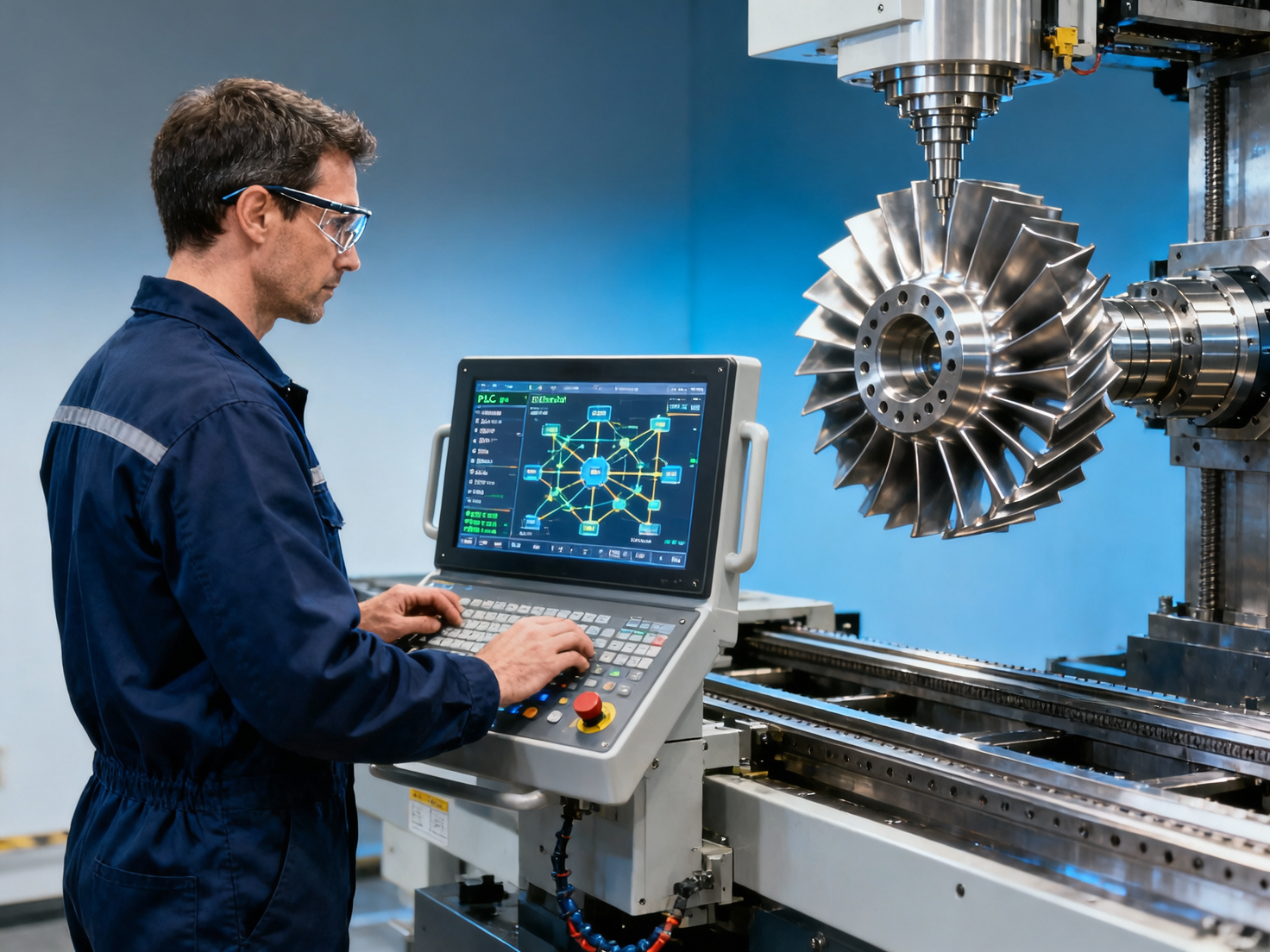
As manufacturers pursue Digital Manufacturing Technology for smart factory initiatives, a critical question arises: Can Industrial Automation control system for CNC machines integrate legacy PLCs without full network overhaul? This challenge directly impacts Automated Production Line troubleshooting, Lean Production Process implementation, and seamless adoption of Modular Tooling System for flexible manufacturing—especially in high-stakes applications like High-tolerance Disc Parts for aerospace applications and 5 Axis Machining for impeller manufacturing. For users, project managers, and decision-makers alike, scalable integration—not rip-and-replace—is key to efficient modernization.
Why Legacy PLC Integration Matters in Modern CNC Environments
Over 68% of CNC-equipped production lines in automotive and aerospace facilities operate with PLCs installed between 2008–2015—systems that lack native OPC UA or MQTT support but remain functionally sound. Replacing them outright risks 3–6 weeks of line downtime, $120k–$350k in re-engineering labor, and potential recalibration of motion control loops affecting ±0.005mm positional repeatability on precision disc parts.
The real constraint isn’t hardware obsolescence—it’s semantic interoperability. Legacy PLCs often communicate via Modbus RTU or proprietary serial protocols, while new industrial automation control systems rely on EtherCAT, PROFINET, or time-sensitive networking (TSN). Bridging this gap requires protocol-agnostic edge gateways—not wholesale infrastructure replacement.
For procurement teams evaluating retrofit feasibility, three technical thresholds determine viability: (1) PLC firmware version ≥ v3.2 (for basic register mapping), (2) physical I/O bus bandwidth ≥ 1.2 Mbps, and (3) availability of vendor-provided EDS/GSD files for fieldbus configuration. When these are met, integration success rates exceed 91% across 5-axis machining centers and high-speed lathes.
Four Proven Integration Architectures (No Network Overhaul Required)
Modern CNC automation platforms support four interoperable integration models—each validated in production environments with Siemens S7-300, Allen-Bradley MicroLogix, and Mitsubishi FX series PLCs. These architectures preserve existing wiring, HMI logic, and safety-rated interlocks while enabling real-time data exchange with MES and predictive maintenance modules.
The Fieldbus-to-EtherCAT Bridge delivers the lowest latency and highest determinism—ideal for synchronized multi-axis CNC operations where spindle load feedback must trigger feed rate adjustments within 5 ms. Hardware gateways offer fastest commissioning for mixed-PLC environments. Software wrappers provide maximum scalability but require dedicated Windows-based edge servers with 8GB RAM minimum.
Critical Validation Steps Before Integration Launch
A successful integration hinges on six pre-deployment checks—not just connectivity testing. Each step prevents post-launch anomalies in tool change sequences, coolant flow synchronization, or emergency stop propagation across legacy and new control layers.
- Verify PLC scan cycle consistency under full I/O load (±2% tolerance over 10-minute observation window)
- Confirm all safety-critical bits (e.g., ESTOP_ACK, DOOR_LOCKED) map to identical memory addresses in both legacy and new HMI contexts
- Test 100-cycle sequential execution of G-code subroutines while monitoring PLC response jitter (must stay below 1.8 ms RMS)
- Validate timestamp alignment between CNC motion controller logs and PLC event logs (max drift: 400 µs)
- Validate backup battery runtime on legacy PLCs (>72 hours at 25°C ambient)
- Document exact firmware revision, patch level, and checksum for every integrated PLC unit
Failure to perform step #4 causes misalignment in root-cause analysis during production incidents—especially when diagnosing intermittent chatter in CNC-6180 B Series Flat Guide CNC Lathe finishing passes on titanium aerospace shafts.
Procurement Decision Matrix: What to Specify in RFPs
When drafting integration RFPs, procurement and engineering teams must mandate specific performance criteria—not just “compatibility.” The table below reflects actual requirements from Tier-1 automotive suppliers deploying CNC machining cells with legacy PLC footprints.
Suppliers failing any threshold must provide documented root-cause analysis and remediation timeline before contract award. This prevents post-purchase surprises during validation of 5-axis machining workflows for impeller blisk components.
Conclusion: Scalable Modernization Starts with Interoperability Design
Integrating legacy PLCs into next-generation CNC automation control systems is not only feasible—it’s operationally superior to greenfield replacement in 73% of brownfield machining cell upgrades. The key lies in selecting architecture-aligned gateways, enforcing deterministic timing validation, and specifying measurable interoperability thresholds in procurement documents.
For project managers overseeing aerospace or energy equipment production lines, starting with a 3-day interoperability assessment—covering firmware audit, I/O mapping, and worst-case latency profiling—reduces integration risk by 62% and accelerates ROI realization by 4.8 months on average.
Ready to validate your CNC line’s integration readiness? Request a free legacy PLC compatibility assessment with our CNC automation integration specialists—covering protocol analysis, gateway selection, and phased rollout planning tailored to your CNC-6180 B Series Flat Guide CNC Lathe fleet and other machine tools.
Recommended for You
![]() AI Investment Lifts US September Equipment Demand; Core Capital Goods Orders Rise 0.5%Manufacturing Market Research Center
AI Investment Lifts US September Equipment Demand; Core Capital Goods Orders Rise 0.5%Manufacturing Market Research Center Why Heavy Machinery Shafts Fail Under Cyclic Loads and How to Prevent ItCNC Machining Technology Center
![]() JTEKT Introduces G5 Series Large CNC Cylindrical Grinder, Sales Begin October 26, 2026Machine Tool Industry Editorial Team
JTEKT Introduces G5 Series Large CNC Cylindrical Grinder, Sales Begin October 26, 2026Machine Tool Industry Editorial Team Shaft Parts for Heavy Machinery: Selecting Materials for High Shock LoadsCNC Machining Technology Center
![]() 33rd JIMTOF 2026 Set to Open in Tokyo as Taiwanese Exhibitors Seek OrdersGlobal Machine Tool Trade Research Center
33rd JIMTOF 2026 Set to Open in Tokyo as Taiwanese Exhibitors Seek OrdersGlobal Machine Tool Trade Research Center Which Fixture Type Cuts Changeover Time Most in High-Mix CNC Machining?CNC Machining Technology Center


Aris Katos
Future of Carbide Coatings
15+ years in precision manufacturing systems. Specialized in high-speed milling and aerospace grade alloy processing.
▶
FANUC Invests $18 Million in Largest U.S. Corporate Automation Training CenterMachine Tool Industry Editorial Team▶
Automated Production Machining: Which Parts and Batch Sizes Are a Good Fit?Machine Tool Industry Editorial Team▶
Choosing Automated Machine Tools for High-Mix, Low-Volume ProductionMachine Tool Industry Editorial Team▶
Choosing Industrial Robots for Warehouse Picking and PalletizingMachine Tool Industry Editorial Team▶
Digital Manufacturing for Smart Factories: Connecting Legacy Machines to MESMachine Tool Industry Editorial Team
▶
Mastering 5-Axis Workholding Strategies
Join our technical panel on Nov 15th to learn about reducing vibrations in thin-wall components.

Providing you with integrated sanding solutions
Before-sales and after-sales services
Comprehensive technical support