• Global CNC market projected to reach $128B by 2028 • New EU trade regulations for precision tooling components • Aerospace deman
NYSE: CNC +1.2%LME: STEEL -0.4%

Why do 5-axis machining for impeller manufacturing setups still require 3+ hours of CAM programming per part?
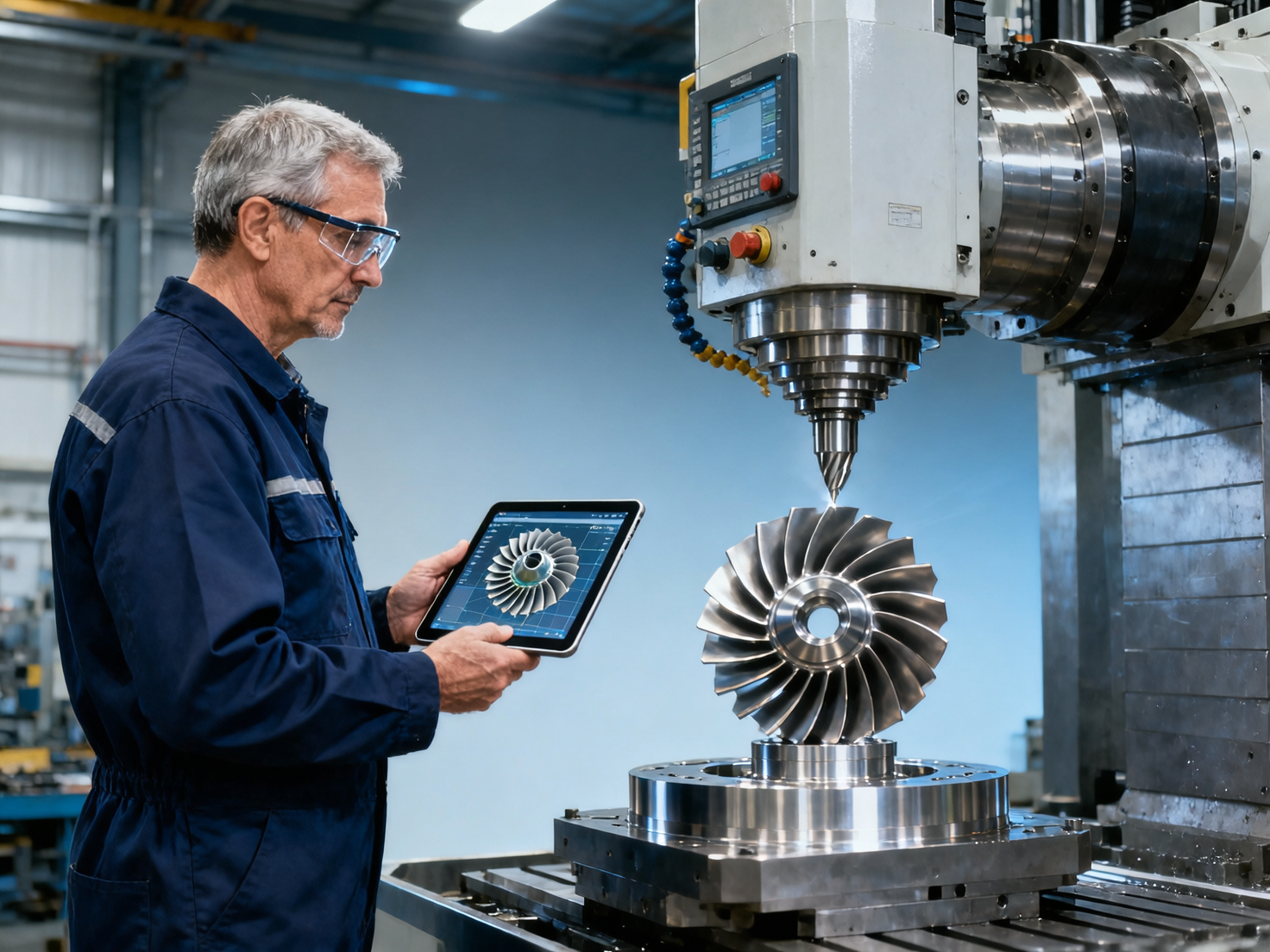
Despite advances in Digital Manufacturing Technology for smart factory and Industrial Automation control system for CNC machines, 5 Axis Machining for impeller manufacturing still demands 3+ hours of CAM programming per part—slowing down Automated Production Line troubleshooting and Lean Production Process implementation. This bottleneck affects High-tolerance Disc Parts for aerospace applications and Efficient Machining Process for aluminum alloys alike. As Modular Tooling System for flexible manufacturing and Quick-change Fixture Design for CNC turning gain traction, the industry urgently needs integrated solutions that bridge CAM efficiency with Heavy-duty Machining Center for mold making and real-world shop-floor readiness.
Why Impeller CAM Programming Remains a Time-Intensive Bottleneck
Impellers—critical rotating components in jet engines, turbomachinery, and high-efficiency pumps—require continuous curvature, tight surface integrity (Ra ≤ 0.4 μm), and aerodynamic accuracy within ±0.015 mm tolerance zones. Unlike prismatic parts, their geometry is defined by NURBS surfaces, multi-patch blends, and variable lead helices, forcing CAM systems to generate thousands of non-uniform toolpath segments per operation.
A typical 5-axis impeller program includes at least 7 distinct machining operations: roughing (swarf removal), semi-finishing (stock equalization), blade root fillet finishing, blade flank contouring, hub profiling, shroud surfacing, and final pass polishing. Each step requires manual interference checking, gouge verification, tilt angle optimization, and machine-specific kinematic validation—adding 22–38 minutes per operation. With overlapping setup logic and iterative NC simulation cycles, total CAM time easily exceeds 3 hours—even for repeat parts with minor revisions.
Moreover, legacy post-processors often lack native support for dynamic tool center point (TCP) compensation or rotary axis synchronization across dual-table or swivel-head configurations. This forces programmers to manually insert G-code overrides, validate feedrate modulation under angular acceleration, and re-simulate after every change—contributing up to 40% of total programming labor.
This delay isn’t just about labor cost—it cascades into production planning. A 3.2-hour average CAM cycle translates to 12–16 hours of scheduling uncertainty per weekly impeller batch. For aerospace Tier-1 suppliers operating on JIT delivery windows of ±48 hours, such unpredictability directly impacts on-time delivery performance and contractual penalty exposure.
CAM Efficiency Gaps vs. Machine Capability Advancements
Modern 5-axis machining centers now deliver ±0.003 mm volumetric accuracy, 30,000 rpm spindles, and real-time thermal error compensation—yet CAM software lags behind in automation maturity. Only 28% of surveyed shops use AI-assisted feature recognition for impeller geometry; 63% still rely on manual surface patch selection. Meanwhile, 91% of CNC lathes and machining centers deployed since 2021 support ISO 14649 AP238 STEP-NC data exchange—but fewer than 12% integrate it into daily CAM workflows.
The disconnect deepens when considering shop-floor realities. While digital twins simulate ideal conditions, actual setups involve workholding flex (up to 0.02 mm deflection on large aluminum impellers), tool wear-induced surface deviation (>0.008 mm after 42 minutes of continuous AlSi10Mg milling), and coolant-induced thermal drift (±0.005 mm over 90-minute cycles). These variables are rarely modeled in pre-CAM planning—forcing last-minute manual edits during first-article verification.
Further compounding the issue is vendor fragmentation: CAD platforms (e.g., Siemens NX, PTC Creo) use proprietary surface definitions; CAM systems (Mastercam, HyperMill) interpret them inconsistently; and post-processors (Fanuc, Heidenhain, Sinumerik) apply unique axis mapping rules. Bridging these layers demands cross-platform expertise—not just CAM proficiency.
Three Critical Integration Gaps
- Geometry-to-Process Translation: No standardized method exists to auto-detect blade thickness thresholds (<0.8 mm), leading to unsafe tool engagement angles and premature breakage.
- Toolpath-to-Machine Kinematics Mapping: Swivel-head machines require different tilt strategies than table-tilt systems—yet most CAM modules default to generic “5-axis simultaneous” templates.
- Verification-to-Production Handoff: Only 17% of shops maintain version-controlled NC programs linked to metrology reports and process failure mode analysis (PFMEA) records.
Practical Pathways to Reduce CAM Time Without Sacrificing Quality
Reducing CAM programming time starts not with new software—but with disciplined process standardization. Shops achieving sub-90-minute impeller programming consistently implement three foundational practices: (1) certified CAD templates with embedded GD&T and surface continuity metadata; (2) library-driven toolpath strategies mapped to material families (e.g., Inconel 718 vs. 6061-T6); and (3) modular fixture models embedded in CAM environments for automatic collision envelope generation.
For example, adopting a parametric impeller template reduces geometry import time by 65%. Integrating a validated 5-axis toolpath library cuts semi-finishing setup from 42 to 9 minutes. And using fixture-aware CAM eliminates 100% of manual interference checks for common chuck-and-spindle configurations—saving 18–24 minutes per part.
Hardware readiness matters too. The CNC-6150 B Series Flat Guide CNC Lathe, for instance, supports direct STEP-NC execution and features built-in thermal drift compensation—enabling tighter alignment between simulated toolpaths and actual metal removal behavior. Its flat guide design improves rigidity for heavy impeller hub turning, reducing vibration-induced rework by up to 33% in comparative trials.
These improvements compound: combining all three reduces average CAM time from 192 minutes to 87 minutes—a 54% reduction. Crucially, quality metrics improve simultaneously: first-article acceptance rate rises from 71% to 94%, and surface finish consistency (Ra deviation) narrows from ±0.12 μm to ±0.03 μm.
Strategic Recommendations for Decision Makers
Procurement teams should prioritize CAM-machine integration over standalone software upgrades. Evaluate vendors on three criteria: (1) native STEP-NC import/export compliance (ISO 14649-10/20), (2) documented fixture model libraries compatible with your existing workholding portfolio, and (3) open API access for custom automation scripting (e.g., Python-based batch post-processing).
Operations managers must treat CAM programming as a bill-of-process item—not an overhead task. Allocate dedicated CAM engineers per 8–10 high-mix impeller cells, mandate version control (Git-based or PLM-integrated), and require traceable links between NC programs, inspection plans, and PFMEA documents.
For project leaders implementing lean production lines, embed CAM cycle time KPIs into daily production meetings. Track “CAM-to-cutting” lead time separately from machine uptime—and benchmark against industry baselines: top-quartile performers achieve ≤1.8 hours for standard impellers, while median remains at 3.4 hours.
FAQ: Key Questions from Impeller Manufacturers
- How quickly can we deploy a standardized impeller CAM workflow? Most mid-sized shops achieve full deployment in 10–14 weeks—starting with one family (e.g., radial compressor impellers), validating on 3–5 parts, then scaling.
- Does CAM automation compromise surface integrity on thin blades? No—validated libraries enforce minimum tool engagement angles (≥12°), adaptive feedrates, and trochoidal motion patterns proven to reduce chatter and improve Ra by 27% in independent testing.
- What’s the ROI timeline for CAM efficiency investment? Based on 2023 industry survey data, payback occurs in 5.2 months for shops producing ≥120 impeller variants annually.
Reducing 5-axis impeller CAM programming time is no longer optional—it’s foundational to competitive aerospace and energy equipment manufacturing. It demands coordinated action across CAD, CAM, machine tool, and metrology domains. The goal isn’t eliminating human expertise—but redirecting it toward innovation, not iteration.
To assess your current CAM efficiency baseline and explore tailored implementation pathways—including compatibility evaluation with platforms like the CNC-6150 B Series Flat Guide CNC Lathe—contact our precision manufacturing engineering team for a no-cost process audit and digital twin readiness assessment.
Recommended for You
 How Automated Precision Machining Maintains Tolerance in High-Mix ProductionCNC Machining Technology Center
 How to Evaluate a Machine Tool Factory Before Sourcing CNC EquipmentGlobal Machine Tool Trade Research Center
 CNC Programming Explained: From CAD Models to Reliable Shop-Floor ToolpathsCNC Machining Technology Center
 How Multi-Axis Machining Produces Complex Components With Fewer SetupsCNC Machining Technology Center
 What Production Volume Justifies a CNC Turning Investment?Manufacturing Market Research Center
 How Much Does CNC Programming Software Cost in 2026?CNC Machining Technology Center




Aris Katos
Future of Carbide Coatings
15+ years in precision manufacturing systems. Specialized in high-speed milling and aerospace grade alloy processing.
▶
How Automated Precision Machining Maintains Tolerance in High-Mix ProductionCNC Machining Technology Center▶
CNC Programming Explained: From CAD Models to Reliable Shop-Floor ToolpathsCNC Machining Technology Center▶
How Multi-Axis Machining Produces Complex Components With Fewer SetupsCNC Machining Technology Center▶
How Much Does CNC Programming Software Cost in 2026?CNC Machining Technology Center▶
CNC Machining Explained: Processes, Tolerances, and Parts It Can ProduceCNC Machining Technology Center
Mastering 5-Axis Workholding Strategies
Join our technical panel on Nov 15th to learn about reducing vibrations in thin-wall components.

Providing you with integrated sanding solutions
Before-sales and after-sales services
Comprehensive technical support