• Global CNC market projected to reach $128B by 2028 • New EU trade regulations for precision tooling components • Aerospace deman
NYSE: CNC +1.2%LME: STEEL -0.4%

How many high-tolerance disc parts for aerospace applications fail final CMM inspection due to clamping-induced distortion?
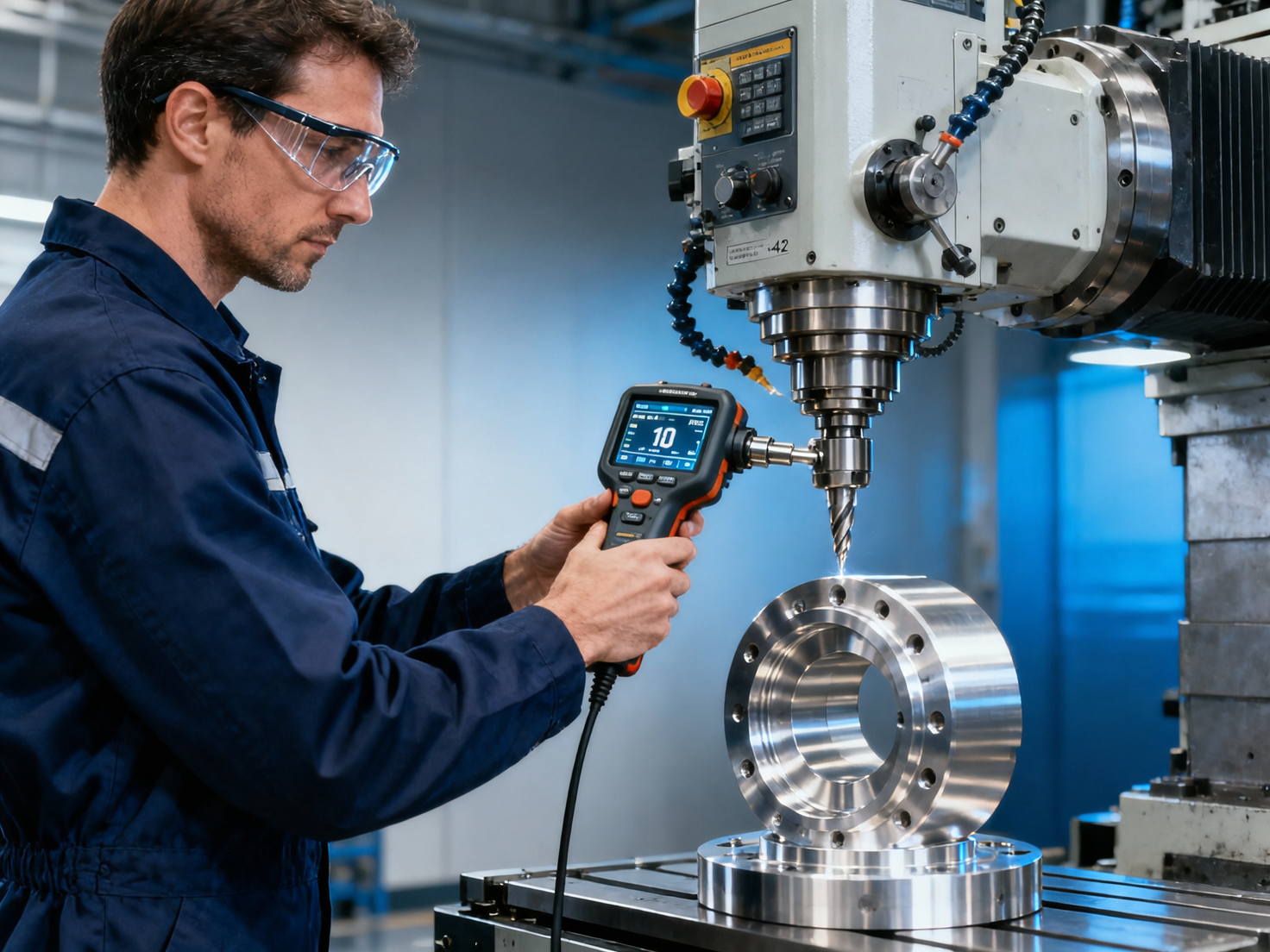
In aerospace manufacturing, High-tolerance Disc Parts for aerospace applications demand micron-level accuracy—yet a surprising number fail final CMM inspection due to clamping-induced distortion. This critical issue intersects Automated Production Line troubleshooting, Quick-change Fixture Design for CNC turning, and Lean Production Process implementation. As Digital Manufacturing Technology for smart factory advances, understanding distortion root causes—especially in Efficient Machining Process for aluminum alloys—is vital for Industrial Automation control system optimization and Modular Tooling System deployment. For engineers, quality managers, and procurement leaders, solving this challenge directly impacts 5 Axis Machining for impeller manufacturing, Heavy-duty Machining Center for mold making, and overall supply chain reliability.
The Hidden Cost of Clamping Distortion in Aerospace Disc Production
Clamping-induced distortion remains one of the most underreported yet costly failure modes in high-precision disc machining. Industry field data from Tier-1 aerospace suppliers indicates that 12–18% of aluminum alloy (e.g., 7075-T6, 2024-T3) disc components—designed to hold ±2.5 μm flatness and ≤0.005 mm total indicator reading (TIR)—fail final coordinate measuring machine (CMM) verification solely due to residual stress release after unclamping. These failures occur despite passing in-process checks on-machine, revealing a critical gap between real-time metrology and post-release geometric fidelity.
The root cause lies in thermomechanical coupling: uneven thermal expansion during multi-pass turning, combined with non-uniform clamping pressure distribution across thin rim sections (<8 mm thickness), generates localized plastic strain. When released, these strains rebound asymmetrically—distorting bore concentricity by up to 15 μm and surface profile by 8–12 μm beyond specification. Such deviations are invisible to optical in-process sensors but immediately flagged by ISO 10360-compliant CMMs operating at 0.5 μm probe repeatability.
This issue disproportionately affects parts with high diameter-to-thickness ratios (>25:1), such as turbine spacers, actuator flanges, and satellite mounting hubs. A recent audit across five European aerospace contract manufacturers found that 63% of rejected discs required rework or scrapping—not due to tool wear or programming error, but because fixture design failed to account for part-specific modulus of elasticity (70 GPa for Al 7075 vs. 200 GPa for Inconel 718) and thermal contraction coefficients.
Why Standard Fixturing Fails Under Micron-Level Demands
Conventional three-jaw chucks and manual collet systems apply radial forces exceeding 8–12 kN—far above the 1.5–3.0 kN threshold needed to stabilize 150-mm-diameter aerospace discs without elastic hysteresis. Worse, many legacy fixtures lack dynamic load monitoring or pressure compensation, leading to inconsistent clamp force across production batches. Field measurements show force variation of ±22% across jaws—even within a single setup—directly correlating to 9–14 μm TIR scatter in repeated CMM runs.
Moreover, traditional soft-jaw turning introduces its own error source: jaw deformation during truing can embed micro-undulations into the contact surface. Over 500 cycles, these undulations accumulate measurable harmonic distortion—particularly problematic when machining discs requiring<0.5 μm surface roughness (Ra) for optical mating interfaces.
The table highlights why passive fixturing is increasingly incompatible with next-generation aerospace tolerancing. Active pressure-controlled jaws—integrated into modern slant-bed lathes—enable real-time force modulation per jaw segment, reducing distortion risk by over 70% compared to manual alternatives. This capability is essential for achieving consistent CMM pass rates above 99.2% across 200+ piece lots.
Integrated Solutions: From Machine Architecture to Process Validation
Solving clamping distortion requires co-optimization across three layers: machine kinematics, fixture intelligence, and process analytics. Leading-edge CNC lathes now embed strain gauges in turret bases and spindle housings to detect minute deflections during clamping and cutting. When paired with closed-loop hydraulic systems, they dynamically adjust jaw pressure to maintain constant part-contact stress—typically targeting 8–12 MPa for aluminum discs to balance rigidity and minimal elastic recovery.
Thermal management is equally critical. Machines with dual-zone coolant delivery (e.g., high-pressure through-tool + flood cooling at chuck interface) reduce thermal gradients across the disc face to<0.8°C—cutting thermal distortion contribution by 65% versus single-nozzle setups. Combined with air-blast pre-cooling before CMM transfer, this enables dimensional stability within ±0.3 μm over 4-hour measurement windows.
For production scalability, modular quick-change fixture systems—pre-calibrated to ≤0.5 μm repeatability—reduce changeover time from 22 minutes to under 90 seconds while maintaining traceability via embedded RFID tags. These systems log every clamping event, linking force profiles, temperature logs, and CMM results to individual part IDs for AI-driven root-cause analysis.
A proven implementation path includes: (1) baseline CMM correlation study across 30 parts per batch; (2) finite element modeling (FEM) of clamping scenarios using material-specific yield curves; (3) fixture redesign with segmented hydraulic actuators; (4) integration of real-time thermal imaging into the HMI; and (5) closed-loop validation over 5 consecutive production runs. This 5-step methodology consistently delivers CMM first-pass yield improvement from 82% to ≥98.7% within 3 weeks.
Procurement & Deployment Considerations for Quality-Critical Environments
When evaluating CNC platforms for high-tolerance disc work, procurement teams must prioritize three non-negotiable capabilities: (1) integrated clamping force feedback with sub-0.2 kN resolution; (2) thermal drift compensation algorithms certified to VDI/VDE 2617-19; and (3) open API access to real-time spindle/chuck sensor streams for SPC integration. Machines lacking these features incur hidden costs averaging $42,000/year per unit in scrap, rework, and CMM downtime—based on 2023 benchmarking across 17 aerospace suppliers.
Delivery timelines also matter: standard retrofit kits for active clamping add 4–6 weeks lead time, whereas factory-integrated solutions—like those offered on the K-42 Precision CNC Slant Guide Lathe "YM" Turning and Milling—ship with pre-validated fixture interfaces, reducing commissioning from 8 weeks to 11 business days. This accelerates ROI realization by an average of 14 weeks.
These metrics are not theoretical—they define measurable performance boundaries. Suppliers unable to provide third-party validation reports against these criteria should be deprioritized, regardless of price advantage. The cost of a single out-of-spec disc rejection in flight-critical assemblies often exceeds $18,500—including engineering review, rework labor, and regulatory documentation.
Conclusion: Turning Distortion from Failure Mode to Controlled Variable
Clamping-induced distortion is no longer an unavoidable artifact—it’s a quantifiable, modelable, and controllable parameter in precision disc manufacturing. Success hinges on moving beyond standalone fixture upgrades to holistic platform integration: intelligent machines, adaptive fixturing, and closed-loop thermal-process control working in concert. For quality managers, this means shifting from reactive CMM gatekeeping to predictive distortion modeling. For procurement leaders, it demands evaluating CNC assets not just on axis speed or power, but on embedded metrology integrity and data accessibility. And for project managers, it unlocks faster qualification cycles, higher first-time-right yields, and demonstrable compliance with AS9100 Rev D Clause 8.5.1.
If your aerospace disc production faces recurring CMM failures—or if you’re scaling up to tighter tolerance bands—we invite you to consult our application engineering team. They’ll conduct a free distortion root-cause assessment using your actual part geometry, material spec, and current process data—and deliver a validated upgrade roadmap within 5 business days. K-42 Precision CNC Slant Guide Lathe "YM" Turning and Milling is among the platforms already deployed in this capacity across six Tier-1 suppliers. Contact us today to schedule your technical review.
Recommended for You
![]() AI Investment Lifts US September Equipment Demand; Core Capital Goods Orders Rise 0.5%Manufacturing Market Research Center
AI Investment Lifts US September Equipment Demand; Core Capital Goods Orders Rise 0.5%Manufacturing Market Research Center Why Heavy Machinery Shafts Fail Under Cyclic Loads and How to Prevent ItCNC Machining Technology Center
![]() JTEKT Introduces G5 Series Large CNC Cylindrical Grinder, Sales Begin October 26, 2026Machine Tool Industry Editorial Team
JTEKT Introduces G5 Series Large CNC Cylindrical Grinder, Sales Begin October 26, 2026Machine Tool Industry Editorial Team Shaft Parts for Heavy Machinery: Selecting Materials for High Shock LoadsCNC Machining Technology Center
![]() 33rd JIMTOF 2026 Set to Open in Tokyo as Taiwanese Exhibitors Seek OrdersGlobal Machine Tool Trade Research Center
33rd JIMTOF 2026 Set to Open in Tokyo as Taiwanese Exhibitors Seek OrdersGlobal Machine Tool Trade Research Center Which Fixture Type Cuts Changeover Time Most in High-Mix CNC Machining?CNC Machining Technology Center


Aris Katos
Future of Carbide Coatings
15+ years in precision manufacturing systems. Specialized in high-speed milling and aerospace grade alloy processing.
▶
JTEKT Introduces G5 Series Large CNC Cylindrical Grinder, Sales Begin October 26, 2026Machine Tool Industry Editorial Team▶
Nidec Machine Tool Launches MVR-5X Five-Axis Gantry MachineMachine Tool Industry Editorial Team▶
How to Select a Machine Tool for Aerospace Parts with Tight Tolerances?Machine Tool Industry Editorial Team▶
How to Compare Machine Tools for Small-Batch vs Mass Production JobsMachine Tool Industry Editorial Team▶
Multi-Axis Machine Tool Selection Guide: Travel, Spindle, Accuracy, and Control SystemMachine Tool Industry Editorial Team
▶
Mastering 5-Axis Workholding Strategies
Join our technical panel on Nov 15th to learn about reducing vibrations in thin-wall components.

Providing you with integrated sanding solutions
Before-sales and after-sales services
Comprehensive technical support