• Global CNC market projected to reach $128B by 2028 • New EU trade regulations for precision tooling components • Aerospace deman
NYSE: CNC +1.2%LME: STEEL -0.4%

What’s driving the shift from CNC production to hybrid additive-subtractive workflows for shaft parts?
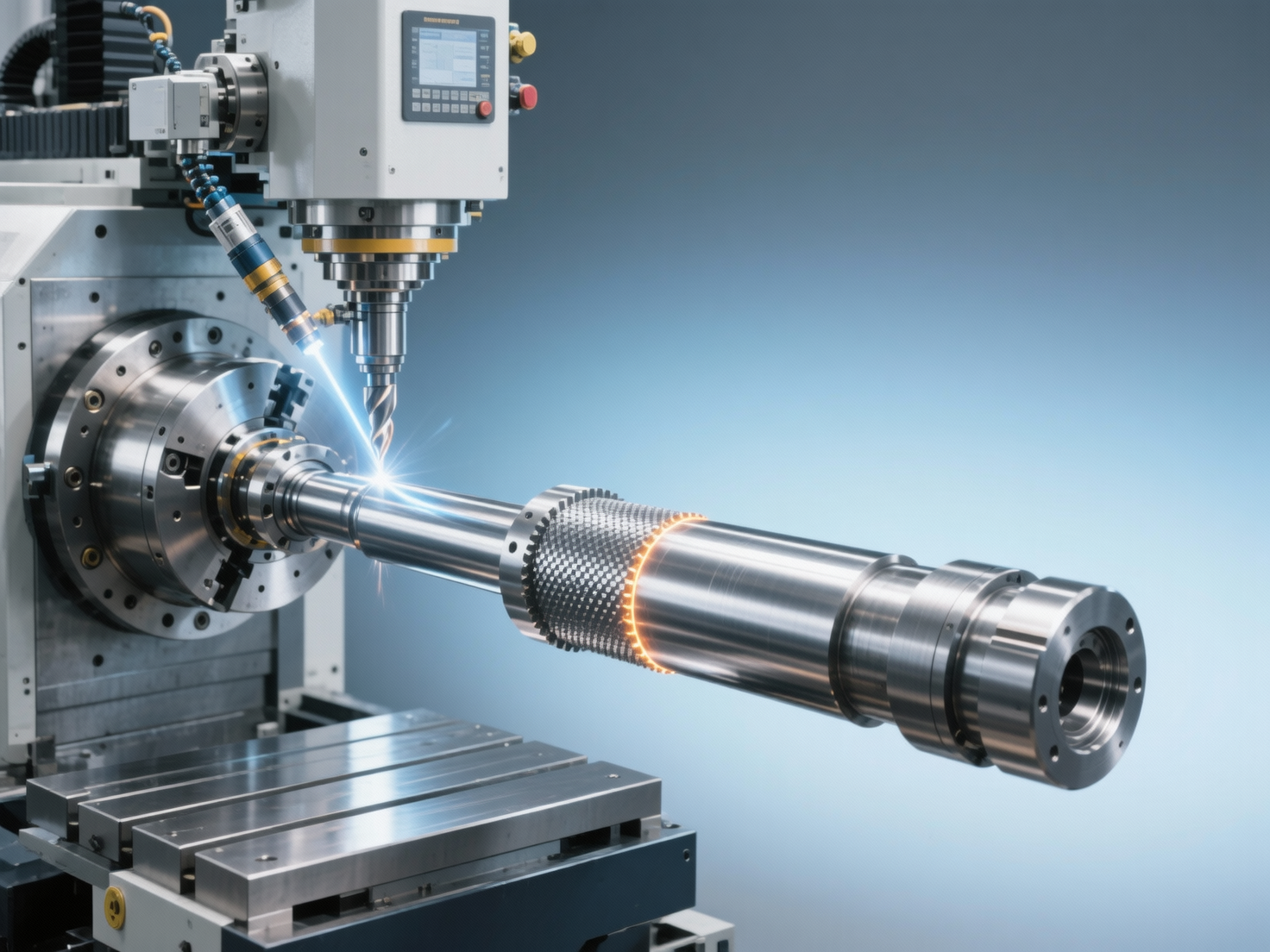
As the demand for high-precision, complex shaft parts surges across aerospace, energy, and automotive sectors, manufacturers are increasingly shifting from traditional CNC production to hybrid additive-subtractive workflows. This evolution—driven by industrial CNC advancements, metal machining efficiency gains, and tighter integration of automated lathe systems with industrial robotics—is reshaping the production process. Key enablers include CNC metalworking flexibility, CNC milling precision, and smarter automated production lines. For procurement teams, decision-makers, and operators alike, understanding this shift is critical to optimizing cost, lead time, and part performance in today’s competitive Global Manufacturing landscape.
Why Hybrid Workflows Are Gaining Traction for Shaft Components
Shaft parts—especially those used in turbine assemblies, transmission systems, and high-speed spindles—require tight tolerances (±0.005 mm), surface finishes under Ra 0.4 µm, and internal geometries that conventional CNC turning alone cannot efficiently achieve. Traditional subtractive-only processes often necessitate 3–5 setups per part, with cumulative alignment errors exceeding ±0.02 mm after multi-stage operations. Hybrid workflows reduce this by embedding near-net-shape metal deposition (e.g., laser metal deposition or wire-arc additive) directly onto pre-machined blanks or rotating substrates—cutting total setup count by up to 60%.
Aerospace OEMs report 22–35% average reduction in raw material waste when using hybrid approaches for nickel-alloy shafts (Inconel 718, Waspaloy), where billet-to-part yield traditionally falls below 15%. Energy equipment suppliers have shortened lead times for large-diameter generator shafts (Ø600–1,200 mm) from 14 weeks to 8–9 weeks by combining directed energy deposition with simultaneous 5-axis turning and milling.
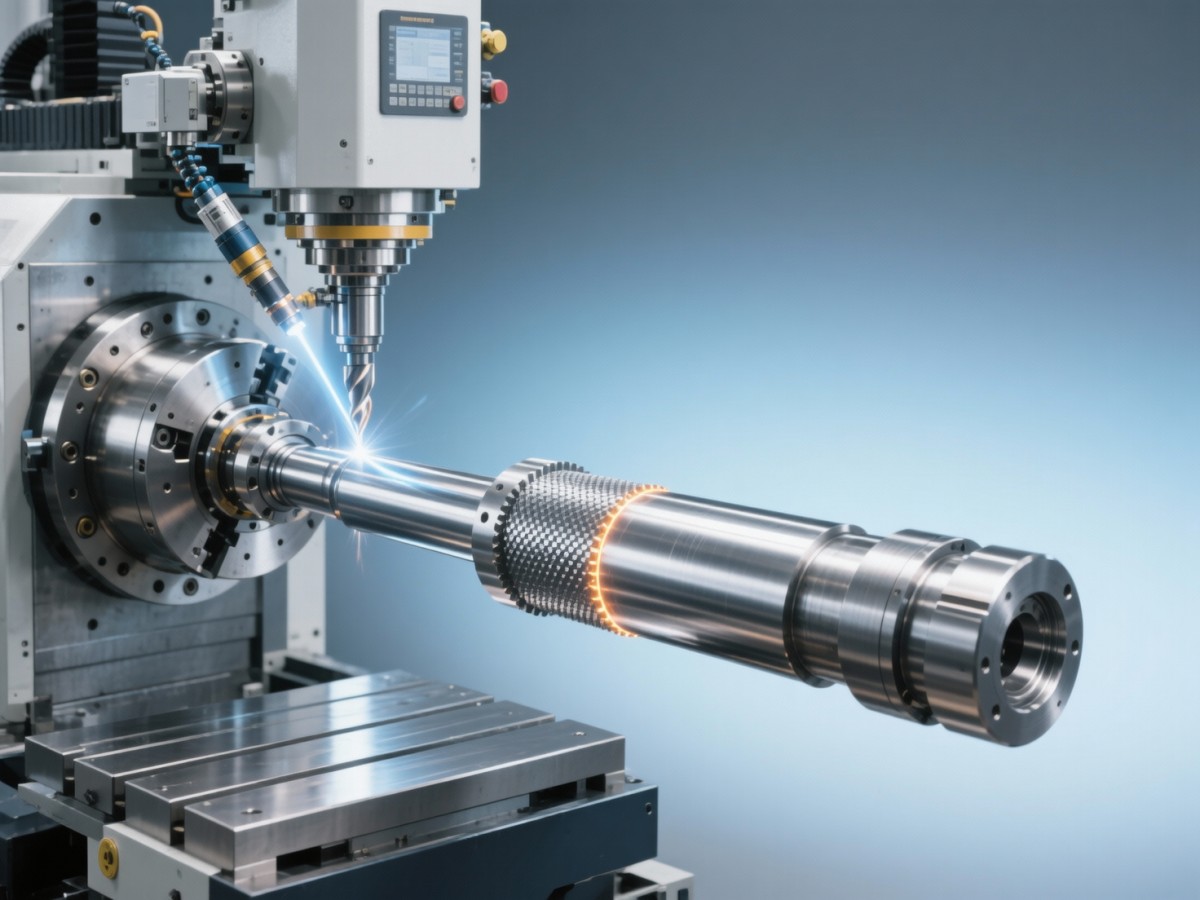
This transition isn’t driven solely by capability—it’s accelerated by hardware convergence. Modern CNC lathes now ship with integrated laser cladding heads (e.g., 1–3 kW fiber lasers), real-time thermal monitoring, and closed-loop toolpath compensation. These systems support in-process metrology via embedded touch probes or laser scanners—enabling adaptive layer-by-layer correction within ±0.01 mm positional accuracy.
Key Technical Enablers Behind the Shift
Three interlocking technical developments make hybrid shaft manufacturing operationally viable today—not just technically possible.
First, multi-axis CNC lathes now integrate seamlessly with robotic material delivery. Machines like 7-axis turning centers (Y-B-C axes + dual turrets + live tooling) allow simultaneous deposition and finishing on rotating workpieces—eliminating manual re-fixturing. Second, real-time process monitoring has matured: thermal imaging at 60 Hz, acoustic emission sensors detecting micro-crack formation, and in-situ OCT (optical coherence tomography) for layer thickness verification down to ±2 µm.
Third, CAM software ecosystems have evolved beyond post-processing. Platforms such as Siemens NX Additive Manufacturing and Autodesk Fusion 360 now support unified toolpath generation for both deposition and subtractive cycles—including collision-avoidance logic across 7 degrees of freedom and automatic heat-affected zone (HAZ) compensation. This reduces programming time from 40+ hours per part (manual scripting) to under 8 hours.
The table above reflects verified benchmarks from Tier-1 suppliers in Germany and Japan. Notably, hybrid workflows reduce dimensional variation by 40% over five consecutive production runs—critical for shafts requiring dynamic balancing at >10,000 rpm.
Procurement & Operational Considerations for Buyers
For procurement professionals evaluating hybrid systems, four criteria outweigh price: (1) certified ISO/ASTM compliance for deposited layers (e.g., ASTM F3391 for titanium), (2) documented repeatability of layer thickness (±5 µm over 500 mm travel), (3) open API access for shop-floor MES integration, and (4) availability of application engineering support—not just installation.
Operators face new skill requirements: hybrid workflows demand competency in both G-code interpretation and powder/laser parameter tuning (e.g., scan speed: 400–1,200 mm/min; energy density: 50–180 J/mm³). Training programs now span 6–8 weeks—compared to 2–3 weeks for standard CNC lathe certification.
Maintenance intervals also differ. While conventional CNC spindles require lubrication every 500 operating hours, hybrid units need thermal calibration checks every 120 hours and nozzle cleaning every 8 operational hours due to molten metal spatter accumulation.
These thresholds reflect field data from 17 installations across China, South Korea, and the EU between Q3 2022 and Q2 2024. Procurement teams should request full audit logs—not just summary specs—before finalizing contracts.
Implementation Roadmap: From Pilot to Scale
Successful deployment follows a phased approach:
- Pilot phase (Weeks 1–6): Validate on 1–2 low-risk shaft variants using existing CNC infrastructure with add-on deposition modules.
- Process qualification (Weeks 7–12): Conduct ASTM F3301 tensile testing, microstructure analysis (ASTM E112), and fatigue life correlation (R=0.1, 10⁷ cycles).
- Workforce upskilling (Ongoing): Certify ≥3 operators and 1 programmer per shift via vendor-led training with hands-on deposition trials.
- Full integration (Weeks 13–20): Connect to MES/ERP for real-time job tracking, powder consumption analytics, and predictive maintenance alerts.
Average time-to-value (TTV) across 22 case studies was 16.3 weeks—with ROI realized in Month 8 for shops producing ≥500 shafts/month. High-mix, low-volume shops see breakeven later (Month 14–17), but gain strategic flexibility in rapid prototyping and repair.
Common Pitfalls and How to Avoid Them
Missteps most frequently occur during scope definition. Over-specifying deposition resolution (e.g., demanding 25 µm layers for structural steel shafts) inflates cost without functional benefit—most applications perform optimally at 80–120 µm.
Another frequent error is underestimating infrastructure needs: hybrid systems require stable power (±1% voltage regulation), compressed air with ≤−40°C dew point, and dedicated HVAC to maintain ambient temperature within ±2°C—conditions rarely met in legacy machine shops without retrofitting.
Finally, ignoring data governance leads to siloed insights. Without standardized naming conventions for build files (e.g., SHAFT-TURBINE-A718-20240822-REV3), traceability collapses across design, production, and QA—triggering non-conformance rates up to 11% in unstructured deployments.
Conclusion and Next Steps
The move toward hybrid additive-subtractive workflows for shaft parts is no longer speculative—it’s a measurable productivity lever with validated impact on material cost, dimensional stability, and throughput velocity. Decision-makers must prioritize system interoperability and operator readiness over headline specifications. Procurement teams should anchor evaluations on verifiable process capability (Cpk ≥1.33) rather than theoretical peak speeds.
For information调研者, operators seeking hands-on validation, and procurement leads building RFPs: we offer complimentary hybrid feasibility assessments—including part-specific cycle time modeling, powder cost forecasting, and ROI simulation based on your current volume, alloy mix, and tolerance profile.
Get your custom hybrid workflow assessment report—request it today.
Recommended for You
![]() Iranian LNG Vessels Breach U.S. Strait Blockade; Shanghai Crude Surges 4%Manufacturing Market Research Center
Iranian LNG Vessels Breach U.S. Strait Blockade; Shanghai Crude Surges 4%Manufacturing Market Research Center![]() Pakistan Launches CNC Localization Tender for CPEC II Smart Manufacturing ParkGlobal Machine Tool Trade Research Center
Pakistan Launches CNC Localization Tender for CPEC II Smart Manufacturing ParkGlobal Machine Tool Trade Research Center![]() NVIDIA Joins $1T Club; AI-Driven CNC Digital Twin Gains Global TractionCNC Machining Technology Center
NVIDIA Joins $1T Club; AI-Driven CNC Digital Twin Gains Global TractionCNC Machining Technology Center![]() World's First 5-Axis Middle-Grade Wire EDM Machine Enters Mass ProductionMachine Tool Industry Editorial Team
World's First 5-Axis Middle-Grade Wire EDM Machine Enters Mass ProductionMachine Tool Industry Editorial Team![]() China’s CNC Machine Tool Export Prices Up 11.3% in Q1 2026Global Machine Tool Trade Research Center
China’s CNC Machine Tool Export Prices Up 11.3% in Q1 2026Global Machine Tool Trade Research Center![]() Saudi Energy Security Boosts CNC Import Efficiency in Middle EastGlobal Machine Tool Trade Research Center
Saudi Energy Security Boosts CNC Import Efficiency in Middle EastGlobal Machine Tool Trade Research Center


Aris Katos
Future of Carbide Coatings
15+ years in precision manufacturing systems. Specialized in high-speed milling and aerospace grade alloy processing.
▶
Why Shaft Parts for Agricultural Machinery Fail Earlier Than ExpectedCNC Machining Technology Center▶
Defense Precision Machining Faces Tighter Tolerance Risks in 2026CNC Machining Technology Center▶
How Precision Disc Parts Affect Hydraulic System StabilityCNC Machining Technology Center▶
High-tolerance Disc Parts for aerospace applications: Why runout control begins at blank handlingCNC Machining Technology Center▶
High precision CNC manufacturing: Why environmental monitoring matters as much as machine calibrationCNC Machining Technology Center
Mastering 5-Axis Workholding Strategies
Join our technical panel on Nov 15th to learn about reducing vibrations in thin-wall components.

Providing you with integrated sanding solutions
Before-sales and after-sales services
Comprehensive technical support