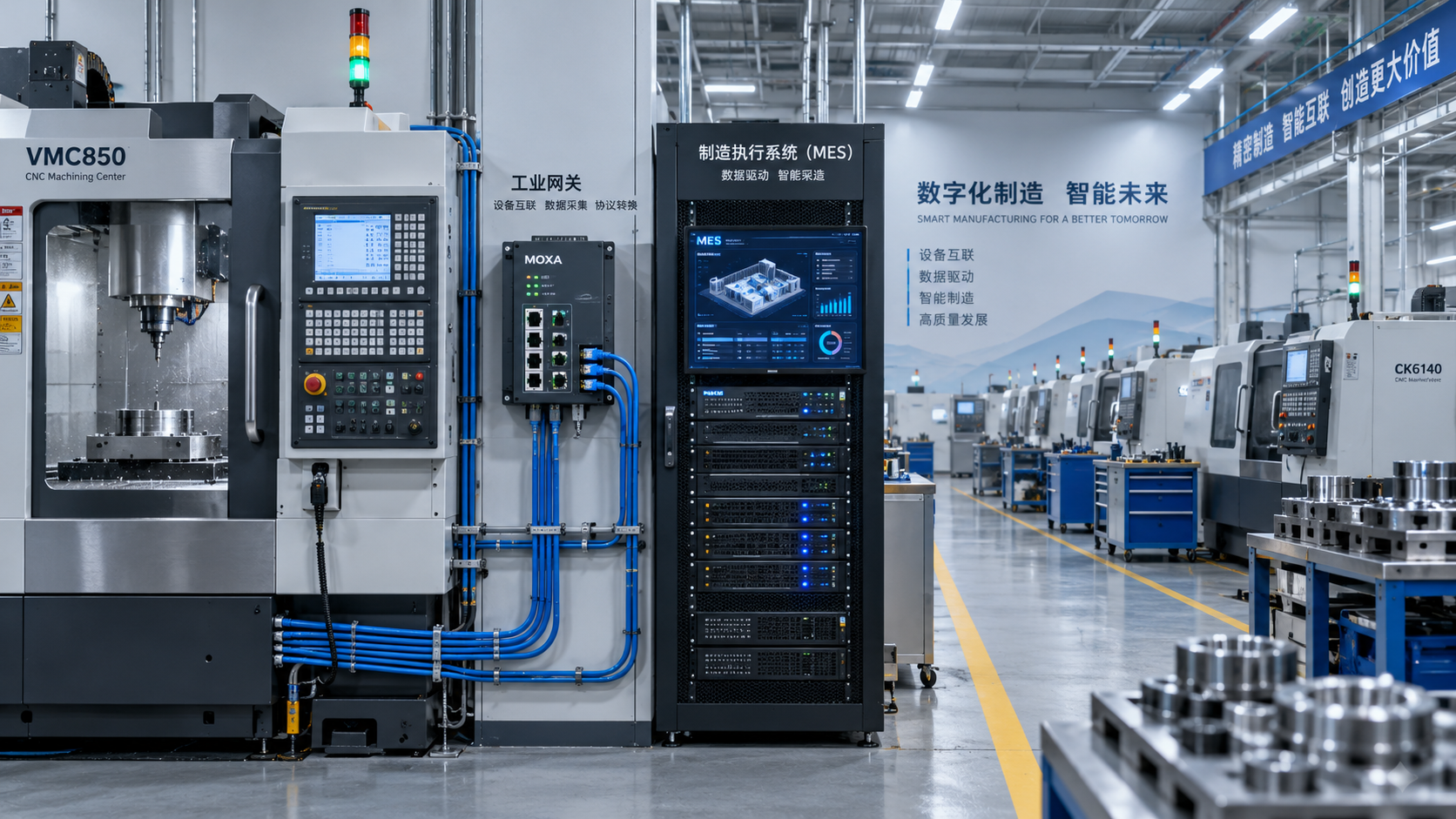
Connecting legacy CNC machines to a manufacturing execution system (MES) can improve production visibility without replacing productive assets, provided integration costs and operational risks remain controlled.
For project leaders, the first decision is which production problem to solve, followed by which machine signals can reliably support that outcome.
Digital Manufacturing Technology for smart factory projects creates value when trustworthy equipment data connects with work orders, operator actions, and decisions that improve production performance.
This article explains how to assess existing equipment, select integration methods, calculate realistic returns, and deploy MES connectivity while protecting cybersecurity and production continuity.
Which Production Problems Justify Connecting Legacy Machines?
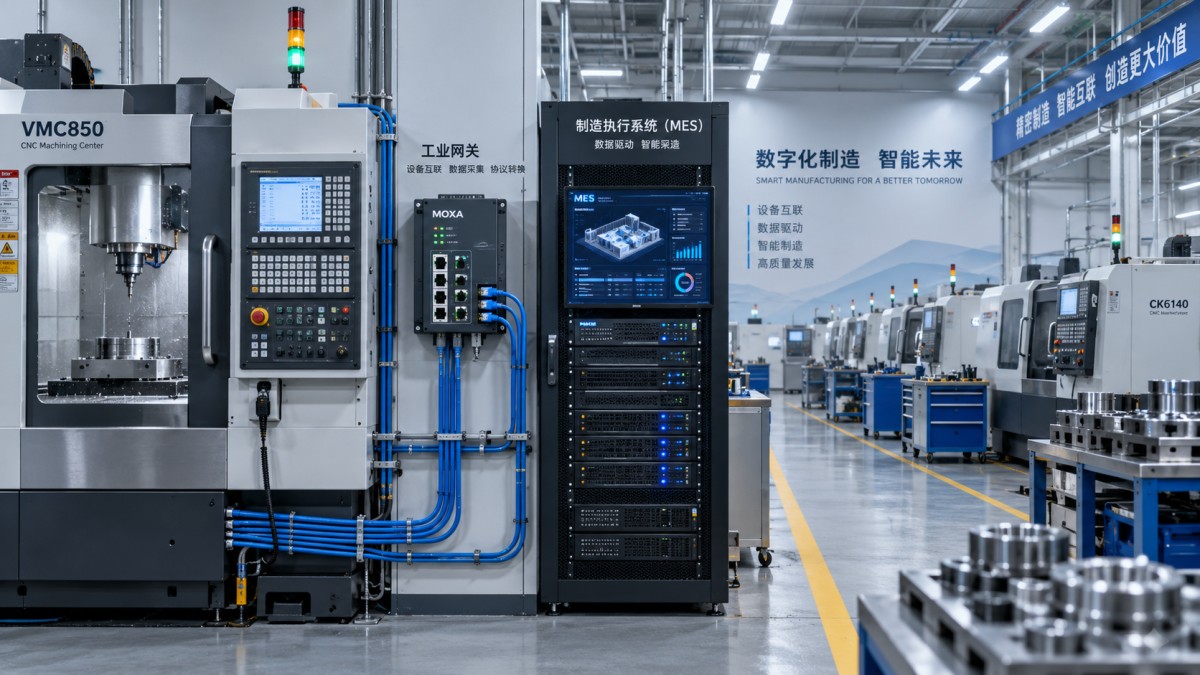
Start with an operational problem that machine connectivity can help resolve: unexplained downtime, unreliable completion estimates, excessive manual reporting, or missing production traceability.
A dashboard showing every spindle is useful only when supervisors can use its information to schedule work, address interruptions, or investigate recurring performance losses.
For a CNC machining department, an effective first objective might be identifying why a bottleneck machining center consistently misses its planned daily output.
That objective requires dependable cycle and downtime information, plus production context. It rarely requires collecting every available controller variable from the entire factory.
Define the intended decision before selecting technology. Specify who receives the information, what action follows, and how the team will measure the result.
Machine monitoring and MES also serve different purposes. Monitoring reveals equipment behavior; MES connects that behavior with production execution, orders, resources, and records.
If supervisors cannot connect machine activity to the correct job, automated monitoring may improve visibility while leaving scheduling accuracy and product traceability largely unchanged.
Prioritize machines by business impact, integration feasibility, and remaining service life. A productive older bottleneck can deserve investment before a newer, underused machine.
What Should the Equipment Assessment Establish Before Procurement?
Build an equipment register covering controller manufacturer, model, software version, available interfaces, network access, existing licenses, maintenance history, and expected remaining operational life.
Record interfaces actually enabled on each machine. An Ethernet port does not prove that production data is accessible, licensed, documented, or supported externally.
Ask the machine builder or controller supplier about supported data access, polling limits, warranty implications, and restrictions affecting changes to the installed control system.
Inspect representative machines directly rather than relying entirely on drawings. Controller replacements, undocumented modifications, and inconsistent software versions often complicate otherwise similar equipment groups.
For each target use case, identify the minimum required signals: operating state, cycle completion, alarm status, part count, and relevant job or program identifiers.
Then assess signal meaning. A controller reporting “running” may indicate program execution while the machine performs positioning, waits for an operator, or cuts material.
Check whether part counters reset, whether one cycle produces multiple components, and whether program names uniquely identify products across different machines and revisions.
Classify each asset as directly connectable, connectable through a gateway, suitable for external sensing, or uneconomic to integrate. Include uncertainties in the project estimate.
Which Connection Method Fits Each Legacy CNC Machine?
The best integration method is usually the least intrusive supported option that delivers sufficiently accurate data for the chosen use case and production environment.
For compatible controllers, native interfaces can expose operating states, alarms, counters, and process variables. Access may depend on controller options, supplier software, or additional licensing.
OPC UA can provide structured industrial data exchange, while MTConnect offers manufacturing equipment information through standardized models. Neither automatically supplies complete MES execution functionality.
Protocol support alone does not guarantee interoperability. Confirm available data items, implementation versions, timestamp behavior, security settings, and compatibility with the proposed MES connector.
Gateways can translate interfaces and buffer events during network interruptions. Evaluate their lifecycle support and replacement arrangements, because an unsupported gateway creates another legacy dependency.
External current sensors or digital inputs may identify broad operating patterns economically. However, power consumption alone cannot reliably distinguish good production from every nonproductive condition.
Where automatic identification remains incomplete, combine machine signals with operator job selection, barcode scanning, and reason codes. Design those interactions around actual shop-floor routines.
Begin with read-only collection wherever practical. Any MES function that downloads programs, changes parameters, or influences operation requires separate validation and clearly controlled authorization.
How Do You Make Machine Data Trustworthy Enough for MES?
Connecting a machine is only the first milestone. Reliable MES integration requires consistent definitions, correct production context, and predictable behavior when data becomes unavailable.
Create a shared state model distinguishing production, setup, planned stops, unplanned stops, and unknown status. Document how each machine’s raw signals map into these categories.
Avoid silently treating missing data as downtime. Lost connectivity, gateway failure, and actual machine stoppage require different responses and should remain distinguishable in reporting.
Associate events with equipment identifiers, work orders, operations, and timestamps. Where necessary, include shifts, operators, material batches, and tooling references to support the agreed scope.
Synchronize clocks and define how buffered events are processed after reconnection. Otherwise, delayed messages can distort sequence, duplicate counts, or attach output to incorrect shifts.
Specify duplicate handling, counter rollover behavior, and job change boundaries. These details matter when machines restart or continue producing during a temporary MES outage.
Validate production counts against physical output and approved records. A cycle completion signal does not necessarily represent one accepted part, particularly with multiple fixtures.
For overall equipment effectiveness, agree planned production time, ideal cycle time, and quality inputs. Connectivity alone cannot make inconsistent OEE definitions comparable across departments.
What Will the Project Cost, and Where Will Returns Come From?
Estimate total ownership cost across the intended operating period. Hardware and software quotations represent only part of the financial commitment required for dependable deployment.
Include controller licenses, gateways, networking, installation, integration engineering, cybersecurity configuration, subscriptions, training, maintenance, and internal staff time. Allow contingency for undocumented equipment differences.
Budget for maintaining connections after controller updates, machine relocation, or MES changes. A connection that works at commissioning still needs an accountable long-term owner.
Establish baseline performance before the pilot starts. Measure reporting effort, downtime, schedule adherence, and output losses using definitions that remain consistent during evaluation.
Separate labor capacity released from cash savings. Reducing manual reporting can free supervisors for production work without immediately reducing payroll or creating equivalent financial returns.
Similarly, recovered machine hours create value only when demand, staffing, tooling, and downstream capacity allow those hours to produce additional saleable output or avoided costs.
As a hypothetical example, recovering 150 bottleneck hours annually at $120 contribution per productive hour creates $18,000 of potential annual value before recurring costs.
If annual support costs total $3,000 and implementation costs $30,000, simple payback is two years, assuming the recovered capacity translates into the projected contribution.
Test conservative, expected, and optimistic scenarios. Make expansion conditional on demonstrated data reliability and operational improvement, rather than an attractive forecast built on unverified assumptions.
How Can You Protect Cybersecurity and Keep Production Running?
Legacy controllers often lack modern security capabilities and may be difficult to patch. Treat connectivity as an architectural change requiring operations and IT collaboration.
Place machines within appropriately segmented operational networks. Permit only necessary communication paths between controllers, gateways, and MES services, with documented ownership of firewall rules.
Avoid direct internet exposure for machine controllers. Where remote supplier access is necessary, use controlled access mechanisms, individual accounts, and logging appropriate to the environment.
Evaluate gateway hardening, credential management, supported updates, and certificate renewal where applicable. Default passwords and unmanaged remote access can undermine an otherwise sound installation.
Confirm that collection frequency and connection counts stay within supported controller limits. Excessive polling may burden older equipment without improving decisions or useful reporting detail.
Schedule electrical work and network changes during approved maintenance windows. Back up relevant configurations and agree restoration steps before altering equipment or production infrastructure.
For a monitoring-only deployment, verify that machines continue operating when MES or connectivity fails. Local buffering should preserve recoverable records within a defined storage limit.
Where MES controls dispatching or execution authorization, define fallback procedures explicitly. Test how operators continue work, record production, and reconcile records after service restoration.
What Should a Phased MES Deployment Look Like?
Select a pilot that includes an operationally important machine and enough controller variety to expose likely integration challenges. An unusually easy demonstration can mislead planning.
Assign named owners for equipment access, data definitions, MES configuration, cybersecurity, and production adoption. Cross-functional ownership prevents interface problems from becoming unresolved departmental handoffs.
Set acceptance criteria before installation. Include agreed count accuracy, event completeness, reporting latency, outage recovery behavior, and the ability to associate activity with jobs.
Run the pilot across normal production conditions, including setup, unattended operation, alarms, shift changes, and rework. Verify reported events against operator observations and production records.
Use pilot findings to refine downtime categories and operator prompts. Excessive manual entry can reduce adoption and compromise data quality even when connectivity works.
Train supervisors to act on the information. Review recurring losses, assign corrective actions, and track results so the system becomes part of daily management.
Expand by equipment family or production area once acceptance criteria are met. Reuse proven configurations while checking differences in controller versions, signals, and operating practices.
Maintain a connection inventory, documented mappings, support contacts, and change procedures. These deliverables make future troubleshooting and upgrades manageable after the implementation team leaves.
When Is Connecting Legacy Machines the Right Investment?
Proceed when existing assets remain productive, accessible signals support a valuable use case, and the organization can maintain both the connection and the operational response.
Consider replacement or a narrower monitoring scope when retrofit costs are disproportionate, essential data remains inaccessible, or equipment reliability already limits its useful service life.
Successful digital manufacturing begins with a measurable production need, trustworthy data, and controlled deployment. Scale MES connectivity when verified improvements justify the next investment.