• Global CNC market projected to reach $128B by 2028 • New EU trade regulations for precision tooling components • Aerospace deman
NYSE: CNC +1.2%LME: STEEL -0.4%

Vertical Lathe vs Horizontal Lathe: Which Fits Large, Heavy Metal Parts Better?

When machining oversized, high-mass metal components, choosing between a vertical lathe and a horizontal lathe directly affects stability, accuracy, and handling efficiency. For technical evaluators, understanding where a vertical lathe offers structural and process advantages is essential to selecting the right solution for demanding industrial applications.
In heavy machining, the decision is rarely about spindle orientation alone. It involves part geometry, load path, floor space, crane handling, tolerance targets, tooling access, and the risk profile of long production cycles. A vertical lathe often becomes the preferred option when workpieces are large in diameter, high in mass, and difficult to clamp safely on a horizontal axis.
For technical evaluation teams in sectors such as energy equipment, aerospace, shipbuilding, rail transit, and industrial machinery, the practical question is straightforward: which machine configuration reduces handling risk while delivering stable accuracy over parts weighing 1 ton, 5 tons, or even 20 tons? This article examines the answer from a structural, process, and procurement perspective.
Why machine orientation matters for large, heavy metal parts
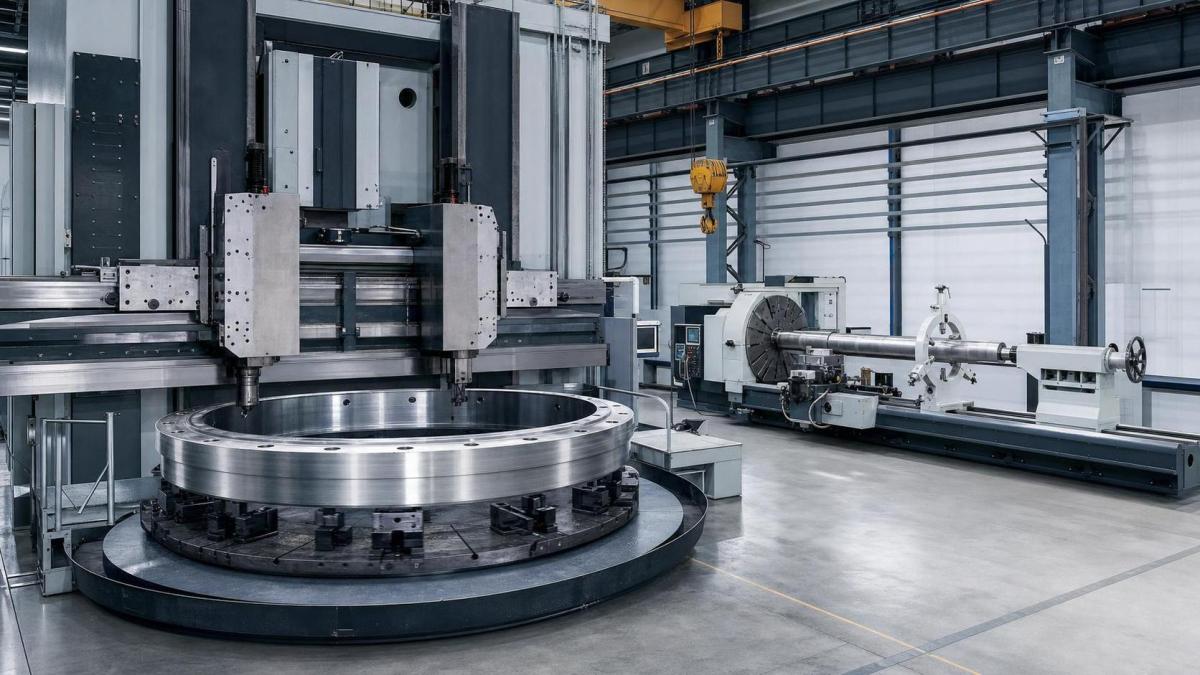
A lathe’s orientation changes how gravity acts on the workpiece, chuck, spindle bearings, and fixture system. In a horizontal lathe, the part mass is cantilevered or supported along a horizontal centerline. In a vertical lathe, the workpiece sits on a table or faceplate, so gravity works with the clamping system rather than against it.
This difference becomes critical when component diameter exceeds 800 mm to 1,200 mm, or when part weight moves above 2 tons. At that scale, setup errors, deflection, and loading complexity can increase sharply. For discs, rings, wheels, valve bodies, bearing races, and turbine casings, a vertical lathe usually offers a more stable mechanical foundation.
Load direction and machine stability
On a vertical lathe, the workpiece load transfers downward into the table structure. This reduces bending stress on the spindle system and helps maintain rotational stability during roughing passes. On a horizontal lathe, especially with very heavy and short parts, the fixture and support arrangement may need more compensation to control runout and sag.
In practical evaluation, this means fewer concerns about imbalance during startup, deceleration, and interrupted cutting. When rough machining forged or cast parts with uneven stock, reducing imbalance is not a minor issue. It directly affects vibration, insert life, and surface consistency across a cycle that may last 2 to 8 hours.
Handling efficiency and shop floor safety
A vertical lathe can simplify part loading because overhead cranes can lower the workpiece directly onto the table. For heavy parts above 3 tons, this often reduces setup steps by 1 to 3 stages compared with aligning a horizontal chucking axis. Less repositioning usually means lower risk of edge damage, clamp misalignment, or operator intervention during loading.
This benefit is especially relevant in smart manufacturing environments where material flow, fixture repeatability, and setup time are measured closely. A reduction of even 20 to 40 minutes per setup can significantly improve equipment utilization over weekly or monthly production planning.
Where horizontal lathes still remain strong
A horizontal lathe is still highly effective for shafts, long cylindrical parts, and components with a length-to-diameter ratio above roughly 2:1 or 3:1. With tailstock support, steady rests, and bar handling options, it is often the more efficient choice for rotational parts that are longer than they are wide.
The evaluation should therefore begin with part family analysis. If the production mix consists mainly of flanges, large rings, brake discs, hubs, and short heavy housings, the vertical lathe deserves serious consideration. If it consists of rotors, rolls, axles, and transmission shafts, a horizontal lathe may remain the better investment.
The table below compares how each machine type performs in core assessment areas for large metal components. It can help technical evaluators align machine selection with part geometry, handling conditions, and process risk.
The key conclusion is not that one design is universally better. It is that a vertical lathe aligns more naturally with heavy, diameter-dominant parts, while a horizontal lathe aligns with length-dominant parts. For technical evaluators, matching orientation to part family is the first filter before reviewing speed, power, or control options.
When a vertical lathe fits better than a horizontal lathe
A vertical lathe is usually the stronger candidate when the workpiece has three characteristics at the same time: high mass, large diameter, and relatively low height. These conditions are common in wind power hubs, valve seats, pump casings, large bearings, flywheels, and energy equipment flanges.
In many factories, once diameter exceeds 1,000 mm and part mass passes 3 to 5 tons, the operational benefits become clearer. Clamp access improves, setup is more intuitive, and the machine can maintain stable contact under heavy roughing loads. These are not only convenience gains; they support predictable process capability.
Typical application scenarios
- Large bearing rings with diameters from 800 mm to 2,500 mm
- Industrial valve bodies and flanges weighing 1 ton to 10 tons
- Turbine casings, sealing rings, and pressure-retaining circular parts
- Rail wheels, brake discs, and heavy hubs requiring concentricity control
- Forged or cast blanks with uneven stock allowance and interrupted cutting zones
Advantages in roughing and finishing
For roughing, a vertical lathe can better tolerate the changing cutting load associated with cast surfaces or flame-cut stock. With the workpiece seated on a rotary table, it is easier to maintain balance and reduce vibration during interrupted cuts. This can help extend insert life and lower the frequency of manual offset correction.
For finishing, the advantage is often dimensional consistency on axial faces and large diameters. If the target includes flatness, parallelism, and concentricity within common industrial ranges such as 0.02 mm to 0.10 mm, machine rigidity and stable support become more important than top spindle speed alone.
Benefits for automated and semi-automated cells
Vertical lathes also integrate well with crane-based handling, robotic tending for smaller heavy parts, and in-process probing systems. In flexible production environments, this can shorten changeover windows and improve first-piece verification. Technical teams evaluating smart factory compatibility should consider not only machining time, but also material flow and intervention frequency.
Common limits and trade-offs
A vertical lathe is not automatically ideal for every large component. Very long parts, parts needing tailstock support over long spans, or jobs requiring extensive shaft work may be less efficient on a vertical machine. Some shops also need to assess ceiling height, crane hook travel, and foundation load before installation.
Another trade-off is process flexibility. If the shop’s production mix changes frequently between long shafts and wide discs, a single machine type may not solve every requirement. In that case, technical evaluators should compare machine utilization over a 12-month mix rather than selecting purely on one flagship part.
Key technical criteria for evaluators comparing machine options
Comparing a vertical lathe with a horizontal lathe requires more than checking swing and spindle power. A sound evaluation should include at least 6 dimensions: maximum part envelope, allowable table or spindle load, clamping concept, required tolerance band, cycle profile, and workshop handling method.
In B2B procurement, selection errors often happen when buyers compare nominal capacity rather than usable capacity. A machine rated for a certain diameter may still be less suitable if fixture height, tool interference, or loading access limits actual production. The points below help convert catalog data into decision-quality criteria.
1. Part envelope and weight distribution
Start with the true machining envelope, not only the raw blank size. Include fixture height, jaw extension, tool clearance, and probing space. A part with a 1,600 mm diameter may require a table larger than 1,800 mm once clamping and safe clearance are included. Weight distribution is equally important if the part has off-center mass or cast asymmetry.
2. Tolerance and surface finish requirements
If the component demands repeatable roundness, face runout, or sealing surface quality, rigidity and thermal stability should be prioritized. Typical targets in heavy industries may range from Ra 1.6 to Ra 3.2 for finish surfaces, with dimensional tolerances from ±0.02 mm to ±0.10 mm depending on the application stage.
3. Cutting profile and material type
Cast iron, carbon steel, alloy steel, stainless steel, and high-temperature alloys create very different cutting loads. Rough stock allowance of 5 mm is not the same as 25 mm. For technical evaluators, torque at low speed often matters more than maximum rpm when judging a vertical lathe for heavy roughing applications.
4. Loading, setup, and changeover time
A machine that saves 15% in cutting time but adds 45 minutes in handling may not be the best choice. Measure total job time from crane pickup to first approved part. In low-volume, high-mix manufacturing, setup and verification can account for 25% to 40% of the full production cycle.
The following table summarizes practical selection criteria that technical evaluators can use when screening machine options for large-part turning projects.
The most useful takeaway is to assess the full process chain instead of focusing on one specification. A vertical lathe can outperform a horizontal lathe not only because of higher stability, but because it reduces hidden losses in setup, support, and heavy-part logistics.
Implementation risks, buying mistakes, and how to avoid them
Technical evaluators are often expected to prevent expensive mismatches before procurement. In large-part turning, the biggest mistakes usually come from underestimating loading constraints, overestimating standard fixtures, or ignoring the real stock condition of cast and forged parts.
Frequent evaluation mistakes
- Choosing by maximum diameter alone without checking usable clamping space
- Ignoring crane path, hook height, and operator access during loading
- Comparing spindle power but not low-speed torque or table rigidity
- Using ideal CAD geometry instead of the actual casting or forging condition
- Failing to calculate total cycle time, including setup and inspection
A practical 5-step evaluation workflow
First, group parts by diameter, height, weight, and annual volume. Second, define critical tolerances and stock removal range. Third, simulate loading and fixture access with crane involvement. Fourth, compare vertical lathe and horizontal lathe options against the same part family. Fifth, validate with sample process planning before final purchase approval.
This 5-step approach is especially useful when the project includes automation, digital inspection, or future capacity expansion. It creates a more reliable basis for capital investment and reduces the risk of buying a machine that fits the brochure better than the production floor.
Maintenance and service considerations
For a vertical lathe, maintenance reviews should cover table bearing condition, lubrication intervals, chip evacuation, thermal management, and geometric inspection frequency. In heavy-duty environments, daily cleaning, weekly lubrication checks, and quarterly geometry verification are common baseline practices, although exact intervals depend on workload and material type.
Service response also matters. If the machine supports critical energy, rail, or process industry production, downtime risk may justify stronger spare-parts planning and remote diagnostics. Technical evaluators should confirm service readiness at the same time they review machine capacity.
FAQ for technical evaluators
Is a vertical lathe always more accurate for large parts?
Not always. Accuracy depends on machine build, thermal behavior, tooling, setup, and process control. However, for short and heavy diameter-dominant parts, the vertical lathe often creates better conditions for stable accuracy because the workpiece is supported more naturally.
At what point should a shop seriously compare a vertical lathe?
A serious comparison usually starts when part diameter approaches 800 mm to 1,200 mm, when weight exceeds 2 to 3 tons, or when loading a horizontal machine becomes complex enough to affect safety and repeatability. The exact threshold depends on part shape and fixture strategy.
Can one vertical lathe replace multiple turning setups?
In some cases, yes. If several heavy disc-type parts share similar diameters and process routes, a vertical lathe may consolidate roughing and finishing into one platform. The result can be fewer handling transfers and lower cumulative error, but this should be verified against the real production mix.
For large, heavy metal parts, the vertical lathe stands out where stability, direct crane loading, and gravity-assisted support improve process security and machining consistency. The horizontal lathe remains essential for long shaft-like workpieces, but for rings, hubs, flanges, casings, and heavy discs, a vertical lathe often delivers the better structural fit.
If you are evaluating machine options for oversized components, focus on actual part family, usable capacity, setup time, and tolerance risk rather than headline specifications alone. To discuss application details, compare configurations, or get a tailored recommendation for your production scenario, contact us today and request a customized solution.
Recommended for You
 Is Learning CNC Programming Worth It for Shop Owners Seeking Higher Margins?CNC Machining Technology Center
 CNC Machine Arrival Inspection: Check Shipping Damage, Accuracy, Safety, and DocumentsCNC Machining Technology Center
 How to Select a Machine Tool for Aerospace Parts with Tight Tolerances?Machine Tool Industry Editorial Team
 How to Select CNC Equipment for High-Mix, Low-Volume ProductionCNC Machining Technology Center
 Can CNC Machining Inconel Control Tool Wear in High-Temperature Aerospace Parts?CNC Machining Technology Center
 Machine Tool Market Outlook: Demand Drivers, Capacity Shifts, and Investment RisksManufacturing Market Research Center

Aris Katos
Future of Carbide Coatings
15+ years in precision manufacturing systems. Specialized in high-speed milling and aerospace grade alloy processing.
▶
When Does CNC Turning Pay Off? A Break-Even Guide by Annual Part VolumeMachine Tool Industry Editorial Team▶
How to Compare CNC Metal Lathe Brands ObjectivelyMachine Tool Industry Editorial Team▶
CNC Lathe Quick Installation Guide: How to Avoid Alignment and Wiring MistakesMachine Tool Industry Editorial Team▶
CNC Lathe Quick Installation Guide: Common Setup Mistakes and How to Avoid ThemMachine Tool Industry Editorial Team▶
CNC Lathe Lead Times Reach 22 WeeksMachine Tool Industry Editorial Team
Mastering 5-Axis Workholding Strategies
Join our technical panel on Nov 15th to learn about reducing vibrations in thin-wall components.

Providing you with integrated sanding solutions
Before-sales and after-sales services
Comprehensive technical support