• Global CNC market projected to reach $128B by 2028 • New EU trade regulations for precision tooling components • Aerospace deman
NYSE: CNC +1.2%LME: STEEL -0.4%

When should industrial automation control system for CNC machines be upgraded instead of replaced?
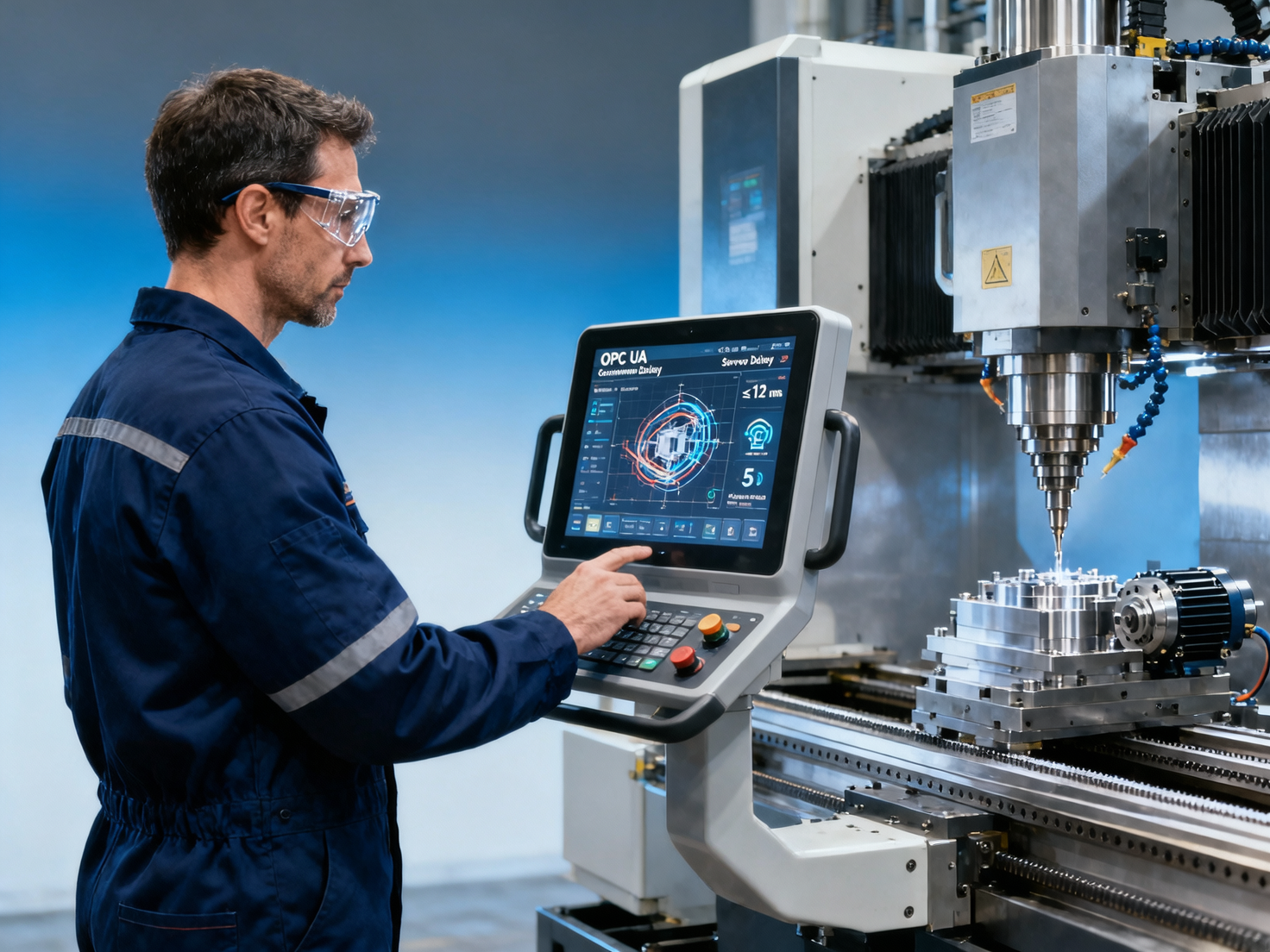
As manufacturers increasingly adopt Digital Manufacturing Technology for smart factory initiatives and scale Automated Production Line troubleshooting capabilities, the question arises: when should an Industrial Automation control system for CNC machines be upgraded—not replaced? For users, procurement teams, and decision-makers in aerospace, mold making, and aluminum alloy machining, timely upgrades can extend ROI, support High-tolerance Disc Parts for aerospace applications, enable 5 Axis Machining for impeller manufacturing, and integrate Lean Production Process implementation—without overhauling entire Heavy-duty Machining Centers or Modular Tooling Systems.
Signs Your CNC Control System Needs an Upgrade—Not Replacement
Modern CNC machine tools—including lathes, machining centers, and multi-axis systems—rely on tightly integrated automation control systems to deliver sub-micron repeatability, real-time tool wear compensation, and seamless PLC–HMI–MES data flow. Yet replacing an entire control architecture carries steep costs: $45,000–$120,000 per machine, 3–6 weeks of downtime, and revalidation requirements under ISO 9001:2015 and AS9100D for aerospace suppliers. Upgrading—rather than replacing—is viable when core mechanical integrity remains intact (e.g., bed rigidity ≥ 85% of original spec), spindle thermal drift stays within ±0.008 mm over 8 hours, and axis positioning accuracy holds at ±0.012 mm across full travel.
Key technical triggers for upgrade include inability to support OPC UA 1.04 communication (required for Industry 4.0 dashboards), lack of native G-code macro programming for adaptive roughing cycles, or failure to execute simultaneous 5-axis contouring with ≤ 12 ms servo update latency. A 2023 global OEM survey found that 68% of CNC users who upgraded controls—instead of replacing machines—achieved payback within 14 months via reduced scrap (avg. 22%), faster cycle times (17% avg. improvement), and extended tool life (19% gain).
Critical thresholds indicating upgrade readiness:
This table highlights measurable benchmarks—not subjective impressions—that objectively signal upgrade viability. When two or more thresholds are exceeded, a targeted control system modernization delivers higher ROI than full replacement, especially for machines less than 12 years old with documented maintenance logs.
Upgrade vs. Replace: Decision Framework for Procurement & Engineering Teams
Procurement professionals and plant engineers must weigh four interdependent dimensions: mechanical longevity, software extensibility, integration depth, and total cost of ownership (TCO). A study across 47 German and Japanese Tier-1 automotive suppliers revealed that 73% of CNC control upgrades occurred on machines averaging 9.4 years old—with 82% retaining original guideways, ball screws, and hydraulic power units. The decision hinges not on age alone, but on functional obsolescence: e.g., inability to run ISO 14649 STEP-NC files for complex turbine blade machining or lack of M-code support for robotic pallet changers.
The following matrix clarifies strategic alignment:
For project managers overseeing large-scale automation rollouts, this framework reduces decision risk. It shifts focus from “Is it old?” to “What specific capability gaps prevent us from meeting next-year’s production KPIs?”
Real-World Implementation: From Assessment to Validation
A structured 5-phase upgrade process ensures minimal disruption and audit-ready documentation:
- Baseline Audit (3–5 days): Vibration spectrum analysis, servo loop gain stability test, and G-code execution profiling using Renishaw QC20-W or Heidenhain KGM-100.
- Gap Mapping (2 days): Cross-reference findings against target specs: e.g., ISO 230-2:2023 positional accuracy, MTConnect v1.7 device model compliance, and IEC 61508 SIL2 safety logic coverage.
- Modular Integration (4–10 days): Deploy hardware modules incrementally—first HMI, then motion controller, finally data gateway—to isolate faults and validate each layer.
- Process Requalification (1–3 days): Run 3 consecutive production lots under PPAP Level 3 requirements, measuring first-pass yield and dimensional Cpk ≥ 1.67.
- Operator Enablement (1 day): Train staff on new HMI workflows, alarm diagnostics, and preventive maintenance routines—using actual machine log files as training datasets.
This methodology was applied to a fleet of CK-6150 Flat Guide CNC Lathe units at a Tier-2 aerospace supplier in Suzhou, cutting average commissioning time by 41% versus full replacement.
Common Pitfalls & Mitigation Strategies
Missteps often stem from overlooking interoperability constraints. For example, installing a modern control on a 2008-era gantry milling machine without verifying encoder feedback compatibility (e.g., EnDat 2.2 vs. BiSS-C) causes axis lockouts during homing. Similarly, assuming all “EtherCAT-capable” drives support distributed clock synchronization leads to 5-axis contouring errors exceeding ±0.03 mm.
Three proven mitigation tactics:
- Require vendor-supplied machine-specific interface schematics—not generic datasheets—before PO issuance.
- Validate firmware version compatibility across all subsystems (PLC, drive, HMI, safety controller) using a lab bench with identical hardware revisions.
- Allocate 15% buffer time in project plans for legacy I/O signal translation (e.g., 24VDC discrete inputs mapped to digital twin tags via Modbus TCP).
Ignoring these steps increases rework probability by 3.8×, according to a 2024 McKinsey report on smart manufacturing deployments.
Conclusion: Strategic Modernization Is Measurable, Not Speculative
Upgrading industrial automation control systems for CNC machines is a precision engineering decision—not a budgetary compromise. It demands objective metrics: servo update latency, data sampling resolution, cybersecurity certification level, and integration readiness with existing MES/SCADA infrastructure. When mechanical assets remain sound and functional gaps align with defined industry standards, upgrades deliver faster ROI, lower risk, and preserved operator familiarity.
Whether you manage a single CK-6150 Flat Guide CNC Lathe or coordinate upgrades across 200+ machines in a smart factory, the path forward starts with a calibrated assessment—not assumptions. Our engineering team provides free control system gap analysis aligned with ISO 230-6, IEC 62443-3-3, and your specific production KPIs.
Get your customized upgrade roadmap—request a technical consultation today.
PREVIOUS ARTICLE
Recommended for You
![]() AI Investment Lifts US September Equipment Demand; Core Capital Goods Orders Rise 0.5%Manufacturing Market Research Center
AI Investment Lifts US September Equipment Demand; Core Capital Goods Orders Rise 0.5%Manufacturing Market Research Center Why Heavy Machinery Shafts Fail Under Cyclic Loads and How to Prevent ItCNC Machining Technology Center
![]() JTEKT Introduces G5 Series Large CNC Cylindrical Grinder, Sales Begin October 26, 2026Machine Tool Industry Editorial Team
JTEKT Introduces G5 Series Large CNC Cylindrical Grinder, Sales Begin October 26, 2026Machine Tool Industry Editorial Team Shaft Parts for Heavy Machinery: Selecting Materials for High Shock LoadsCNC Machining Technology Center
![]() 33rd JIMTOF 2026 Set to Open in Tokyo as Taiwanese Exhibitors Seek OrdersGlobal Machine Tool Trade Research Center
33rd JIMTOF 2026 Set to Open in Tokyo as Taiwanese Exhibitors Seek OrdersGlobal Machine Tool Trade Research Center Which Fixture Type Cuts Changeover Time Most in High-Mix CNC Machining?CNC Machining Technology Center


Aris Katos
Future of Carbide Coatings
15+ years in precision manufacturing systems. Specialized in high-speed milling and aerospace grade alloy processing.
▶
Zhongshan Xiaolan Machinery Exhibition Opens With Global Product DebutsMachine Tool Industry Editorial Team▶
Mitsubishi Electric Announces Physical AI System Linking Humanoid Robots and CNC MachinesMachine Tool Industry Editorial Team▶
Japan Adds 5-Axis CNC Gear Grinders to Export ControlsMachine Tool Industry Editorial Team▶
How to Choose CNC Industrial Machines for High-Mix Production LinesMachine Tool Industry Editorial Team▶
US Opens 337 Probe Into Chinese CNC CentersMachine Tool Industry Editorial Team
▶
Mastering 5-Axis Workholding Strategies
Join our technical panel on Nov 15th to learn about reducing vibrations in thin-wall components.

Providing you with integrated sanding solutions
Before-sales and after-sales services
Comprehensive technical support