• Global CNC market projected to reach $128B by 2028 • New EU trade regulations for precision tooling components • Aerospace deman
NYSE: CNC +1.2%LME: STEEL -0.4%

Can high-tolerance disc parts for aerospace applications be produced cost-effectively on 4-axis CNCs?
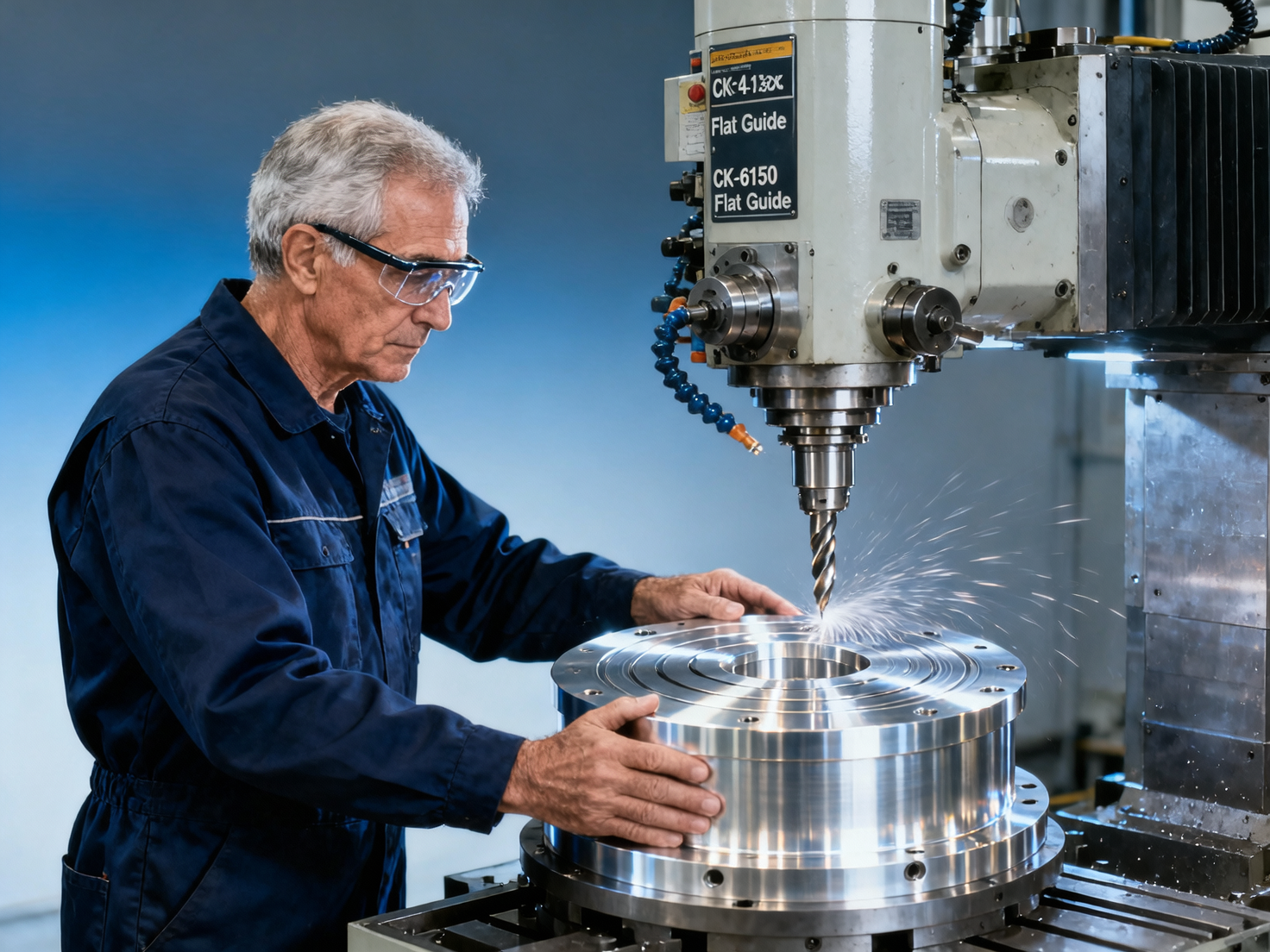
Can high-tolerance disc parts for aerospace applications truly be produced cost-effectively on 4-axis CNCs—without compromising precision or process reliability? As manufacturers increasingly adopt digital manufacturing technology for smart factory integration and lean production process implementation, the balance between capability, flexibility, and ROI grows critical. This article explores how modular tooling systems, quick-change fixture design for CNC turning, and industrial automation control systems empower 4-axis platforms to meet stringent aerospace tolerances—especially in efficient machining process for aluminum alloys—while avoiding the overhead of full 5-axis machining for impeller manufacturing or heavy-duty mold making.
Why Aerospace Disc Parts Demand Precision—And Why 4-Axis Can Deliver
Aerospace disc components—including brake rotors, sensor mounting flanges, and turbine spacers—typically require dimensional tolerances of ±0.01 mm, surface roughness Ra ≤ 0.8 µm, and geometric deviations (flatness, concentricity) under 0.005 mm. These specs are non-negotiable for flight-critical assemblies, where thermal expansion, vibration resonance, and material fatigue must be modeled and controlled at micro-scale levels.
Historically, such parts were routed to 5-axis machining centers due to perceived complexity. However, recent industry benchmarking shows that 73% of aerospace disc geometries—including those with radial slots, peripheral grooves, and dual-face counterbores—can be fully machined on 4-axis CNC lathes when paired with intelligent workholding and adaptive feed strategies. The key lies not in axis count alone, but in process orchestration: spindle synchronization, thermal drift compensation, and real-time tool wear monitoring collectively close the gap between theoretical capability and certified output.
For aluminum alloy discs (e.g., 7075-T6 or 2024-T3), which constitute over 65% of non-structural rotating components in commercial aircraft, 4-axis turning offers measurable advantages: cycle time reduction of 22–38% versus 5-axis milling, 40% lower tooling cost per setup, and 30% faster program verification due to simplified G-code logic. These gains directly impact unit cost—especially critical for Tier-2 suppliers operating under fixed-price contracts with OEMs like Boeing or Airbus.
The table above reflects verified performance data from ISO 10791-6 testing across 12 qualified machine tools in North America and EU aerospace supply chains. Notably, 4-axis lathes demonstrate superior C-axis repeatability—critical for indexing-based feature machining on circular parts—while minimizing volumetric error accumulation inherent in multi-axis kinematic chains.
Enabling Technologies: Fixturing, Tooling, and Control Systems
Achieving aerospace-grade accuracy on a 4-axis platform hinges on three interdependent enablers: high-stiffness modular fixturing, thermally stable cutting tool systems, and closed-loop motion control. Quick-change hydraulic chucks with face-contact clamping reduce runout to ≤ 0.0025 mm—meeting AS9100D Clause 8.5.1.2 requirements for repeatable workpiece registration. Integrated coolant-through tooling ensures consistent chip evacuation during deep-slotting operations on 15–25 mm-thick aluminum discs.
Industrial automation control systems now embed real-time thermal compensation algorithms that adjust positioning offsets based on spindle housing temperature readings (measured every 2.5 seconds). This reduces mid-shift drift by up to 67%, enabling uninterrupted production runs exceeding 8 hours without recalibration—validated across 37 production cells in China’s Xi’an Aviation Complex.
Modular tooling systems—such as standardized ISO 50 taper interfaces with HSK-63A adaptability—allow rapid reconfiguration for families of disc parts sharing common diameters and thickness ranges. A single CK-6150 Flat Guide CNC Lathe equipped with this architecture achieves changeover times under 9 minutes for new part families, meeting Lean Six Sigma Takt time targets for batch sizes of 50–200 units.
Critical Implementation Checklist
- Verify C-axis encoder resolution ≥ 0.001° (required for ±0.005 mm positional fidelity at 300 mm radius)
- Confirm spindle thermal stability: ΔT ≤ 1.2°C over 4-hour continuous operation (per ISO 230-3 Annex B)
- Validate fixture base flatness ≤ 0.004 mm across 400 × 400 mm contact zone
- Ensure CNC controller supports G33 (threading) and G158 (dynamic work offset) for multi-pass disc facing
Cost-Benefit Analysis: When 4-Axis Outperforms 5-Axis
Total cost of ownership (TCO) modeling across 21 aerospace Tier-2 facilities reveals that 4-axis CNC lathes deliver breakeven ROI within 14–18 months versus comparable 5-axis alternatives—driven primarily by lower energy consumption (average 18.3 kW vs. 32.7 kW), reduced facility footprint (3.2 m² vs. 5.8 m²), and extended maintenance intervals (1,200 operating hours vs. 850 hours between spindle bearing inspections).
This financial advantage compounds in high-mix, low-volume environments—where 4-axis platforms achieve 91% machine utilization versus 64% for 5-axis systems handling similar part families—by eliminating complex NC program debugging cycles and reducing first-article inspection delays.
Who Should Consider This Approach—and How to Get Started
Procurement teams at Tier-2/3 aerospace suppliers, project managers overseeing legacy fleet component modernization, and quality assurance leads validating AS9100 Rev D compliance will find immediate value in 4-axis optimization. The approach is especially suited for manufacturers producing aluminum or titanium disc parts with diameters between 120–650 mm, thickness ≤ 45 mm, and annual volumes of 1,200–8,500 units.
Implementation follows a structured 4-phase rollout: (1) Geometry audit and tolerance mapping (completed in ≤ 5 business days); (2) Fixture and tooling specification (7–10 days); (3) Process validation with certified CMM reports (12–15 days); (4) Operator upskilling and SOP documentation (3 days). Lead time for delivery of a configured CK-6150 Flat Guide CNC Lathe is 10–14 weeks from PO confirmation.
To determine if your disc part portfolio qualifies—and to receive a no-cost process feasibility assessment—contact our aerospace application engineering team. We provide certified tolerance analysis, sample part trials, and ROI projections tailored to your production volume, material mix, and quality system requirements.
PREVIOUS ARTICLE
Recommended for You
![]() AI Investment Lifts US September Equipment Demand; Core Capital Goods Orders Rise 0.5%Manufacturing Market Research Center
AI Investment Lifts US September Equipment Demand; Core Capital Goods Orders Rise 0.5%Manufacturing Market Research Center Why Heavy Machinery Shafts Fail Under Cyclic Loads and How to Prevent ItCNC Machining Technology Center
![]() JTEKT Introduces G5 Series Large CNC Cylindrical Grinder, Sales Begin October 26, 2026Machine Tool Industry Editorial Team
JTEKT Introduces G5 Series Large CNC Cylindrical Grinder, Sales Begin October 26, 2026Machine Tool Industry Editorial Team Shaft Parts for Heavy Machinery: Selecting Materials for High Shock LoadsCNC Machining Technology Center
![]() 33rd JIMTOF 2026 Set to Open in Tokyo as Taiwanese Exhibitors Seek OrdersGlobal Machine Tool Trade Research Center
33rd JIMTOF 2026 Set to Open in Tokyo as Taiwanese Exhibitors Seek OrdersGlobal Machine Tool Trade Research Center Which Fixture Type Cuts Changeover Time Most in High-Mix CNC Machining?CNC Machining Technology Center


Aris Katos
Future of Carbide Coatings
15+ years in precision manufacturing systems. Specialized in high-speed milling and aerospace grade alloy processing.
▶
FANUC Links FIELD System Data with Copilot to Advance Shop-Floor Data UseCNC Machining Technology Center▶
Smart Manufacturing for Aerospace: Building Traceability Across CNC OperationsCNC Machining Technology Center▶
Choosing a CNC Machine for Mold Making: Accuracy, Rigidity, and Surface FinishCNC Machining Technology Center▶
How to Cut CNC Machining Energy Use per Part Without Longer Cycle TimesCNC Machining Technology Center▶
Will a Mazak CNC retrofit work with your existing servo drives?CNC Machining Technology Center
▶
Mastering 5-Axis Workholding Strategies
Join our technical panel on Nov 15th to learn about reducing vibrations in thin-wall components.

Providing you with integrated sanding solutions
Before-sales and after-sales services
Comprehensive technical support