• Global CNC market projected to reach $128B by 2028 • New EU trade regulations for precision tooling components • Aerospace deman
NYSE: CNC +1.2%LME: STEEL -0.4%

Choosing Automated Machine Tools for High-Mix, Low-Volume Production
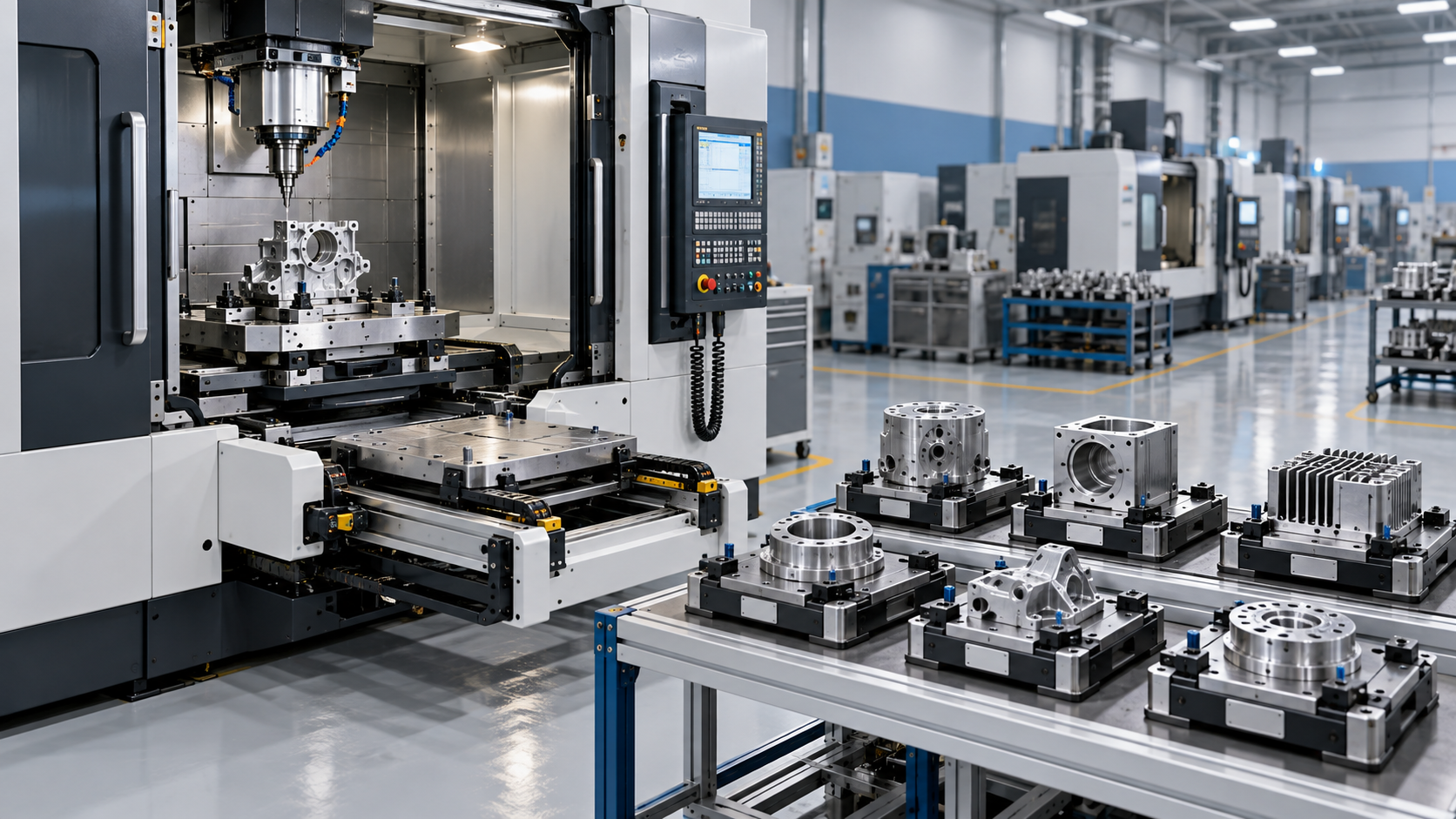
A machining cell can finish each part quickly and still miss delivery targets when every new order requires different jaws, fresh offsets, another program prove-out, and first-piece inspection. In high-mix, low-volume production, these interruptions can consume more capacity than cutting time. Choosing automated machine tools therefore starts with reducing the work between batches, not simply selecting the fastest spindle or adding a robot.
The strongest configuration is usually the least complex system that can process representative part families with repeatable setups, manageable programming effort, and reliable exception recovery. Compare candidates on total time to produce an accepted batch, including preparation and inspection. Then verify that their workholding, tool capacity, material handling, and software can accommodate the expected production mix without frequent engineering intervention.
Define the production mix before comparing machines
A maximum part envelope and a list of materials are not enough to specify an automated cell. Two components that fit the same machine may need entirely different automation: one can be gripped from bar stock, while another needs a dedicated nest and several orientation changes.
Build a representative evaluation set from current orders and credible upcoming work. Include repeat runners, difficult geometries, delicate parts, and jobs that change frequently. Group them by manufacturing requirements rather than customer or drawing number.
- Geometry and access: rotational or prismatic features, machining faces, deep cavities, and restricted tool approach angles.
- Stock condition: bar, saw-cut billet, casting, or forging, including variation that affects locating and gripping.
- Quality requirements: critical tolerances, datum relationships, surface finish, and inspection access.
- Production behavior: batch sizes, repeat frequency, schedule changes, and the availability of proven programs.
- Handling constraints: part mass, sharp edges, cosmetic surfaces, residual coolant, and finished-part separation.
Use these families to distinguish mandatory capabilities from occasional exceptions. A rare oversized component should not automatically determine the size of every machine. Compare the cost of accommodating that exception against routing it elsewhere or retaining a separate process.
Match the automation architecture to the setup burden
Automation pays off differently depending on what currently stops production. A robot addresses repeated loading, but it does little for lengthy fixture alignment or unavailable programs. A pallet system can move setup work outside the machine, but only when fixtures and job preparation are ready before the active pallet finishes.
A flexible manual-loading arrangement may outperform a robot cell when each batch needs a new gripping solution. Conversely, stable part families with frequent repeat orders can justify automated loading even when individual batches are small. The relevant question is how much preparation can be reused across orders, not whether a batch exceeds an arbitrary quantity.
Measure changeover from the last good part to the next
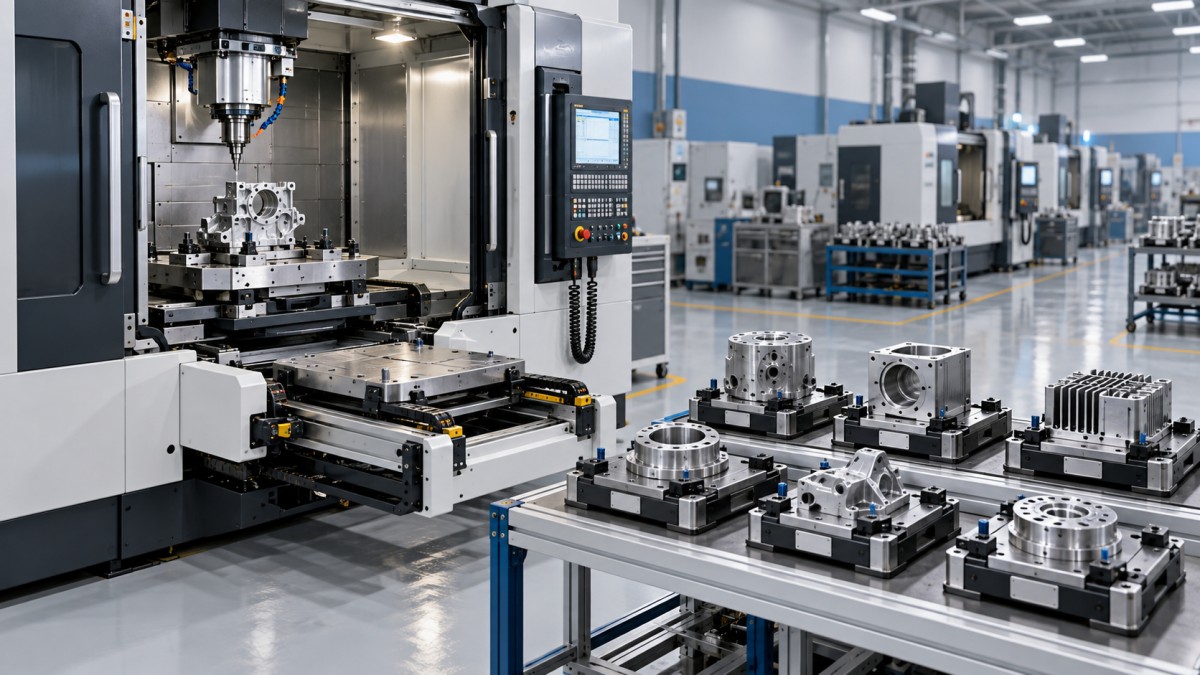
Published tool-change and pallet-exchange times describe individual machine actions. They do not show how long production stops when switching jobs. Measure changeover from the final accepted part of one job to the first accepted part of the next, and record which tasks require the machine to remain idle.
Separate external preparation from internal setup. Fixture assembly, tool presetting, program verification, and material staging should happen outside the machine wherever practical. Compare quick-change interfaces by their locating repeatability, contamination sensitivity, clamping confirmation, and accessibility—not just their release speed.
Workholding deserves particular scrutiny. Standardized base interfaces can reduce alignment work, but the complete fixture stack must still provide adequate stiffness, tool access, chip clearance, and holding force. A compact vise that helps loading may leave thin walls unsupported; a large fixture may block the rotary travel needed for five-axis machining.
Ask suppliers to demonstrate a change between dissimilar representative jobs. Include a fixture exchange, tool-data transfer, program selection, offset verification, and first-piece approval. A demonstration that starts with every fixture installed and every tool loaded avoids the work most likely to limit a high-mix operation.
Programming capacity can become the bottleneck
Machine flexibility has little value if engineering cannot release work quickly enough. Evaluate the path from the current CAD model to a controlled, proven machining program. Check CAM compatibility, postprocessor support, tool-library management, and revision control across both CNC and robot programs.
Simulation should represent the actual machine configuration, fixtures, holders, and relevant stock. Toolpath verification alone does not establish that a rotary axis can reach a position without interference. Changes to workholding or tool length must reach the simulation model rather than remaining informal shop-floor adjustments.
Test a repeat order as well as a new part
A new-part trial reveals programming effort; a repeat-order trial reveals whether the system preserves manufacturing knowledge. Confirm that operators can retrieve the approved program, setup instructions, fixture identity, tool requirements, and inspection plan without reconstructing the process.
Robot recipes need the same discipline. A part-number change may affect grip position, jaw selection, loading orientation, and unloading location. Where identification is automated, verify the response to an unreadable identifier or a mismatch between the selected job and installed fixture.
Qualify unattended running as a process, not a feature
Automatic loading does not establish unattended capability. The cell must cope with tool wear, chip accumulation, coolant changes, and stock variation for the intended operating window. Determine what can stop the process, what can damage a part or machine, and which conditions the control can reliably detect.
Tool capacity should cover the scheduled mix, sister tools where justified, and realistic tool-life variation. A large magazine is less useful when oversized tools consume adjacent pockets or long tools restrict available positions. Check usable capacity with the proposed tooling package rather than relying on the headline pocket count.
- Chips and coolant: examine evacuation from pockets, fixture interfaces, grippers, and locating surfaces over a sustained run.
- Tool monitoring: confirm what breakage or load monitoring can detect and which failure modes may remain unnoticed.
- Part handling: verify grip confirmation, part seating, finished-part capacity, and management of rejected or suspect parts.
- Recovery: establish whether a stopped cycle can resume safely or requires re-datuming, inspection, or program restart.
Machine probing can support datum setting, seating checks, and selected in-process measurements. It does not automatically replace independent inspection: shared thermal or geometric errors can affect both machining and on-machine measurement. Define which characteristics probing controls and which require separate verification.
Evaluate thermal behavior under the planned schedule, especially when materials, spindle duty, or idle periods vary. Accuracy demonstrated on a warmed machine running one component may not represent a mixed queue after an extended stop.
Check integration at the points where failures occur
An interface specification should describe behavior, not simply state that equipment is “automation-ready.” Establish how the CNC, robot, pallet controller, inspection equipment, and production software exchange job status and permissions. Signals such as door closed, chuck clamped, fixture pressure valid, and cycle complete need clear ownership and fault responses.
Scheduling software must account for actual readiness. A queued job should not start unless its fixture, material, tools, and approved program are available. Also check whether operators can insert an urgent order without losing the state of interrupted work or creating tool and pallet conflicts.
Safety assessment must cover the integrated cell, including loading stations, access for maintenance, and recovery tasks. A collaborative robot is not automatically safe for every machining application; sharp workpieces, grippers, payload, and surrounding equipment affect the required protective measures. Assign responsibility for integration, validation, documentation, and later modifications before purchase.
Compare cost per accepted batch, not purchase price alone
Build the economic comparison around the expected order mix. Include the machine, automation, fixtures, tooling, software, integration, training, floor space, maintenance, and commissioning effort. Recurring costs should include program preparation, changeover labor, inspection, consumables, and support.
A useful comparison is allocated ownership cost plus operating, setup, programming, inspection, and expected quality costs, divided by accepted parts. Use consistent allocation assumptions across candidates. For small batches, setup and programming can dominate; for repeat work, reusable fixtures and proven programs can change the result substantially.
Keep labor attendance separate from machine running time. One operator may support several machines only when loading frequency, walking distance, inspection duties, and fault rates permit it. Do not treat every unattended spindle hour as an equal hour of labor savings.
Test the business case against a less favorable mix: fewer repeat orders, shorter runs, more difficult materials, or reduced unattended availability. A configuration that depends on continuously full pallets and minimal engineering changes may be poorly matched to volatile demand.
Make acceptance trials reflect the work you intend to run
Use the same representative parts and evaluation rules for shortlisted systems. Agree on tooling, stock, inspection methods, setup boundaries, and operator involvement before the trial. Record interventions and rejected parts alongside cycle times; otherwise, a fast demonstration can conceal substantial support effort.
- Run a difficult representative part and verify critical dimensions with the agreed inspection method.
- Change to another part family, recording elapsed time, labor, and first-piece approval requirements.
- Demonstrate scheduling and recovery from representative interruptions under controlled, safe conditions.
- Run long enough to assess relevant thermal, chip-management, tool-life, and output-storage constraints.
- Confirm that supplied documentation allows trained staff to repeat the process without supplier intervention.
Set acceptance criteria around your production constraints rather than a universal utilization target. A system may need to meet a defined changeover window, maintain specified characteristics across job transitions, or recover from a loading fault without losing traceability. If a candidate only performs well after excluding the parts or interruptions that characterize your workload, narrow its intended role—or choose a less elaborate configuration with a more repeatable process.
PREVIOUS ARTICLE
NEXT ARTICLE
Recommended for You
![]() Mitsubishi Electric Announces Physical AI System Linking Humanoid Robots and CNC MachinesMachine Tool Industry Editorial Team
 Precision Machining for Defense: Supplier Quality and Traceability ChecksManufacturing Market Research Center
![]() Nidec Machine Tool Launches MVR-5X Five-Axis Gantry MachineMachine Tool Industry Editorial Team
 Choosing a Precision Disc Parts Manufacturer in China: Tolerances and Quality ChecksManufacturing Market Research Center
![]() Siemens Executive Says AI Could Raise Factory Automation to 80%Manufacturing Market Research Center
 Choosing Automated Machine Tools for High-Mix, Low-Volume ProductionMachine Tool Industry Editorial Team


Aris Katos
Future of Carbide Coatings
15+ years in precision manufacturing systems. Specialized in high-speed milling and aerospace grade alloy processing.
▶
Choosing Automated Machine Tools for High-Mix, Low-Volume ProductionMachine Tool Industry Editorial Team▶
Choosing Industrial Robots for Warehouse Picking and PalletizingMachine Tool Industry Editorial Team▶
Digital Manufacturing for Smart Factories: Connecting Legacy Machines to MESMachine Tool Industry Editorial Team▶
Selecting Machine Tools for Automotive Parts: Accuracy, Throughput, and AutomationMachine Tool Industry Editorial Team▶
Smart Manufacturing for Small Businesses: Where Automation Delivers the Fastest ROIMachine Tool Industry Editorial Team
▶
Mastering 5-Axis Workholding Strategies
Join our technical panel on Nov 15th to learn about reducing vibrations in thin-wall components.

Providing you with integrated sanding solutions
Before-sales and after-sales services
Comprehensive technical support