• Global CNC market projected to reach $128B by 2028 • New EU trade regulations for precision tooling components • Aerospace deman
NYSE: CNC +1.2%LME: STEEL -0.4%

How lean production process implementation reshapes operator roles in CNC machine shops — case studies from Japan and Mexico
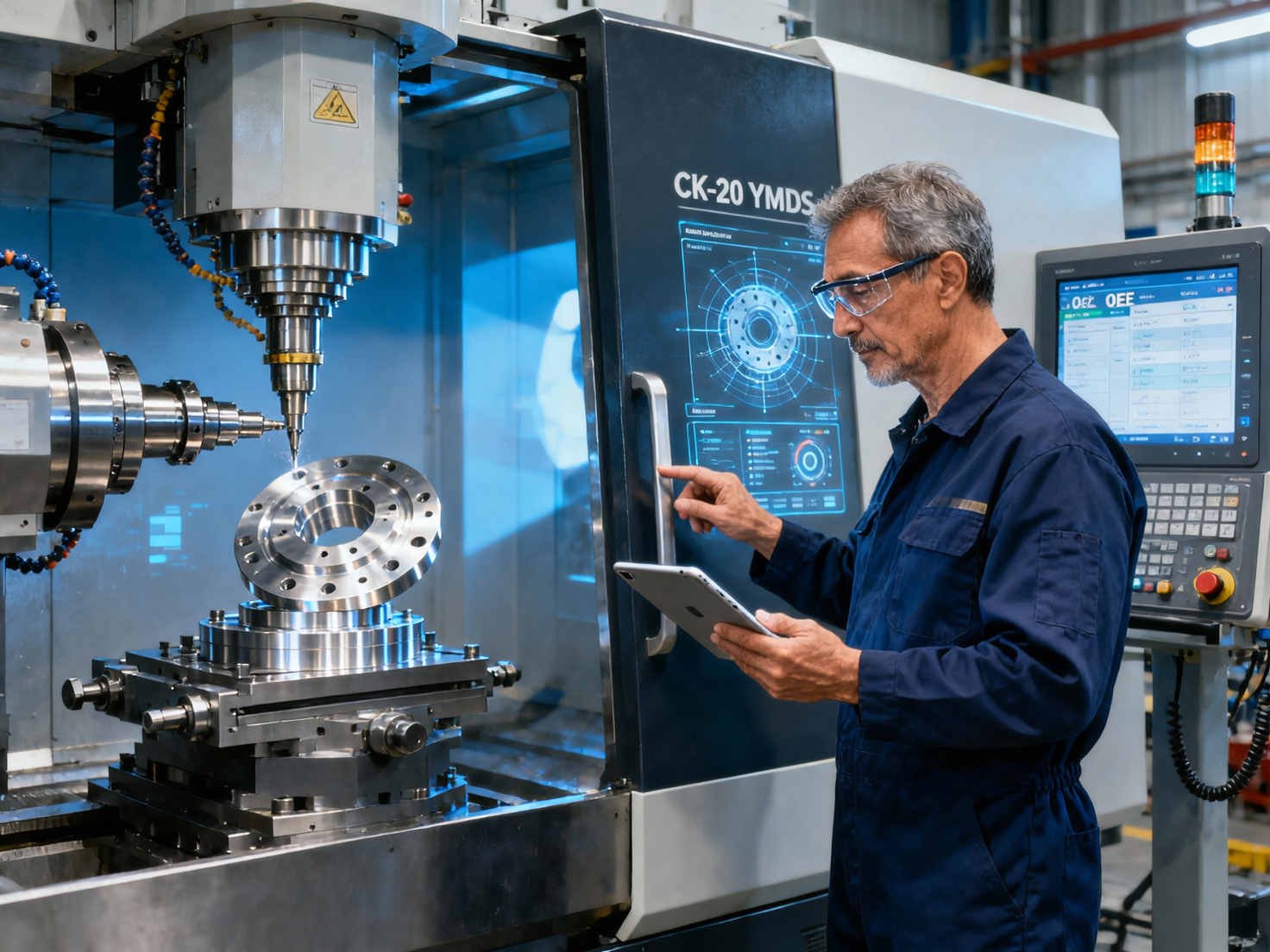
As Lean Production Process implementation gains traction in CNC machine shops worldwide, operator roles are undergoing a profound transformation — shifting from manual execution to cross-functional problem solving and real-time process optimization. Drawing on revealing case studies from Japan’s precision-driven facilities and Mexico’s rapidly scaling automotive suppliers, this article explores how Lean principles intersect with Industrial Automation control systems for CNC machines, Modular Tooling Systems for flexible manufacturing, and Digital Manufacturing Technology for smart factories. We examine impacts on Efficient Machining Process for aluminum alloys, Quick-change Fixture Design for CNC turning, and High-tolerance Disc Parts for aerospace applications — offering actionable insights for operators, project managers, and enterprise decision-makers navigating the future of automated production.
From Machine Tenders to Process Stewards: The Evolving Operator Profile
Lean implementation in CNC environments does not eliminate human involvement—it redefines it. In traditional setups, operators typically perform repetitive loading/unloading, cycle initiation, and visual inspection—tasks that occupy 60–70% of shift time but contribute minimally to value creation. Under Lean, operators become frontline improvement agents: they monitor real-time OEE dashboards, adjust feed rates within ±5% tolerance windows based on tool wear analytics, and initiate Kaizen events targeting setup reduction or coolant flow optimization.
Japan’s Toyota-affiliated Tier-1 suppliers report a 42% average increase in operator-initiated process improvements after full Lean integration (2022–2023 internal audit data). In contrast, Mexican automotive suppliers—many operating under JIT contracts with U.S.-based OEMs—have reduced average changeover time from 28 minutes to 9.3 minutes per job through standardized SMED protocols co-developed by operators and industrial engineers.
This evolution demands new competencies: basic PLC logic interpretation, GD&T literacy for in-process verification, and familiarity with digital twin interfaces. Training programs now span 12–16 weeks—not just on machine operation, but on root cause analysis, 5S auditing, and statistical process control (SPC) charting for critical dimensions like disc runout (±0.008 mm).
Lean × CNC Integration: Three Critical Enablers
Successful role transformation hinges on three interdependent technical foundations. First, Industrial Automation control systems must support operator-level intervention—not just automation-for-automation’s-sake. Modern CNC controllers now embed HMI layers allowing operators to modify tool compensation tables without PLC programming access, provided changes stay within pre-approved parameter bands (e.g., spindle speed ±15%, feed rate ±12%).
Second, Modular Tooling Systems enable rapid reconfiguration. A single CK-20 YMDS Dual Spindle Precision CNC Turning and Milling platform, for example, supports 14 distinct fixture families via ISO 2662-1 compliant quick-clamp interfaces—cutting changeover for aluminum alloy housings from 45 to 7 minutes.
Third, Digital Manufacturing Technology provides visibility. Cloud-connected CNCs transmit cycle time variance, thermal drift logs, and servo error codes every 3 seconds—feeding predictive maintenance alerts and enabling operators to preemptively swap inserts before surface finish degrades beyond Ra 0.8 µm.
The table above confirms that enablers function synergistically: modular tooling without digital traceability leads to misapplied configurations; automation without operator training yields low system utilization. Cross-functional ownership is non-negotiable.
Case Evidence: Japan vs. Mexico Operational Realities
Japanese facilities prioritize precision sustainability. At a Nagoya-based supplier machining titanium landing gear components, operators conduct hourly micro-adjustments to coolant pressure (target: 6.2–6.8 bar) and monitor spindle vibration spectra (threshold:<0.8 mm/s RMS at 12 kHz). Their authority extends to halting production if SPC charts exceed Cpk 1.33 limits—triggering immediate engineering review.
Mexican operations emphasize throughput agility. A Querétaro plant producing aluminum engine blocks for North American EVs deploys “operator-led line balancing”: teams dynamically redistribute work across 8 CNC machining centers daily, adjusting batch sizes between 12–24 units based on real-time WIP inventory and delivery window constraints (±4-hour windows). This reduced average lead time from 5.2 to 2.9 days.
Both contexts share one constant: operators now own quality gates. In Japan, final inspection occurs post-machining but pre-wash; in Mexico, in-process probing verifies critical bores (Ø42.000 ±0.005 mm) after roughing—eliminating 100% of downstream rework for that feature.
Implementation Roadmap: Four Phases, Six Critical Success Factors
Transitioning operator roles requires deliberate sequencing—not wholesale replacement. Phase 1 (0–3 months) focuses on standardizing documentation: visual work instructions, poka-yoke checklists for fixture mounting, and color-coded torque maps. Phase 2 (4–7 months) introduces operator-led 5S audits with quantified scoring (≥92% compliance required for certification). Phase 3 (8–12 months) embeds SPC training and grants controlled parameter adjustment rights. Phase 4 (13+ months) establishes cross-shift Kaizen boards tracking improvement ideas per operator/month (target: ≥3.2).
- Operator selection criteria: minimum 2 years CNC experience + demonstrated problem-solving aptitude (validated via structured simulation)
- Training investment: 180–220 hours/operator over 12 months, including 40 hours on GD&T interpretation
- Technology readiness: CNCs must support OPC UA connectivity and have ≥80% firmware version compliance
- KPI alignment: 30% of operator bonus tied to OEE improvement, scrap reduction, and Kaizen participation
- Leadership cadence: Daily 15-minute “Gemba walks” by supervisors focusing on operator-reported bottlenecks
- Tooling validation: All quick-change fixtures require ≤2-minute verification cycle time with certified master parts
Strategic Implications for Decision-Makers
For procurement teams: Prioritize CNC platforms with open architecture (e.g., Fanuc 31i-B5 or Siemens SINUMERIK ONE) that support third-party HMI integration and parameter lockdown granularity. Avoid proprietary controllers limiting operator interface customization.
For project managers: Allocate 22–26% of total Lean budget to human capital development—not just hardware. Include costs for bilingual trainers (critical in Mexico), GD&T certification exams ($420/person), and digital twin licensing per machine ($1,800–$3,200/year).
For enterprise leaders: Track “operator-initiated improvement ROI” as a core KPI. Top performers achieve $12,500–$18,700 annual savings per operator through reduced scrap, energy optimization, and preventive maintenance scheduling.
Lean reshapes CNC operator roles not as a cost-cutting exercise, but as a strategic capability upgrade—one that turns frontline personnel into indispensable nodes in a responsive, intelligent manufacturing network. The convergence of precision engineering, modular systems, and real-time data empowers operators to drive measurable gains in quality, efficiency, and innovation velocity.
To assess your shop’s readiness for this transformation—or explore how platforms like the CK-20 YMDS Dual Spindle Precision CNC Turning and Milling accelerate Lean adoption—contact our application engineering team for a no-obligation operational maturity review.
Recommended for You
 How Automated Precision Machining Maintains Tolerance in High-Mix ProductionCNC Machining Technology Center
 How to Evaluate a Machine Tool Factory Before Sourcing CNC EquipmentGlobal Machine Tool Trade Research Center
 CNC Programming Explained: From CAD Models to Reliable Shop-Floor ToolpathsCNC Machining Technology Center
 How Multi-Axis Machining Produces Complex Components With Fewer SetupsCNC Machining Technology Center
 What Production Volume Justifies a CNC Turning Investment?Manufacturing Market Research Center
 How Much Does CNC Programming Software Cost in 2026?CNC Machining Technology Center




Aris Katos
Future of Carbide Coatings
15+ years in precision manufacturing systems. Specialized in high-speed milling and aerospace grade alloy processing.
▶
Global Manufacturing Trends: How Supply Chains and Regional Shifts Affect SourcingManufacturing Market Research Center▶
Small-Batch Production and Smart Manufacturing for Small Businesses: Where to Start FirstManufacturing Market Research Center▶
What Smart Manufacturing Technology for Industry 4.0 Means for Mid-Sized FactoriesManufacturing Market Research Center▶
How Smart Manufacturing Benefits Reduce Downtime and Scrap in Metal Parts ProductionManufacturing Market Research Center▶
Advanced Manufacturing Technology for Energy Equipment: Key Processes and Use CasesManufacturing Market Research Center
Mastering 5-Axis Workholding Strategies
Join our technical panel on Nov 15th to learn about reducing vibrations in thin-wall components.

Providing you with integrated sanding solutions
Before-sales and after-sales services
Comprehensive technical support