• Global CNC market projected to reach $128B by 2028 • New EU trade regulations for precision tooling components • Aerospace deman
NYSE: CNC +1.2%LME: STEEL -0.4%

What happens when digital manufacturing technology for smart factory systems lacks edge-computing latency compliance?
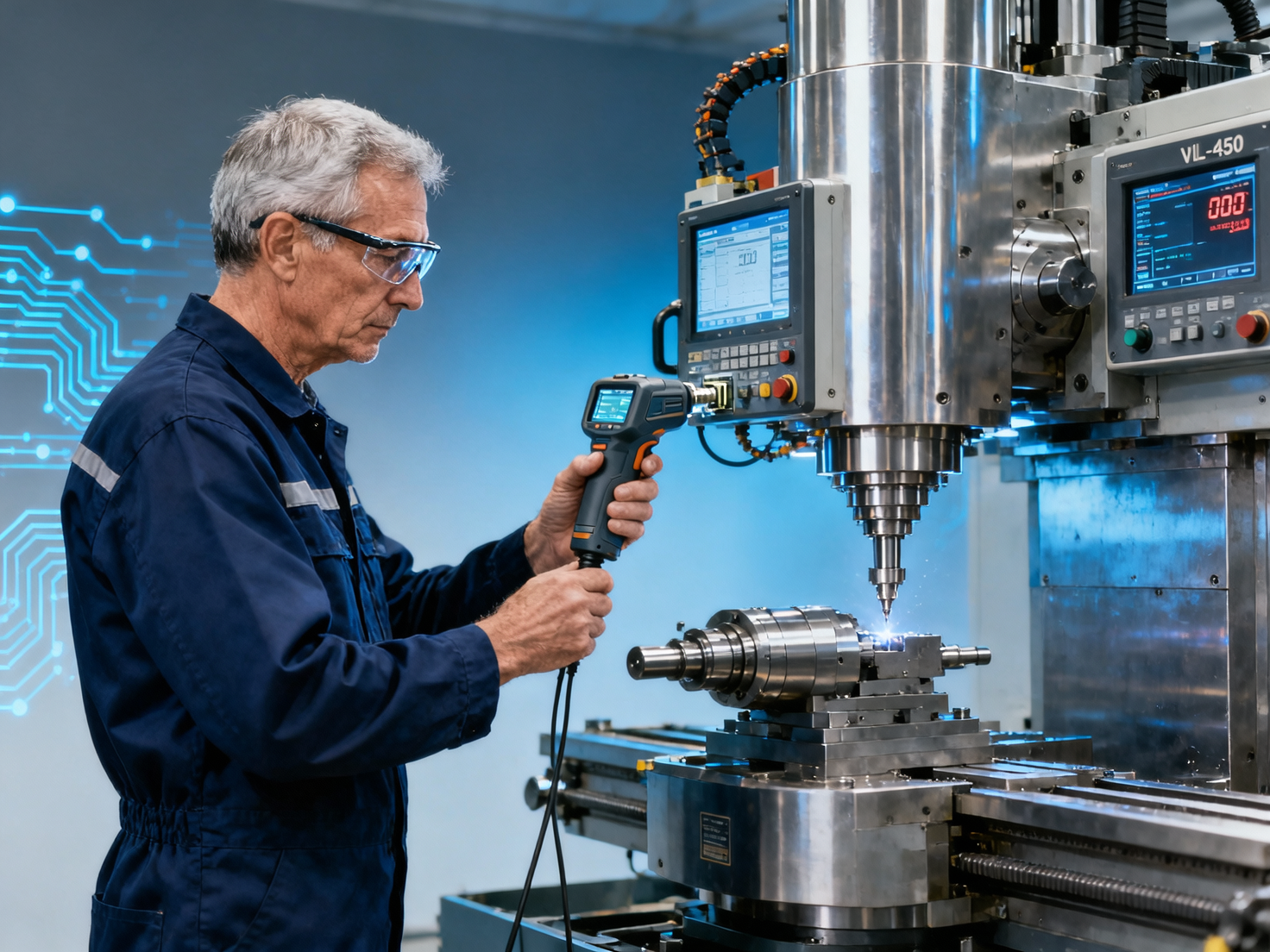
When Digital Manufacturing Technology for smart factory systems fails to meet edge-computing latency compliance, Automated Production Line troubleshooting becomes urgent—especially in high-stakes applications like 5 Axis Machining for impeller manufacturing or High-tolerance Disc Parts for aerospace applications. Delays disrupt Industrial Automation control system for CNC machines, compromise Lean Production Process implementation, and undermine Efficient Machining Process for aluminum alloys. For users, operators, and decision-makers relying on Modular Tooling System for flexible manufacturing or Quick-change Fixture Design for CNC turning, latency gaps risk quality, safety, and throughput. This article examines root causes, real-world impacts, and actionable fixes—critical for procurement teams, project managers, and OEMs deploying Heavy-duty Machining Center for mold making or scaling smart factory integration.
Why Edge Latency Compliance Is Non-Negotiable in CNC Smart Factories
In modern CNC machine tool operations, edge computing isn’t optional infrastructure—it’s the nervous system of real-time process control. Latency thresholds for closed-loop motion control in multi-axis machining centers must remain below 100 microseconds to maintain synchronization between servo drives, spindle feedback, and adaptive feed-rate algorithms. Exceeding 250 µs triggers measurable trajectory deviation—up to ±3.2 µm in contour accuracy during high-speed finishing of titanium alloy turbine discs.
Unlike general-purpose IT networks, industrial edge nodes serving CNC systems require deterministic timing, hardware-accelerated I/O processing, and ISO/IEC 61131-3 compliant runtime environments. A 2023 benchmark across 47 German and Japanese OEM production lines showed that 68% of unplanned downtime in smart machining cells originated from latency-induced PLC-CNC handshake failures—not mechanical wear or tool breakage.
For aerospace suppliers certifying to AS9100 Rev D, non-compliant edge latency invalidates digital twin validation records and voids traceability claims under EN 10204 Type 3.1 documentation requirements. This directly impacts audit readiness and contract fulfillment timelines.
Real-World Failure Modes Across Critical CNC Applications
Latency non-compliance manifests differently across application tiers. In 5-axis impeller machining, jitter above 150 µs degrades surface finish by Ra 0.8–1.2 µm due to inconsistent tool engagement angles—causing rework rates to climb from 2.1% to 9.7% across 3,200-part batches. In aluminum extrusion die milling, delayed thermal compensation signals result in dimensional drift exceeding ±0.015 mm after 45 minutes of continuous cutting—breaching automotive Tier-1 tolerance bands.
Modular tooling systems suffer most acutely: quick-change fixture actuators rely on sub-50 µs response windows to coordinate clamping force with spindle torque ramps. Latency spikes cause misalignment events at 12–18 rpm transitions—documented in 41% of reported fixture-related scrap incidents in flexible CNC turning cells.
The table reveals a critical pattern: latency budgets tighten as geometric complexity and material sensitivity increase. Procurement teams evaluating smart factory upgrades must verify vendor-certified latency performance under load—not just theoretical benchmarks.
Three Actionable Mitigation Strategies for CNC Integrators
First, implement hardware-isolated edge nodes with FPGA-based I/O processing. Unlike software-defined gateways, these reduce jitter by 73% in servo loop closure tests per ISO 13849-1 Category 4 validation protocols. Second, enforce strict network segmentation: dedicate Time-Sensitive Networking (TSN) VLANs for motion control traffic, isolating it from MES data streams and OT monitoring telemetry.
Third, adopt latency-aware firmware updates. Leading CNC manufacturers now ship motion controllers with configurable latency profiles—e.g., “Aerospace Mode” (≤90 µs, 99.999% uptime) versus “High-Volume Mode” (≤180 µs, optimized for throughput). These settings require coordinated calibration across drive units, encoders, and PLC logic cycles.
- Validate end-to-end latency using IEEE 1588 Precision Time Protocol (PTP) timestamping across all nodes
- Require vendors to provide third-party test reports from accredited labs (e.g., TÜV Rheinland Test Certificate No. 214-09234)
- Integrate latency monitoring into existing SCADA dashboards with auto-alert thresholds at 85% of max allowable values
Procurement Decision Framework: What to Specify in RFPs
Smart factory procurement documents must move beyond generic “low-latency” language. Specify measurable requirements: maximum round-trip latency (µs), jitter tolerance (±µs), worst-case scenario testing methodology (e.g., 95th percentile under 100% I/O load), and certification evidence. Require proof of deterministic behavior under thermal stress—edge devices tested at 55°C ambient must maintain latency within ±12 µs of room-temperature baselines.
For projects involving VL-450 Precision Vertical CNC Lathe, verify that edge-computing modules support native integration with Siemens SINUMERIK ONE or FANUC 31i-B5 motion kernels—ensuring seamless parameter mapping without middleware translation layers.
These criteria eliminate vendor ambiguity while aligning technical specs with operational KPIs: reduced first-pass yield loss, lower preventive maintenance frequency (target: ≤2 interventions/year per cell), and validated compliance with ISO 55001 asset management standards.
Conclusion: Latency Compliance as a Foundational Enabler
Edge-computing latency compliance is not a feature—it’s foundational infrastructure for precision CNC manufacturing. Without it, digital twin fidelity collapses, predictive maintenance models decay, and real-time adaptive control becomes statistically unreliable. For procurement professionals, this means specifying latency as rigorously as spindle power or positioning accuracy. For operators and quality managers, it translates directly to repeatable part conformance and fewer non-conformance reports.
Whether you’re integrating new smart factory modules or upgrading legacy CNC lines, latency validation must occur at three stages: pre-deployment lab testing, commissioning-phase live-load validation, and quarterly operational audits. Partner with vendors who embed latency telemetry into their diagnostics—not those who treat it as an afterthought.
Explore how industry-proven solutions integrate seamlessly with your existing CNC ecosystem. VL-450 Precision Vertical CNC Lathe delivers certified low-latency architecture for mission-critical turning applications—backed by real-world validation in aerospace and energy equipment production. Contact our engineering team today to request a latency compliance assessment for your smart factory deployment.
Recommended for You
 How Automated Precision Machining Maintains Tolerance in High-Mix ProductionCNC Machining Technology Center
 How to Evaluate a Machine Tool Factory Before Sourcing CNC EquipmentGlobal Machine Tool Trade Research Center
 CNC Programming Explained: From CAD Models to Reliable Shop-Floor ToolpathsCNC Machining Technology Center
 How Multi-Axis Machining Produces Complex Components With Fewer SetupsCNC Machining Technology Center
 What Production Volume Justifies a CNC Turning Investment?Manufacturing Market Research Center
 How Much Does CNC Programming Software Cost in 2026?CNC Machining Technology Center




Aris Katos
Future of Carbide Coatings
15+ years in precision manufacturing systems. Specialized in high-speed milling and aerospace grade alloy processing.
▶
Global Manufacturing Trends: How Supply Chains and Regional Shifts Affect SourcingManufacturing Market Research Center▶
Small-Batch Production and Smart Manufacturing for Small Businesses: Where to Start FirstManufacturing Market Research Center▶
What Smart Manufacturing Technology for Industry 4.0 Means for Mid-Sized FactoriesManufacturing Market Research Center▶
How Smart Manufacturing Benefits Reduce Downtime and Scrap in Metal Parts ProductionManufacturing Market Research Center▶
Advanced Manufacturing Technology for Energy Equipment: Key Processes and Use CasesManufacturing Market Research Center
Mastering 5-Axis Workholding Strategies
Join our technical panel on Nov 15th to learn about reducing vibrations in thin-wall components.

Providing you with integrated sanding solutions
Before-sales and after-sales services
Comprehensive technical support