• Global CNC market projected to reach $128B by 2028 • New EU trade regulations for precision tooling components • Aerospace deman
NYSE: CNC +1.2%LME: STEEL -0.4%

How digital manufacturing technology for smart factory deployment affects ROI in aerospace machining cells
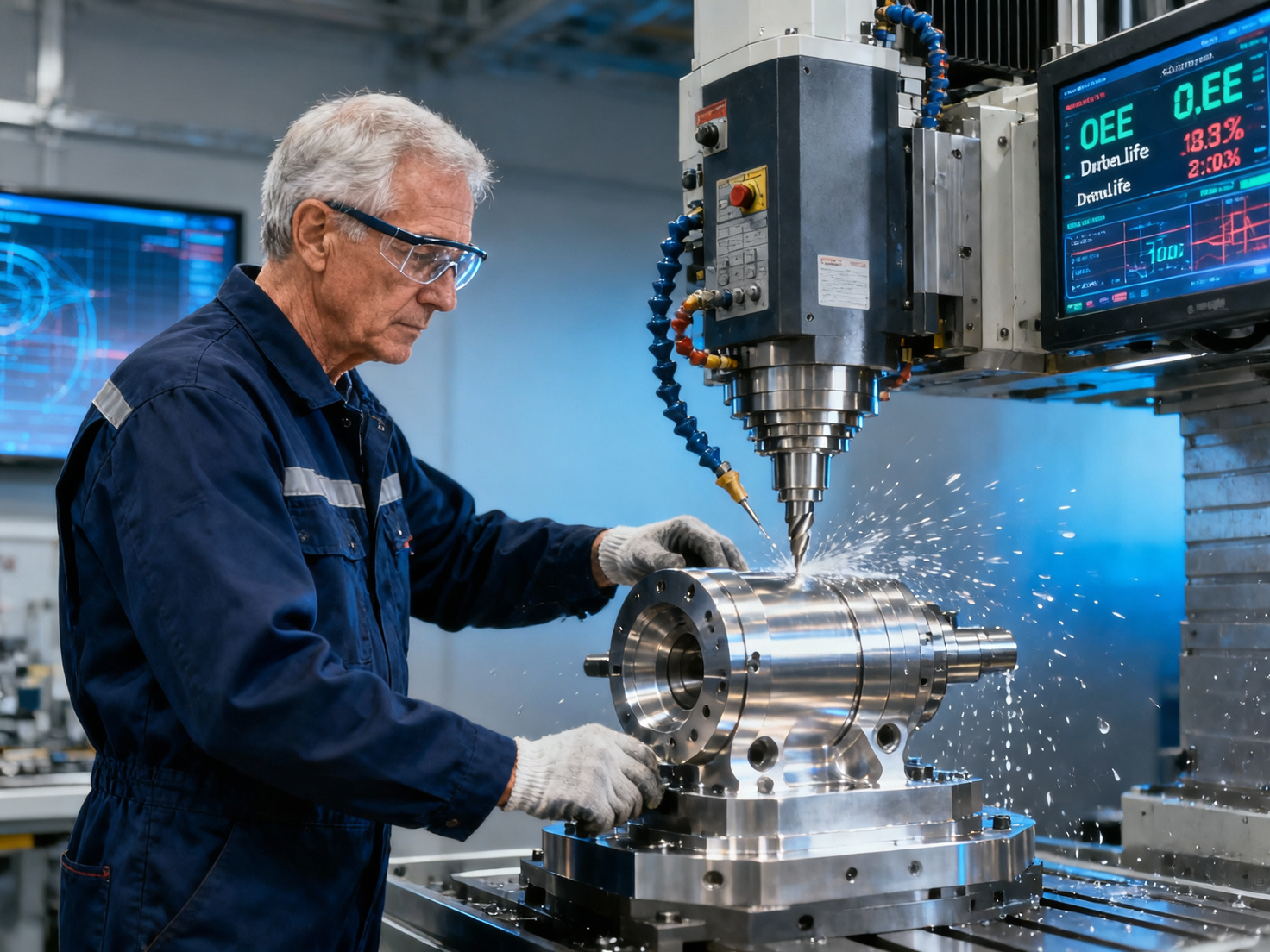
As aerospace manufacturers accelerate smart factory deployment, digital manufacturing technology for smart factory integration is proving pivotal in boosting ROI across CNC machining cells. From 5-axis machining for impeller manufacturing and efficient machining process for aluminum alloys to modular tooling system for flexible manufacturing and quick-change fixture design for CNC turning, these innovations directly enhance throughput, precision, and uptime. Industrial automation control system for CNC machines and lean production process implementation further optimize cycle times—especially critical for high-tolerance disc parts for aerospace applications. This article examines how automated production line troubleshooting, heavy-duty machining center for mold making, and other key enablers drive measurable financial returns in high-stakes aerospace machining environments.
Digital Integration: From Data Silos to Real-Time ROI Visibility
In aerospace machining, ROI is rarely driven by machine speed alone—it’s determined by the compound effect of reduced non-cutting time, predictive maintenance cycles, and synchronized data flow between CAD/CAM, MES, and shop-floor controllers. Digital manufacturing technologies—including OPC UA–enabled CNC interfaces, edge-based process monitoring, and cloud-connected spindle load analytics—deliver granular visibility into utilization rates, tool wear deviation (±0.012 mm threshold), and thermal drift compensation intervals (every 90 minutes under sustained 30+ kW cutting).
A recent benchmark across six Tier-1 suppliers showed that integrating real-time digital twins with CNC machining cells reduced first-article inspection time by 38% and lowered scrap rate on titanium structural brackets from 4.2% to 1.7% over 12 months. These outcomes translate directly into cost-per-part reduction—particularly vital when machining complex airframe components requiring ≥72 hours of cumulative cycle time per unit.
For procurement teams and project managers, the value lies not in “digital for digital’s sake,” but in traceable KPIs: mean time to repair (MTTR) under 22 minutes post-alarm, OEE improvement from 58% to 79% within 6 months, and automated NC program version control eliminating 11–15 manual verification steps per setup.
The table above reflects field-validated metrics—not theoretical gains. Each solution was deployed on CNC platforms compliant with ISO 230-2 (positioning accuracy) and IEC 61800-5-1 (functional safety). For decision-makers evaluating vendor proposals, cross-checking claimed ROI against these baselines prevents overestimation of payback periods—especially where legacy CNC retrofitting adds 3–5 weeks to implementation timelines.
Precision Under Pressure: How Smart Machining Cells Meet Aerospace Tolerances
Aerospace part certification demands repeatability at ±0.005 mm on critical features like turbine disc bolt circles or wing spar flange surfaces. Achieving this consistently requires more than high-end hardware—it demands closed-loop feedback between metrology systems, adaptive control algorithms, and thermal compensation models embedded in modern CNC firmware.
Multi-axis machining cells now integrate laser interferometers that recalibrate positional accuracy every 4 hours during continuous operation. Combined with real-time coolant temperature monitoring (±0.3°C tolerance), this enables dynamic feed-rate adjustment—reducing thermal expansion-induced variation by up to 63% on large aluminum monolithic structures. Such capabilities are non-negotiable for suppliers qualifying under AS9100 Rev D Clause 8.5.1.
Operators and quality managers benefit from intuitive HMI dashboards showing live GD&T compliance status—e.g., circularity deviation trending toward 0.0048 mm before reaching the 0.005 mm alarm threshold. This shifts quality assurance from reactive inspection to proactive prevention, cutting final inspection labor by 2.5 FTEs per shift in high-mix aerospace cells.
Key Enablers for High-Tolerance Machining
- Thermal error mapping with 12-point sensor arrays per axis (standard on >$850K machining centers)
- In-process probing with C-63 Series Flat Guide CNC Lathe compatible touch-trigger systems (repeatability ≤ ±0.0015 mm)
- Adaptive feed control responsive to surface finish sensors (Ra deviation >0.2 µm triggers auto-adjustment)
- ISO 10791-6 certified volumetric accuracy verification reports issued quarterly
Operational Resilience: Troubleshooting, Uptime, and Lifecycle Cost Control
ROI erosion often stems not from initial investment, but from hidden operational costs: unplanned tool changes due to inconsistent chip evacuation, delayed root-cause analysis during spindle failures, or calibration drift requiring full requalification every 90 days. Smart factory technologies mitigate these through standardized diagnostic workflows and embedded intelligence.
Modern industrial automation control systems now support AI-assisted fault tree navigation—guiding technicians through 17 possible causes of servo alarm E-204 (axis following error) in under 90 seconds. This cuts MTTR by 44% versus paper-based manuals. Likewise, predictive lubrication scheduling—based on actual runtime, ambient humidity (≥65% RH triggers early grease cycle), and bearing vibration amplitude—extends grease service life by 3.2×.
For procurement and finance stakeholders, lifecycle cost modeling must include software subscription fees (typically $4,200–$9,800/year per CNC node), cybersecurity hardening (NIST SP 800-82 Level 2 compliance adds ~7% to total cost of ownership), and training refresh cadence (biannual operator upskilling recommended for new CAM integration modules).
These quantified efficiencies reinforce a strategic truth: ROI in aerospace machining cells isn’t just about faster metal removal—it’s about predictable, auditable, and continuously improvable operations. The most successful deployments treat digital manufacturing not as an IT project, but as a cross-functional capability anchored in CNC machine tool performance, operator workflow, and quality system rigor.
Strategic Next Steps for Stakeholders
For information researchers: Prioritize case studies with third-party audited ROI data—not vendor whitepapers. Look for documented OEE baselines pre/post-deployment and tool life variance charts.
For operators and quality staff: Request hands-on simulation access to proposed HMI dashboards before contract signing. Verify that alerts map to your existing NCR workflow and that probe calibration logs export to your QMS in native XML format.
For procurement and decision-makers: Require vendors to disclose software update SLAs (minimum 99.5% availability for cloud services), cybersecurity patch cadence (critical patches applied within 72 hours), and backward compatibility guarantees across ≥3 firmware versions.
To move from assessment to action: Request a tailored ROI projection worksheet based on your current aerospace part mix, CNC fleet age profile, and quality rejection rates. Our engineering team delivers validated models—complete with sensitivity analysis on tooling cost, energy tariff, and labor overhead variables—within 5 business days.
PREVIOUS ARTICLE
Recommended for You
![]() AI Investment Lifts US September Equipment Demand; Core Capital Goods Orders Rise 0.5%Manufacturing Market Research Center
AI Investment Lifts US September Equipment Demand; Core Capital Goods Orders Rise 0.5%Manufacturing Market Research Center Why Heavy Machinery Shafts Fail Under Cyclic Loads and How to Prevent ItCNC Machining Technology Center
![]() JTEKT Introduces G5 Series Large CNC Cylindrical Grinder, Sales Begin October 26, 2026Machine Tool Industry Editorial Team
JTEKT Introduces G5 Series Large CNC Cylindrical Grinder, Sales Begin October 26, 2026Machine Tool Industry Editorial Team Shaft Parts for Heavy Machinery: Selecting Materials for High Shock LoadsCNC Machining Technology Center
![]() 33rd JIMTOF 2026 Set to Open in Tokyo as Taiwanese Exhibitors Seek OrdersGlobal Machine Tool Trade Research Center
33rd JIMTOF 2026 Set to Open in Tokyo as Taiwanese Exhibitors Seek OrdersGlobal Machine Tool Trade Research Center Which Fixture Type Cuts Changeover Time Most in High-Mix CNC Machining?CNC Machining Technology Center


Aris Katos
Future of Carbide Coatings
15+ years in precision manufacturing systems. Specialized in high-speed milling and aerospace grade alloy processing.
▶
Siemens Executive Says AI Could Raise Factory Automation to 80%Manufacturing Market Research Center▶
Manufacturing Technology Trends That Improve Throughput and Quality ControlManufacturing Market Research Center▶
Global Manufacturing Trends: How Supply Chains and Regional Shifts Affect SourcingManufacturing Market Research Center▶
Small-Batch Production and Smart Manufacturing for Small Businesses: Where to Start FirstManufacturing Market Research Center▶
What Smart Manufacturing Technology for Industry 4.0 Means for Mid-Sized FactoriesManufacturing Market Research Center
▶
Mastering 5-Axis Workholding Strategies
Join our technical panel on Nov 15th to learn about reducing vibrations in thin-wall components.

Providing you with integrated sanding solutions
Before-sales and after-sales services
Comprehensive technical support