• Global CNC market projected to reach $128B by 2028 • New EU trade regulations for precision tooling components • Aerospace deman
NYSE: CNC +1.2%LME: STEEL -0.4%

Choosing an Automated Lathe: Bar Capacity, Accuracy and Production Volume
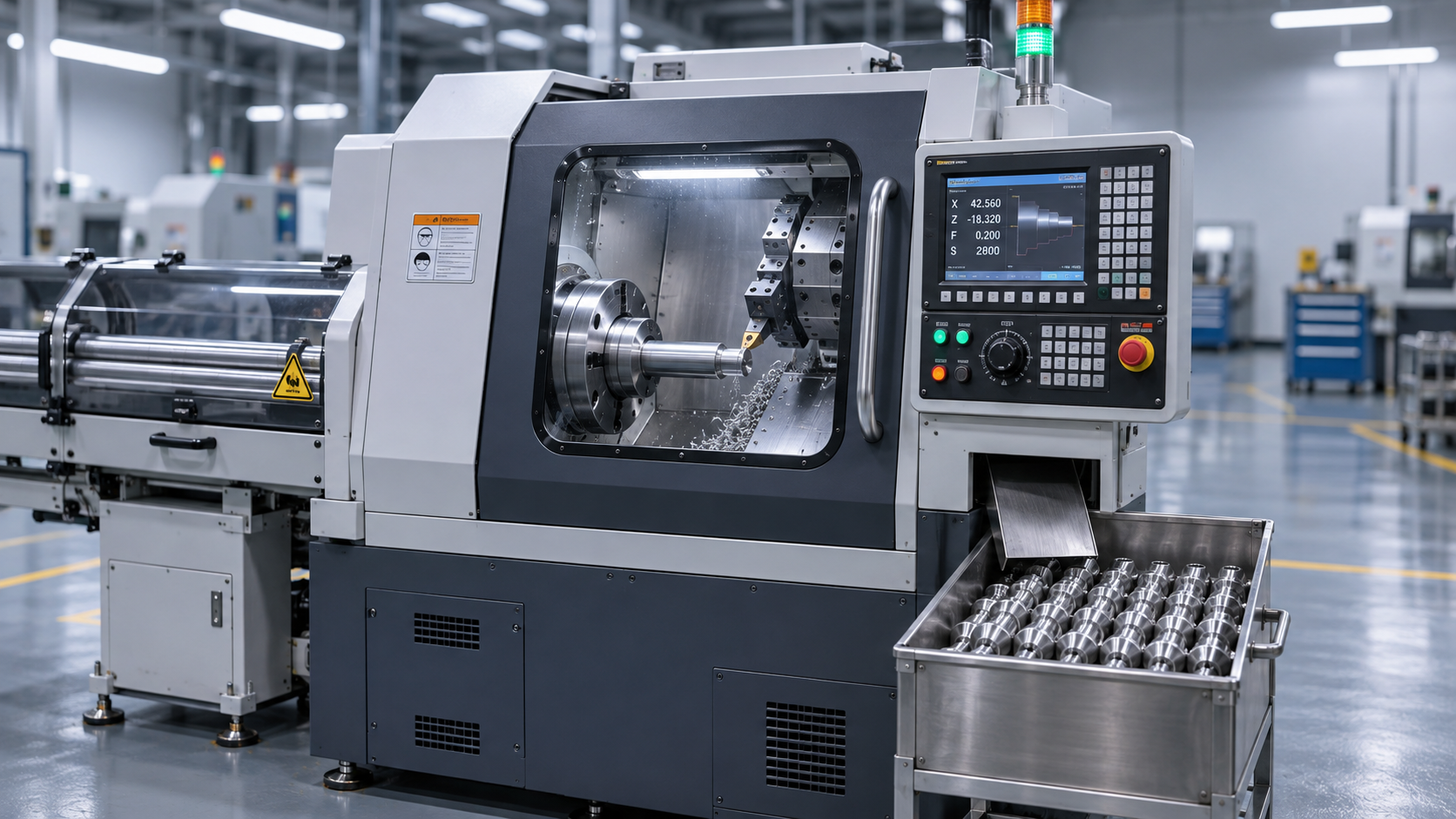
Choosing an automated lathe requires more than comparing spindle speeds and machine prices. Bar capacity determines the range of stock the machine can handle, while achievable accuracy affects part quality and process reliability. Production volume also shapes the choice of bar feeders, tooling, and automation features. The right machine is the one that can repeatedly make the required parts, at the required rate, without relying on assumptions that disappear once production starts.
That distinction matters whether the application involves automotive shafts, electronic connectors, energy equipment components, or precision aerospace parts. These jobs may all use CNC turning, but they place very different demands on stock handling, process stability, documentation, and inspection.
Start with the part family, not the largest machine specification
Collect representative drawings before requesting quotations. Include the highest-volume part, the most demanding tolerance, the longest component, and any part that requires a second operation or features such as cross-holes and flats. A machine selected around one convenient sample can look attractive until the rest of the workload reaches the shop floor.
For each part, identify the incoming stock size and form, material condition, finished length, critical tolerances, surface requirements, and expected batch size. Then separate genuine requirements from preferences. Live tooling, a subspindle, high-pressure coolant, and automatic gauging may be valuable, but only if they solve a defined process problem or remove a meaningful constraint.
It is also worth identifying the likely route through the factory. A lathe that completes turning quickly but leaves every part waiting for milling or deburring may not improve overall throughput. Conversely, completing more features in one setup can reduce handling and preserve relationships between features, even if the machine cycle is longer.
Bar capacity is a system limit, not just a spindle number
The advertised maximum bar diameter is a useful starting point, not a guarantee that every bar of that diameter will run. Check the usable passage through the spindle, drawtube, collet or chuck, bar feeder, and any guide components. The smallest restriction determines what can actually pass through the system.
Allow for the incoming stock’s real condition as well. Nominal diameter is not the same as the largest diameter permitted by the material specification. Straightness, surface finish, and whether the stock is round, hexagonal, or shaped all affect feeder compatibility. Ask the supplier to confirm the allowable stock range for the complete configuration, including any liners and workholding selected for the job.
Do not assume that running near maximum capacity is always desirable. A job with an unfinished bar surface, an awkward profile, or limited clearance may need a larger passage or a different feeding arrangement. On the other hand, buying a much larger machine solely for an occasional oversize part can add cost and consume floor space without improving the regular workload.
Bar length is another practical constraint. A long-bar feeder can reduce the frequency of stock loading, but it requires space behind the machine and suitable access for handling material. A short-bar feeder may fit a crowded cell and simplify some changeovers, while increasing the frequency of loading and the proportion of material left as remnants. Compare the actual floor plan, crane or material-handling route, and expected staffing pattern before deciding.
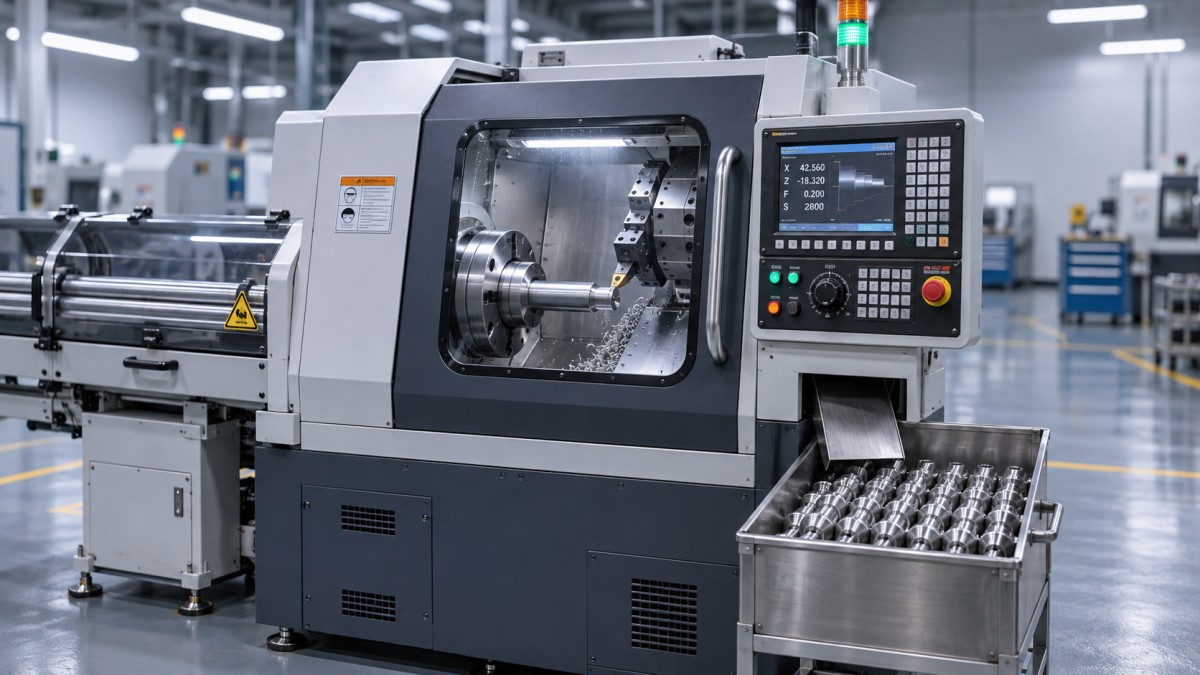
Guide-bush or fixed-head turning?
For slender parts, a sliding-headstock machine with a guide bush can support the bar close to the cutting zone. That can be useful when deflection limits the process. The trade-off is that guide-bush setups have their own stock preparation, adjustment, and remnant considerations. Some machines can also operate without the guide bush; confirm what changeover involves and how the usable part length and support conditions change.
A fixed-head turning center may be a better fit for shorter, more rigid parts or work that benefits from heavier cutting and conventional chucking. Neither layout is automatically superior. Part geometry, material, tolerances, and the operations needed after cutoff should decide the comparison.
Accuracy has to survive a production shift
Positioning and repeatability figures describe aspects of machine performance, but they are not finished-part guarantees. The part sees the entire process: workholding, tool projection, insert wear, coolant delivery, machine temperature, bar condition, and cutting forces. A supplier’s specification should therefore be read alongside the proposed tooling and inspection method.
Start with the features that control acceptance. A bearing journal, for example, may require attention to diameter, roundness, surface finish, and its relationship to a shoulder. A long shaft may also be sensitive to taper or deflection. If a feature is made after a subspindle transfer, ask how the proposed sequence controls concentricity and axial location across that transfer.
Thermal behavior deserves particular scrutiny. A machine can make an acceptable first-off part and drift as the spindle, coolant, and enclosure reach operating temperature. For demanding work, ask for a test that includes warm-up conditions and parts taken over a representative run, rather than a single demonstration component. Agree in advance on material, tooling, measurement equipment, inspection locations, and acceptance criteria.
Keep measurement uncertainty in view. If the tolerance is narrow relative to the capability of the measuring method, the team may spend more time arguing about readings than improving the process. Confirm how the part will be held, cleaned, measured, and recorded, and whether the inspection method is suitable for the drawing requirement.
Automatic offsets or in-process probing can help manage variation, but they are not substitutes for a stable cut. Before adding closed-loop correction, establish what causes drift and whether it can be controlled through tooling, coolant, warm-up practice, or maintenance.
Match automation to volume and changeover frequency
Annual volume alone can be misleading. A large annual quantity spread across many small releases is a different problem from a sustained run of one part. Ask how often bar diameter, material, tooling, jaws, programs, and inspection setups will change. Setup labor and restart checks can outweigh a modest cycle-time advantage in high-mix production.
For recurring work, a bar feeder and reliable part catcher may remove substantial manual handling. A subspindle can complete back-end operations in the same machine, avoiding a second setup. Driven tools and a controlled spindle axis can produce cross-holes or flats without sending parts to a machining center. Each addition should be tested against the actual part route: some features are better machined elsewhere, especially if adding them makes the lathe cycle the new bottleneck.
For long runs, unattended operation is not simply a matter of loading enough bar. Chip evacuation, tool life, coolant level, part collection, and fault recovery must all support the intended run length. Stringy chips around the workholding or a full parts bin can stop an otherwise capable cell. A practical trial should include the material and cutting conditions most likely to create those problems.
For shorter batches, favor features that make changeovers predictable: accessible tooling, repeatable toolholders, straightforward feeder adjustment, and clear program management. These may matter more than a complex automation package that saves seconds in the cut but adds preparation and troubleshooting time.
Compare throughput using the complete cycle
A quoted cutting time is not the same as output from an operating cell. The comparison should include bar changes, cutoff and part handling, tool indexing, inspection interruptions, planned tool changes, and any secondary operations. If the proposed process relies on overlapping main- and subspindle work, verify that the stated cycle reflects a realistic tool schedule rather than two independent best-case times.
Model at least two scenarios: the regular production mix and a demanding but plausible mix with more frequent changeovers or tighter inspection. Use the shop’s own assumptions for staffing, scrap, and available hours, and make those assumptions visible. There is little value in a precise-looking cost per part built on an unsupported unattended-run estimate.
Material yield belongs in the calculation too. Remnant length, cutoff width, facing allowance, and rejected parts all affect how many acceptable components come from each bar. For expensive alloys or short parts, small changes to the process plan can have a noticeable effect on the comparison.
What to settle before issuing the purchase order
Request quotations on the same basis. A lower machine price may exclude the bar feeder interface, collets, guide components, toolholders, coolant filtration, chip management, installation, or training. List the required accessories and utilities explicitly, along with any factory network or data-collection interfaces the plant intends to use.
For equipment sourced internationally, check the availability of local service, control-system support, replacement parts, documentation, and the electrical and safety requirements applicable at the installation site. Suppliers from different manufacturing regions may offer very different support arrangements; the country of origin alone is not a reliable proxy for service capability.
Finally, put the acceptance test in writing. Define the sample part, material, production sequence, inspection method, required documentation, and responsibilities for tooling and setup. If the purchase depends on a cycle time or sustained accuracy target, state the conditions under which it will be demonstrated. The best choice is not necessarily the machine with the broadest capacity or the shortest quoted cycle; it is the one whose complete, supportable process meets the workload you can actually document.
PREVIOUS ARTICLE
NEXT ARTICLE
Recommended for You
![]() Perpetua Resources Signs MOU to Evaluate US Tungsten Supply ChainManufacturing Market Research Center
 Choosing an Automated Lathe: Bar Capacity, Accuracy and Production VolumeCNC Machining Technology Center
![]() US Cutting Tool Shipments Reach $287.6 Million in September 2026Machine Tool Industry Editorial Team
 Choosing a Machine Tool Supplier: Service, Lead Times and Total CostManufacturing Market Research Center
![]() India Announces Domestic Five-Axis CNC Machine With 2-Micron AccuracyMachine Tool Industry Editorial Team
 Integrating Industrial Automation into Existing Production Lines: Key StepsMachine Tool Industry Editorial Team


Aris Katos
Future of Carbide Coatings
15+ years in precision manufacturing systems. Specialized in high-speed milling and aerospace grade alloy processing.
▶
Choosing an Automated Lathe: Bar Capacity, Accuracy and Production VolumeCNC Machining Technology Center▶
What Is a Turning Center? Capabilities, Components, and ApplicationsCNC Machining Technology Center▶
Manual vs. CNC Lathe for Simple Parts: How Batch Size Affects the ChoiceCNC Machining Technology Center▶
How Do You Evaluate a CNC Lathe's Repeat Positioning Accuracy?CNC Machining Technology Center▶
How to Select a CNC Metal Lathe for Tight-Tolerance Shaft and Sleeve PartsCNC Machining Technology Center
▶
Mastering 5-Axis Workholding Strategies
Join our technical panel on Nov 15th to learn about reducing vibrations in thin-wall components.

Providing you with integrated sanding solutions
Before-sales and after-sales services
Comprehensive technical support