• Global CNC market projected to reach $128B by 2028 • New EU trade regulations for precision tooling components • Aerospace deman
NYSE: CNC +1.2%LME: STEEL -0.4%

Manual vs. CNC Lathe for Simple Parts: How Batch Size Affects the Choice
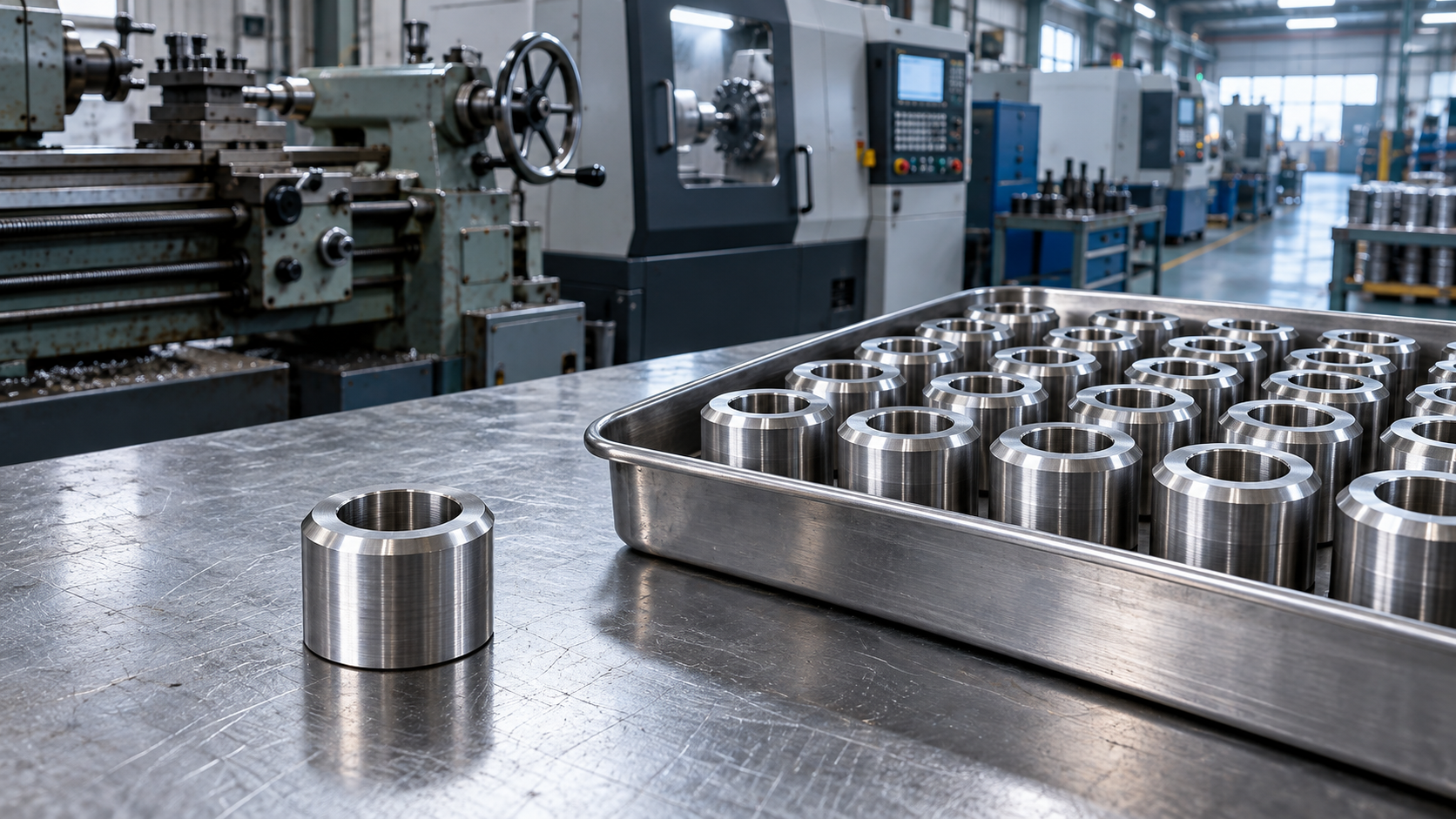
A drawing lands on your desk: a short steel spacer with a bore, two faced ends, and a chamfer. Nothing about it looks difficult. Yet choosing the machine is not quite as simple as choosing the process. One piece needed today, twenty pieces needed next week, and twenty pieces ordered every month can justify three different production decisions.
For evaluators asking “is metal lathe better than CNC lathe for simple parts,” the first distinction is terminology: both machines can cut metal. The useful comparison is a manual metal lathe versus a CNC lathe. Batch size matters because it determines how much programming, setup, inspection, and operator time each finished part must carry.
Manual turning can be the practical choice for a straightforward one-off. CNC turning can become more economical as quantities grow or orders repeat. But there is no universal quantity at which the answer switches. The decision depends on the work required before the first acceptable part—and what happens during every cycle afterward.
“Simple” geometry does not always mean simple production
A plain shaft, bush, sleeve, or disc may require only basic turning operations. That does not automatically make it inexpensive to produce manually. The relevant question is how much attention and control the complete manufacturing route demands.
Consider two sleeves with similar outside dimensions. One needs a clearance bore and an ordinary turned finish. The other needs a closely controlled bore, consistent wall thickness, and a specified surface finish. Their drawings may look equally uncomplicated, but their machining and inspection requirements differ substantially.
Before comparing machines, establish:
- Features and handling: How many cuts, tool changes, reversals, and separate setups are required?
- Critical characteristics: Which dimensions, geometric tolerances, and finishes determine acceptance?
- Material behavior: Will the material create difficult chips, rapid tool wear, or distortion?
- Workholding: Can standard jaws hold the part safely without damaging or deforming it?
- Delivery pattern: Is this a single purchase, a trial batch, or recurring production?
These details explain why a manual lathe can be sensible for a large, uncomplicated repair component while CNC makes sense for a small batch of apparently basic precision sleeves.
Where batch size changes the economics
Manual and CNC turning distribute effort differently. Manual production often starts with less preparation, but the operator remains closely involved in each piece. CNC production usually requires more preparation, then repeats an established cutting sequence with less direct intervention.
The table describes tendencies, not guaranteed outcomes. A CNC lathe with conversational programming and tools already installed may be ready quickly. A manual job requiring special tooling or awkward alignment may take longer to prepare than expected.
Compare the actual production routes, not an ideal manual process against a poorly prepared CNC process—or the reverse.
A break-even calculation worth using
For an initial comparison, express total batch cost as:
Total batch cost = fixed preparation cost + quantity × variable cost per acceptable part.
Preparation includes programming, setup, special workholding preparation, and first-piece approval. Variable cost includes the recurring machining, handling, tooling, and inspection costs, with an allowance for expected scrap or rework. Material can be excluded from a preliminary comparison only when its cost and yield are genuinely equivalent.
If CNC has higher preparation cost but lower variable cost, the simplified break-even quantity is:
Break-even quantity = (CNC preparation cost − manual preparation cost) ÷ (manual variable cost − CNC variable cost).
The denominator must be positive for this relationship to produce a meaningful crossover. If CNC does not reduce variable cost, increasing quantity alone will not make it cheaper under these assumptions.
A time-only illustration makes the mechanism clearer. Suppose manual preparation takes 20 minutes and each part takes 8 minutes, while CNC preparation takes 80 minutes and each part takes 3 minutes. The additional 60 minutes of CNC preparation are recovered after 12 parts because each cycle saves 5 minutes. These are illustrative assumptions, not industry benchmarks.
That is a time crossover, not necessarily a cost crossover. Different machine rates, operator involvement, tooling consumption, and inspection requirements can move the economic break-even point considerably.
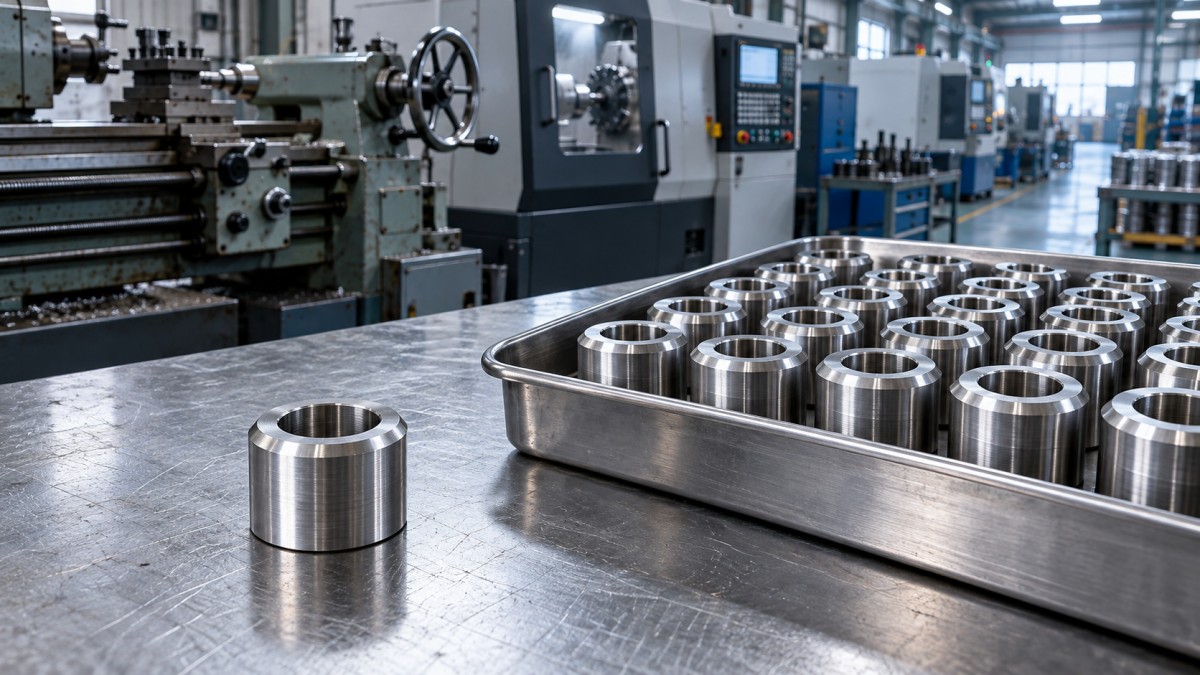
How the choice shifts across production scenarios
One-off work: preparation and uncertainty dominate
For a single spacer, repair shaft, or modified component, a manual lathe often deserves serious consideration. An experienced machinist can take measurements, make a cut, check the fit, and adjust without building a program for a sequence that may never repeat.
This is especially useful when the final dimension depends on a mating part rather than a fully defined drawing. The ability to work incrementally has practical value.
However, “one part means manual” is too rigid. CNC may still be preferable when the part includes a controlled taper, a demanding thread, several closely related diameters, or an existing proven program. Available machine capacity also matters: waiting for a manual specialist can erase an apparent setup advantage.
Small batches: count interventions, not just pieces
Small batches create the most difficult comparisons. Manual production avoids some programming overhead, but repeated tool changes, measurements, and hand-controlled movements can accumulate quickly.
Watch the full sequence. Does the operator repeatedly stop to establish a shoulder position? Are several diameters checked on every piece? Must the part be reversed and indicated again? These interventions may matter more than cutting time.
CNC becomes attractive when one setup can execute several operations consistently. Manual turning remains competitive when the work involves very few cuts, forgiving requirements, and minimal handling. A process trial or detailed cycle estimate is more reliable than a rule such as “CNC starts paying at fifty pieces.”
Larger batches: repeatability matters, but handling can become the bottleneck
As quantity increases, CNC preparation is spread across more parts. Programmed feeds, tool positions, and cutting sequences reduce dependence on repeated manual execution. Tool offsets also provide a structured way to compensate for wear.
Still, automatic cutting does not equal automatic production. Loading blanks, clearing chips, deburring, measuring, and unloading may dominate a short cycle. A bar feeder, parts catcher, or suitable tending system can change the economics, but its compatibility, setup effort, and cost must be included.
For sustained production, evaluate output over a realistic shift, including tool changes and inspection—not simply the fastest observed cycle.
Tolerances and labor can outweigh the quantity advantage
A capable manual machinist can produce accurate parts. CNC does not create accuracy merely by being computer-controlled. Machine condition, workholding, thermal behavior, tool condition, and measurement practice affect both routes.
The stronger CNC advantage is often repeatable execution of a controlled process. Maintaining consistent shoulder positions and diameter relationships across many components is different from making one excellent piece.
For technical evaluation, separate three questions:
- Can the machine and setup achieve the specification?
- Can the process maintain it throughout the batch?
- What inspection effort is needed to demonstrate compliance?
A nominally cheaper route may lose its advantage if it requires extensive checking or creates more rework. Conversely, a capable manual process may be entirely adequate for a loose-tolerance component, making additional automation unnecessary.
Labor calculations need similar care. A CNC machine running for several minutes does not automatically release those minutes for other productive work. Shared tending depends on safe access, stable chip control, compatible cycle lengths, inspection duties, and nearby work that can actually be performed.
Separate machine occupancy from attended labor time. Use shop rates consistently so that labor is not counted twice. If a machine rate already includes an operator allowance, adding full labor again can distort the comparison.
Repeat orders change the meaning of batch size
An order for ten parts may look like a manual job until purchasing confirms that it returns every month. The first CNC batch carries development work; later batches may reuse the program, tool list, jaw arrangement, and inspection plan.
Evaluate both the current release quantity and the credible repeat volume. Keep confirmed demand separate from optimistic forecasts. An uncertain future order should not automatically justify extensive preparation today.
Repeatability also depends on documentation. A saved program alone is not a production-ready process. Useful records include workholding details, tool identification, offsets or setting methods, material specification, inspection requirements, and approved revisions.
Small repeat batches still incur setup and first-piece checks. If switching between jobs takes substantial time, annual volume cannot simply be treated as one uninterrupted production run. Compare the expected sequence of releases, including changeovers and storage of dedicated tooling.
Make the selection using evidence from your shop
Before approving either route, build a short comparison using the same drawing revision, material condition, quality requirements, and delivery quantity. Ask the process planner or supplier to show:
- Preparation scope: Programming, workholding, tool preparation, prove-out, and first-piece inspection.
- Complete cycle: Cutting, loading, unloading, repositioning, deburring, and routine measurement.
- Resource assumptions: Machine occupancy, attended labor, and any justified shared tending.
- Quality exposure: Likely wear adjustments, scrap risk, rework, and inspection frequency.
- Repeat-order conditions: What can be reused and what must be repeated at every release.
Run the comparison at several realistic quantities rather than requesting a single unit price. Where estimates are uncertain, test a range of setup and cycle times. If a modest change reverses the result, a short trial is more useful than false numerical precision.
The final choice should also account for delivery and capacity. A small theoretical saving may not justify occupying a CNC lathe needed for more demanding work. Equally, choosing manual turning can be expensive if it ties up the only machinist able to solve urgent production problems.
For simple parts, manual turning is often strongest when preparation is minimal, quantities are low, and hands-on adjustment is valuable. CNC turning gains ground when repeated operations, consistency, reusable setups, and credible production volume outweigh its preparation burden. The right machine is the one that delivers acceptable parts at the lowest realistic total cost—not the one associated with a particular batch-size rule.
NEXT ARTICLE
Recommended for You
![]() Mitsubishi Electric Announces Physical AI System Linking Humanoid Robots and CNC MachinesMachine Tool Industry Editorial Team
 Precision Machining for Defense: Supplier Quality and Traceability ChecksManufacturing Market Research Center
![]() Nidec Machine Tool Launches MVR-5X Five-Axis Gantry MachineMachine Tool Industry Editorial Team
 Choosing a Precision Disc Parts Manufacturer in China: Tolerances and Quality ChecksManufacturing Market Research Center
![]() Siemens Executive Says AI Could Raise Factory Automation to 80%Manufacturing Market Research Center
 Choosing Automated Machine Tools for High-Mix, Low-Volume ProductionMachine Tool Industry Editorial Team


Aris Katos
Future of Carbide Coatings
15+ years in precision manufacturing systems. Specialized in high-speed milling and aerospace grade alloy processing.
▶
Manual vs. CNC Lathe for Simple Parts: How Batch Size Affects the ChoiceCNC Machining Technology Center▶
How to Select a CNC Metal Lathe for Tight-Tolerance Shaft and Sleeve PartsCNC Machining Technology Center▶
CNC Lathe Quick Installation Guide: Alignment Checks Before First Production RunCNC Machining Technology Center▶
How to Select a CNC Lathe for Small Parts Without Sacrificing Accuracy or Cycle TimeCNC Machining Technology Center▶
How to Select a Slant Bed Lathe for High-Precision Shaft and Chuck WorkCNC Machining Technology Center
▶
Mastering 5-Axis Workholding Strategies
Join our technical panel on Nov 15th to learn about reducing vibrations in thin-wall components.

Providing you with integrated sanding solutions
Before-sales and after-sales services
Comprehensive technical support