• Global CNC market projected to reach $128B by 2028 • New EU trade regulations for precision tooling components • Aerospace deman
NYSE: CNC +1.2%LME: STEEL -0.4%

How to Choose a CNC Machine for Small-Batch vs Mass Production
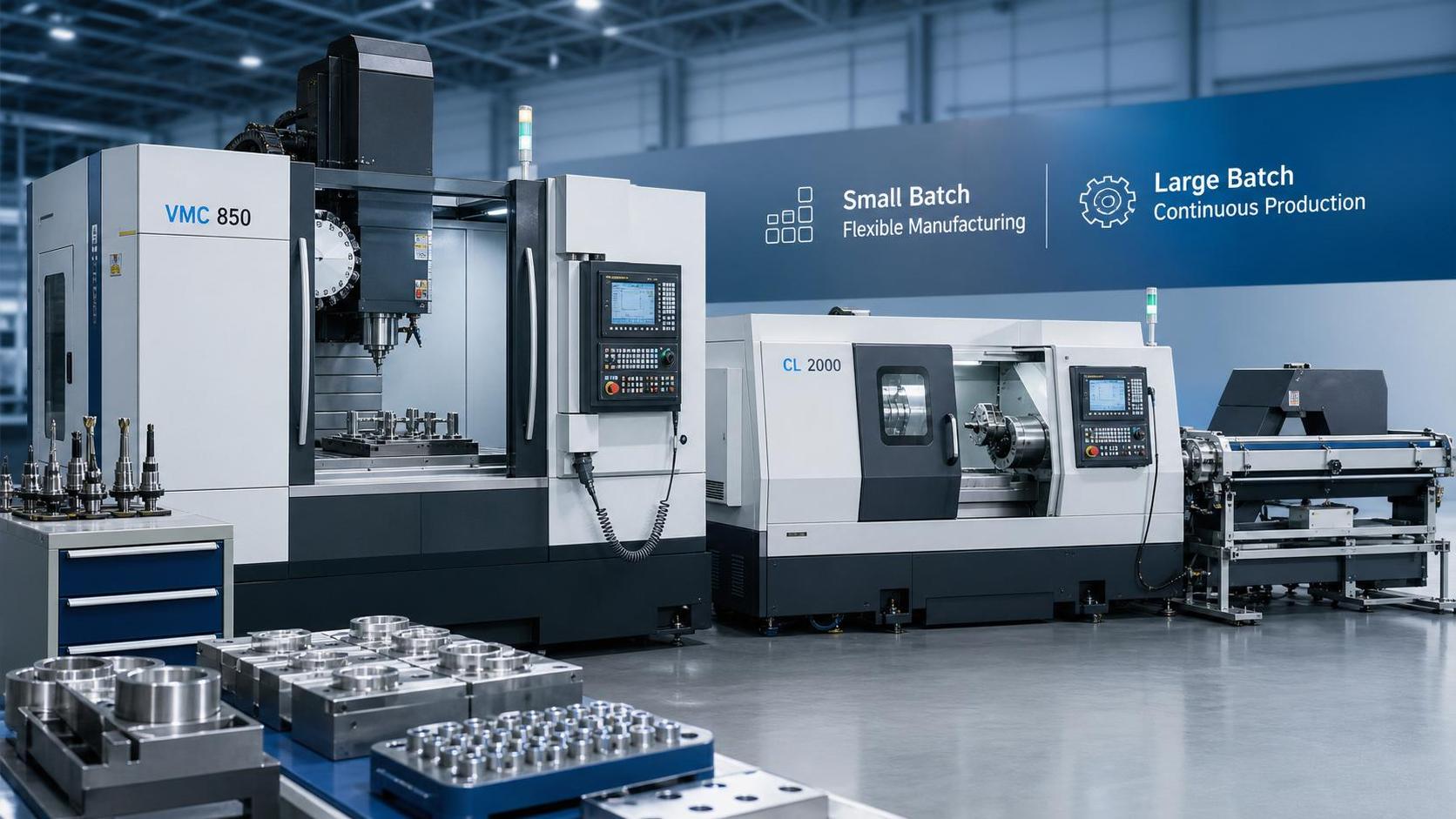
Why the Production Context Changes the Right CNC Machine
Choosing a CNC Machine is rarely about buying the most advanced model.
The real decision starts with production volume, part mix, tolerance targets, and delivery pressure.
A machine that performs well in small-batch work may become expensive in mass production.
The opposite is also true.
A highly automated CNC Machine built for long, stable runs can lose efficiency when orders change every week.
This matters more today because manufacturing is moving toward tighter precision, faster turnaround, and deeper digital integration.
Across automotive, aerospace, energy equipment, and electronics, machine tool investments now shape both cost structure and operational flexibility.
A sound selection process connects equipment capability with the economics of actual production.
Small-Batch and Mass Production Are Different Operating Models
Small-batch production usually involves frequent changeovers, mixed part families, and uneven order patterns.
In that setting, setup time often matters as much as spindle power.
A flexible CNC Machine helps reduce downtime between jobs and supports faster response to design changes.
Mass production follows a different logic.
Volumes are higher, part variation is lower, and repeatability becomes the main driver of margin.
Here, cycle time, automation stability, and tool life consistency usually outweigh broad flexibility.
That distinction sounds simple, but many purchasing mistakes happen when both models are treated the same.
Where the cost structure shifts
For small batches, hidden costs often sit in programming, fixture changes, idle time, and operator intervention.
For mass production, hidden costs usually appear in bottlenecks, scrap at scale, and unplanned stoppages.
The right CNC Machine should address the dominant cost source, not just the purchase price.
Machine Types Should Match Part Complexity and Output Rhythm
The machine category often narrows the decision faster than brand comparisons.
CNC lathes suit rotational parts, shafts, bushings, and threaded components.
Vertical machining centers are common for prismatic parts and general-purpose milling work.
Horizontal machining centers usually make more sense when throughput, chip evacuation, and pallet-based automation are priorities.
Multi-axis systems become valuable when part geometry is complex and secondary operations are costly.
In practice, part geometry and output rhythm should be evaluated together.
A versatile machine that covers many processes can be the better business choice for mixed production.
For stable long runs, specialized equipment often delivers better unit economics.
Automation Level Changes the Investment Logic
Automation is no longer limited to very large factories.
Robotic loading, pallet changers, tool monitoring, and digital production tracking are becoming standard evaluation points.
Still, the right automation level depends on order behavior.
For small-batch environments
Light automation is often more effective than a fully integrated cell.
Quick-change fixtures, offline programming, and tool presetting may create more value than complex robotics.
A CNC Machine should make changeovers predictable and reduce dependence on manual adjustments.
For mass production lines
Automation usually has a stronger return because the same cycle repeats for long periods.
Bar feeders, gantry loading, in-process gauging, and automated tool compensation can improve consistency at scale.
When output commitments are high, a CNC Machine that integrates smoothly into a production line becomes strategically important.
Precision Requirements Should Be Linked to Commercial Reality
High precision is valuable, but overbuying precision can weaken return on investment.
The better question is how much accuracy is truly required over the full production cycle.
In aerospace or electronics, thermal stability, repeatability, and surface finish may justify a premium CNC Machine.
In less demanding applications, that premium may not convert into stronger margins.
Precision also depends on the surrounding system.
Cutting tools, fixtures, programming quality, coolant control, and maintenance discipline influence final results as much as the machine itself.
That is why machine selection should be treated as part of a production ecosystem, not as a standalone hardware purchase.
What to Compare Before Making a Final Decision
A useful comparison framework keeps attention on operational fit.
Vendor presentations tend to highlight maximum capabilities.
The better evaluation looks at repeatable day-to-day performance.
- Cycle time under real cutting conditions, not only dry-run data.
- Setup and fixture change time across different part families.
- Tool magazine capacity and accessibility for mixed jobs.
- Software compatibility with existing CAD, CAM, and MES tools.
- Spare parts support, service response, and local technical coverage.
- Power consumption, maintenance intervals, and operator training needs.
- Scalability for future automation or additional production cells.
This is especially relevant in global manufacturing networks.
Suppliers in China, Germany, Japan, and South Korea offer different strengths in cost, precision, standardization, and support structure.
Comparing only initial quotation can hide important operational differences.
A Practical Way to Align Equipment With Growth Plans
The strongest CNC Machine decision usually comes from a phased view.
Start with current part demand, then test how that demand may change over two to five years.
If order patterns are still uncertain, flexibility should carry more weight.
If contracts point to stable volume, throughput and automation deserve higher priority.
Questions worth settling early
- Will the machine run many part numbers or only a few core products?
- Is lead time pressure driven by setup delays or machining capacity?
- Will quality risk increase sharply when volume rises?
- Can the selected CNC Machine connect to future smart factory plans?
- Is the expected payback based on realistic utilization rates?
These questions turn selection from a hardware discussion into a business decision.
That is the shift shaping the machine tool market today.
As digital integration, flexible lines, and precision demands continue to rise, the most effective CNC Machine is the one that fits both present workload and future operating model.
The next step is to map part types, annual volume bands, tolerance levels, and automation targets before comparing suppliers.
With that structure in place, equipment evaluation becomes clearer, faster, and more defensible.
Recommended for You
 Manufacturing Technology Trends That Improve Throughput and Quality ControlManufacturing Market Research Center
 How to Design Cost-Effective Fixtures That Maintain Cycle Time in Mass ProductionCNC Machining Technology Center
 Is Learning CNC Programming Worth It for Shop Owners Seeking Higher Margins?CNC Machining Technology Center
 CNC Machine Arrival Inspection: Check Shipping Damage, Accuracy, Safety, and DocumentsCNC Machining Technology Center
 How to Select a Machine Tool for Aerospace Parts with Tight Tolerances?Machine Tool Industry Editorial Team
 How to Select CNC Equipment for High-Mix, Low-Volume ProductionCNC Machining Technology Center

Aris Katos
Future of Carbide Coatings
15+ years in precision manufacturing systems. Specialized in high-speed milling and aerospace grade alloy processing.
▶
Is Learning CNC Programming Worth It for Shop Owners Seeking Higher Margins?CNC Machining Technology Center▶
How to Select CNC Equipment for High-Mix, Low-Volume ProductionCNC Machining Technology Center▶
Can CNC Machining Inconel Control Tool Wear in High-Temperature Aerospace Parts?CNC Machining Technology Center▶
How Automated Precision Machining Maintains Tolerance in High-Mix ProductionCNC Machining Technology Center▶
CNC Programming Explained: From CAD Models to Reliable Shop-Floor ToolpathsCNC Machining Technology Center
Mastering 5-Axis Workholding Strategies
Join our technical panel on Nov 15th to learn about reducing vibrations in thin-wall components.

Providing you with integrated sanding solutions
Before-sales and after-sales services
Comprehensive technical support