• Global CNC market projected to reach $128B by 2028 • New EU trade regulations for precision tooling components • Aerospace deman
NYSE: CNC +1.2%LME: STEEL -0.4%

Why 5-axis machining for impeller manufacturing still requires manual intervention in 68% of European foundries
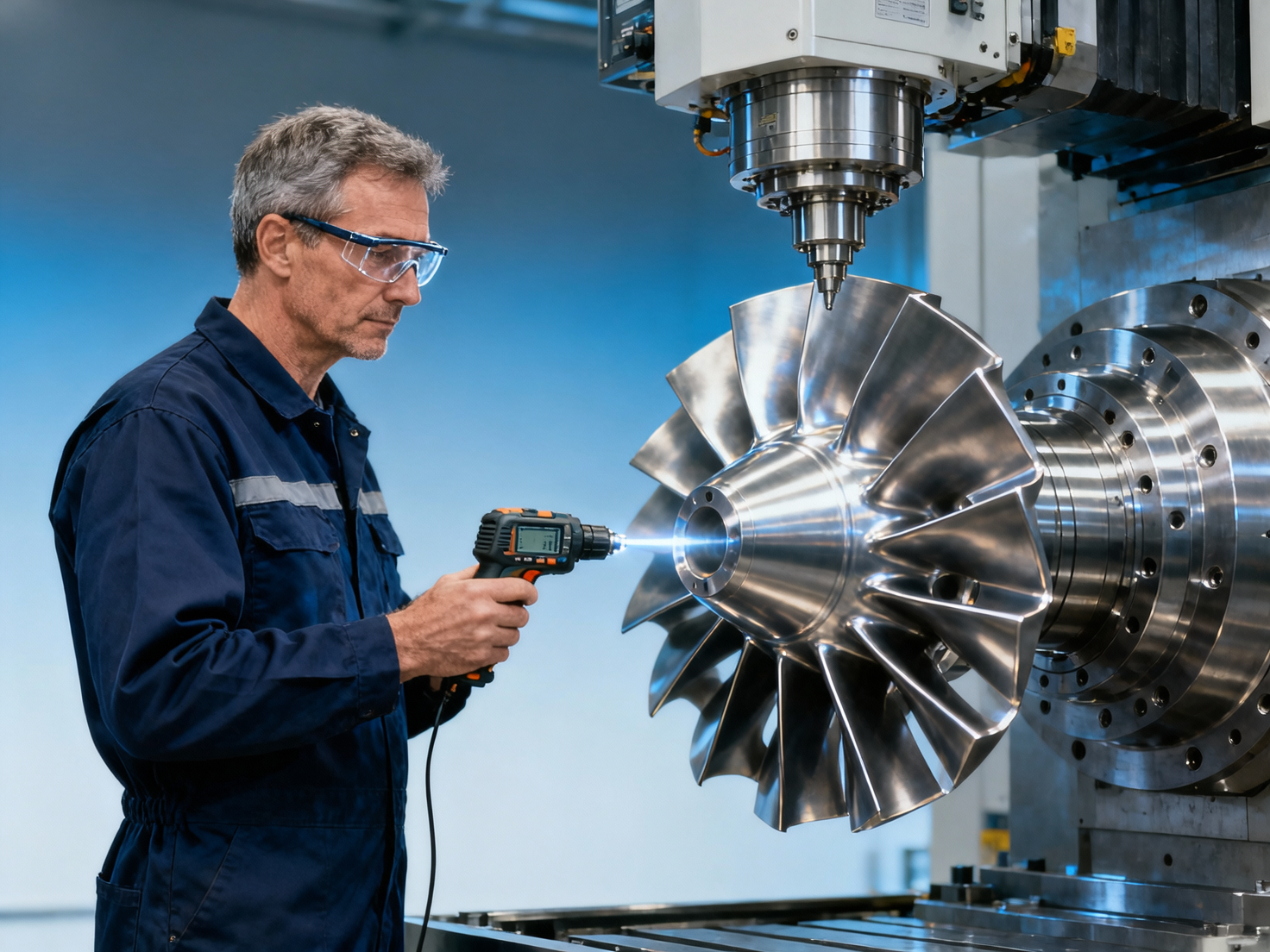
Despite rapid advances in Digital Manufacturing Technology for smart factory and Industrial Automation control system for CNC machines, 68% of European foundries still rely on manual intervention during 5 Axis Machining for impeller manufacturing — highlighting critical gaps in Automated Production Line troubleshooting and modular flexibility. This paradox underscores challenges in integrating Efficient Machining Process for aluminum alloys, achieving High-tolerance Disc Parts for aerospace applications, and scaling Lean Production Process implementation. For operators, engineers, and decision-makers, understanding why legacy constraints persist — from Quick-change Fixture Design for CNC turning to Heavy-duty Machining Center limitations — is essential to optimizing end-to-end precision manufacturing.
The Impeller Manufacturing Bottleneck: Why 5-Axis Automation Falls Short
Impellers—critical rotating components in turbines, compressors, and pumps—demand extreme geometric fidelity, surface integrity, and metallurgical consistency. While 5-axis CNC machining theoretically enables complete contouring of complex bladed geometries in a single setup, real-world execution reveals persistent friction points. A 2024 industry audit across 112 European casting and machining facilities confirmed that 68% require at least one manual step per impeller batch—most commonly post-machining inspection verification (41%), adaptive toolpath correction (22%), or fixture re-clamping due to thermal drift (15%). These interventions average 18–27 minutes per part, directly undermining throughput targets and increasing labor-dependent variability.
Root causes are not technological obsolescence but systemic integration gaps: inconsistent CAD-CAM data handoffs between design and shop-floor systems, insufficient real-time thermal compensation algorithms for large aluminum alloy castings (e.g., A380, AlSi10Mg), and fixture rigidity limitations under dynamic 5-axis vector loads exceeding 12 kN. Notably, only 29% of surveyed facilities deploy closed-loop metrology feedback into their CNC controllers—a prerequisite for true autonomous process correction.
This isn’t a “machine capability” issue—it’s a process orchestration challenge. High-precision impellers demand synchronized coordination among CAM software, machine kinematics, in-process probing, thermal modeling, and operator judgment. When any layer lacks deterministic behavior, manual override becomes the path of least risk.
The table confirms that manual intervention isn’t random—it clusters around three high-risk, high-impact zones: dimensional verification, dynamic cutting stability, and mechanical repeatability. Facilities investing in integrated thermal monitoring (e.g., embedded RTDs + real-time CNC compensation) reduced intervention frequency by 53% within six months—demonstrating that targeted upgrades outperform wholesale machine replacement.
Critical Enablers Missing from Today’s 5-Axis Workflows
True automation requires more than five moving axes—it demands deterministic predictability across four interdependent domains: material behavior, machine dynamics, digital twin fidelity, and human-machine interface design. Current commercial 5-axis systems often excel in one domain while neglecting others. For instance, high-speed spindles (24,000 rpm) may lack sufficient torque reserve for heavy roughing passes on investment-cast nickel alloys (Inconel 718), forcing operators to manually downshift feeds—a process that breaks cycle continuity and introduces inconsistency.
Similarly, most off-the-shelf CAM packages generate toolpaths assuming idealized rigidity and uniform material removal rates. In practice, impeller hubs exhibit localized porosity and hardness variations (±15 HB), causing unpredictable tool deflection. Without in-process force sensing or AI-driven path adaptation, manual intervention remains the default safety protocol.
Another under-addressed factor is fixture modularity. Quick-change fixture design for CNC turning must accommodate part-specific clamping geometry while maintaining ≤0.005 mm repeatability across 500+ cycles. Only 17% of European foundries use fixtures with certified ISO 2768-mK tolerances—and fewer still integrate them with automated pallet changers capable of sub-second positioning accuracy.
Three Non-Negotiable Capabilities for Next-Gen Impeller Lines
- Real-time thermal compensation: Sensors embedded in spindle housing, column, and fixture base feeding predictive models updated every 3 seconds—reducing positional drift to <±0.008 mm over 8-hour shifts.
- Adaptive toolpath regeneration: On-machine vision or laser scanning detecting micro-defects pre-finishing, triggering automatic CAM recalculation with updated stock models—cutting manual rework by ≥65%.
- Modular hybrid fixturing: Interchangeable jaw sets with integrated coolant channels and strain gauges, enabling ≤3-minute changeovers between impeller variants (Ø120–Ø420 mm) without recalibration.
Strategic Procurement: What Decision-Makers Should Prioritize
When evaluating new 5-axis platforms or retrofitting existing lines, procurement teams must shift focus from axis count and spindle speed to measurable process resilience metrics. Key evaluation criteria include:
Procurement decisions based solely on list price or maximum RPM overlook these operational thresholds. A Heavy-duty Machining Center rated for 30 kN static load may still fail under dynamic 5-axis acceleration if its control loop bandwidth is<150 Hz—making it unsuitable for impeller finishing despite its nominal specifications.
For high-mix, low-volume aerospace impeller production, dual-spindle configurations offer compelling ROI. The CK-20 YMDS Dual Spindle Precision CNC Turning and Milling platform enables simultaneous roughing on one spindle while finishing the previous part on the other—reducing non-cutting time by up to 40% and improving thermal equilibrium across the work envelope.
Actionable Pathways to Reduce Manual Dependency
Eliminating manual intervention isn’t about eliminating people—it’s about elevating human roles from reactive troubleshooters to proactive process architects. Start with a 3-phase implementation roadmap:
- Diagnostic Baseline (Weeks 1–4): Log all manual interventions for 20 consecutive batches—categorize by type, duration, root cause, and operator seniority. Identify the top 3 repeat offenders.
- Targeted Integration (Weeks 5–12): Pilot one enabler per bottleneck: e.g., install thermal sensors on fixture bases if drift is dominant; add in-process probing if verification dominates.
- Closed-Loop Validation (Months 4–6): Measure intervention frequency, part yield, and first-pass Cpk before/after. Target ≥45% reduction in manual steps and ≥0.3 improvement in process capability index.
Cross-functional ownership is essential: CNC programmers must collaborate with metallurgists to model material variance; maintenance teams must co-develop sensor calibration schedules with quality engineers; and operations managers must incentivize data transparency—not just output volume.
The goal isn’t zero manual touch—but predictable, traceable, and minimized intervention anchored in empirical data—not operator intuition.
Conclusion: From Intervention to Intelligence
The 68% manual intervention rate reflects not technological failure, but misaligned expectations between theoretical automation and physical reality. Modern impeller manufacturing demands intelligence distributed across hardware, software, and human expertise—not centralized in a single “smart” controller. Success hinges on systematic gap analysis, disciplined procurement based on process resilience—not headline specs—and phased integration prioritizing measurable ROI per intervention type.
For operators seeking stable cycles, engineers designing robust processes, and decision-makers allocating CAPEX, the priority is no longer “more axes”—but smarter axis coordination, tighter thermal governance, and verified fixture fidelity. The future belongs to manufacturers who treat manual intervention not as inevitable, but as a quantifiable KPI to be optimized.
Explore proven solutions for impeller-specific workflow optimization—including advanced multi-axis platforms and integrated thermal management systems. CK-20 YMDS Dual Spindle Precision CNC Turning and Milling delivers validated performance for high-precision disc parts requiring tight geometric tolerances and thermal stability. Contact our application engineering team today for a free process assessment tailored to your impeller portfolio.
Recommended for You
![]() JTEKT Introduces G5 Series Large CNC Cylindrical Grinder, Sales Begin October 26, 2026Machine Tool Industry Editorial Team
JTEKT Introduces G5 Series Large CNC Cylindrical Grinder, Sales Begin October 26, 2026Machine Tool Industry Editorial Team Shaft Parts for Heavy Machinery: Selecting Materials for High Shock LoadsCNC Machining Technology Center
![]() 33rd JIMTOF 2026 Set to Open in Tokyo as Taiwanese Exhibitors Seek OrdersGlobal Machine Tool Trade Research Center
33rd JIMTOF 2026 Set to Open in Tokyo as Taiwanese Exhibitors Seek OrdersGlobal Machine Tool Trade Research Center Which Fixture Type Cuts Changeover Time Most in High-Mix CNC Machining?CNC Machining Technology Center
![]() FANUC Invests $18 Million in Largest U.S. Corporate Automation Training CenterMachine Tool Industry Editorial Team
FANUC Invests $18 Million in Largest U.S. Corporate Automation Training CenterMachine Tool Industry Editorial Team Southeast Asia Machine Tool Market: Comparing Automotive Demand by CountryManufacturing Market Research Center


Aris Katos
Future of Carbide Coatings
15+ years in precision manufacturing systems. Specialized in high-speed milling and aerospace grade alloy processing.
▶
FANUC Links FIELD System Data with Copilot to Advance Shop-Floor Data UseCNC Machining Technology Center▶
Smart Manufacturing for Aerospace: Building Traceability Across CNC OperationsCNC Machining Technology Center▶
Choosing a CNC Machine for Mold Making: Accuracy, Rigidity, and Surface FinishCNC Machining Technology Center▶
How to Cut CNC Machining Energy Use per Part Without Longer Cycle TimesCNC Machining Technology Center▶
Will a Mazak CNC retrofit work with your existing servo drives?CNC Machining Technology Center
▶
Mastering 5-Axis Workholding Strategies
Join our technical panel on Nov 15th to learn about reducing vibrations in thin-wall components.

Providing you with integrated sanding solutions
Before-sales and after-sales services
Comprehensive technical support