• Global CNC market projected to reach $128B by 2028 • New EU trade regulations for precision tooling components • Aerospace deman
NYSE: CNC +1.2%LME: STEEL -0.4%

How long does CNC machine delivery and installation usually take?
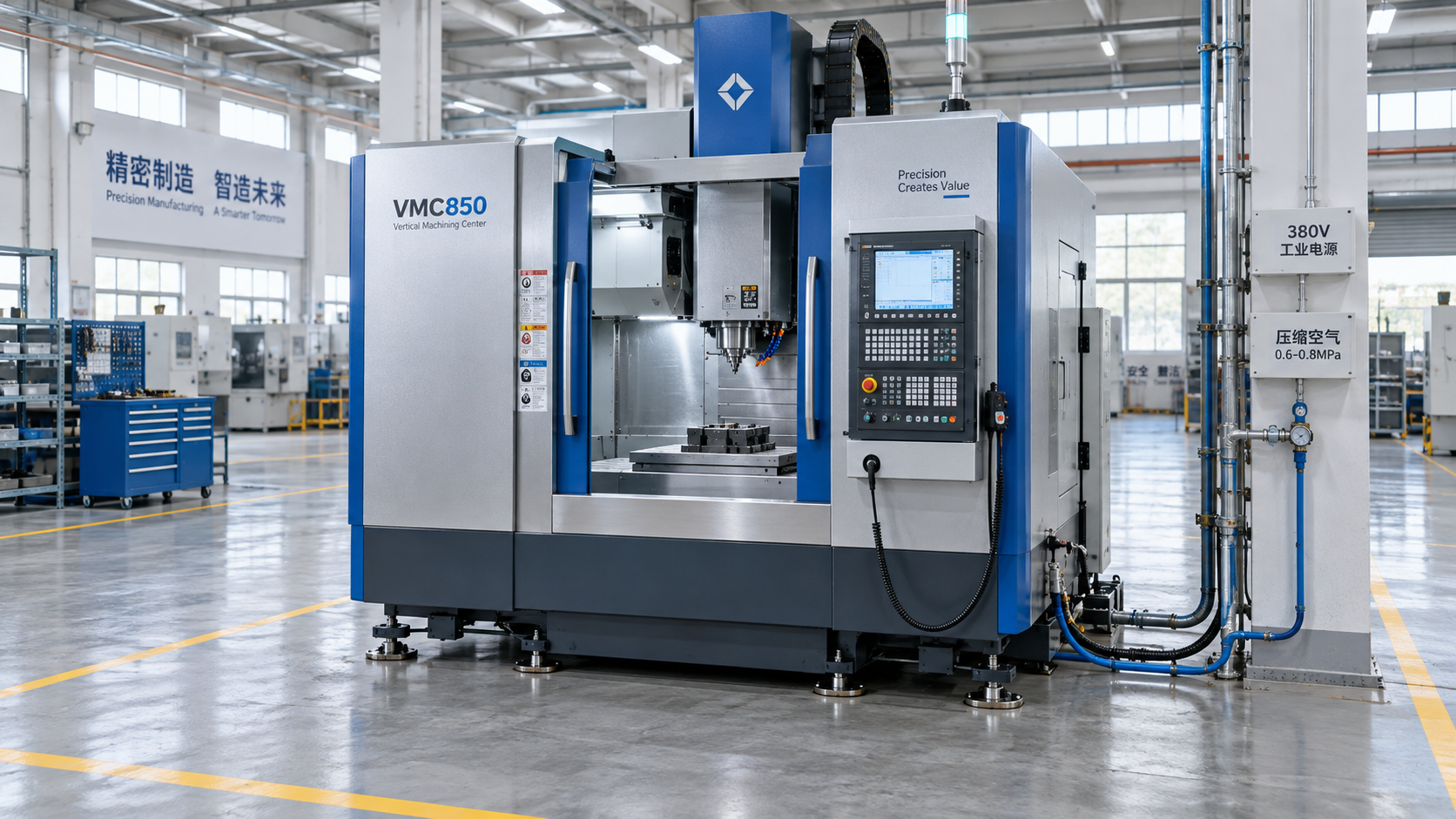
The purchase order is approved, the production team is looking ahead, and a customer’s next program already has a launch date. Then comes the question that can reshape the entire project schedule: what's the typical lead time to get a new CNC machine delivered and installed?
For early planning, an available machine supplied locally may be delivered and commissioned within a few weeks. A standard machine built to order often requires several months, while a customized multi-axis system or automated machining cell can take six to twelve months or longer. These are broad planning ranges, not supplier commitments. Machine availability, configuration, transport, site preparation, and acceptance requirements all affect the actual date.
The most important distinction is between arriving at your facility and being ready to produce acceptable parts. For project managers, the second milestone is usually the one that matters.
A practical starting point for CNC machine lead times
Before a supplier confirms a schedule, the following ranges can help frame a preliminary discussion. They assume reasonably straightforward procurement and a prepared installation site; unusual specifications, constrained components, or difficult logistics can extend them substantially.
Do not treat these ranges as market averages or guaranteed delivery windows. A particular supplier may have the right machine available immediately, or a production slot far beyond these estimates. Confirm availability for the exact configuration, not merely the model family.
Also check what “commissioned” means in the quotation. Basic machine startup may be included, while process development, robot integration, and production qualification are separate activities.
One delivery date can conceal several different milestones
A quotation stating “delivery in 16 weeks” is incomplete unless it identifies where that period starts and ends. Does the clock begin at purchase order receipt, deposit payment, or final technical approval? Does delivery mean factory release, arrival at a port, or placement on your shop floor?
A useful project schedule separates these milestones:
- Configuration approval: machine specifications, options, interfaces, and acceptance criteria are agreed.
- Factory completion: the equipment is assembled and ready for testing.
- Shipment release: testing, documentation, payment conditions, and packing are complete.
- Site arrival and positioning: the machine reaches the facility and is moved into place.
- Installation and commissioning: connections, alignment, safety checks, and functional testing are completed.
- Production acceptance: the agreed machining process demonstrates the required results.
These milestones prevent an easy misunderstanding: procurement reports an on-time shipment while manufacturing still cannot run the planned job. Neither team is necessarily wrong; they may simply be measuring different endpoints.
Where the waiting time usually sits
Machine availability and configuration
An in-stock CNC machine offers the shortest route only if it matches the application. Adding a different controller, rotary table, probing package, high-pressure coolant system, or automation interface may require engineering work, components, and additional testing.
For built-to-order equipment, the factory schedule is usually the largest part of the lead time. Assembly capacity and availability of controls, drives, spindles, and other critical components can all influence completion. Ask whether the quoted date reflects an allocated production slot or a preliminary estimate.
A standard three-axis machining center generally involves fewer integration tasks than a five-axis system connected to pallet handling, robotic loading, and production-management software. However, complexity alone does not determine availability: a distributor may already hold a suitable advanced machine in stock.
Transport and import clearance
Domestic road transport may take only days once the machine is released, but booking suitable vehicles and rigging crews can add waiting time. International delivery also includes export packing, inland movements, port handling, ocean or air transport, customs clearance, and final delivery.
For ocean freight, allow for a journey measured in weeks rather than assuming the vessel’s sailing time represents the entire process. Route, service frequency, transshipment, and border procedures make a material difference.
Clarify the agreed Incoterm and named location. They help define transport responsibilities, costs, and risk transfer, but do not automatically define installation obligations. Confirm who arranges unloading, insurance, customs documentation, and movement from the receiving area to the machine’s final position.
Service-team availability
The machine may be ready before the installer is. Supplier technicians, control specialists, and automation engineers often serve several projects, particularly across international markets.
Reserve a provisional commissioning window early, then agree how it will be updated as shipment information becomes firmer. This avoids discovering that the next available engineer is several weeks away after the equipment has arrived.
How long does CNC machine installation take after arrival?
For a conventional CNC lathe or machining center at a prepared site, physical installation and basic commissioning may take around two to five working days. Larger machines, demanding accuracy requirements, or more involved configurations may require one to three weeks or longer. These are working estimates; the manufacturer’s installation procedure should govern the plan.
The work is more than connecting power. It can include removing transport restraints, positioning, leveling, connecting utilities, filling specified fluids, checking lubrication, verifying safety functions, and testing machine operation. Depending on the equipment and contract, geometric checks, probing calibration, or thermal stabilization may also be required.
Automation changes the scope. Robot loading, pallet systems, conveyors, guarding, and interlocks must operate safely as a coordinated system. A machine that runs correctly by itself may still need substantial cell-level commissioning.
Operator training and production prove-out should appear separately in the schedule. Basic control training does not establish that a difficult aerospace component or high-volume automotive part can be produced consistently at the target cycle time.
The site-readiness work that protects your delivery date
A machine sitting on the shop floor can feel like progress. If the electrical supply is unfinished or the rigging route is blocked, however, it is simply expensive equipment waiting for the project to catch up.
Use the supplier’s installation drawings and utility specifications to check readiness before dispatch, not after arrival.
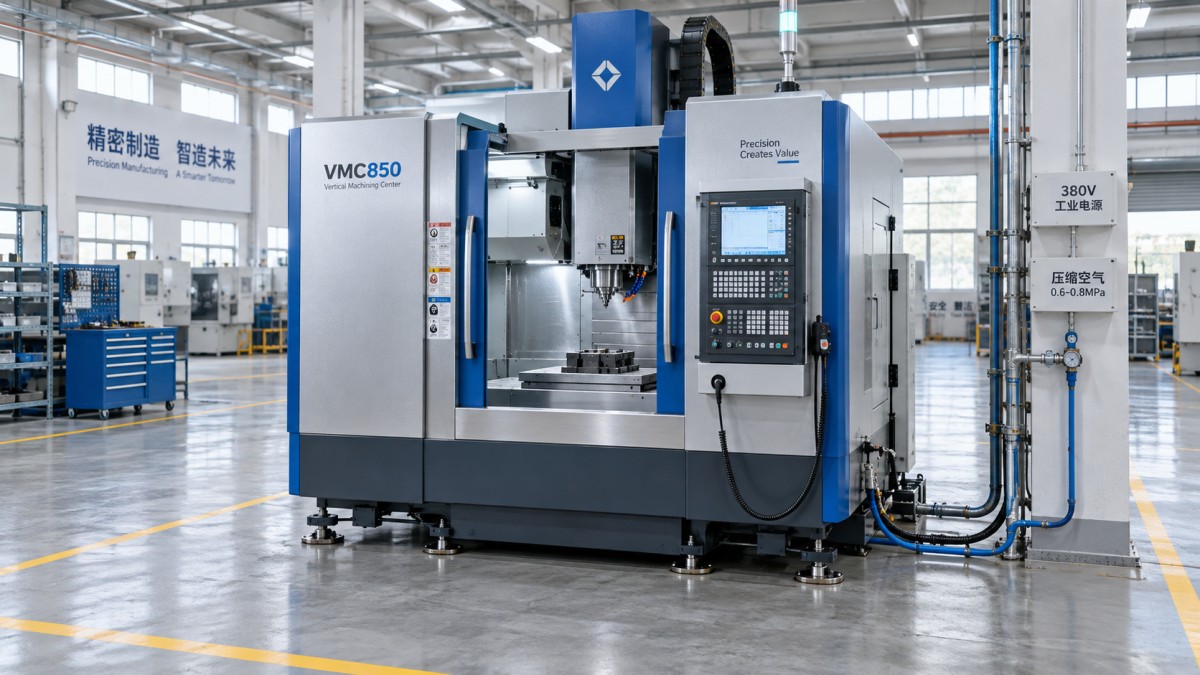
- Access and handling: verify shipping dimensions, machine weight, door clearances, overhead restrictions, turning space, and suitable lifting arrangements.
- Floor and foundation: confirm load capacity, support requirements, anchoring, and any specified foundation work. Not every CNC machine needs a special foundation.
- Electrical supply: check voltage, frequency, capacity, grounding, isolation, and any transformer requirements against manufacturer instructions and local rules.
- Compressed air and services: confirm the required pressure, flow, and air quality, plus coolant, extraction, drainage, or cooling arrangements where applicable.
- Working environment: consider temperature stability, vibration sources, maintenance access, chip handling, and safe operator movement.
- Digital connections: prepare approved network access, machine-data interfaces, cybersecurity permissions, and remote-support arrangements if required.
Assign an owner and completion date to each item. “Facilities is handling it” is not a sufficiently clear status when several contractors are involved. A readiness review with the supplier can expose missing details while there is still time to correct them.
Build the schedule backward from acceptable production
If the business needs qualified parts by a particular date, work backward from that requirement. Include time for process prove-out, operator preparation, installation, transport, factory testing, and manufacture.
Not every activity needs to happen sequentially. Tool selection, fixture design, CAM programming, site preparation, and training arrangements can often progress while the machine is being built. This overlap can shorten the overall project without forcing the supplier to compress essential checks.
For example, in a hypothetical machining-center project, the shipment arrives on schedule but the production fixture is still unfinished. Installation succeeds, yet part trials cannot begin. The machine supplier has met its milestone; the production launch is nevertheless delayed. A combined equipment-and-process schedule makes that dependency visible.
Add contingency where uncertainty actually exists rather than applying one arbitrary buffer to everything. International freight, foundation work, new automation interfaces, and unfamiliar machining processes may deserve different allowances. Discuss these allowances with the responsible teams and avoid presenting the earliest possible date as the committed launch date.
Define acceptance before ordering
Agree whether acceptance covers machine functionality, geometric performance, a specified test piece, or your actual production component. Define the measurement method, operating conditions, documentation, and responsibility for tooling and programs.
A factory acceptance test, where included, can identify issues before shipment. Site acceptance then verifies the agreed requirements after transport and installation. Neither should be assumed to include a complete production-capability study unless that scope is explicitly contracted.
For regulated or demanding applications, customer approval and internal quality validation may continue after supplier commissioning. Keep those activities visible rather than hiding them inside a vague “startup” milestone.
Questions to ask before committing to a launch date
A short, precise supplier conversation is more useful than repeatedly asking whether delivery can be faster:
- Is the quoted machine physically available, allocated to us, or still awaiting a production slot?
- Which approvals or payments trigger the lead-time clock?
- Does the promised date mean factory dispatch or arrival at our named site?
- Which options could change the schedule, and when must the configuration be frozen?
- Are unloading, rigging, installation, training, and acceptance included?
- What site conditions must be verified before the technician attends?
- Which current dependencies could move the date, and how will changes be reported?
Request a milestone schedule that connects the supplier’s responsibilities with your own. For overseas purchases, also confirm who provides local service and how specialist support will be arranged.
The date worth managing
CNC machine delivery and installation can take weeks for readily available equipment or many months for built-to-order systems. The reliable answer comes from matching the exact machine configuration to a confirmed supply schedule, realistic logistics, and a genuinely ready site.
For project managers, the strongest plan carries three distinct dates: arrival, commissioning completion, and production readiness. Keeping them separate makes dependencies easier to manage—and reduces the chance that an on-time delivery becomes a late production launch.
Recommended for You
![]() Mitsubishi Electric Announces Physical AI System Linking Humanoid Robots and CNC MachinesMachine Tool Industry Editorial Team
 Precision Machining for Defense: Supplier Quality and Traceability ChecksManufacturing Market Research Center
![]() Nidec Machine Tool Launches MVR-5X Five-Axis Gantry MachineMachine Tool Industry Editorial Team
 Choosing a Precision Disc Parts Manufacturer in China: Tolerances and Quality ChecksManufacturing Market Research Center
![]() Siemens Executive Says AI Could Raise Factory Automation to 80%Manufacturing Market Research Center
 Choosing Automated Machine Tools for High-Mix, Low-Volume ProductionMachine Tool Industry Editorial Team


Aris Katos
Future of Carbide Coatings
15+ years in precision manufacturing systems. Specialized in high-speed milling and aerospace grade alloy processing.
▶
What Is Metal Processing? From Raw Material to Finished Machine PartsCNC Machining Technology Center▶
How long does CNC machine delivery and installation usually take?CNC Machining Technology Center▶
CNC Machine Arrival Inspection: Check Shipping Damage, Accuracy, Safety, and DocumentsCNC Machining Technology Center▶
What Should You Check When a CNC Machine Arrives at Your Factory?CNC Machining Technology Center▶
What Safety Checks Are Required for CNC Cutting Operations?CNC Machining Technology Center
▶
Mastering 5-Axis Workholding Strategies
Join our technical panel on Nov 15th to learn about reducing vibrations in thin-wall components.

Providing you with integrated sanding solutions
Before-sales and after-sales services
Comprehensive technical support