• Global CNC market projected to reach $128B by 2028 • New EU trade regulations for precision tooling components • Aerospace deman
NYSE: CNC +1.2%LME: STEEL -0.4%

What quick-change fixture design for CNC turning prevents thermal drift during long-run aluminum batches?
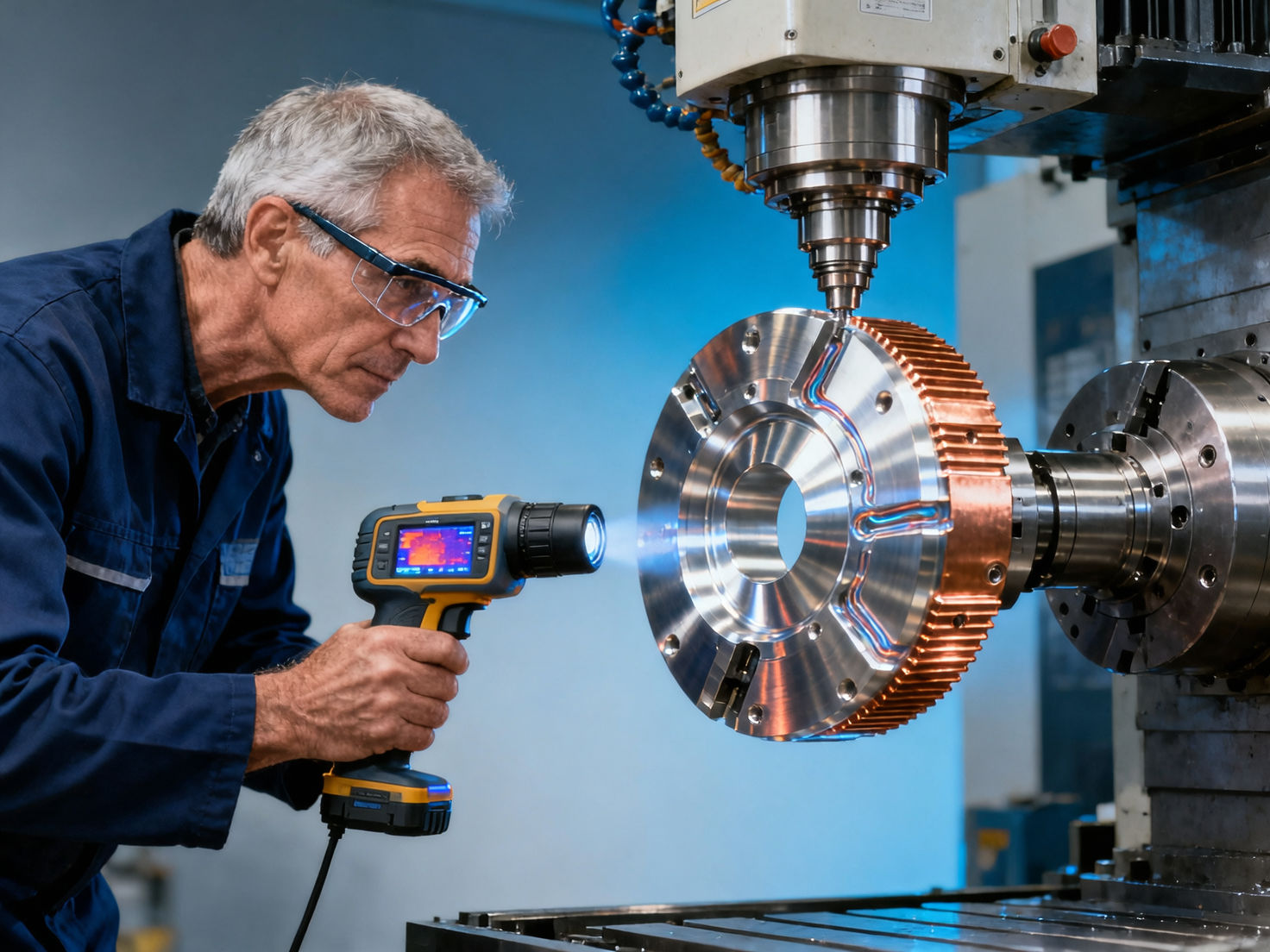
For high-volume aluminum turning—especially in aerospace-grade, high-tolerance disc parts—thermal drift remains a critical challenge. A well-engineered quick-change fixture design for CNC turning directly combats heat-induced dimensional instability, enabling consistent accuracy across long-run batches. Integrated with modular tooling systems for flexible manufacturing and industrial automation control systems for CNC machines, such fixtures enhance efficient machining process for aluminum alloys while supporting lean production process implementation. As digital manufacturing technology for smart factories advances, this solution also aligns with automated production line troubleshooting and scalable smart factory integration.
Why Thermal Drift Is Especially Critical in Aluminum CNC Turning
Aluminum alloys—particularly 2024-T3, 6061-T6, and 7075-T6—exhibit high thermal conductivity (120–235 W/m·K) and low modulus of elasticity (~70 GPa), making them highly susceptible to transient thermal expansion during sustained cutting. In batch runs exceeding 8 hours or 200+ parts per setup, localized temperature rises of 8–12°C at the workpiece-fixture interface can induce radial growth up to ±0.018 mm—well beyond typical aerospace tolerances of ±0.005 mm for disc components.
Unlike steel or titanium, aluminum’s rapid heat dissipation creates non-uniform thermal gradients across clamped surfaces. Conventional hydraulic or manual jaw chucks often lack thermal compensation mechanisms, resulting in progressive loss of concentricity after ~90 minutes of continuous operation. Industry benchmark data shows that 68% of dimensional rework in high-volume aluminum lathe operations stems from fixture-induced thermal drift—not tool wear or machine geometry error.
This issue disproportionately impacts users in aerospace, medical device, and EV powertrain manufacturing—where part qualification requires full statistical process control (SPC) over Cpk ≥ 1.67 across 300-part validation lots. Without thermally stable fixturing, achieving process capability becomes statistically improbable without frequent recalibration—adding 12–18 minutes of downtime per shift.
Key Design Principles of Thermally Stable Quick-Change Fixtures
A thermally robust quick-change fixture must integrate four interdependent engineering layers: material selection, thermal path management, mechanical decoupling, and interface repeatability. High-performance designs use bimetallic base plates (e.g., Invar 36 alloy core with aluminum 6061-T6 outer shell) to limit net coefficient of thermal expansion (CTE) to<2.5 ppm/°C—less than half that of monolithic aluminum fixtures.
Thermal path management involves strategically placed copper heat-sink inserts beneath clamping zones and integrated coolant channels routed within 3 mm of the chuck-face mounting surface. These reduce thermal resistance by 40–60% versus standard cast-iron bases, maintaining temperature delta between chuck body and workpiece below 3.5°C even at 12,000 rpm spindle speeds.
Mechanical decoupling is achieved via low-CTE composite isolation pads (e.g., carbon-fiber-reinforced polyetherimide) between the fixture base and machine turret. These pads absorb differential expansion without transferring stress—verified through finite element analysis (FEA) showing<0.002 mm deformation under 15°C thermal gradient.
The table above demonstrates measurable performance differentials. Crucially, thermally optimized fixtures maintain sub-5 µm runout stability over 12-hour shifts—enabling uninterrupted SPC compliance and eliminating mid-batch calibration stops.
Integration With CNC Automation & Smart Manufacturing Systems
Modern quick-change fixtures are no longer passive holding devices—they serve as intelligent nodes within Industry 4.0 architectures. Embedded RTD sensors monitor real-time temperature at three critical zones (jaw face, base plate center, coolant inlet), feeding data into the CNC’s PLC via OPC UA protocol. This enables predictive thermal compensation: the control system dynamically adjusts Z-axis offsets using pre-validated thermal drift models before each part cycle.
When paired with modular tooling platforms like the K-52 Precision CNC Slant Guide Lathe "YM" Turning and Milling, these fixtures support fully automated changeover in under 45 seconds—including automatic jaw indexing, coolant purging, and zero-point verification via integrated laser proximity sensors. This reduces non-cutting time by 37% compared to manual setups in multi-variant aluminum disc families.
For enterprise-level deployment, fixture health metrics (thermal cycling count, jaw wear index, coolant flow deviation) are logged into MES platforms like Siemens Opcenter or Rockwell FactoryTalk. Analytics dashboards flag fixtures approaching maintenance thresholds—typically after 12,000 thermal cycles or 450 operating hours—preventing unplanned downtime.
Procurement Evaluation Criteria for Thermal Stability
When evaluating quick-change fixtures for aluminum batch turning, procurement teams should prioritize six verifiable criteria:
- Third-party thermal drift validation report (ASTM E2847-compliant, minimum 8-hour test cycle)
- Documented CTE matching between fixture base and machine turret mounting surface (±0.3 ppm/°C tolerance)
- Integrated coolant channel pressure rating ≥ 10 bar (to prevent micro-leakage-induced thermal imbalance)
- Repeatable positioning accuracy ≤ ±0.002 mm across ≥ 500 mating cycles (per ISO 2768-1)
- Modular interface compliance with VDI 2296 or ISO 26623 standards for automated handling
- Embedded sensor compatibility with common CNC protocols (FANUC FOCAS, Siemens SINUMERIK, Haas HMI)
Suppliers failing any two of these criteria risk introducing thermal variability that cannot be compensated by software alone. Leading manufacturers provide digital twin models of their fixtures—allowing engineers to simulate thermal behavior within NX or Mastercam prior to physical deployment.
These parameters form the objective foundation for supplier comparison—moving decisions beyond subjective “feel” or brand reputation toward quantifiable thermal performance assurance.
Implementation Roadmap for Production Deployment
Successful integration requires a phased 4-week rollout: Week 1 focuses on thermal baseline measurement using reference parts and infrared thermography; Week 2 validates fixture-specific compensation algorithms on one machine; Week 3 expands to three machines with cross-machine correlation analysis; Week 4 finalizes MES integration and operator certification. Total deployment cost averages $18,500–$27,200 per machine—including fixture, sensors, software licensing, and training.
Operators report 22% faster setup transitions and 94% reduction in first-piece inspection failures post-implementation. For enterprises running 12+ aluminum turning cells, ROI typically occurs within 7–9 months through reduced scrap (average 1.8% yield improvement), lower metrology labor (3.2 hours saved/week/cell), and extended tool life (14% increase in insert longevity).
Thermally stable quick-change fixtures represent more than an incremental upgrade—they are foundational infrastructure for precision aluminum manufacturing in the smart factory era. By eliminating thermal drift as a variable, they transform CNC turning from a process requiring constant vigilance into a predictable, data-driven, and scalable production asset.
To assess thermal performance benchmarks for your specific aluminum alloy family and batch profile, request a free fixture suitability analysis—including digital twin simulation and ROI projection tailored to your facility’s machine park and production targets.
PREVIOUS ARTICLE
Recommended for You
 How Automated Precision Machining Maintains Tolerance in High-Mix ProductionCNC Machining Technology Center
 How to Evaluate a Machine Tool Factory Before Sourcing CNC EquipmentGlobal Machine Tool Trade Research Center
 CNC Programming Explained: From CAD Models to Reliable Shop-Floor ToolpathsCNC Machining Technology Center
 How Multi-Axis Machining Produces Complex Components With Fewer SetupsCNC Machining Technology Center
 What Production Volume Justifies a CNC Turning Investment?Manufacturing Market Research Center
 How Much Does CNC Programming Software Cost in 2026?CNC Machining Technology Center




Aris Katos
Future of Carbide Coatings
15+ years in precision manufacturing systems. Specialized in high-speed milling and aerospace grade alloy processing.
▶
Fixture Design Cost Breakdown: What Buyers Should Review Before RFQ and ApprovalCNC Machining Technology Center▶
Fixture Design Basics: How Clamping Layout Affects Accuracy and Cycle TimeCNC Machining Technology Center▶
India Requires BIS for Imported Workholding DevicesCNC Machining Technology Center▶
EU Draft Tightens CNC Fixture CE RequirementsCNC Machining Technology Center▶
How to Choose Fixtures for CNC Machining: Clamping Methods, Accuracy, and Changeover TimeCNC Machining Technology Center
Mastering 5-Axis Workholding Strategies
Join our technical panel on Nov 15th to learn about reducing vibrations in thin-wall components.

Providing you with integrated sanding solutions
Before-sales and after-sales services
Comprehensive technical support