• Global CNC market projected to reach $128B by 2028 • New EU trade regulations for precision tooling components • Aerospace deman
NYSE: CNC +1.2%LME: STEEL -0.4%

Zero-Point Clamping or Modular Fixtures? Choosing a Faster CNC Changeover System
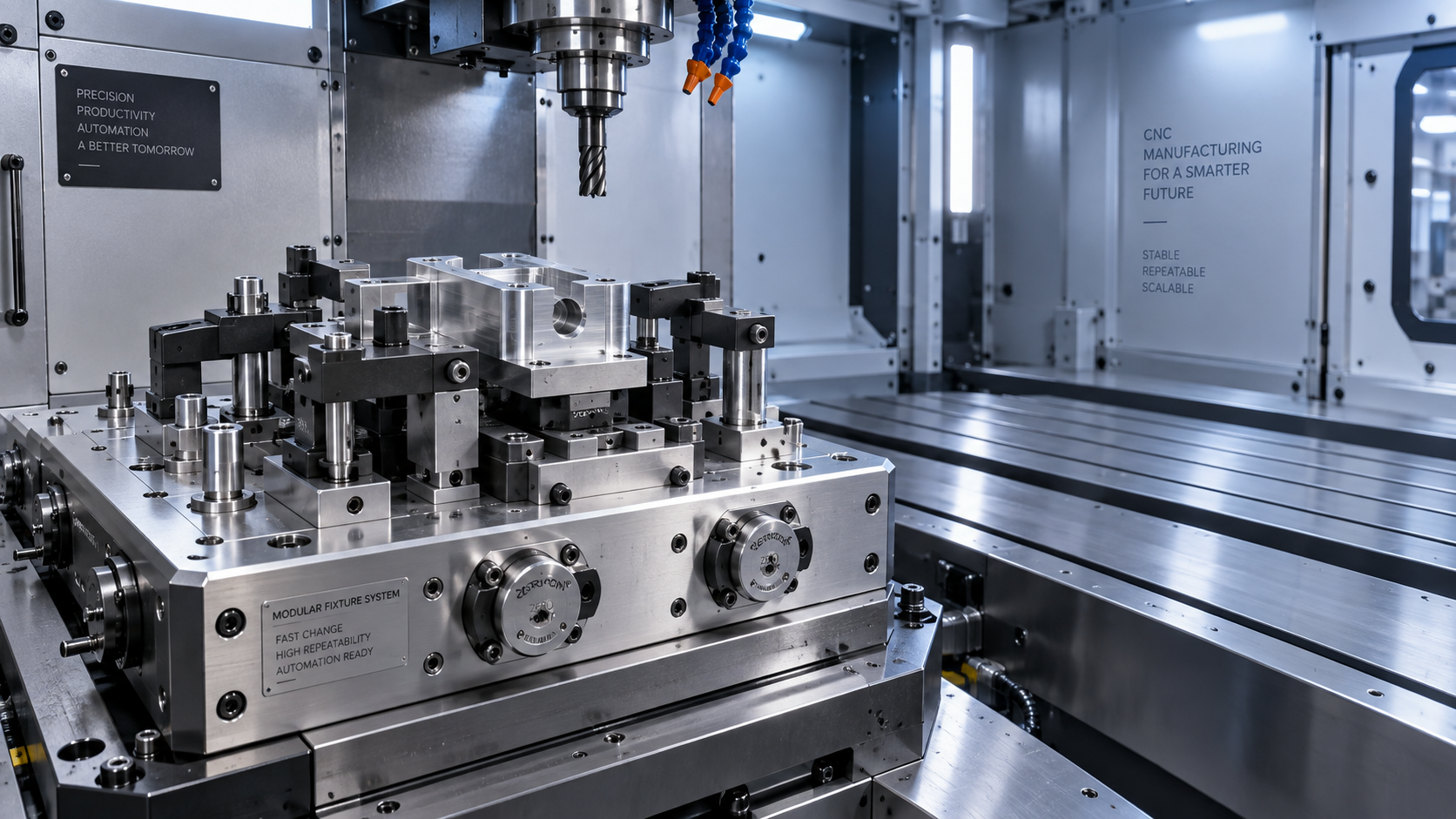
A machining cell is rarely judged only by its spindle time. For technical evaluators, the more revealing question is what happens in the minutes between parts: the old fixture comes out, the new setup goes in, offsets are checked, clamps are verified, and the operator decides whether the first part is safe to run. In a high-mix environment, those minutes can quietly determine whether a CNC line feels flexible or permanently congested.
That is why the question of how to reduce fixture changeover in CNC production lines has become more important as manufacturers move toward shorter production runs, more frequent engineering changes, unattended shifts, and multi-part machining strategies. Two approaches dominate the discussion: zero-point clamping systems and modular fixture systems. Both can reduce setup effort, but they solve different problems and introduce different trade-offs in repeatability, rigidity, investment, programming discipline, and workflow design.
The right choice is not necessarily the system with the shortest advertised exchange time. It is the system that reduces the total time and risk required to move from one stable, validated process to the next.
Start with the changeover that actually limits the cell
Before comparing hardware, evaluators should separate “fixture changeover” into its real components. Removing and mounting a fixture is only one part of the event. A complete changeover may also include cleaning the table, locating the fixture, tightening fasteners, connecting hydraulics or pneumatics, loading jaws or nests, touching off work offsets, checking clamp stroke, proving a new NC program, and measuring the first-off part.
A zero-point system can dramatically shorten the physical exchange of a pallet, vise, fixture plate, or tombstone. It cannot, by itself, eliminate uncertainty in the locating scheme, inconsistent workholding design, or a poorly controlled offset strategy. Modular fixtures can streamline part-specific setup and reduce the need to build dedicated tooling, yet they may still require manual positioning and verification each time a configuration changes.
For this reason, the first assessment should be process-led rather than product-led. Ask:
- How often does the machine move between part families or operations?
- Is downtime driven by bolting fixtures down, or by setting work offsets and proving the process?
- Must the fixture be removed outside the machine while another job is running?
- Are parts mostly prismatic, rotational, thin-walled, cast, forged, or irregularly shaped?
- Will the cell need robotic loading, pallet automation, or lights-out operation?
- What repeatability is required at the fixture interface, and what accuracy must still be established at the workpiece datum?
These questions expose an important distinction: a fast fixture swap does not automatically mean a fast production restart. The target is a controlled return to cutting, not merely a fixture that can be unlocked quickly.
Zero-point clamping: speed through a defined interface
Zero-point clamping systems use precisely located receivers mounted on the machine table or pallet and matching pull studs or clamping modules on the fixture. The fixture is placed onto the receivers, seated against defined locating surfaces, and clamped mechanically, pneumatically, hydraulically, or through a combination of actuation methods. Once the interface is standardized, a prepared fixture can be installed in a repeatable position with minimal alignment work.
This approach is especially attractive where a machining center handles multiple fixtures during a shift, where setup can be performed offline, or where the business case depends on reducing machine idle time. A fixture can be assembled, loaded, and checked at a bench while the machine continues producing another part. At the planned change point, the operator—or an automated handling system—exchanges the prepared fixture and resumes machining from a known reference condition.
In the best applications, zero-point clamping changes the nature of setup. Instead of building the setup inside an expensive machine enclosure, the team creates repeatable fixture packages outside it.
Where zero-point systems tend to perform well
- High-mix, low- to medium-volume production: Frequent job changes make offline preparation valuable.
- Multi-machine standardization: A common receiver pattern can allow fixtures to move between compatible machining centers with less requalification effort.
- Automated cells: Repeatable interfaces support pallet changers, robots, and coordinated fixture identification.
- Five-axis machining: Compact mounting can preserve access around the workpiece, although fixture geometry remains decisive.
- Complex dedicated fixtures: A hydraulic, pneumatic, or multi-location fixture can be built as a self-contained unit and exchanged as one assembly.
However, evaluators should not treat zero-point repeatability as a substitute for good fixturing practice. The system may locate the fixture consistently, but the fixture must still locate the part correctly. A weak nest, poor support arrangement, uncontrolled chip accumulation, or inconsistent clamping sequence can affect finished geometry regardless of how accurately the fixture is seated on the table.
Rigidity also deserves careful review. Receiver spacing, fixture base stiffness, drawbar force, workpiece cutting loads, and the height of the machining force above the clamping plane all influence performance. A compact three- or four-point interface may be entirely suitable for a small precision component, yet insufficiently robust for a tall tombstone carrying heavy roughing loads. The system should be evaluated as a load path, not as a catalog component.
Modular fixtures: flexibility at the workholding level
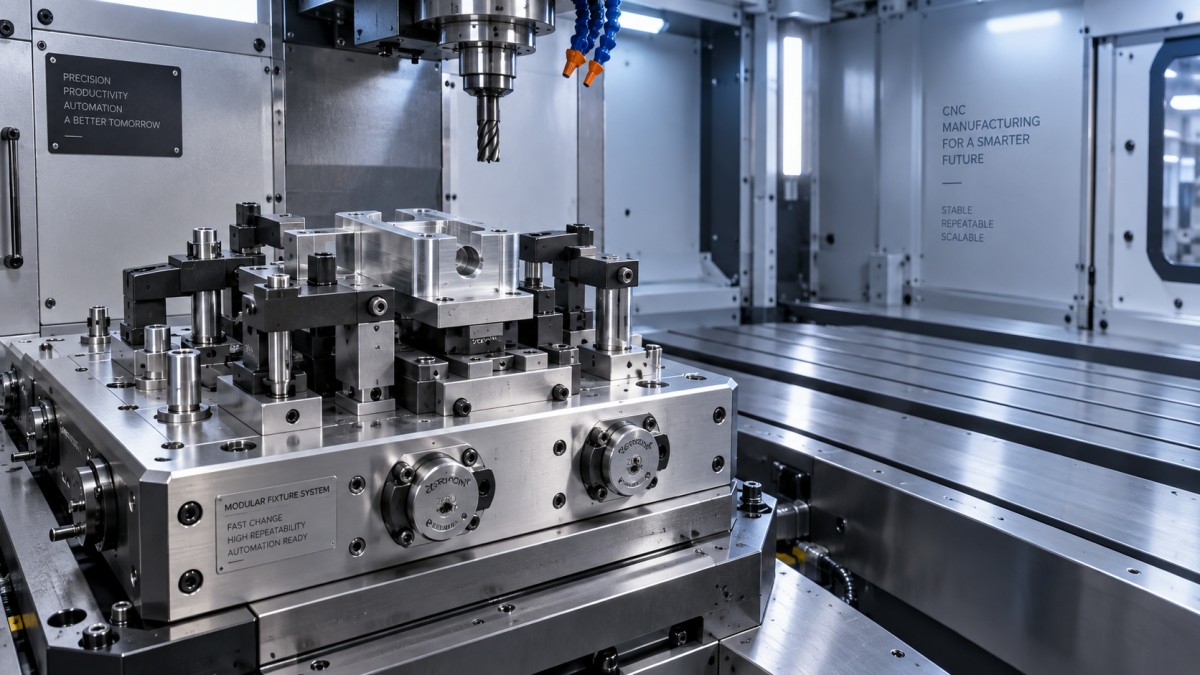
Modular fixture systems use standardized elements—base plates, locating pins, supports, clamps, risers, angle blocks, jaws, and grid-based mounting patterns—to create a workholding arrangement suited to a particular part or family. Rather than purchasing or designing a dedicated fixture for every new component, the shop combines reusable elements into a tailored setup.
For engineering teams facing uncertain demand, prototype-to-production transitions, or a large variety of geometries, modularity can be a practical answer. It provides a toolkit for creating stable workholding without waiting for a fully bespoke fixture. The system is often valuable when a component family shares common datum logic but differs in dimensions, access requirements, or clamping locations.
Its strength is adaptability. A modular fixture can evolve with the part revision, while a dedicated fixture may require substantial rework or replacement. That flexibility is particularly relevant in aerospace, energy equipment, industrial machinery, and precision component production, where part life cycles can be long but annual volumes may vary.
The limitation: reconfiguration is still a setup activity
Modular workholding reduces design and procurement lead time, but it does not always reduce changeover time to the same extent as a zero-point interface. If an operator must rebuild clamps, relocate supports, re-indicate blocks, and re-establish offsets for each job, the machine may remain idle longer than planned. A modular system becomes genuinely efficient when the shop develops repeatable recipes, labeled component kits, standardized datum plans, and documented assembly methods.
There is also a tendency to over-modularize. A fixture assembled from many small elements can create stack-up risk, reduced stiffness, obstructed tool access, and more opportunities for assembly error. For a frequently repeated, high-value component, a dedicated fixture may ultimately be more stable and less labor-intensive than a clever but complicated modular arrangement.
Zero-point clamping or modular fixtures? The comparison should not be binary
Technical teams often frame the decision as an either-or choice. In practice, the strongest architecture is frequently a hybrid: modular workholding built on a zero-point-ready base. The modular elements provide part-level adaptability, while the zero-point interface provides machine-level repeatability and faster exchange.
This arrangement is useful when several fixtures serve related products. A standardized baseplate can carry a vise, a modular nest, a hydraulic fixture, or a dedicated fixture body. Each assembly returns to the same machine reference when mounted. The machine-side interface remains stable, while the top-side workholding changes according to the part.
How to reduce fixture changeover in CNC production lines without moving risk downstream
A better fixture system should not simply shift work from the machine to the inspection room. The following controls help ensure that faster exchanges remain repeatable in production.
Use one datum strategy from fixture design to CNC program
Define how the fixture relates to the machine coordinate system, how the part relates to the fixture, and how those relationships are verified. When fixture IDs, offset tables, and NC programs are linked to a controlled setup record, the operator is less likely to select an incorrect offset after a rapid swap. For automated production lines, this linkage should be designed early rather than added after the workholding choice has been made.
Plan for chips, coolant, and seating verification
Precision interfaces are only repeatable when their contact surfaces are clean. Chips trapped beneath a fixture plate or around locating surfaces can introduce tilt, positional error, or incomplete seating. Include cleaning access, air blast provisions where appropriate, and a simple inspection routine. Some applications may also justify clamp-status confirmation or seating sensors, particularly when running unattended.
Measure the full setup cycle, not just the lock-and-unlock time
During evaluation, time the entire sequence: fixture preparation, transport, machine loading, clamping, connection of utilities, offset confirmation, first-part verification, and release to production. Include the labor required to reset after an interruption. This produces a more honest comparison than focusing on a few seconds of clamping action.
Match stiffness to the operation, not the part size alone
A small part can generate substantial cutting forces in aggressive roughing, while a large aluminum structure may require more concern about distortion than clamp capacity. Review the cutting strategy, tool reach, orientation, support points, and anticipated load directions. For thin-wall machining, the fixture may need controlled support and low-distortion clamping rather than maximum holding force.
A practical selection path for technical evaluators
If the production line loses time mainly because operators repeatedly bolt down and align complete fixtures, zero-point clamping is likely the more direct improvement. It is especially compelling when the same machine must move predictably among prepared jobs, or when future automation is part of the manufacturing roadmap.
If the pressing challenge is the diversity of parts and the cost or lead time of dedicated workholding, modular fixtures deserve priority. They can give process engineers a controlled way to respond to new geometries and evolving demand. Their value rises when the organization maintains disciplined fixture libraries and standardized assembly documentation.
Where both conditions exist—which is common in modern CNC operations—the hybrid route often deserves the closest review. Build modular or dedicated workholding packages around a common zero-point base, validate the repeatability of each package, and make offline preparation a formal part of the production schedule.
The final decision should be based on the manufacturing system you are building, not just the next job waiting at the machine. In a factory moving toward connected machining centers, robotic handling, flexible lines, and traceable process control, workholding is no longer a passive accessory. It is the interface between planning and production. Choosing the right changeover strategy can turn that interface from a recurring source of delay into a dependable part of the process.
NEXT ARTICLE
Recommended for You
 Zero-Point Clamping or Modular Fixtures? Choosing a Faster CNC Changeover SystemCNC Machining Technology Center
 How to Cut CNC Fixture Changeover Time Without Sacrificing Part AccuracyCNC Machining Technology Center
 When Does CNC Turning Pay Off? A Break-Even Guide by Annual Part VolumeMachine Tool Industry Editorial Team
 Machine Tool Standards by Country: What Importers Must Verify Before PurchaseManufacturing Policy Research Center
 CNC Lathe Quick Installation Guide: Alignment Checks Before First Production RunCNC Machining Technology Center
 How to Select a CNC Lathe for Small Parts Without Sacrificing Accuracy or Cycle TimeCNC Machining Technology Center

Aris Katos
Future of Carbide Coatings
15+ years in precision manufacturing systems. Specialized in high-speed milling and aerospace grade alloy processing.
▶
Zero-Point Clamping or Modular Fixtures? Choosing a Faster CNC Changeover SystemCNC Machining Technology Center▶
How to Cut CNC Fixture Changeover Time Without Sacrificing Part AccuracyCNC Machining Technology Center▶
Can One Fixture Handle Multiple Part Geometries Efficiently?CNC Machining Technology Center▶
Fixture Design Cost Breakdown: What Buyers Should Review Before RFQ and ApprovalCNC Machining Technology Center▶
Fixture Design Basics: How Clamping Layout Affects Accuracy and Cycle TimeCNC Machining Technology Center
Mastering 5-Axis Workholding Strategies
Join our technical panel on Nov 15th to learn about reducing vibrations in thin-wall components.

Providing you with integrated sanding solutions
Before-sales and after-sales services
Comprehensive technical support