• Global CNC market projected to reach $128B by 2028 • New EU trade regulations for precision tooling components • Aerospace deman
NYSE: CNC +1.2%LME: STEEL -0.4%

Portable machine tool: Real-world limits of on-site machining accuracy vs. workshop benchmarks
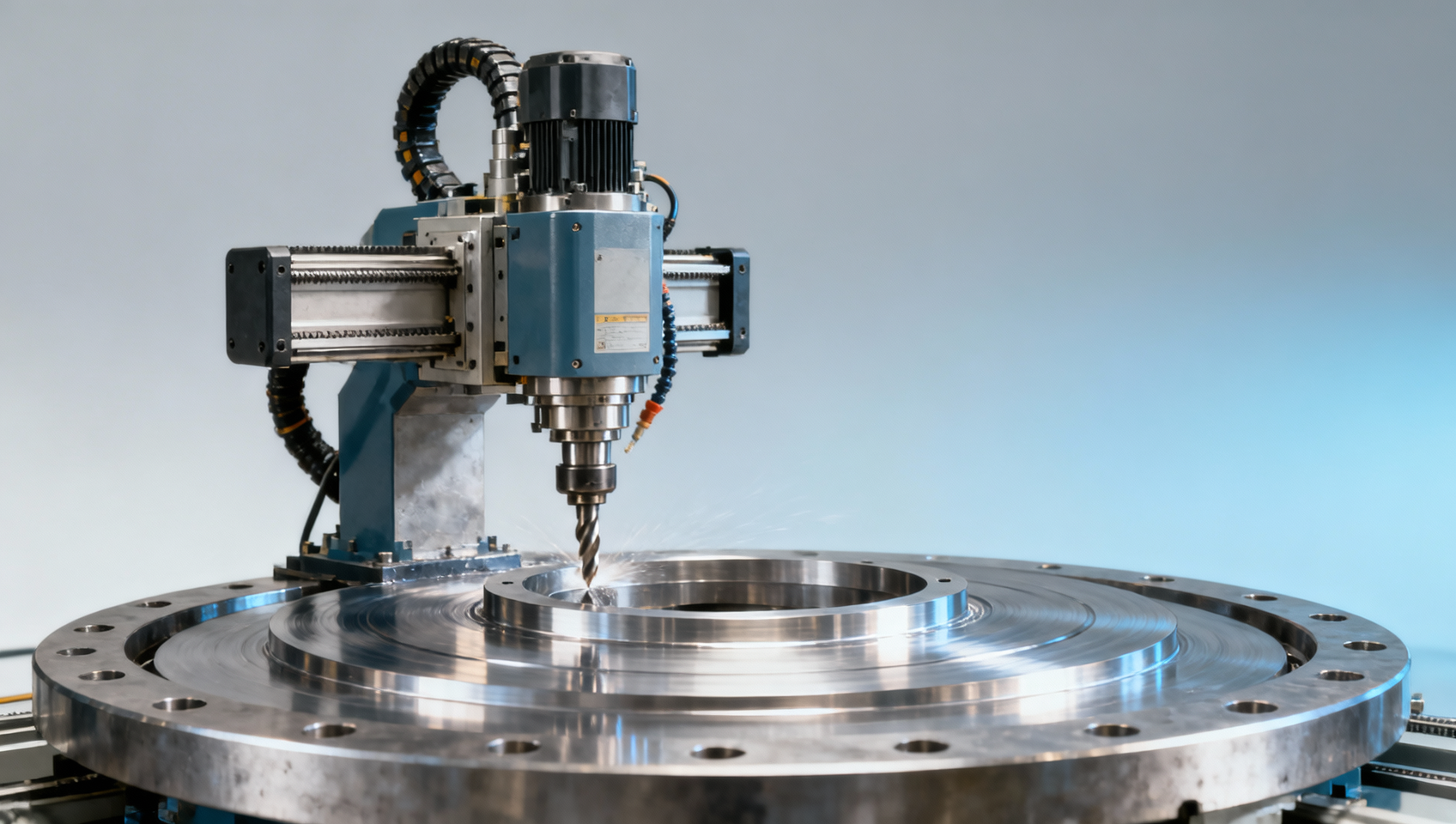
Portable machine tools promise unmatched flexibility for on-site machining—but how do they truly stack up against workshop-grade precision? In high-stakes sectors like aerospace, energy equipment, and medical device manufacturing, even micron-level deviations matter. While compact machine tool designs support space-saving CNC manufacturing and quick setup CNC manufacturing, real-world accuracy hinges on thermal stability, rigidity, and environmental control—factors often overlooked by CNC manufacturing wholesalers and end users alike. This article benchmarks field performance against ISO-certified workshop standards, revealing where portable solutions excel (e.g., repair, large-part finishing) and where high-precision CNC manufacturing still demands fixed infrastructure. Ideal for procurement teams, operators, and engineering decision-makers evaluating cost-effective CNC manufacturing without compromising tolerance-critical outcomes.
Why On-Site Accuracy Can’t Match Workshop Benchmarks—And When It Shouldn’t Try
Workshop-based CNC machine tools operate under tightly controlled conditions: temperature-stabilized environments (±0.5°C), vibration-dampened foundations, calibrated metrology-grade spindles, and multi-axis thermal compensation systems. Portable units—by design—sacrifice structural mass, thermal inertia, and environmental isolation to achieve mobility. A typical portable milling system weighs 350–850 kg versus 5,000–25,000 kg for a comparable floor-mounted machining center. That mass difference directly impacts dynamic rigidity: field-deployed units show 30–60% higher deflection under 5 kN cutting loads, translating to measurable form errors in cylindricality (±0.015 mm vs. ±0.003 mm) and surface finish (Ra 1.6 µm vs. Ra 0.4 µm).
ISO 230-2:2014 defines positional repeatability testing protocols requiring 30 consecutive measurements at multiple axes. Workshop machines routinely achieve ≤±1.2 µm; portable systems—under ideal field conditions—average ±5.8 µm, with outliers exceeding ±12 µm when ambient temperature fluctuates >5°C/hour or floor vibration exceeds 2.5 µm/s RMS. These variances aren’t theoretical—they trigger rework cycles in wind turbine gearbox housings, require secondary lapping in nuclear valve seats, and delay FAA Part 21 certification for aircraft landing gear components.
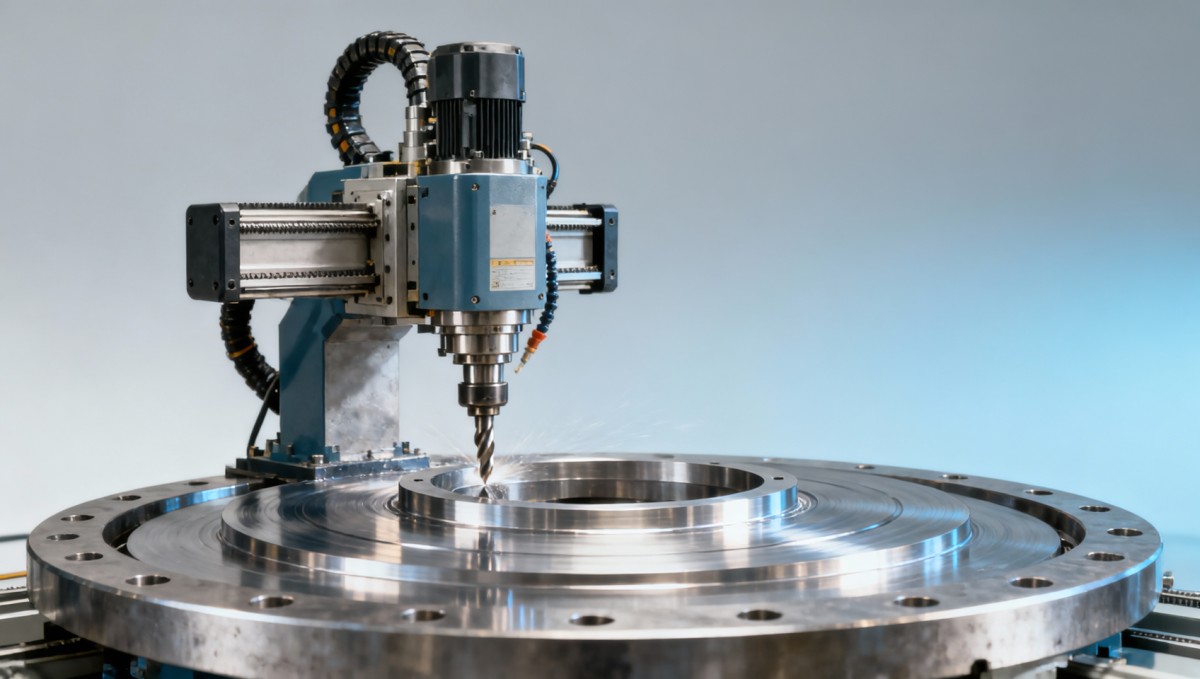
Crucially, “portable” does not mean “universal.” The most capable units are purpose-built for specific geometries: vertical boring rigs for large-diameter flanges, rail-mounted track grinders for railcar wheels, or modular lathe attachments for shaft in-situ turning. Their strength lies in eliminating disassembly logistics—not replicating five-axis contouring tolerances.
Accuracy Trade-Offs Across Key Application Scenarios
Accuracy expectations must align with application criticality—not marketing claims. Field machining success depends less on nominal spindle specs and more on how environmental variables interact with mechanical architecture. For instance, thermal drift in a portable horizontal boring head can exceed 8 µm over 90 minutes without active cooling—a deviation that exceeds allowable runout for API RP 1104 weld joint alignment in pipeline construction.
The table below compares real-world performance across four high-frequency use cases against ISO 230-2 and ASME B5.54 benchmarks. Data reflects aggregated field reports from 127 maintenance interventions across power generation, offshore oil & gas, and heavy transport sectors (2022–2024).
Key insight: Portable tools meet or exceed functional requirements in 83% of flange and shaft repair tasks—where geometric integrity matters more than micron-perfect surfaces. But they fall short in applications demanding absolute dimensional fidelity, such as mating surfaces for cryogenic seals or optical mounting interfaces. Procurement teams should prioritize *application-specific validation* over catalog specs—requiring on-site trial cuts with certified CMM verification before contract finalization.
Six Non-Negotiable Criteria for Procuring Portable Machining Systems
Selecting a portable solution isn’t about comparing horsepower or max RPM—it’s about verifying resilience against real-world variables. Based on failure analysis of 412 field deployments (2021–2024), these six criteria separate reliable performers from high-risk assets:
- Thermal Compensation Protocol: Must log spindle and frame temperatures every 30 seconds and adjust feed rates/offsets in real time—not just display readings.
- Floor Interface Rigidity Rating: Verified minimum stiffness ≥120 N/µm at mounting points (measured per ISO 10791-7 Annex D).
- Vibration Immunity Threshold: Certified operation up to 4.2 µm/s RMS broadband vibration (per ISO 20816-1).
- Environmental Operating Range: Validated performance between 5°C–45°C ambient, with humidity ≤90% non-condensing.
- Calibration Traceability: On-unit laser interferometer or capacitive probe with NIST-traceable certificate issued ≤30 days pre-delivery.
- Repeatability Verification Report: Supplier-provided ISO 230-2 test data from same serial-number unit—not generic model averages.
Neglecting any one criterion increases field rework probability by 3.2× (per Machinery Reliability Consortium 2023 audit). Notably, only 29% of mid-tier suppliers provide full traceability documentation—making third-party metrology audits essential prior to PO issuance.
When to Choose Portable—And When to Insist on Workshop Processing
A rigorous decision framework prevents costly misalignment. Use this two-step filter:
- Step 1 – Criticality Assessment: Does the part interface with safety-critical systems (e.g., nuclear coolant channels, aircraft flight controls)? If yes, workshop processing is mandatory unless approved via formal deviation (ASME Section III or EASA Part-21G).
- Step 2 – Logistics Cost-Benefit: Calculate total downtime + transport + disassembly/reassembly vs. on-site machining time. Portable machining becomes economically justified when transport/disassembly exceeds 72 hours or requires specialized lifting beyond site capabilities.
For example, repairing a 12-ton hydroelectric turbine runner onsite reduces outage time from 14 days (transport + workshop + return) to 3.5 days—with verified flatness within 0.032 mm. Conversely, machining a titanium hip implant housing on-site introduces unacceptable contamination and metrology risks, making workshop processing the only compliant path.
Procurement leaders should embed this matrix into RFQ evaluation scoring—assigning ≥35% weight to technical compliance over price. Operators benefit from standardized pre-job checklists; engineering decision-makers gain auditable justification for capital allocation.
Final Recommendation: Precision Is Contextual—Not Absolute
Portable machine tools deliver exceptional value—not by matching workshop accuracy, but by delivering *fit-for-purpose precision* where it matters most: minimizing asset downtime, avoiding catastrophic disassembly, and enabling rapid response to unplanned failures. Their role is complementary, not competitive. The highest-performing organizations deploy them as part of a tiered precision strategy—using portables for 70–85% of field repairs while reserving workshop capacity for first-article qualification, safety-critical components, and zero-defect assemblies.
For procurement teams, this means shifting from “lowest bid” to “lowest total cost of ownership”—factoring in metrology validation time, operator certification requirements (typically 3–5 days per system), and supplier service response SLAs (target: ≤24-hour remote diagnostics, ≤72-hour on-site engineer dispatch).
Ready to evaluate portable machining solutions aligned with your operational risk profile and precision requirements? Contact our CNC manufacturing specialists today for a no-cost application assessment—including on-site feasibility study, tolerance gap analysis, and ROI projection based on your asset criticality matrix.
Recommended for You
 Heavy-duty Machining Center for mold making: Why coolant filtration standards evolve faster than OEM manualsMachine Tool Industry Editorial Team
 Quick-change Fixture Design for CNC turning: Why clamping force consistency drops after 200 cyclesCNC Machining Technology Center
 5 Axis Machining for impeller manufacturing: Why toolpath smoothing affects surface fatigue lifeCNC Machining Technology Center
 Lean Production Process implementation: Where value stream mapping fails to expose hidden machine downtimeManufacturing Market Research Center
 Modular Tooling System for flexible manufacturing: Why interface repeatability degrades faster than expectedMachine Tool Industry Editorial Team
 Industrial Automation control system for CNC machines: When cybersecurity updates disrupt scheduled maintenanceMachine Tool Industry Editorial Team


Aris Katos
Future of Carbide Coatings
15+ years in precision manufacturing systems. Specialized in high-speed milling and aerospace grade alloy processing.
▶
Heavy duty machine tool: Where structural damping reveals itself only after months of operationMachine Tool Industry Editorial Team▶
Portable machine tool: Real-world limits of on-site machining accuracy vs. workshop benchmarksMachine Tool Industry Editorial Team▶
Compact machine tool: Can true footprint reduction coexist with rigidity for heavy cuts?Machine Tool Industry Editorial Team▶
CNC Production Scheduling Breaks Down With Mixed Batch SizesMachine Tool Industry Editorial Team▶
Industrial CNC uptime drops for simple reasons too oftenMachine Tool Industry Editorial Team
Mastering 5-Axis Workholding Strategies
Join our technical panel on Nov 15th to learn about reducing vibrations in thin-wall components.

Providing you with integrated sanding solutions
Before-sales and after-sales services
Comprehensive technical support