• Global CNC market projected to reach $128B by 2028 • New EU trade regulations for precision tooling components • Aerospace deman
NYSE: CNC +1.2%LME: STEEL -0.4%

How to Compare CNC Metal Lathe Brands Objectively
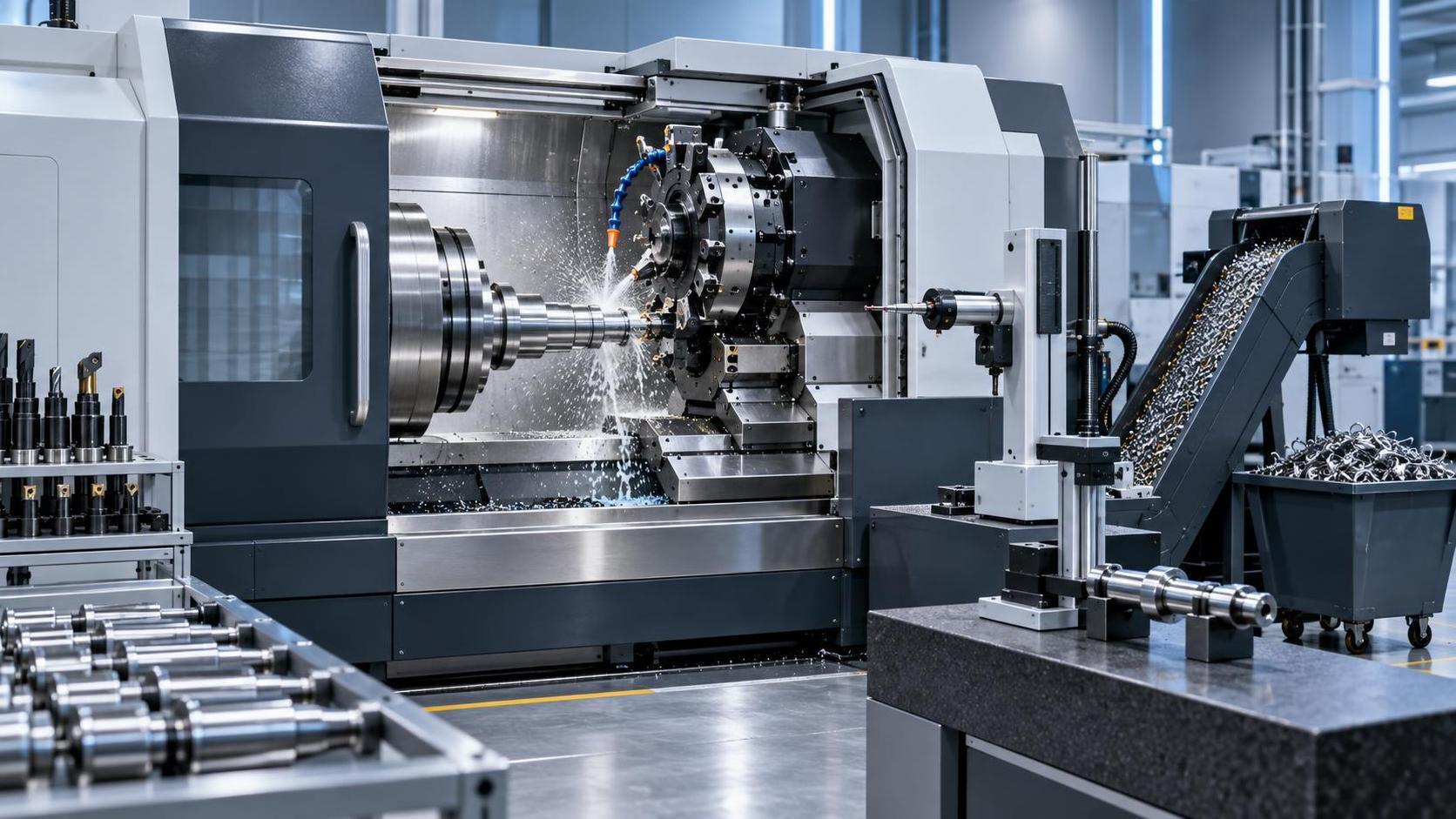
A CNC metal lathe brand should be compared as a production system, not as a nameplate, a brochure specification, or a quoted purchase price. Two machines with similar swing, spindle power, and advertised positioning accuracy can behave very differently once they are cutting parts through a full shift, changing tools, holding tolerance after thermal growth, or waiting for service support.
An objective comparison starts with the work the machine must perform. A shop producing short batches of varied components will value setup speed, programming convenience, and operator access differently from a supplier running the same automotive shaft around the clock. A brand that is an excellent fit for one environment may be an expensive mismatch for the other.
The practical goal is to compare evidence against the same operating requirement. That means defining the parts, materials, tolerances, volumes, and workflow before asking suppliers to prove their machines are suitable.
Start with a representative part, not a generic machine category
“CNC metal lathe” covers a wide range of equipment: compact two-axis machines, slant-bed turning centers, large-bore lathes, mill-turn machines, and machines designed for bar-fed production. Comparing brands at that level produces weak conclusions because the category is too broad.
Build a short reference package from parts that reflect the work expected over the next several years. Include the most demanding diameter-to-length ratio, the tightest recurring tolerance, the least forgiving material, the heaviest workpiece, and the cycle-time-sensitive family of parts. A straightforward turned sleeve and a thin-wall stainless component may require very different machine behavior even when both fit within the same published work envelope.
- Part drawings, including geometric tolerances and critical surface requirements.
- Material grades and expected stock condition, such as bar, forging, casting, or pre-machined blank.
- Annual volume, batch size, and anticipated changeover frequency.
- Required secondary operations, including drilling, live-tool milling, sub-spindle transfer, or probing.
- Target cycle time where production output is the constraint.
- Planned automation, such as bar feeders, parts catchers, gantries, robot tending, or in-process gauging.
Ask each brand or distributor to respond to this same package. Their response is useful evidence in itself. A supplier that asks detailed questions about fixturing, chip formation, tolerances, and process sequence is engaging with the application. One that quickly recommends the largest or most heavily optioned model may still be correct, but the recommendation needs closer examination.
Separate brochure accuracy from sustained production capability
Published positioning accuracy and repeatability matter, but they should not be treated as a complete measure of machining performance. They are commonly measured under defined conditions, while production accuracy is affected by temperature, tooling load, workholding, programming, coolant strategy, machine geometry, and operator practice.
For a buyer learning how to compare CNC metal lathe brands objectively, the more useful question is: how reliably can this machine hold the required part characteristics across a normal production run?
Request a demonstration on a relevant material and part geometry where possible. The demonstration should include more than producing one acceptable first-off component. Ask to see several parts taken after the machine has been running, and inspect the dimensions that matter to the application: diameter consistency, taper, roundness where critical, runout, face condition, bore quality, and feature relationships after a transfer to a sub-spindle.
There are limits to what a pre-sale trial can establish. Different tooling, fixtures, and ambient conditions will exist at the buyer’s site. Still, the trial reveals whether the supplier can discuss a process in operational terms rather than relying only on stated specifications.
Look at the machine structure behind the numbers
Machine mass alone does not establish rigidity, but the structural design deserves close attention. Examine the bed configuration, guideway type, turret construction, spindle arrangement, tailstock or steady-rest capability, and the routing of chips and coolant. A lathe intended for interrupted cuts in difficult materials needs stable support throughout the cutting path, not simply high spindle power on paper.
For long shafts, the interaction between the workholding method, tailstock, steady rest, and machine alignment can matter more than an impressive headline spindle rating. For small, precise parts, spindle runout, thermal behavior, collet capability, and parts-handling consistency may have greater influence on yield.
Machine options also need to be compared as a complete configuration. One quotation may include a high-pressure coolant package, tool presetter, chip conveyor, bar-feed interface, probing, and suitable workholding; another may price these separately. A lower base price is not a lower production cost if essential equipment appears later as an option or site modification.
Assess controls through the shop’s actual workflow
The control platform affects programming, troubleshooting, data handling, operator training, and long-term support. Familiarity has value: a shop with established post-processors, programmers, and maintenance knowledge may reduce implementation risk by remaining within a known control ecosystem. But selecting a control solely because it is familiar can prevent a better fit where the machine builder’s integration, cycle functions, or support capability is stronger.
Evaluate the control in the context of the planned work. For repeat production, examine tool-life management, offset handling, program protection, alarm diagnostics, and the ability to recover safely from interruptions. For high-mix work, look at setup aids, conversational functions if they fit the workforce, program transfer practices, and how easily operators can verify changes.
It is also worth clarifying ownership and accessibility of production data. If the business intends to connect machines to monitoring software or a manufacturing execution system, determine what interfaces are available, what additional hardware or licenses are required, and who supports the connection when responsibility crosses between the machine supplier and a third-party automation provider.
Digital features should solve an identified operational problem. Remote monitoring is useful when someone can act on the information. Predictive-maintenance functions are more valuable when the service model, spare-parts availability, and internal maintenance process can turn warnings into planned work.
Compare service as a measurable operating risk
A CNC lathe purchase creates a long service relationship. The quality of local support can outweigh modest differences in machine specification, particularly for companies without a deep internal maintenance team or for operations where a stopped machine disrupts a tightly scheduled line.
Do not settle for a general assurance that service is available. Ask practical questions that reveal the support structure behind the claim:
- Who will commission the machine, train operators, and perform warranty work?
- Where are the nearest qualified field technicians located?
- Which replacement parts are held locally or regionally, and which must be sourced internationally?
- How are urgent technical cases logged and escalated outside normal business hours?
- Can the supplier provide remote diagnostic support, and what access must be enabled for it?
- Which items are considered consumables, which are recommended spares, and which repairs require a specialist visit?
The answers should be specific enough to evaluate. A global brand may have strong engineering resources but limited direct coverage in a particular region. A smaller regional builder may offer faster access to technicians and common spare parts. Neither condition makes one brand universally superior; it changes the downtime exposure for the buyer’s location.
Service quality also includes application capability. A technician can restore a machine after a fault, while an applications engineer can help stabilize a difficult process, improve tool life, or resolve a transfer and workholding issue. Shops purchasing complex turning centers or automated cells should distinguish these functions when comparing proposals.
Use total cost of ownership, but keep it grounded
Purchase price is visible and immediate. The more consequential costs often emerge through utilization, setup time, scrap, tool consumption, maintenance, energy use, financing, and lost output during downtime. A total-cost review is useful only when it is based on operating assumptions that the buyer can defend.
For example, a more expensive lathe may be justified if it reduces a bottleneck cycle time, combines operations previously performed on separate equipment, enables unattended running with appropriate automation, or produces a feature consistently enough to avoid inspection and rework. Those benefits should be calculated from the shop’s own volumes and labor model, not assumed because the machine carries a premium brand position.
Likewise, a lower-cost machine can be the sensible choice when tolerances are moderate, utilization is limited, production volumes do not support advanced automation, and local service is strong. The mistake is treating either price level as a proxy for business value.
Watch for comparisons that create false certainty
Several common shortcuts can make a brand comparison look more objective than it is. Ranking machines only by spindle power ignores torque behavior, rigidity, and the actual cutting regime. Choosing the largest work envelope “for future flexibility” can add cost and reduce efficiency if the machine is oversized for the overwhelming majority of parts. Treating country of origin as a full quality assessment overlooks variation between product lines, local support organizations, configurations, and manufacturing locations.
Reference visits can be valuable, but only when the reference operation resembles the intended one. A facility successfully running high-volume aluminum parts does not necessarily validate a machine for low-volume alloy-steel shafts with frequent setups. Ask what materials are machined, how many hours the machine runs, how support issues are handled, and what the user would configure differently if buying again.
Quoted acceptance conditions need the same scrutiny. Confirm what part, material, tooling, tolerance, cycle time, and inspection method will be used to accept the machine. A vague acceptance clause creates room for disagreement precisely when the machine is expected to begin production.
Make the decision with a weighted score and an evidence record
A scoring matrix is not a substitute for engineering judgment, but it prevents the discussion from being dominated by the loudest sales claim or the most familiar brand. Assign weights that reflect the business constraint. A contract manufacturer with demanding delivery commitments may give service response and changeover time substantial weight. A specialist aerospace supplier may put more emphasis on process stability, documentation, and capability for complex workholding. A new production line may prioritize automation integration and commissioning responsibility.
Score each candidate only against evidence collected through drawings, technical responses, demonstrations, site visits, and commercial terms. Keep a short note beside every score explaining why it was assigned. That record is valuable when a lower-priced bid loses, when management asks why a premium was accepted, or when the purchase team needs to identify conditions that must be written into the contract.
The strongest CNC metal lathe brand is therefore not the one with the broadest reputation or the most elaborate option list. It is the supplier whose machine configuration, process capability, service coverage, and commercial commitments fit the parts and production model the business actually needs to support.
Recommended for You
![]() FANUC Invests $18 Million in Largest U.S. Corporate Automation Training CenterMachine Tool Industry Editorial Team
FANUC Invests $18 Million in Largest U.S. Corporate Automation Training CenterMachine Tool Industry Editorial Team Southeast Asia Machine Tool Market: Comparing Automotive Demand by CountryManufacturing Market Research Center
![]() Zhongshan Xiaolan Machinery Exhibition Opens With Global Product DebutsMachine Tool Industry Editorial Team
Zhongshan Xiaolan Machinery Exhibition Opens With Global Product DebutsMachine Tool Industry Editorial Team Automated Production Machining: Which Parts and Batch Sizes Are a Good Fit?Machine Tool Industry Editorial Team
![]() FANUC Links FIELD System Data with Copilot to Advance Shop-Floor Data UseCNC Machining Technology Center
FANUC Links FIELD System Data with Copilot to Advance Shop-Floor Data UseCNC Machining Technology Center Smart Manufacturing for Aerospace: Building Traceability Across CNC OperationsCNC Machining Technology Center


Aris Katos
Future of Carbide Coatings
15+ years in precision manufacturing systems. Specialized in high-speed milling and aerospace grade alloy processing.
▶
How to Select an Industrial Lathe for High-Volume Shaft ProductionMachine Tool Industry Editorial Team▶
When Does CNC Turning Pay Off? A Break-Even Guide by Annual Part VolumeMachine Tool Industry Editorial Team▶
How to Compare CNC Metal Lathe Brands ObjectivelyMachine Tool Industry Editorial Team▶
CNC Lathe Quick Installation Guide: How to Avoid Alignment and Wiring MistakesMachine Tool Industry Editorial Team▶
CNC Lathe Quick Installation Guide: Common Setup Mistakes and How to Avoid ThemMachine Tool Industry Editorial Team
▶
Mastering 5-Axis Workholding Strategies
Join our technical panel on Nov 15th to learn about reducing vibrations in thin-wall components.

Providing you with integrated sanding solutions
Before-sales and after-sales services
Comprehensive technical support