• Global CNC market projected to reach $128B by 2028 • New EU trade regulations for precision tooling components • Aerospace deman
NYSE: CNC +1.2%LME: STEEL -0.4%

When Does CNC Turning Pay Off? A Break-Even Guide by Annual Part Volume
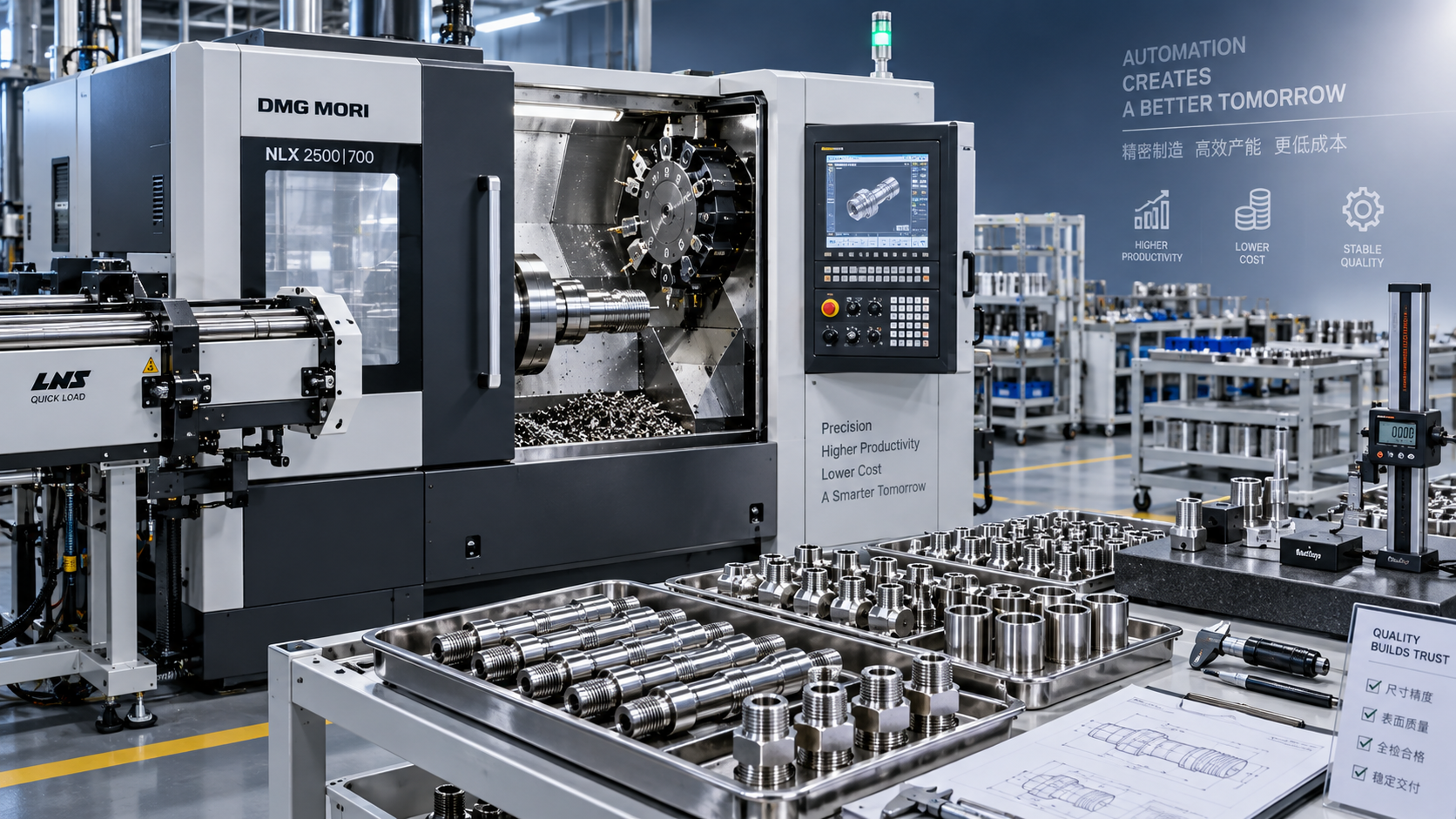
A production manager notices the pattern before it appears in a spreadsheet: operators spending too much time tending manual lathes, queues forming around outside suppliers, and repeat orders arriving just large enough to make every quote feel uncomfortable. The parts may be simple shafts, threaded adapters, bushings, pins, or precision discs—but the decision is not simple.
For manufacturing leaders, the practical question is what production volume justifies a CNC turning investment. CNC turning is not automatically the lowest-cost route, and annual quantity alone does not provide the answer. A run of 500 parts can support automation if the part is difficult, labor-intensive, or repeatedly reordered. Conversely, 20,000 very simple parts may still be better sourced externally if demand is uncertain or the machine would sit idle.
The break-even point comes from the relationship between fixed investment, unit-cost reduction, available capacity, and the commercial value of bringing a process under control. This guide offers a decision framework for evaluating CNC lathe investment by annual part volume—without relying on a misleading “one-size-fits-all” threshold.
The break-even calculation starts with the manufacturing route
Before comparing annual volumes, compare two realistic ways of making the part. One may be a manual lathe or conventional production cell. Another may be outsourced CNC machining. The proposed alternative could be an in-house two-axis CNC lathe, a turning center with a bar feeder, or a more capable multi-axis machine.
The basic financial logic is straightforward:
Annual savings = (current fully loaded unit cost − proposed fully loaded unit cost) × annual volume
The investment begins to make sense when annual savings cover the annualized cost of the equipment, including financing or depreciation, maintenance, software, operator training, tooling, floor space, utilities, and the working capital needed for material and work-in-process.
A simplified break-even formula is:
Break-even annual volume = Annual fixed cost of the CNC solution ÷ Unit-cost savings
That equation is useful, but only when both inputs are honest. Many investment proposals underestimate the full cost of keeping a machine productive. Others underestimate savings by comparing only machine cycle time while ignoring manual inspection, secondary operations, changeovers, scrap, expediting fees, and supplier lead-time risk.
Annual volume is important—but repeatability matters more than many buyers expect
A single order for 10,000 pieces is not necessarily a strong reason to buy a CNC turning center. A family of parts totaling 10,000 to 20,000 pieces per year may be far more attractive if their diameters, materials, and setup requirements are similar. Shared tools, common chucking methods, and repeatable programming turn several modest part numbers into a stable production case.
Decision-makers should separate volume into three categories:
- One-off volume: a large order with no credible follow-on demand. This may support outsourcing, leasing, or a temporary capacity arrangement rather than capital equipment.
- Recurring volume: regular releases over multiple years. This is the strongest basis for a CNC turning investment because the learning curve, fixtures, and programming effort can be recovered over time.
- Volatile volume: demand that rises and falls sharply. This requires a more conservative utilization assumption and often favors flexible equipment over highly dedicated automation.
For many organizations, the best business case is not built around one “hero part.” It is built around a portfolio: repeat shafts from industrial equipment, small turned fittings for energy systems, precision sleeves for automation assemblies, and occasional higher-margin urgent jobs that previously went to outside shops.
A practical volume guide for CNC turning decisions
The following ranges are directional rather than universal. Material, tolerance, labor rates, and equipment configuration can move the break-even point substantially. Still, they help frame a first discussion with finance, operations, and procurement.
These bands should not be used as approval rules. A 1,200-piece annual demand for a complex stainless-steel component can justify CNC turning sooner than a 15,000-piece annual demand for a simple soft-metal spacer. The difference is often hidden in minutes per part rather than pieces per year.
Cycle time creates the economic leverage
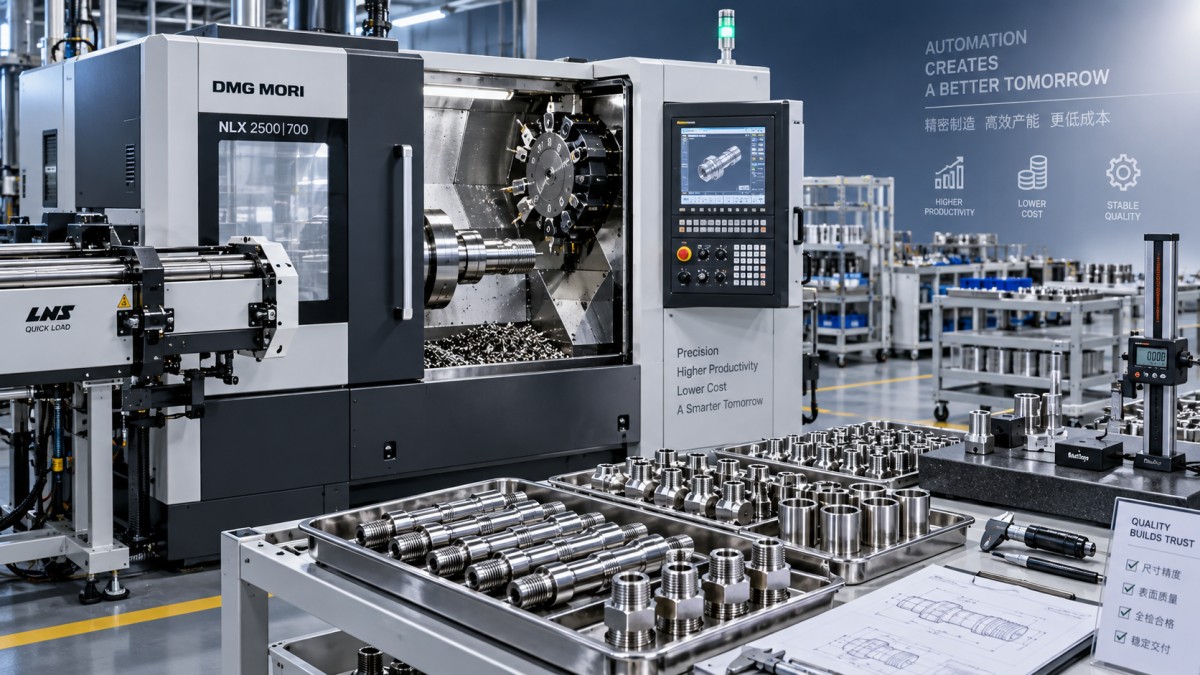
When evaluating a turning investment, ask how much elapsed time a part consumes today—not just how long the tool contacts the material. Manual production may include loading, indicating the part, changing tools, measuring dimensions, deburring, moving the part to a drill press or milling station, and recording inspection results. Outside sourcing can add quote cycles, freight, incoming inspection, and safety-stock carrying costs.
A CNC turning process can reduce this total through repeatable programs, turret tooling, controlled spindle speeds, automated tool changes, and, where appropriate, bar feeding or parts catching. On more complex components, a live-tool turning center may combine turning, cross drilling, slotting, or milling operations that would otherwise require separate machines and multiple setups.
However, leaders should resist the temptation to compare an ideal CNC cycle against a fully burdened manual process. The right comparison includes realistic CNC uptime: setup, first-off approval, tool replacement, chip management, planned maintenance, operator support, and inspection. A machine that theoretically produces a part in 90 seconds but needs frequent intervention has a different economic profile from one that runs reliably for hours.
Use contribution per machine hour, not only piece price
Piece price is intuitive, but capacity is often the scarcer resource. If a proposed CNC lathe will consume 2,000 annual machine hours, management needs to know what those hours are worth and what work they will displace. If it replaces outsourced production with healthy margins, the project may be compelling. If it merely transfers low-margin work from an underused supplier to an already constrained internal team, the financial gain may be limited.
A useful internal measure is the expected contribution per spindle hour after materials, consumables, labor, and quality costs. This makes it easier to compare a new turning cell with other capital priorities, such as a machining center, inspection system, robotic loading solution, or expanded subcontract capacity.
It also exposes a common mistake: buying a machine for a single low-margin part because its annual volume appears high. Volume without contribution can create activity, not value.
The “hidden” costs that move break-even later
CNC turning can be highly economical, but only if the organization plans for the entire production system around it. A capital request that includes only the machine purchase price is incomplete. Consider the following costs before deciding that a calculated break-even is secure:
- Workholding, jaws, collets, custom fixtures, and gauging
- Toolholders, inserts, drills, boring bars, cutoff tools, and tool-life management
- CAM or programming resources, prove-out time, and process documentation
- Training for operators, programmers, maintenance personnel, and inspectors
- Electrical supply, coolant systems, chip handling, compressed air, and floor preparation
- Preventive maintenance, spare parts, service response, and unplanned downtime exposure
- First-article inspection and traceability requirements for regulated sectors
For aerospace, energy equipment, medical-adjacent applications, or safety-critical automotive components, validation and documentation can be a material part of the project. Those requirements do not argue against CNC investment; they simply need to be treated as real costs and schedule items rather than surprises after the purchase order is issued.
When outsourcing remains the smarter option
There is no strategic weakness in buying turned parts from a capable specialist. External suppliers can spread the cost of advanced machines, tooling knowledge, and skilled programmers across many customers. They may also offer capacity that would be expensive to duplicate internally.
Outsourcing usually remains attractive when annual demand is low or unpredictable, the part requires specialized multi-axis equipment that would be underutilized, raw material purchasing is difficult, or internal teams lack the engineering depth to stabilize the process. It can also be the right answer during new-product introduction, when design revisions are still frequent.
The key is to compare against the right outsourcing number. The quoted unit price is only one element. Add transportation, receiving inspection, inventory buffers, minimum-order constraints, engineering-change delays, and the cost of an interrupted supply chain. For critical parts, the value of shorter response time may outweigh a modest difference in unit price.
A break-even example without false precision
Imagine a company buying a recurring turned component at a fully landed cost of $18 per part. An internal CNC process, including material, direct labor, tooling consumption, quality activity, and machine operating cost, is estimated at $12 per part. The apparent savings is $6 each.
If the annualized fixed cost of the machine, support equipment, maintenance, and training is $60,000, the simple break-even volume is 10,000 parts per year. Yet the final decision still depends on whether the projected demand is credible, whether the machine has room for additional work, and whether $12 reflects real operating conditions rather than an optimistic estimate.
If the same machine can also absorb several related parts and generate another $30,000 in annual savings, the investment profile changes rapidly. This is why evaluating part families is usually more useful than forcing every capital decision through a single-part calculation.
Questions executives should ask before approving the investment
A sound CNC turning proposal should survive a few direct questions. What happens if demand falls 30 percent? How many productive spindle hours are assumed, and is that consistent with the planned shift pattern? Which operations will actually be eliminated? Who owns programming and process improvement after installation? How quickly can the team recover from a tool break, a quality drift issue, or a control failure?
Also ask whether the chosen machine matches the likely future mix. A basic CNC lathe may offer the quickest payback for straightforward shafts and discs. A turning center with live tooling, a Y-axis, sub-spindle capability, or automated feeding costs more, but may eliminate second operations and prepare the business for more complex work. The lowest purchase price is not always the lowest cost per good part.
The decision point is confidence, not a magic quantity
Ultimately, the answer to what production volume justifies a CNC turning investment is not a universal annual number. The investment pays off when recurring demand, measurable unit-cost savings, realistic utilization, and strategic capacity needs align. For simple low-volume work, outside sourcing may remain sensible. For recurring part families with meaningful labor content, quality demands, or supply-chain sensitivity, CNC turning can become financially attractive much earlier than expected.
The strongest decisions use a conservative volume forecast, fully loaded costs, and a plan for the machine beyond its first part number. In a manufacturing environment shaped by automation, tighter tolerances, and shorter customer expectations, the real return is often more than lower piece price. It is the ability to control quality, lead time, capacity, and future growth with greater confidence.
PREVIOUS ARTICLE
NEXT ARTICLE
Recommended for You
 When Does CNC Turning Pay Off? A Break-Even Guide by Annual Part VolumeMachine Tool Industry Editorial Team
 Machine Tool Standards by Country: What Importers Must Verify Before PurchaseManufacturing Policy Research Center
 CNC Lathe Quick Installation Guide: Alignment Checks Before First Production RunCNC Machining Technology Center
 How to Select a CNC Lathe for Small Parts Without Sacrificing Accuracy or Cycle TimeCNC Machining Technology Center
 How to Select a Slant Bed Lathe for High-Precision Shaft and Chuck WorkCNC Machining Technology Center
 Smart Manufacturing for Small Businesses: Where Automation Delivers the Fastest ROIMachine Tool Industry Editorial Team

Aris Katos
Future of Carbide Coatings
15+ years in precision manufacturing systems. Specialized in high-speed milling and aerospace grade alloy processing.
▶
When Does CNC Turning Pay Off? A Break-Even Guide by Annual Part VolumeMachine Tool Industry Editorial Team▶
How to Compare CNC Metal Lathe Brands ObjectivelyMachine Tool Industry Editorial Team▶
CNC Lathe Quick Installation Guide: How to Avoid Alignment and Wiring MistakesMachine Tool Industry Editorial Team▶
CNC Lathe Quick Installation Guide: Common Setup Mistakes and How to Avoid ThemMachine Tool Industry Editorial Team▶
CNC Lathe Lead Times Reach 22 WeeksMachine Tool Industry Editorial Team
Mastering 5-Axis Workholding Strategies
Join our technical panel on Nov 15th to learn about reducing vibrations in thin-wall components.

Providing you with integrated sanding solutions
Before-sales and after-sales services
Comprehensive technical support