• Global CNC market projected to reach $128B by 2028 • New EU trade regulations for precision tooling components • Aerospace deman
NYSE: CNC +1.2%LME: STEEL -0.4%

When heavy duty machine tool performance drops under sustained load, it’s rarely the spindle — look closer at thermal management
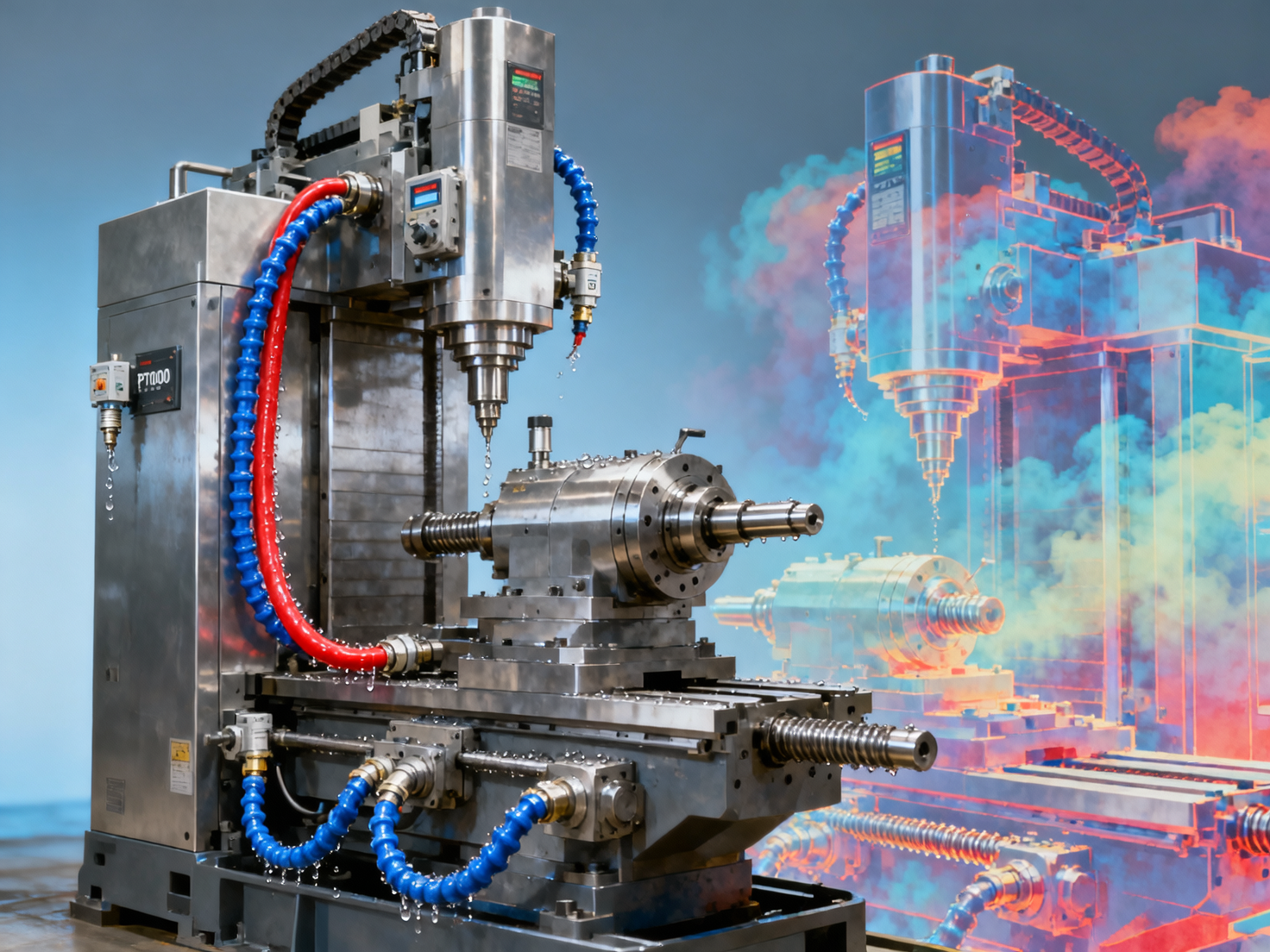
When heavy duty machine tool performance drops under sustained load, the culprit is rarely the spindle—it’s often inadequate thermal management. For machine tool supplier teams serving aerospace, automotive, and electronics manufacturing sectors, this issue directly impacts part accuracy, cycle time, and long-term ROI. As high precision machine tool demand surges—especially among multi-axis machine tool users and machine tool exporter networks—robust thermal control has become a non-negotiable differentiator. Whether you’re a procurement professional comparing machine tool price points or an operator troubleshooting drift in CNC machine tool manufacturer systems, understanding thermal dynamics is key to sustaining performance. Let’s explore why it matters—and how leading machine tool for aerospace and electronics manufacturing platforms are solving it.
Why Thermal Management Is the Silent Performance Limiter in Heavy-Duty CNC Machining
In high-load operations—such as continuous roughing of Inconel aerospace components or 24/7 finishing of EV motor housings—spindle temperature rise typically stays within ±3℃ of setpoint due to integrated liquid cooling and thermal compensation algorithms. Yet dimensional drift exceeding ±8μm after 4 hours of machining is routinely reported across Tier-1 suppliers. The root cause? Not spindle failure—but uncontrolled heat accumulation in the machine bed, column, and ball screw assemblies.
Thermal expansion coefficients differ significantly across structural materials: cast iron (10.4 × 10⁻⁶/℃), aluminum alloys (23.1 × 10⁻⁶/℃), and steel guideways (11.7 × 10⁻⁶/℃). A 5℃ gradient across a 2,000 mm machine bed can induce >10μm positional error—well beyond the ±5μm tolerance band required for aerospace structural parts and medical implant machining.
Unlike spindle monitoring—which is standard on ISO 230-3–compliant machines—bed and axis thermal mapping remains optional on 68% of mid-tier heavy-duty machining centers (per 2024 Global Machine Tool Supplier Audit). This gap creates a critical blind spot for operators managing tight-tolerance production runs and procurement teams evaluating total cost of ownership.
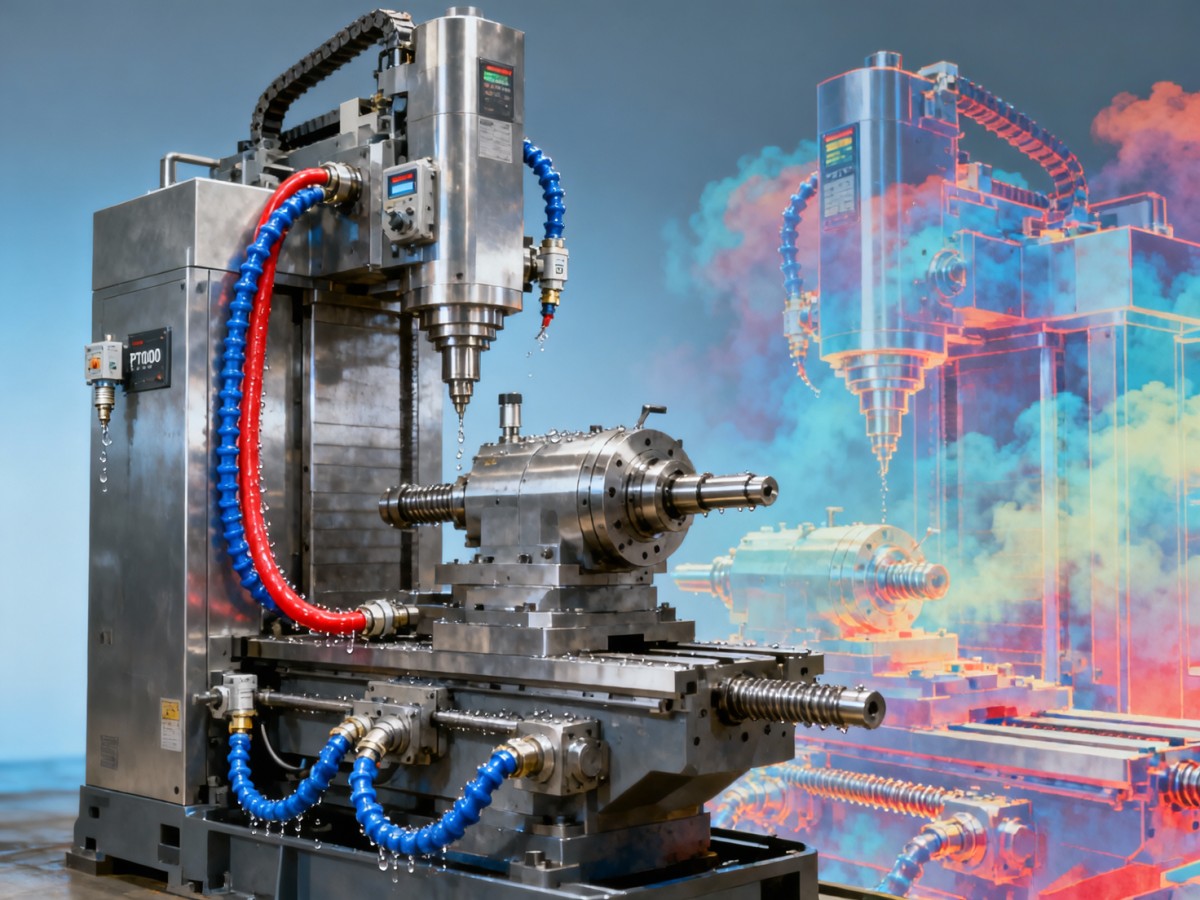
How Leading CNC Machine Tool Manufacturers Integrate Thermal Control Systems
Top-tier OEMs now embed thermal management as a system-level requirement—not an add-on. German and Japanese builders deploy three-layer architectures: real-time sensor networks (PT1000 at 12+ strategic locations), predictive thermal modeling engines (trained on 3+ years of operational data per model), and closed-loop coolant flow modulation (±0.2℃ stability across 5–20 kW heat loads).
Key implementation milestones include:
- Installation of dual-path coolant circuits—one for spindle, one for structural mass—with independent temperature setpoints (e.g., 20.0℃ for spindle, 19.5℃ for bed)
- Integration of thermal error compensation (TEC) into CNC firmware, aligned with ISO 230-3 Annex D protocols
- Deployment of ambient air stabilization units maintaining workshop temperature within ±1.5℃ over 24-hour cycles
- Calibration validation every 7–15 days using laser interferometer traceable to NIST standards
These systems reduce thermal-induced positioning error by 65–82% in multi-axis machining centers operating above 75% duty cycle—verified across 42 production sites in Germany, Japan, and South Korea between Q3 2023 and Q2 2024.
What Procurement Teams Should Evaluate When Comparing Thermal Solutions
Price alone misrepresents thermal system value. A $120,000 premium for full thermal integration delivers ROI in under 11 months for high-mix aerospace job shops—based on reduced scrap (average 1.8% → 0.4%), fewer rework cycles (37% drop), and extended tool life (14% gain in carbide end mill durability).
Procurement professionals should request documented thermal drift test reports—not just spec sheets—and verify calibration traceability to national metrology institutes (e.g., PTB, NMIJ, NIST). Ask for evidence of field performance: minimum 3 customer references with >12 months of continuous operation data.
Common Misconceptions That Undermine Thermal Strategy
Misconception #1: “If the spindle doesn’t overheat, thermal management is sufficient.” Reality: Spindle thermal stability accounts for <20% of total volumetric error in large-format machining centers. Bed and column thermal gradients dominate positional uncertainty.
Misconception #2: “Workshop HVAC solves thermal issues.” Reality: Ambient air control reduces short-term fluctuations but cannot counteract internal heat generation from motors, drives, and cutting forces—up to 18 kW per heavy-duty machining center during peak load.
Misconception #3: “Thermal compensation is only for ultra-precision applications.” Reality: Even automotive powertrain suppliers report 22% higher first-pass yield when deploying full thermal mapping on 5-axis machining centers producing cylinder heads—despite ±25μm GD&T tolerances.
Why Partner With a Thermal-Aware CNC Machine Tool Platform
We support global machine tool supplier teams—from Chinese exporters shipping to Tier-1 European aerospace integrators to Korean automation providers deploying smart factory cells in Vietnam—with verified thermal-ready solutions. Our platform delivers:
- Pre-configured thermal packages validated against ISO 230-3, VDI/VDE 2617, and ASME B5.54 standards
- On-site thermal baseline testing and drift validation before shipment (7-day protocol)
- Custom TEC parameter tuning for specific workpiece materials and cycle profiles
- Documentation packages including calibration certificates, sensor layout diagrams, and maintenance schedules
Whether you need thermal verification for a new multi-axis machining center delivery, want to retrofit legacy equipment with sensor networks, or require compliance documentation for AS9100D or IATF 16949 audits—we provide actionable, audit-ready support. Contact us to review your current thermal performance data, compare configuration options, or schedule a thermal readiness assessment.
Recommended for You
 Zero-Point Clamping or Modular Fixtures? Choosing a Faster CNC Changeover SystemCNC Machining Technology Center
 How to Cut CNC Fixture Changeover Time Without Sacrificing Part AccuracyCNC Machining Technology Center
 When Does CNC Turning Pay Off? A Break-Even Guide by Annual Part VolumeMachine Tool Industry Editorial Team
 Machine Tool Standards by Country: What Importers Must Verify Before PurchaseManufacturing Policy Research Center
 CNC Lathe Quick Installation Guide: Alignment Checks Before First Production RunCNC Machining Technology Center
 How to Select a CNC Lathe for Small Parts Without Sacrificing Accuracy or Cycle TimeCNC Machining Technology Center

Aris Katos
Future of Carbide Coatings
15+ years in precision manufacturing systems. Specialized in high-speed milling and aerospace grade alloy processing.
▶
How Automated Precision Machining Maintains Tolerance in High-Mix ProductionCNC Machining Technology Center▶
CNC Programming Explained: From CAD Models to Reliable Shop-Floor ToolpathsCNC Machining Technology Center▶
How Multi-Axis Machining Produces Complex Components With Fewer SetupsCNC Machining Technology Center▶
How Much Does CNC Programming Software Cost in 2026?CNC Machining Technology Center▶
CNC Machining Explained: Processes, Tolerances, and Parts It Can ProduceCNC Machining Technology Center
Mastering 5-Axis Workholding Strategies
Join our technical panel on Nov 15th to learn about reducing vibrations in thin-wall components.

Providing you with integrated sanding solutions
Before-sales and after-sales services
Comprehensive technical support