• Global CNC market projected to reach $128B by 2028 • New EU trade regulations for precision tooling components • Aerospace deman
NYSE: CNC +1.2%LME: STEEL -0.4%

High Precision Machining vs Standard Machining: When Tight Tolerances Are Worth the Cost
High Precision Machining vs Standard Machining: When Tight Tolerances Are Worth the Cost
In manufacturing, the difference between profit and waste often comes down to tolerance.
Standard machining works well for many components with moderate functional demands.
But high precision machining matters when small dimensional errors create large business risks.
That can mean failed assemblies, unstable performance, warranty claims, or missed compliance targets.
The real question is not whether tighter tolerances are better.
It is whether high precision machining creates enough operational and commercial value to justify its added cost.
That decision becomes more important as CNC machining, automation, and smart manufacturing keep raising expectations across global supply chains.
What Separates High Precision Machining from Standard Machining
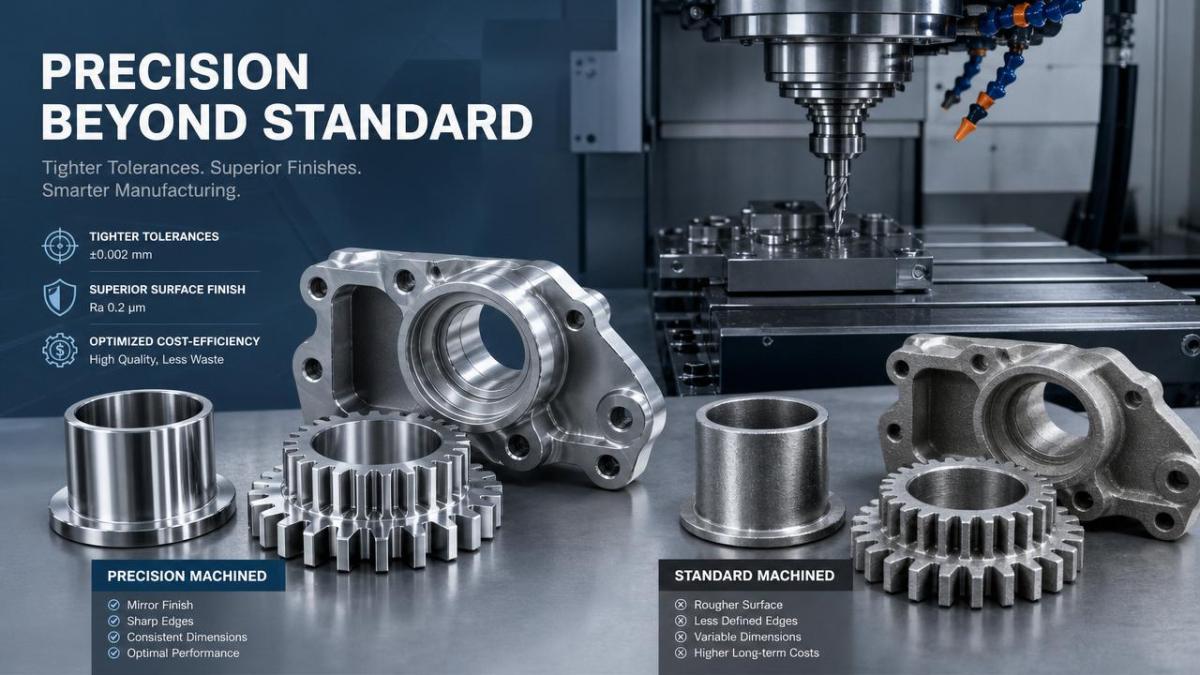
The clearest difference is tolerance capability.
Standard machining usually supports parts where slight variation does not affect fit, motion, or safety.
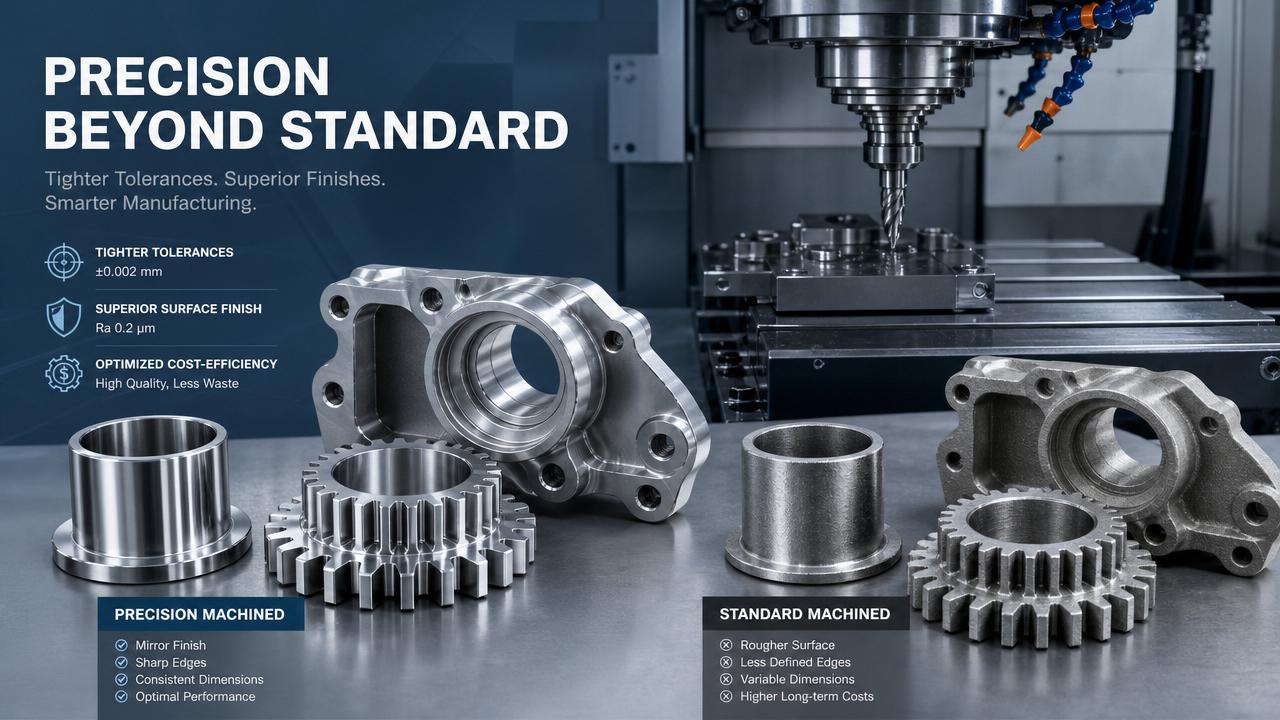
High precision machining targets much tighter dimensional control, finer surface finish, and stronger repeatability across production batches.
In practice, that often requires better machine rigidity, thermal control, tooling strategy, inspection methods, and operator discipline.
It also changes the production environment.
More process validation is needed, more measurement points are checked, and more attention goes to material behavior.
This is why high precision machining costs more, even before considering scrap risk or slower cycle times.
Key capability differences
- Tolerance control is tighter and more stable.
- Surface quality is often significantly better.
- Process repeatability supports demanding assemblies.
- Inspection requirements are more extensive.
- Machine setup and tooling standards are higher.
So, standard machining is not low quality.
It is simply the more economical option when part function allows normal variation.
When High Precision Machining Is Truly Worth the Cost
This is where many sourcing decisions go wrong.
Some teams over-specify precision because it feels safer.
Others under-specify it because the initial quotation looks more attractive.
A better approach is to link tolerance directly to functional value.
Choose high precision machining when the part affects:
- Critical fit between mating components.
- Rotational balance, sealing, or alignment.
- Safety performance in regulated applications.
- High-speed, high-load, or high-temperature operation.
- Product consistency across large production volumes.
- Downstream automation or robotic assembly reliability.
This is common in aerospace components, automotive powertrain parts, precision electronics housings, energy equipment, and medical-adjacent industrial systems.
In these cases, a cheaper part can become the most expensive choice later.
Rework, inspection delays, field failures, and customer complaints quickly erase upfront savings.
Typical decision signals
From recent industry shifts, one clearer signal is the rise of automated production lines.
Automation tolerates less variation than manual assembly.
That means high precision machining often supports not just part quality, but stable throughput.
Another signal is product miniaturization.
As components get smaller and more complex, tolerance stack-up becomes harder to ignore.
When Standard Machining Makes More Business Sense
Not every part needs high precision machining.
In fact, many parts perform perfectly well with standard machining and sensible quality controls.
This matters because tolerance inflation quietly raises cost without adding market value.
Standard machining is often enough for:
- Structural parts with non-critical mating surfaces.
- Fixtures, brackets, covers, and supports.
- Low-speed mechanical components.
- Prototype runs focused on early design validation.
- Cost-sensitive products where function is unaffected.
In actual operations, the smartest strategy is often mixed tolerance planning.
Only the critical features get high precision machining.
The rest of the part stays within standard machining limits.
That reduces cost while protecting performance where it matters most.
The Hidden Cost Drivers Behind High Precision Machining
To make a strong decision, it helps to see where the extra money actually goes.
The quote is not just paying for a tighter number on a drawing.
Main cost factors include:
- Higher-grade CNC machines and spindle stability.
- Longer setup, calibration, and process verification.
- Specialized tooling and more frequent tool changes.
- Slower feeds to protect dimensional accuracy.
- More in-process and final inspection time.
- Higher scrap exposure when variation exceeds limits.
This also explains why supplier capability matters so much.
A supplier may accept a high precision machining job on paper, yet struggle to hold consistency at scale.
That is especially important in global sourcing, where machine tool quality, metrology systems, and process maturity can vary widely.
A Practical Evaluation Framework for Better Decisions
If the team is comparing high precision machining with standard machining, a structured review prevents overengineering.
It also helps avoid false savings.
Ask these five questions first
- Which dimensions directly affect function, safety, or assembly yield?
- What failure cost appears if tolerance drifts beyond the target?
- Can only selected features require high precision machining?
- Does the supplier have proven process capability data?
- Will tighter tolerances improve long-term throughput or reduce total ownership cost?
These questions shift the conversation from unit price to business impact.
That is usually where the best sourcing decisions are made.
Quick comparison table
How to Reduce Cost Without Sacrificing Precision
There is a practical middle path.
Choosing high precision machining does not mean accepting every cost driver without challenge.
- Tighten tolerances only on functional features.
- Simplify geometries that create avoidable machining complexity.
- Align material choice with actual performance needs.
- Use capable suppliers with strong metrology systems.
- Review tolerance stack-up early, before release.
- Confirm whether process automation offsets added part cost.
In many cases, the savings come from smarter specification, not cheaper production.
That is an important distinction when evaluating high precision machining suppliers.
Final Takeaway
High precision machining is worth the cost when tolerance directly protects function, yield, safety, or lifecycle value.
Standard machining remains the right choice when a part performs reliably without extreme accuracy.
The strongest decisions come from matching tolerance to business impact, not from chasing the lowest quote or the tightest specification.
Before placing the next order, review which features truly need high precision machining and which do not.
That simple step can improve quality, control cost, and strengthen long-term manufacturing performance.
Recommended for You
![]() 33rd JIMTOF 2026 Set to Open in Tokyo as Taiwanese Exhibitors Seek OrdersGlobal Machine Tool Trade Research Center
33rd JIMTOF 2026 Set to Open in Tokyo as Taiwanese Exhibitors Seek OrdersGlobal Machine Tool Trade Research Center Which Fixture Type Cuts Changeover Time Most in High-Mix CNC Machining?CNC Machining Technology Center
![]() FANUC Invests $18 Million in Largest U.S. Corporate Automation Training CenterMachine Tool Industry Editorial Team
FANUC Invests $18 Million in Largest U.S. Corporate Automation Training CenterMachine Tool Industry Editorial Team Southeast Asia Machine Tool Market: Comparing Automotive Demand by CountryManufacturing Market Research Center
![]() Zhongshan Xiaolan Machinery Exhibition Opens With Global Product DebutsMachine Tool Industry Editorial Team
Zhongshan Xiaolan Machinery Exhibition Opens With Global Product DebutsMachine Tool Industry Editorial Team Automated Production Machining: Which Parts and Batch Sizes Are a Good Fit?Machine Tool Industry Editorial Team


Aris Katos
Future of Carbide Coatings
15+ years in precision manufacturing systems. Specialized in high-speed milling and aerospace grade alloy processing.
▶
How thermal drift affects accuracy in high-precision manufacturingCNC Machining Technology Center▶
What Tolerances Are Typical in Precision Machining?CNC Machining Technology Center▶
Industrial Machining: Selecting Processes for Tight-Tolerance Metal PartsCNC Machining Technology Center▶
How Does Precision Machining Differ From Standard Machining?CNC Machining Technology Center▶
CNC Precision: Which Tolerances, Materials, and Processes Fit Your Part?CNC Machining Technology Center
▶
Mastering 5-Axis Workholding Strategies
Join our technical panel on Nov 15th to learn about reducing vibrations in thin-wall components.

Providing you with integrated sanding solutions
Before-sales and after-sales services
Comprehensive technical support