• Global CNC market projected to reach $128B by 2028 • New EU trade regulations for precision tooling components • Aerospace deman
NYSE: CNC +1.2%LME: STEEL -0.4%

Shaft Parts for Energy Equipment: Key Materials, Tolerances, and Machining Requirements

Shaft Parts for Energy Equipment sit at the center of rotating systems where load, heat, vibration, and uptime expectations are all high. In turbines, pumps, compressors, generators, and transmission assemblies, a small deviation in material quality or machining accuracy can shorten service life, raise maintenance costs, or reduce operating efficiency. That is why the discussion around Shaft Parts for Energy Equipment is no longer limited to drawing compliance. It now connects directly with CNC capability, process stability, and the broader shift toward smart manufacturing.
Why shaft quality matters more in today’s energy systems
Energy equipment is expected to run longer, work harder, and fail less often than before. This increases attention on every rotating interface, especially shafts that transfer torque and maintain alignment.
At the same time, global CNC manufacturing is moving toward higher precision, automation, and digital integration. That trend matters because advanced shaft production depends on repeatable machining, stable fixturing, and traceable inspection data.
For energy applications, the risk is rarely one-dimensional. A shaft may meet nominal dimensions, yet still underperform because of residual stress, poor concentricity, surface damage, or unsuitable heat treatment.
What defines Shaft Parts for Energy Equipment
In practical terms, these parts include transmission shafts, rotor shafts, stepped shafts, splined shafts, hollow shafts, and bearing journals used in power generation and process systems.
Their common feature is functional precision. They must carry torque, support radial and axial loads, preserve balance, and maintain stable interaction with bearings, seals, couplings, and gears.
Simple geometry does not always mean simple production. Many shaft components combine long length-to-diameter ratios, multiple diameters, threaded sections, keyways, or tight fit zones in one part.
Material selection starts with service conditions
Material choice should follow the actual duty cycle. Torque level, temperature range, corrosion exposure, rotational speed, and shock loading all influence what is suitable.
Common material groups
Alloy steels are widely used because they offer a good balance of strength, toughness, and machinability. Grades such as 42CrMo, 4140, 4340, and similar equivalents are common for demanding shaft bodies.
Stainless steels are selected when corrosion resistance is critical, especially in offshore, chemical, or humid operating environments. However, they can increase machining difficulty and cost.
Carbon steels may still be suitable for moderate loads and controlled environments, especially when cost discipline is important. Yet they often need coating, hardening, or improved surface protection.
Special alloys are used for extreme heat, wear, or corrosive media. These cases are less common, but they often define the highest-value Shaft Parts for Energy Equipment.
What should be checked beyond the material name
- Heat treatment route, including quenching, tempering, induction hardening, or nitriding
- Core hardness and surface hardness consistency
- Internal cleanliness, segregation level, and ultrasonic inspection status
- Forging quality, grain flow direction, and defect control
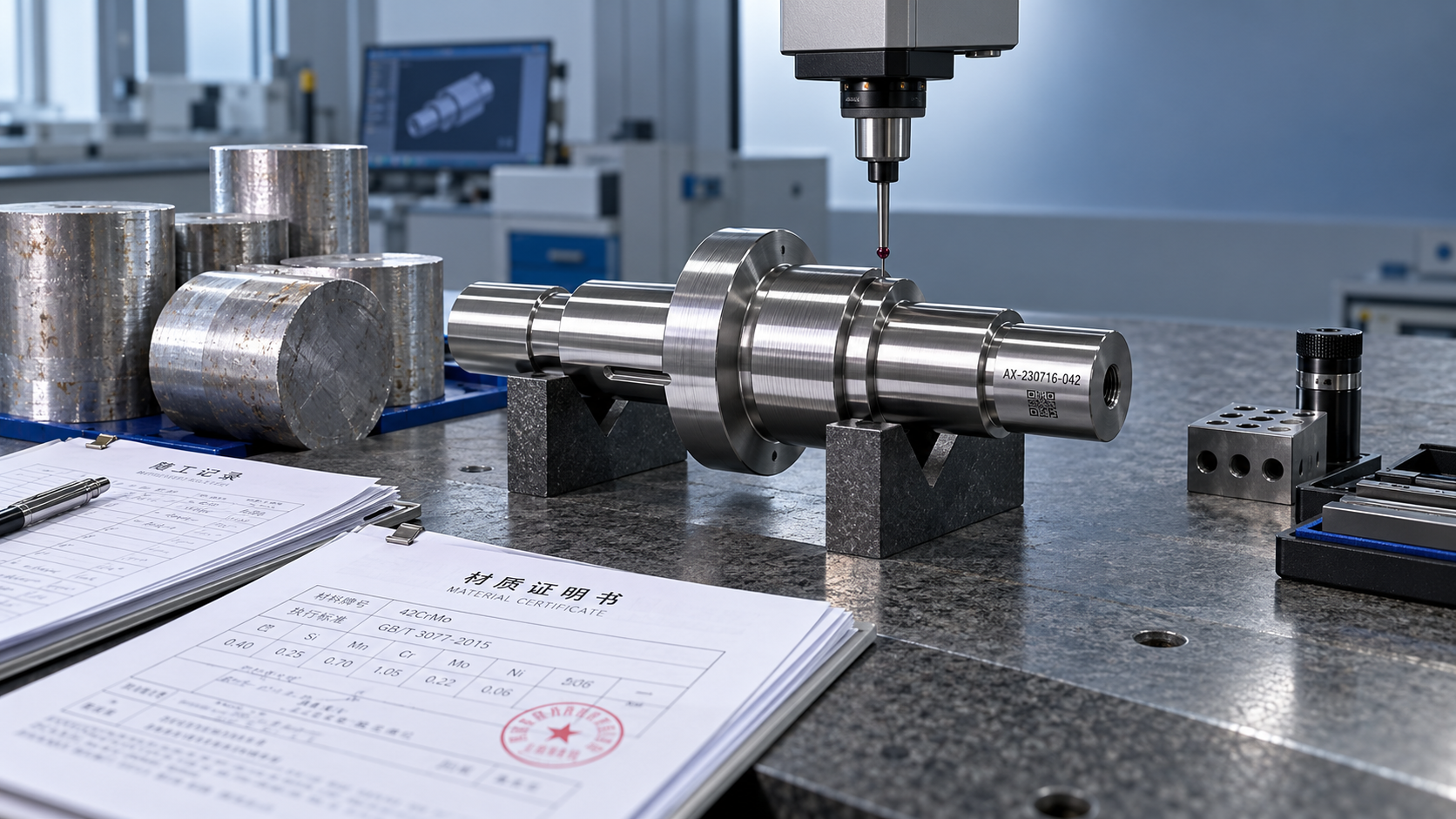
In other words, the material certificate is only a starting point. Performance depends on the full material condition delivered into machining.
Tolerance strategy is about function, not only tightness
One common mistake is assuming that tighter tolerances always mean better quality. For Shaft Parts for Energy Equipment, the better question is whether each tolerance supports the working assembly.
Bearing seats, seal journals, coupling fits, and gear interfaces usually carry the strictest requirements. Other sections may allow wider control bands without affecting performance.
Key tolerance items
A sensible tolerance scheme also supports manufacturability. If every feature is specified at the highest precision level, cost rises quickly while process capability may drop.
Machining requirements that shape final performance
Modern CNC lathes, machining centers, grinders, and multi-axis systems make complex shaft production more stable than in the past. Even so, process planning remains decisive.
Critical process stages
Rough turning establishes the reference structure and removes stock efficiently. The next concern is how much stress remains in the part after material removal.
Heat treatment is often inserted between rough and finish machining. This helps stabilize dimensions, but it can also introduce distortion that must be predicted and corrected.
Finish turning, grinding, or hard turning sets the final functional surfaces. For bearing and seal zones, surface finish is usually as important as dimensional size.
Secondary operations such as keyway milling, spline cutting, drilling, and thread machining should be planned to protect datum consistency and avoid cumulative error.
Surface integrity deserves close attention
A shaft can pass dimensional inspection and still fail in service because the surface layer is damaged. Burn marks, tensile residual stress, chatter, or micro-cracks can accelerate fatigue.
This is especially relevant in high-speed energy systems, where repeated cyclic loading turns small surface defects into real reliability issues.
Typical application differences across energy equipment
Not all Shaft Parts for Energy Equipment are evaluated the same way. The operating context changes what deserves the closest scrutiny.
- Wind power shafts emphasize fatigue resistance, size stability, and reliable forging quality over long service periods.
- Pump and compressor shafts need strong control of runout, journal finish, and corrosion resistance in fluid-contact environments.
- Generator and motor shafts often require tight balance, concentricity, and stable fits for rotating electrical assemblies.
- Oil and gas equipment may demand upgraded alloys, deeper hardening, and stronger inspection records due to harsh media and safety requirements.
The practical takeaway is clear: evaluation should follow the duty profile, not only the drawing title.
How to assess production capability with fewer blind spots
When reviewing suppliers or internal production plans, it helps to look beyond machine lists. Advanced equipment matters, but process discipline matters more.
Useful checkpoints
- Whether the process route matches the shaft’s function, not just its geometry
- Whether turning, grinding, and heat treatment are linked through clear datum management
- Whether inspection includes runout, roughness, hardness, and material verification
- Whether long and slender parts have distortion control during clamping and machining
- Whether batch consistency is supported by in-process measurement and traceability
In a market shaped by automation and digital manufacturing, suppliers that combine CNC capacity with repeatable quality systems usually offer more dependable results than those relying on final inspection alone.
A practical way to move the evaluation forward
Shaft Parts for Energy Equipment should be judged as functional components inside a complete operating system. Material grade, tolerance callouts, machining route, and inspection records all need to be read together.
A useful next step is to map each shaft feature to a service requirement: load transfer, alignment, sealing, wear life, or corrosion resistance. That approach quickly shows which specifications are essential and which may be overdefined.
From there, compare manufacturing capability against those priorities, especially in heat treatment control, grinding quality, and dimensional consistency across batches. That is usually where the real difference in Shaft Parts for Energy Equipment becomes visible.
Recommended for You
![]() FANUC Links FIELD System Data with Copilot to Advance Shop-Floor Data UseCNC Machining Technology Center
FANUC Links FIELD System Data with Copilot to Advance Shop-Floor Data UseCNC Machining Technology Center Smart Manufacturing for Aerospace: Building Traceability Across CNC OperationsCNC Machining Technology Center
![]() Mitsubishi Electric Announces Physical AI System Linking Humanoid Robots and CNC MachinesMachine Tool Industry Editorial Team
Mitsubishi Electric Announces Physical AI System Linking Humanoid Robots and CNC MachinesMachine Tool Industry Editorial Team Precision Machining for Defense: Supplier Quality and Traceability ChecksManufacturing Market Research Center
![]() Nidec Machine Tool Launches MVR-5X Five-Axis Gantry MachineMachine Tool Industry Editorial Team
Nidec Machine Tool Launches MVR-5X Five-Axis Gantry MachineMachine Tool Industry Editorial Team Choosing a Precision Disc Parts Manufacturer in China: Tolerances and Quality ChecksManufacturing Market Research Center

Aris Katos
Future of Carbide Coatings
15+ years in precision manufacturing systems. Specialized in high-speed milling and aerospace grade alloy processing.
▶
How thermal drift affects accuracy in high-precision manufacturingCNC Machining Technology Center▶
Industrial Machining: Selecting Processes for Tight-Tolerance Metal PartsCNC Machining Technology Center▶
How Does Precision Machining Differ From Standard Machining?CNC Machining Technology Center▶
CNC Precision: Which Tolerances, Materials, and Processes Fit Your Part?CNC Machining Technology Center▶
How to Choose Metal Machining Processes for Tight Tolerances and Production VolumeCNC Machining Technology Center
▶
Mastering 5-Axis Workholding Strategies
Join our technical panel on Nov 15th to learn about reducing vibrations in thin-wall components.

Providing you with integrated sanding solutions
Before-sales and after-sales services
Comprehensive technical support