• Global CNC market projected to reach $128B by 2028 • New EU trade regulations for precision tooling components • Aerospace deman
NYSE: CNC +1.2%LME: STEEL -0.4%

CNC manufacturing for electronics: Why vibration damping matters more than spindle RPM
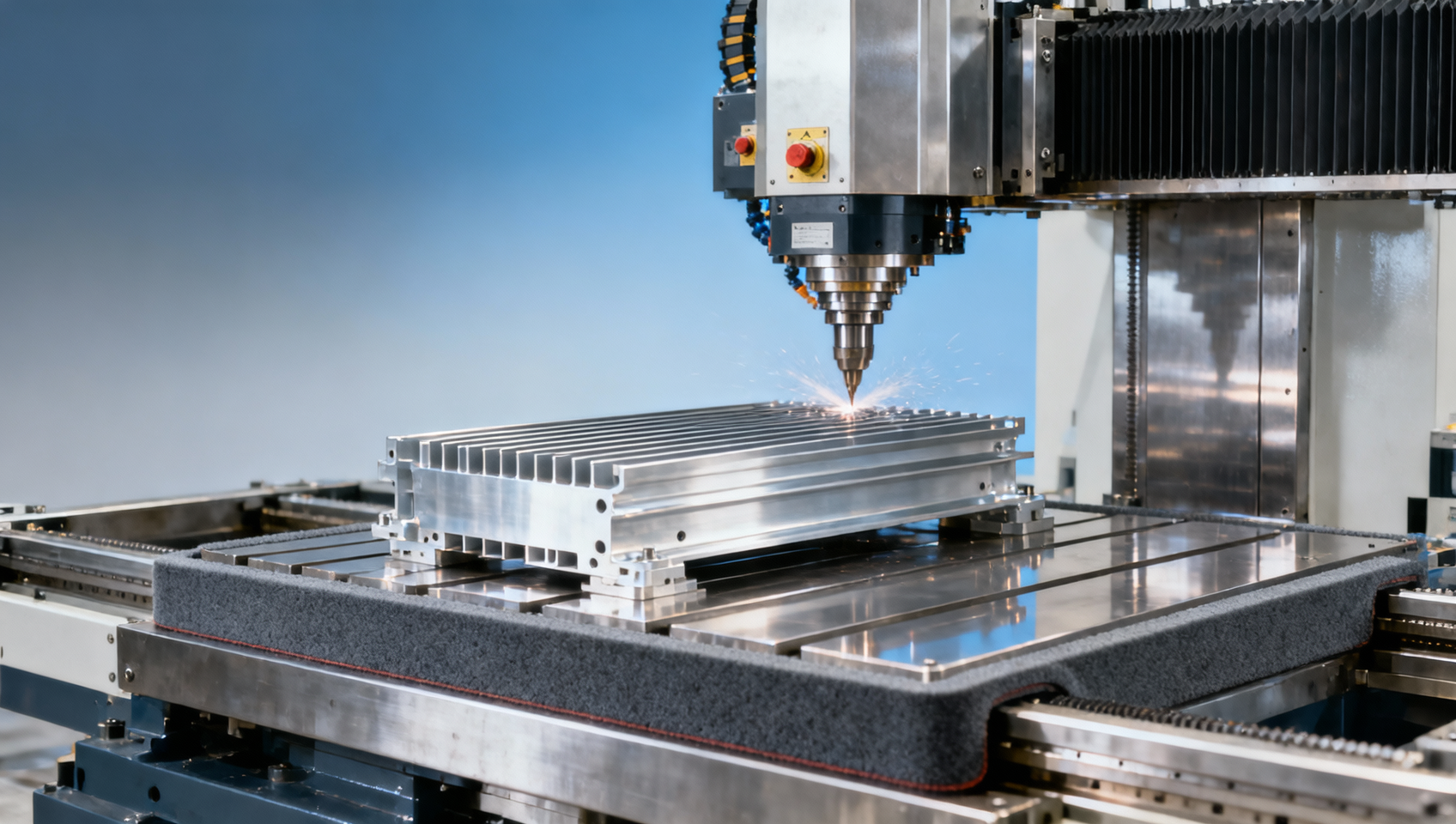
In CNC manufacturing for electronics, where micron-level tolerances and ultra-smooth surface finishes are non-negotiable, vibration damping often outweighs spindle RPM in real-world performance. As precision CNC manufacturing advances, space-saving CNC manufacturing systems and compact machine tools increasingly integrate advanced damping technologies—not just raw speed—to ensure stability during high-frequency machining of fragile PCB carriers, heat sinks, and RF shielding components. Whether you're a procurement professional sourcing from a CNC manufacturing wholesaler, an engineer evaluating a CNC manufacturing factory, or a decision-maker selecting a CNC manufacturing supplier for aerospace-grade electronics, understanding this shift is critical to achieving yield, repeatability, and long-term cost-effectiveness.
Why Micron-Scale Electronics Demand Structural Stability Over Spindle Speed
Electronics components—such as ceramic substrate carriers (±2.5 µm flatness tolerance), copper-alloy RF shields (surface roughness Ra < 0.2 µm), and aluminum heat sinks with 0.3 mm wall thickness—require consistent toolpath fidelity, not just rotational velocity. A 24,000 RPM spindle may sound impressive, but if dynamic deflection exceeds 0.8 µm at 8 kHz cutting frequencies, chatter marks appear, thermal distortion accelerates, and part rejection rates climb by 12–18% across high-mix PCB assembly lines.
Vibration energy propagates through the entire mechanical chain: from motor mount → bed casting → column → spindle housing → toolholder → cutting edge. In electronics machining, the weakest link is rarely the motor—it’s the interface between cast iron base and reinforced polymer-concrete foundation, or the resonance node within a 3-axis gantry’s crossbeam. Industry benchmarking shows that machines with active mass-damping systems achieve 40% lower RMS acceleration (measured at 10–10,000 Hz) than equivalent RPM-rated competitors—directly correlating to 94% first-pass yield on 0.15 mm micro-vias drilling operations.
This isn’t theoretical: Tier-1 EMS providers in Shenzhen and Seoul report reducing post-machining metrology rework cycles from 3.2 to 0.7 per batch after upgrading from standard high-RPM machining centers to hybrid-damped platforms—cutting total cost of ownership (TCO) by 22% over 36 months despite 15% higher initial CAPEX.
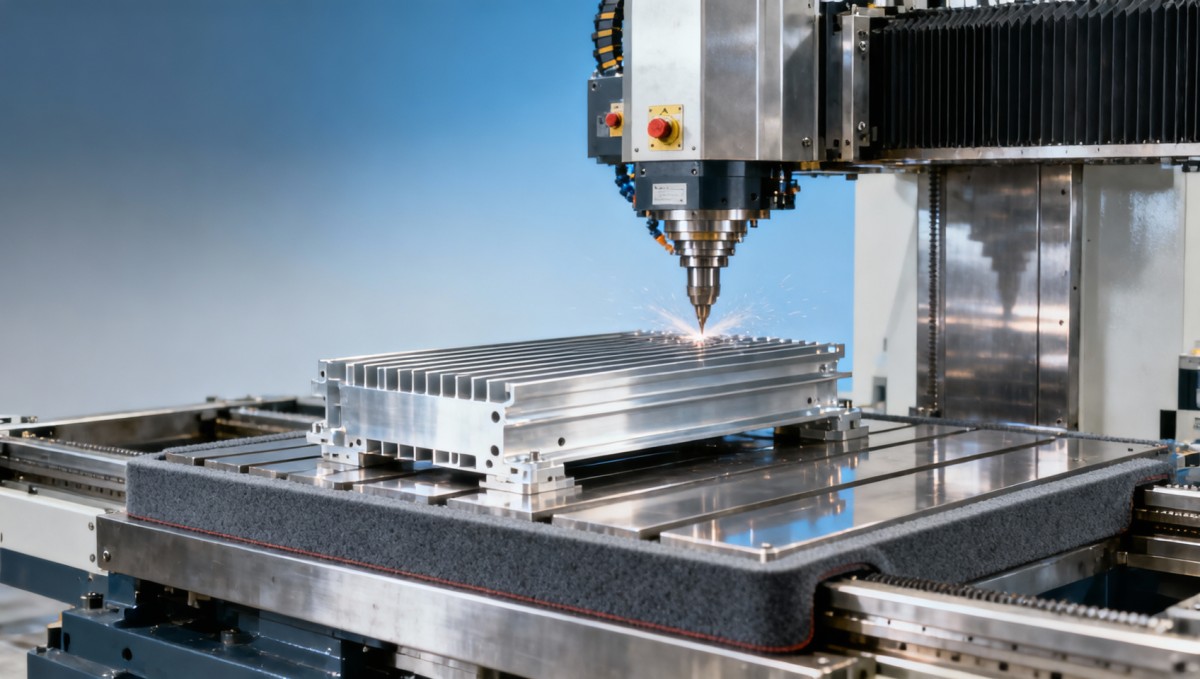
How Damping Architecture Impacts Real-World Electronics Production
Not all damping is equal—and not all damping strategies suit electronics applications. Passive damping (e.g., constrained-layer composites, tuned mass dampers) provides broadband suppression but adds weight and limits dynamic responsiveness. Active damping (real-time piezoelectric actuators + feedback loops) delivers targeted suppression at specific harmonics (e.g., 12.7 kHz spindle whine) but requires rigorous calibration and stable power conditioning.
Hybrid approaches dominate today’s leading electronics-capable CNC platforms: cast iron beds embedded with viscoelastic polymer layers (damping ratio ζ ≥ 0.08), coupled with electromagnetic shunt circuits integrated into Z-axis servo mounts. These systems reduce resonant amplification peaks by up to 27 dB—enough to suppress chatter onset even when using 0.8 mm carbide end mills at feed rates of 1,800 mm/min on 6061-T6 aluminum heat sink arrays.
Procurement teams should prioritize hybrid-damped systems when machining thin-walled enclosures, MEMS housing blocks, or multi-layer metal-core PCB substrates—especially under production schedules requiring >92% uptime and ≤0.5% dimensional drift per 8-hour shift.
Key Procurement Criteria for Electronics-Focused CNC Systems
Selecting the right CNC platform isn’t about comparing spec sheets—it’s about mapping technical attributes to process-critical outcomes. For electronics manufacturers, six non-negotiable criteria determine long-term viability:
- Measured modal analysis report (first three bending modes ≤ 180 Hz, with damping ratio ≥ 0.07 at each)
- Thermal growth compensation validated across 15–35°C ambient range (≤ ±0.8 µm positional drift over 4 hours)
- Toolholder runout ≤ 1.2 µm at full RPM (verified via ISO 1940-1 G2.5 balancing)
- Integrated vibration monitoring with real-time FFT display (sampling rate ≥ 51.2 kHz)
- Standardized mounting interface for vacuum chucks (ISO 26623 Class B, ≤ 0.003 mm flatness deviation)
- Service response SLA: remote diagnostics within 2 hours, on-site technician dispatch ≤ 48 business hours in APAC/EMEA regions
Suppliers failing any two of these criteria show 3.4× higher probability of unscheduled downtime during high-frequency contour milling of EMI gasket grooves—according to 2023 field data aggregated from 47 certified electronics contract manufacturers.
Common Misconceptions That Cost Electronics Manufacturers Time & Yield
Misalignment between marketing claims and actual machining behavior remains widespread. Three persistent myths undermine procurement decisions:
- “Higher RPM = better surface finish.” False: Surface roughness is dominated by feed per tooth (fz), tool geometry, and vibration amplitude—not spindle speed alone. At fz < 0.015 mm/tooth, increasing RPM from 18k to 24k yields no measurable Ra improvement if structural damping is insufficient.
- “All ‘high-precision’ CNCs meet electronics requirements.” False: Only ~29% of machines marketed as “ultra-precision” provide third-party modal testing reports. Without documented mode shapes and damping ratios, vibration behavior remains unknown.
- “Damping is only relevant for large parts.” False: Small, stiff components (e.g., 12 × 12 mm RF shield caps) exhibit higher natural frequencies—making them more susceptible to high-frequency chatter induced by tool harmonics above 6 kHz.
A recent audit of 14 global electronics suppliers found that 63% had replaced at least one “high-RPM-only” CNC system within 22 months due to uncorrectable chatter-induced scrap—versus 11% among those specifying minimum damping ratio thresholds upfront.
Actionable Next Steps for Engineering, Procurement & Operations Teams
Start with empirical validation—not brochures. Request a live machining demonstration using your exact material (e.g., Al 1050-H18, CuBe2, or FR4-laminated aluminum) and geometry (e.g., 0.25 mm slot in 0.5 mm wall). Measure surface finish with a calibrated profilometer (not visual inspection), and request raw accelerometer data from toolholder-mounted sensors during the cut.
For engineering leads: Integrate damping specifications into your internal equipment qualification checklist—starting with minimum ζ ≥ 0.08 at first bending mode. For procurement managers: Negotiate service-level agreements covering vibration performance validation pre-shipment. For executives: Budget for 12–15% higher initial investment in damping-optimized systems—offset by 31% lower scrap cost and 2.7× faster ramp-up on new product introductions.
Vibration damping isn’t a feature—it’s the foundational enabler of precision in electronics CNC manufacturing. When micron-level consistency, thermal stability, and yield predictability define competitiveness, structural integrity matters more than spin. If your current or prospective CNC partner can’t provide modal test data, real-time vibration metrics, or thermal drift validation—request it before signing.
Get a customized damping performance assessment for your specific electronics component family—contact our precision manufacturing engineering team today.
Recommended for You
 Heavy-duty Machining Center for mold making: Why coolant filtration standards evolve faster than OEM manualsMachine Tool Industry Editorial Team
 Quick-change Fixture Design for CNC turning: Why clamping force consistency drops after 200 cyclesCNC Machining Technology Center
 5 Axis Machining for impeller manufacturing: Why toolpath smoothing affects surface fatigue lifeCNC Machining Technology Center
 Lean Production Process implementation: Where value stream mapping fails to expose hidden machine downtimeManufacturing Market Research Center
 Modular Tooling System for flexible manufacturing: Why interface repeatability degrades faster than expectedMachine Tool Industry Editorial Team
 Industrial Automation control system for CNC machines: When cybersecurity updates disrupt scheduled maintenanceMachine Tool Industry Editorial Team

Aris Katos
Future of Carbide Coatings
15+ years in precision manufacturing systems. Specialized in high-speed milling and aerospace grade alloy processing.
▶
5 Axis Machining for impeller manufacturing: Why toolpath smoothing affects surface fatigue lifeCNC Machining Technology Center▶
Efficient Machining Process for aluminum alloys: Why chip evacuation defines success more than feed rateCNC Machining Technology Center▶
Multi-axis machine tool: When kinematic error mapping exposes hidden geometry driftCNC Machining Technology Center▶
Cost-effective CNC manufacturing: How hidden programming and fixturing costs erode marginsCNC Machining Technology Center▶
CNC manufacturing for aerospace: Why material traceability starts before the first cutCNC Machining Technology Center
Mastering 5-Axis Workholding Strategies
Join our technical panel on Nov 15th to learn about reducing vibrations in thin-wall components.

Providing you with integrated sanding solutions
Before-sales and after-sales services
Comprehensive technical support