• Global CNC market projected to reach $128B by 2028 • New EU trade regulations for precision tooling components • Aerospace deman
NYSE: CNC +1.2%LME: STEEL -0.4%

Why CNC Cutting Quality Drops on Thin Metal Sheets
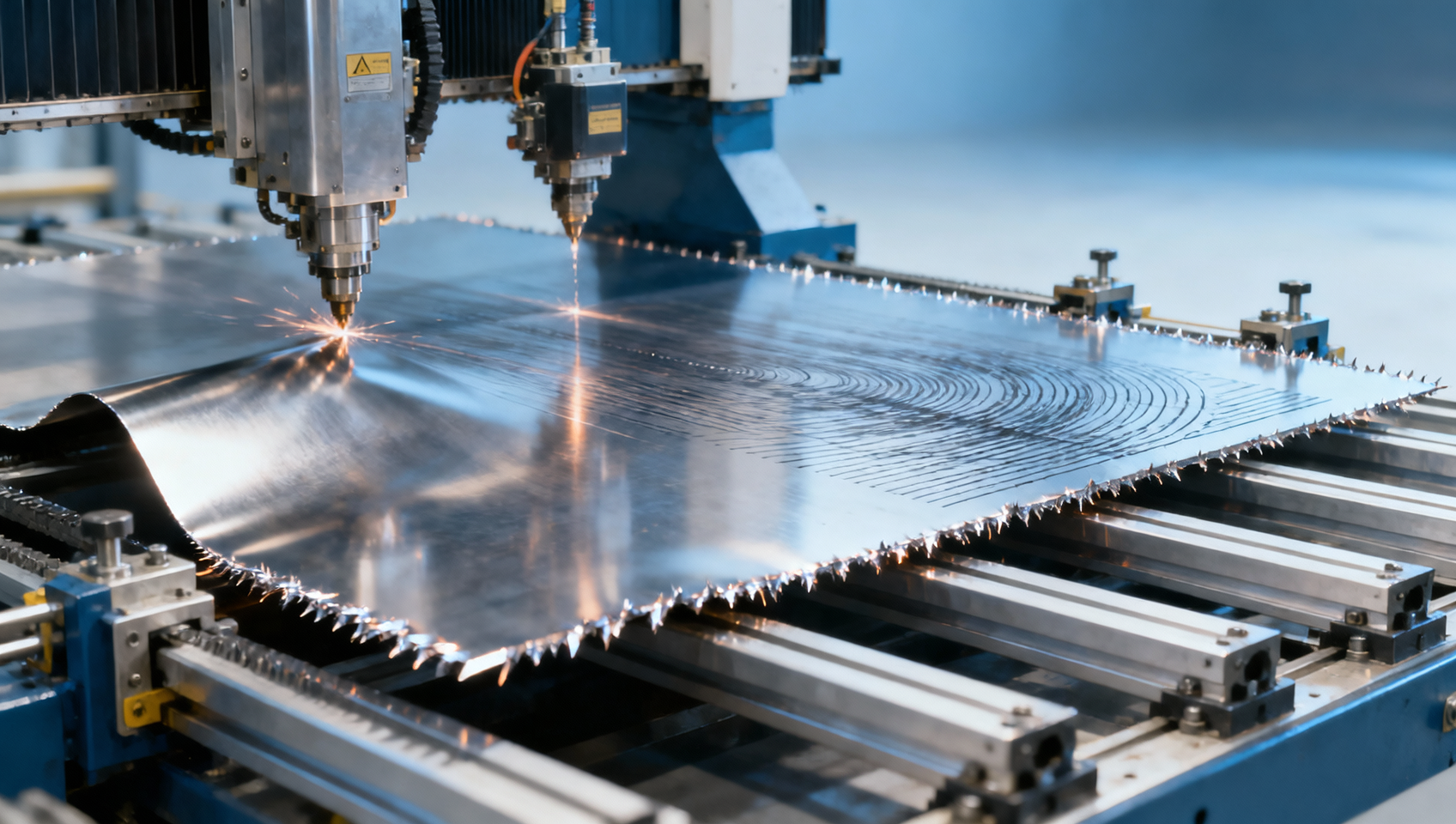
In metal machining, thin sheets often expose the limits of CNC cutting, where vibration, heat, and poor clamping can quickly reduce accuracy and edge finish. For professionals in CNC industrial environments, understanding why quality drops is essential to improving the production process, reducing scrap, and maintaining stable automated production across modern CNC metalworking applications.
Why thin metal sheets are harder to cut well in CNC production
Thin sheet cutting behaves very differently from machining thicker plate or solid stock. Once material thickness moves into common light-gauge ranges such as 0.5 mm to 3.0 mm, rigidity falls sharply while sensitivity to thermal input and clamping pressure rises. That combination makes CNC cutting quality less stable, especially when shops try to run high throughput with standard settings.
The main issue is not only machine accuracy. Even a precise CNC system can produce poor edges, burrs, distortion, or dimensional drift if the sheet flexes during cutting. In practical factory conditions, the weak point is often the interaction between sheet stiffness, cutting energy, toolpath strategy, fixture support, and cycle time pressure.
For operators, this means a program that works on 6 mm steel may fail on 1 mm stainless sheet. For buyers and decision-makers, it means equipment specifications alone do not guarantee consistent results. Process compatibility matters just as much as spindle power, controller brand, or automation level.
In industries such as electronics enclosures, ventilation parts, automotive brackets, battery housings, and appliance panels, tolerance expectations are often tight while material is thin. That creates a narrow process window. A variation of only a small amount in hold-down force, feed rate, or heat concentration can visibly reduce CNC cutting quality.
What quality loss usually looks like on thin sheets
- Edge burrs increase, especially near corners, exit points, and direction changes.
- Flatness worsens after cutting, with local warping appearing within minutes as residual heat relaxes.
- Hole roundness and slot width drift beyond the expected tolerance band, often in the ±0.1 mm to ±0.3 mm range depending on the process.
- Surface scratches rise when unstable chips, poor nesting, or sheet lift-up interfere with the tool or support table.
These symptoms are common across laser cutting, plasma cutting, waterjet trimming, routing, and mechanical CNC cutting, although the root causes differ. The important point is that thin material magnifies process weaknesses much faster than thicker parts do.
Which technical factors usually cause CNC cutting quality to drop?
When manufacturers troubleshoot thin sheet problems, they often focus first on machine calibration. Calibration matters, but it is only one part of the picture. In most production lines, quality loss comes from 5 core variables working together: material behavior, clamping, cutting parameters, toolpath dynamics, and thermal control.
Material type changes everything. Thin aluminum reflects heat and can move quickly. Thin stainless steel stores heat and can discolor or distort. Coated steel introduces another layer of risk because protective surfaces can burn, peel, or mark. A setup that is acceptable for mild steel may be unsuitable for galvanized or mirror-finish material.
Clamping is another major cause of unstable CNC cutting quality. If hold-down force is too weak, the sheet vibrates or lifts. If pressure is too high, the material deforms before cutting even starts. On large-format parts, support spacing also matters. Unsupported spans over 200 mm to 400 mm can become a problem depending on thickness and cutting method.
Thermal input is especially critical in automated production. Long continuous cuts, dense nesting, and repeated contouring in one zone build heat quickly. Once temperature accumulates in a localized area, edge finish drops and dimensional accuracy becomes inconsistent from part to part within the same batch.
The most common causes in production workshops
The table below helps information researchers, operators, and procurement teams connect visible defects with likely root causes. This is useful when comparing machine capability, fixture design, and process readiness before launching a new thin sheet cutting project.
This comparison shows why quality problems should not be treated as a single machine fault. In thin sheet CNC cutting, diagnosis works best when teams review the full process chain, from incoming material flatness to tool wear cycles and unloading behavior.
Why vibration and acceleration matter more on thin stock
High-speed CNC systems are designed for productivity, but thin metal sheets may not tolerate the same acceleration profile used on thicker workpieces. Rapid direction changes at corners, narrow webs, and nested micro-parts can trigger resonance. Even if the machine frame is stable, the material itself can behave like a vibrating membrane.
A practical solution is to separate roughing speed from fine-feature speed. Many shops gain better results by reducing acceleration on small contours, reducing lead-in aggression, and adding support bridges where geometry permits. The cycle time increase may be only 3% to 8%, but scrap reduction can be far more valuable.
How should operators and engineers adjust the process for thin metal sheets?
Improving CNC cutting quality on thin sheet material usually depends on process discipline rather than one dramatic machine upgrade. The most effective improvements come from parameter refinement, workholding optimization, maintenance routines, and program sequencing. These actions are realistic for both independent workshops and automated production lines.
Start with the material itself. Confirm actual thickness variation, sheet flatness, protective film condition, and lot consistency before adjusting the program. In many factories, incoming material variation is overlooked, even though a difference of a few tenths of a millimeter can change cutting response on thin stock.
Next, review fixture and support layout. For thin sheets, the support strategy should match part geometry rather than rely only on standard table spacing. Small windows, long slots, and narrow tabs need local support. This is especially important in high-mix production, where setup teams may reuse a fixture arrangement from a previous job.
Finally, monitor consumables and inspection frequency. In thin sheet CNC cutting, tool wear or nozzle wear becomes visible sooner in edge quality than in machine alarms. A routine check every 1 shift, every batch, or every 2 to 4 production hours can prevent a large amount of rework.
A practical 4-step improvement workflow
- Verify material and machine condition: check flatness, thickness, support table cleanliness, consumables, and axis repeatability.
- Tune the cut recipe: adjust feed, speed, assist gas, spindle or beam settings, lead-ins, and acceleration for thin stock instead of copying thick-plate programs.
- Optimize nesting and sequence: distribute heat, avoid long uninterrupted contour loops, and cut small internal features before outer profiles.
- Inspect and document: record burr level, flatness, dimensional stability, and scrap reasons over 3 to 5 batches to build a repeatable process window.
This workflow is useful because it connects operator actions with engineering control. It also helps purchasing teams evaluate whether a supplier understands process capability, not just machine sales language.
Typical adjustment priorities by cutting method
Different CNC cutting technologies fail in different ways on thin metal sheets. The table below gives a selection-oriented view that can support process planning, supplier comparison, and equipment procurement discussions.
For decision-makers, the takeaway is clear: the best CNC cutting process for thin sheet depends on required edge quality, downstream forming, tolerance band, and batch size. No single method fits every production target.
What should buyers and decision-makers evaluate before choosing a CNC cutting solution?
Procurement errors often start with an incomplete question. Instead of asking only which CNC machine is more advanced, buyers should ask which process is more stable for our material range, lot size, tolerance, and automation plan. Thin sheet cutting quality is a process capability issue as much as an equipment issue.
A useful purchasing framework includes 5 dimensions: supported thickness range, repeatable edge quality, fixture and material handling capability, maintenance burden, and integration with existing production software or automation cells. This is especially important for factories moving toward digital manufacturing and flexible production lines.
Buyers should also ask suppliers how they validate thin sheet performance. A meaningful discussion includes sample material type, thickness range such as 0.8 mm to 2.0 mm or 1.5 mm to 4.0 mm, expected tolerance, burr acceptance level, and whether parts will be welded, bent, coated, or assembled later. Those downstream steps strongly affect what “good cutting quality” really means.
For management teams, cost evaluation should include more than machine price. Scrap, rework, maintenance frequency, setup time, operator skill demand, and batch changeover losses can be more significant over 12 to 36 months than the initial purchase gap between two machine options.
A procurement checklist for thin sheet CNC cutting
- Confirm the actual material portfolio: stainless, aluminum, carbon steel, coated sheet, and the main thickness intervals used each month.
- Define quality targets numerically: flatness allowance, burr level, edge oxidation limit, and dimensional tolerance by feature type.
- Check automation compatibility: loading, unloading, part sorting, nesting software, and MES or ERP data connection.
- Request process support details: parameter setup, sample testing, operator training, and post-installation optimization during the first 2 to 8 weeks.
- Review service risk: consumable lead time, remote diagnostics, spare part access, and preventive maintenance intervals.
This checklist helps purchasing teams avoid buying a machine that looks strong on paper but performs inconsistently on actual thin sheet jobs. In B2B manufacturing, stable output matters more than headline speed alone.
Common decision mistakes
One common mistake is assuming that higher power automatically improves thin sheet cutting quality. In reality, excessive energy can widen the heat-affected zone or reduce edge consistency. Another mistake is focusing only on maximum thickness capacity while ignoring the shop’s real production mix, which may be concentrated below 3 mm.
A third mistake is skipping sample validation under realistic nesting conditions. A single demo part may look excellent, but a full sheet run with 20, 50, or 100 nested components reveals whether the process stays stable across heat buildup, feature density, and production rhythm.
FAQ: common questions about CNC cutting quality on thin metal sheets
Why does thin sheet warp even when the CNC machine is accurate?
Machine accuracy and part stability are not the same thing. Thin sheet warps mainly because of low stiffness, thermal concentration, and residual stress release after cutting. Even with a precise CNC platform, long contours, dense nesting, or poor support can cause distortion during or after the cut. Reviewing cut sequence and cooling distribution is often more effective than recalibration alone.
How can operators reduce burrs on thin metal sheets?
Operators should check 4 areas first: consumable wear, feed or speed settings, sheet support, and part lift-up near the end of the cut. In many shops, a scheduled check every shift and a controlled parameter library by material thickness can reduce burr variation significantly. Fine-feature acceleration control is also important, especially on small holes and narrow slots.
Which process is better for precision thin sheet parts?
The answer depends on material, edge requirement, and batch size. Fiber laser cutting is widely preferred for high-volume thin sheet work that needs speed and reasonable precision. Waterjet is useful for heat-sensitive materials or parts where thermal effects are unacceptable. Mechanical CNC cutting can be suitable for selected materials if vibration and fixture support are well controlled.
What should procurement teams ask before ordering equipment or outsourcing cutting work?
Ask for tested thickness ranges, sample validation conditions, burr and flatness control methods, maintenance intervals, and support for your downstream process such as bending, welding, or coating. Also confirm typical lead times for commissioning, training, spare parts, and sample runs. These details are more useful than generic performance claims.
Why choose us for thin sheet CNC cutting insight and project support?
We focus on the global CNC machining and precision manufacturing industry, with close attention to machine tools, automated production, digital integration, and the practical requirements of industrial buyers and production teams. That perspective helps connect technical process issues with procurement decisions and factory-level implementation.
If your thin metal sheet cutting quality is dropping, we can help you narrow the real cause faster. Discussion can cover material range, process selection, parameter direction, fixture concerns, automation compatibility, and supplier comparison logic. This is especially useful when your project involves tight tolerances, complex part geometry, or pressure to reduce scrap within a short production window.
You can contact us for support on sample evaluation, cutting method comparison, equipment selection, delivery cycle planning, and custom production scenarios across automotive parts, energy equipment, electronics structures, and general precision fabrication. If compliance or export requirements affect your project, that can also be addressed during early-stage communication.
For a more effective discussion, prepare 6 key inputs: material type, thickness range, part drawings, expected tolerance, monthly volume, and downstream process requirements. With those details, it becomes much easier to assess whether the right solution is a parameter adjustment, a fixture upgrade, a different CNC cutting process, or a new equipment investment.
PREVIOUS ARTICLE
Recommended for You
 Heavy-duty Machining Center for mold making: Why coolant filtration standards evolve faster than OEM manualsMachine Tool Industry Editorial Team
 Quick-change Fixture Design for CNC turning: Why clamping force consistency drops after 200 cyclesCNC Machining Technology Center
 5 Axis Machining for impeller manufacturing: Why toolpath smoothing affects surface fatigue lifeCNC Machining Technology Center
 Lean Production Process implementation: Where value stream mapping fails to expose hidden machine downtimeManufacturing Market Research Center
 Modular Tooling System for flexible manufacturing: Why interface repeatability degrades faster than expectedMachine Tool Industry Editorial Team
 Industrial Automation control system for CNC machines: When cybersecurity updates disrupt scheduled maintenanceMachine Tool Industry Editorial Team

Aris Katos
Future of Carbide Coatings
15+ years in precision manufacturing systems. Specialized in high-speed milling and aerospace grade alloy processing.
▶
CNC Cutting Gas Choice Affects More Than Edge FinishCNC Machining Technology Center▶
CNC Cutting Edge Wear Patterns That Change Part AccuracyCNC Machining Technology Center▶
Metal Machining Costs Rise Fast With Poor Chip ControlCNC Machining Technology Center▶
Why CNC Cutting Quality Drops on Thin Metal SheetsCNC Machining Technology Center▶
CNC cutting quality drops fast when tool wear goes unnoticedCNC Machining Technology Center
Mastering 5-Axis Workholding Strategies
Join our technical panel on Nov 15th to learn about reducing vibrations in thin-wall components.

Providing you with integrated sanding solutions
Before-sales and after-sales services
Comprehensive technical support