• Global CNC market projected to reach $128B by 2028 • New EU trade regulations for precision tooling components • Aerospace deman
NYSE: CNC +1.2%LME: STEEL -0.4%

Metal Lathe vs CNC Milling for Low Volume Round Parts
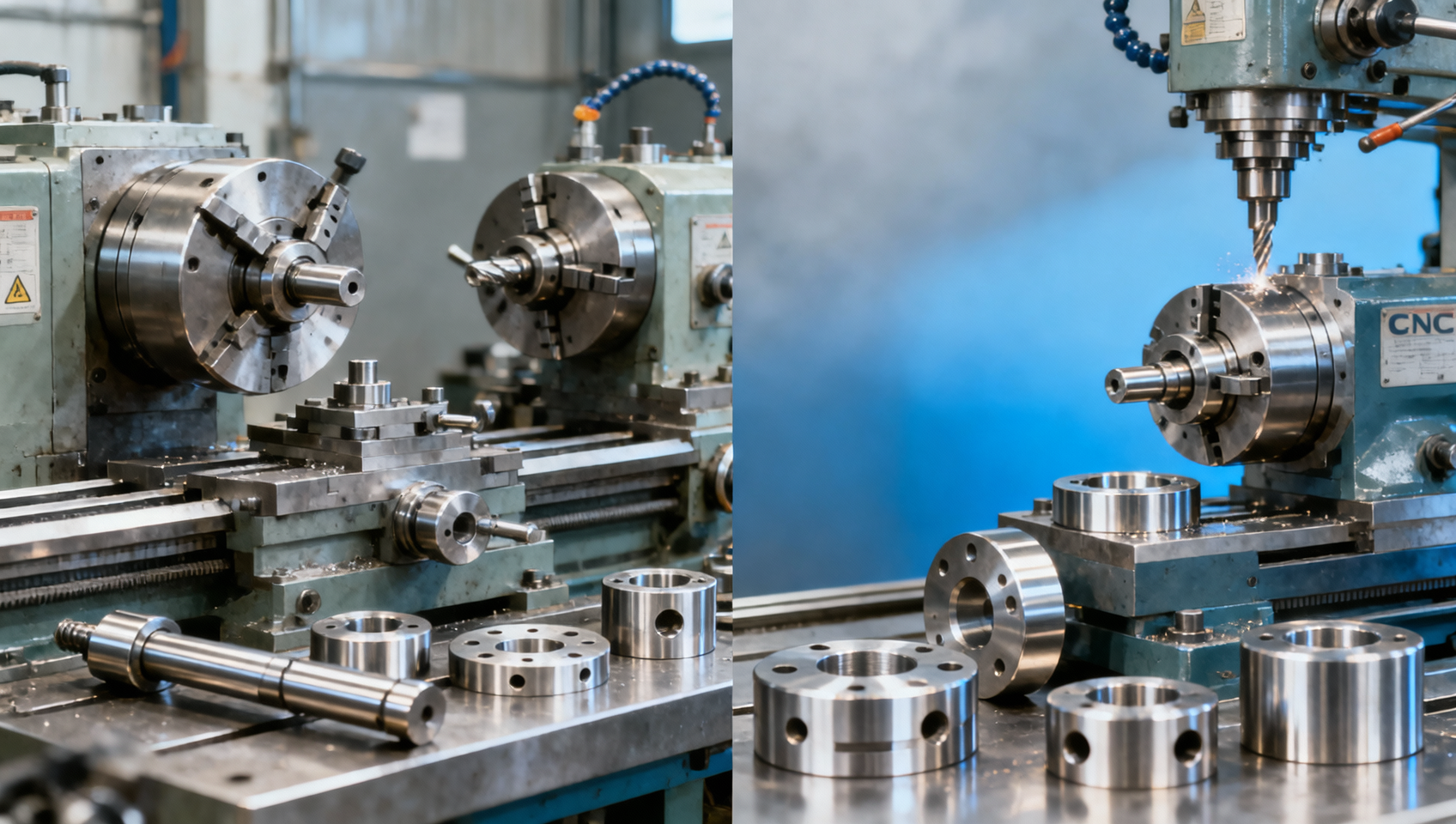
For low-volume round parts, choosing between a metal lathe and CNC milling can directly affect cost, precision, and production efficiency. This guide compares metal machining methods used in industrial CNC environments, helping buyers, operators, and decision-makers evaluate the best fit for shaft parts, CNC production needs, and today’s automated production process.
How should you compare a metal lathe and CNC milling for low-volume round parts?
In low-volume manufacturing, the decision is rarely about which machine is more advanced. It is about which process matches the geometry, tolerance, setup burden, and delivery target of the part. For simple round parts, a metal lathe often delivers the shortest path from raw stock to finished component. For round parts that also need flats, cross holes, pockets, or off-center features, CNC milling may reduce secondary operations and simplify the routing.
This distinction matters across automotive, energy equipment, electronics, aerospace support components, and industrial automation. Buyers are often balancing 3 core variables at the same time: unit cost, lead time, and dimensional consistency. Operators care about workholding, chip control, and repeatability across 10–200 pieces. Decision-makers usually want to avoid underutilized equipment, delayed samples, or quality escapes during pilot runs.
A metal lathe is built around rotational symmetry. It excels when the part’s primary dimensions are diameters, shoulders, grooves, tapers, and threads. CNC milling removes material by rotating the cutter rather than the part. That gives more flexibility for complex geometry, but it can also mean longer cycle times for fully round surfaces if the part could have been turned more directly.
For low-volume round parts, the best answer often depends on whether the component is 70% rotational or 70% prismatic in its critical features. That simple ratio can guide early screening before detailed process planning begins.
A practical first-pass comparison
The table below gives a fast process comparison for buyers and engineers reviewing shaft parts, bushings, collars, rollers, housings, and similar round components in prototype or small-batch production.
For most low-volume round parts, turning remains the default baseline because it aligns with the part’s natural shape. Milling becomes the stronger candidate when secondary features are numerous enough to offset added setup and toolpath complexity.
Which process fits different round-part applications in industrial CNC production?
Application fit should be evaluated by feature mix, not by the part name alone. A “shaft” may look like a turning part, but if it requires 2 cross holes, 1 milled flat, and a timing slot, the real question becomes whether those features justify moving the entire process to CNC milling or combining turning with a second operation.
In pilot lots of 5–50 pieces, setup efficiency is often more important than peak machine speed. In repeat low-volume orders of 50–200 pieces, fixture repeatability and inspection time become more influential. That is why many purchasing teams compare not just machining cost, but also handoff risk between operations.
A metal lathe is commonly preferred for pins, spacers, rollers, threaded adapters, simple bushings, and stepped sleeves. CNC milling is often selected for round bases, flanged discs with bolt patterns, clamping collars with slots, sensor mounts, and circular parts with multiple indexed features.
In advanced CNC environments, the answer is sometimes neither “lathe only” nor “mill only.” A two-stage route can be more stable: turn the concentric diameters first, then mill the non-rotational details. This hybrid approach is common when tolerances on coaxial features must be protected while also adding functional geometry.
Typical application scenarios
The following scenarios can help engineers and sourcing teams match process choice to part function and batch size.
This comparison shows why part function matters more than shape alone. In industrial procurement, many avoidable cost increases come from selecting a process by visual impression instead of feature priority and setup count.
Three questions to ask before routing the job
- Are the critical tolerances mainly on diameters, roundness, and concentricity, or on position, flatness, and angular features?
- Can the part be completed in 1–2 setups on a lathe, or would milling eliminate 2–3 downstream operations?
- Is the planned batch a one-time prototype run, a monthly replenishment order, or a bridge lot before scale-up?
These questions often reveal the more economical process without requiring detailed CAM work at the quotation stage.
What do buyers and operators need to know about precision, setup, and machining risk?
Precision for low-volume round parts should be discussed in layers. First comes dimensional capability, then repeatability across the lot, and finally inspection burden. A lathe typically supports stronger natural control over concentric diameters because the workpiece rotates on a defined axis. A milling machine can still produce accurate round-related features, but feature relationships depend more heavily on fixturing and datum strategy.
For operators, risk often appears before measurement does. Long and slender shafts may deflect under cutting force. Thin-wall round parts may distort after clamping. On the milling side, an unstable fixture can shift hole position or create variation between the first and tenth piece. In low-volume work, even small setup errors matter because they are spread across fewer units.
A practical evaluation uses 4 checkpoints: raw material condition, workholding method, tool accessibility, and inspection plan. If one of these is weak, the process may look acceptable on paper but perform poorly on the shop floor. This is especially relevant when delivery targets are tight, such as 7–15 days for prototypes or 2–4 weeks for sampled industrial parts.
Tolerance requirements also influence machine choice. When the drawing centers on OD, ID, and shoulder relationships, turning is usually more direct. When the drawing includes coordinate-based hole positions, face features, and angular references, milling becomes easier to program and inspect.
Common technical decision points
Rather than treating all tolerances equally, procurement and production teams should identify which dimensions truly control assembly, sealing, motion, or alignment.
- For shafts and rotating parts, check runout, concentricity, and bearing-seat finish before comparing machine hourly rates.
- For round parts with mounting features, review datum transfer between operations and whether one fixture can hold the complete coordinate pattern.
- For mixed-material jobs such as aluminum, stainless steel, or engineering plastics, confirm tool wear behavior and burr removal time, especially in lots under 100 pieces.
- For repeated small-batch orders, ask whether soft jaws, collets, or dedicated fixtures will be retained for the next cycle to reduce setup time.
Why setup time changes the economics of small batches
In high-volume manufacturing, cycle seconds dominate. In low-volume work, setup hours can dominate. If a lathe can complete a part family with standard jaws and a familiar tool package, it may outperform milling even when the machine rate is similar. If milling removes 2 extra handling steps and avoids a custom turning fixture, the balance can shift quickly.
This is why process review should include both machining time and preparation time. A part that runs for 12 minutes but needs 3 setup changes may be less efficient overall than a part that runs for 18 minutes in one stable setup.
How do cost, lead time, and procurement priorities change the best choice?
For procurement teams, cost analysis should not stop at unit price. Low-volume round parts involve at least 5 cost layers: raw material, setup, machining time, inspection, and post-processing. Secondary operations such as deburring, heat treatment, coating, or marking may shift the advantage from one route to another.
A metal lathe often wins on cost when the part is mostly cylindrical and requires limited secondary features. CNC milling can become more economical when the same setup produces multiple functional details that would otherwise require drilling, slotting, indexing, or manual handling after turning. For batches of 10–30 parts, even one removed setup can make a noticeable difference in quotation stability.
Lead time should also be separated into quotation review, process preparation, production, and inspection. Prototype jobs may move in 7–10 days if stock material and standard tooling are available. More complex low-volume industrial parts often require 2–3 weeks when fixtures, inspection points, or finishing steps are added.
Decision-makers should also account for future repeatability. A slightly higher first-order cost may be acceptable if the chosen route is easier to repeat every month or every quarter with stable quality and less engineering intervention.
Cost and sourcing comparison for small-batch CNC parts
This table is useful during RFQ review when sourcing teams compare machining routes for low-volume round parts.
The key sourcing lesson is simple: compare total process cost, not isolated machine preference. This avoids underestimating fixture design, secondary setups, and inspection complexity in low-volume CNC production.
A practical procurement checklist
- Identify the 3 most critical dimensions on the drawing and match them to the process that controls them most naturally.
- Ask suppliers to separate setup cost, machining cost, and finishing cost in the quotation when possible.
- Confirm standard lead time, urgent lead time, and what changes if the order expands from 20 pieces to 100 pieces.
- Review whether the route supports future repeat orders without rebuilding tooling or redefining inspection methods.
This checklist helps both technical buyers and non-technical procurement staff ask better questions before approving a machining route.
What mistakes are common when choosing between turning and milling?
One common mistake is assuming CNC milling is automatically the better modern solution. In reality, a conventional or CNC lathe can be the more efficient and more accurate choice for rotational geometry. Another mistake is evaluating the process using only machine capability while ignoring fixture complexity, operator skill, and inspection flow.
A second mistake appears in RFQ preparation. Buyers sometimes send incomplete drawings without material grade, surface finish requirements, or tolerance notes. That makes any comparison between metal lathe and CNC milling less reliable. Even a difference between a general machined finish and a tighter functional finish can alter tooling, cycle time, and process route.
A third mistake is overlooking future production logic. A route that works for 8 prototype parts may not scale well to 80 pieces per month. If the project is likely to move from trial production into scheduled replenishment within 1–2 quarters, the process should be reviewed for repeatability, fixture retention, and changeover burden.
Finally, some teams compare machines but forget the value of combined process planning. In many real factories, the best result comes from turning plus milling rather than choosing only one method.
FAQ for buyers, operators, and project managers
Is a metal lathe always cheaper for round parts?
Not always. It is often cheaper for parts that are primarily rotational and can be completed in 1–2 turning setups. If the part needs several off-center features, cross drilling, slots, or milled faces, the total cost can rise due to added operations. In that case, CNC milling or a hybrid route may be more economical.
When is CNC milling the better choice for a round component?
CNC milling is the better choice when the part’s critical value lies in non-rotational features. Examples include bolt circles, slots, pockets, flat surfaces, or hole patterns that must relate to one another in a coordinate system. It also helps when one setup can eliminate 2–3 downstream operations.
What quantity counts as low volume in CNC machining?
There is no universal threshold, but in industrial sourcing, low volume commonly covers prototypes, sample lots, and small production runs from around 5 pieces up to 200 pieces. The exact number depends on part complexity, material, and whether the order is one-time or recurring.
What should be checked before requesting a quotation?
At minimum, provide the latest drawing revision, material specification, quantity, key tolerances, finish expectations, and any required secondary process such as heat treatment or coating. If possible, mark the 3–5 dimensions that are functionally critical. This helps the supplier recommend whether turning, milling, or a combined CNC process is the strongest option.
Why choose us when evaluating low-volume CNC round parts?
In the global CNC machine tool and precision manufacturing sector, process choice is no longer just a workshop issue. It affects sourcing efficiency, engineering communication, and delivery confidence. Our platform focuses on industrial CNC machining, precision manufacturing trends, and international production insight, helping professionals compare machining routes with a stronger technical and commercial basis.
We support evaluation around the questions that matter in real B2B decisions: whether a part should be turned, milled, or split into multiple operations; what batch size makes sense for the chosen route; how lead time may change between prototype and repeat orders; and what drawing details should be clarified before supplier comparison. This is especially useful for buyers managing mixed part families and for operators seeking more stable production planning.
If you are reviewing low-volume round parts, you can contact us to discuss parameter confirmation, machining route selection, typical lead-time ranges, material and finish considerations, sample support, and quotation communication. We can also help structure the RFQ so suppliers respond on a comparable basis rather than using different assumptions that make pricing difficult to judge.
For better project results, send your drawing, quantity range, target delivery window, and any known tolerance priorities. With that information, the discussion can move quickly from generic machine comparison to a practical decision on cost, process stability, and low-volume production readiness.
PREVIOUS ARTICLE
NEXT ARTICLE
Recommended for You
 Global Manufacturing Lead Times Improve but Not EverywhereGlobal Machine Tool Trade Research Center
 Machine Tool Market Inventory Pressure Is Building AgainGlobal Machine Tool Trade Research Center
 Metal Lathe vs CNC Milling for Low Volume Round PartsCNC Machining Technology Center
 CNC Cutting Gas Choice Affects More Than Edge FinishCNC Machining Technology Center
 CNC Metalworking Shops Face New Pressure on TraceabilityManufacturing Policy Research Center
 Automated Lathe Cycle Time Gains Can Hide Quality LossesCNC Machining Technology Center



Aris Katos
Future of Carbide Coatings
15+ years in precision manufacturing systems. Specialized in high-speed milling and aerospace grade alloy processing.
▶
Metal Lathe vs CNC Milling for Low Volume Round PartsCNC Machining Technology Center▶
Production Process Mapping Still Misses the Real Delay PointsCNC Machining Technology Center▶
Why CNC industrial projects miss deadlines after quotingCNC Machining Technology Center▶
What causes unstable output in CNC production scheduling?CNC Machining Technology Center▶
Production Process delays often begin before machining startsCNC Machining Technology Center
Mastering 5-Axis Workholding Strategies
Join our technical panel on Nov 15th to learn about reducing vibrations in thin-wall components.

Providing you with integrated sanding solutions
Before-sales and after-sales services
Comprehensive technical support