• Global CNC market projected to reach $128B by 2028 • New EU trade regulations for precision tooling components • Aerospace deman
NYSE: CNC +1.2%LME: STEEL -0.4%

Production Process Mapping Still Misses the Real Delay Points
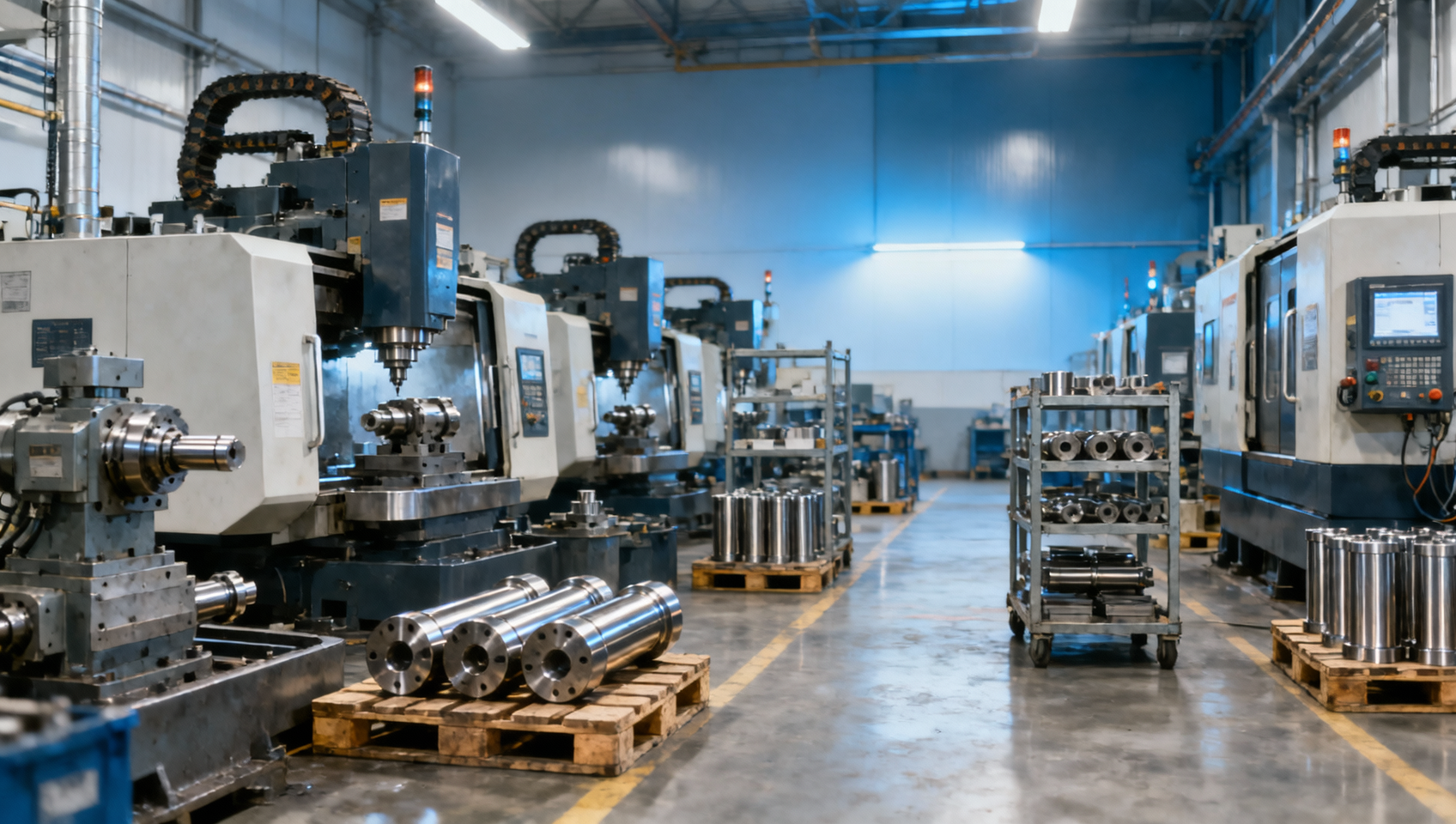
Production Process mapping often looks complete on paper, yet real delay points in metal machining and CNC production still go unnoticed. In today’s Manufacturing Industry, where industrial CNC, automated production lines, and Industrial Automation drive output, hidden bottlenecks in CNC milling, CNC cutting, and shaft parts handling can quietly reduce efficiency. This article explores where process visibility fails and how Global Manufacturing leaders are responding.
Why process maps in CNC production still miss the real delay points
A production process map usually shows routing, machine sequence, inspection stages, and material flow. For many factories, that seems sufficient. However, in CNC machining and precision manufacturing, the true delay often happens between formal steps rather than inside them. A machine may complete a cycle in 6–12 minutes, but a part can still wait 20–40 minutes for loading, fixture change, in-process inspection, or internal transport. The map looks clean while the floor reality stays fragmented.
This gap matters across automotive manufacturing, aerospace components, energy equipment, and electronics production. These sectors rely on CNC lathes, machining centers, and multi-axis systems where takt time, dimensional stability, and line balance directly affect delivery commitments. If process mapping records only planned operations, it ignores unplanned pauses such as tool preset delays, queue buildup before a coordinate measuring step, or operator waiting for a crane, pallet, or approved first article.
For information researchers, the key issue is not whether mapping exists, but whether it captures actual production behavior. For operators, the pain point is practical: they know where work stops, yet those stop points are rarely formalized. For procurement teams, an incomplete map creates supplier evaluation risk. For decision-makers, it distorts capacity planning, cost assumptions, and automation priorities over a 3–12 month horizon.
In modern industrial CNC operations, delay visibility should cover three layers: machine time, support time, and queue time. Many organizations measure only the first layer. That is why overall equipment efficiency may seem acceptable while on-time shipment still slips. In high-mix, medium-volume production, hidden delay points are especially common because setup frequency, fixture variation, and program adjustment happen more often than in stable mass production.
- Machine time includes cutting, spindle rotation, and programmed motion.
- Support time includes setup, offset confirmation, tooling replacement, cleaning, and gauge preparation.
- Queue time includes waiting for material release, forklift movement, inspection approval, or the next free workstation.
Where hidden bottlenecks usually appear on the shop floor
The delays are often outside the cutting cycle
In CNC milling and CNC cutting environments, the most visible part of production is the programmed cycle. Yet the least visible losses happen before and after it. A shaft parts batch may wait for deburring, a precision disc may queue for surface verification, and a structural part may be held because the correct fixture is still in another cell. None of these pauses are dramatic, but repeated 8–15 times per shift, they create measurable throughput loss.
Another common issue is setup dependency. If one experienced technician handles program prove-out, offset correction, and first-piece validation for several machines, production maps may still show parallel flow. In practice, the line behaves like a bottlenecked single-resource system. This is common in small and medium precision manufacturing plants where one specialist supports 4–8 machines during peak schedules.
Material presentation also creates hidden delay points. Raw bars, forgings, or castings may arrive on time, but not in a machine-ready format. The result is extra handling for cleaning, orientation, palletizing, or traceability labeling. In flexible production lines, every unprepared material handoff adds friction. The process map records “material available,” while the operator experiences “material not ready.”
Inspection and transfer nodes often slow the line
Inspection is essential in high-precision machining, but it often becomes a silent delay amplifier. When in-process checks, final inspection, and first article approval all rely on one measuring resource, queue time can exceed machining time for some parts. In shops producing tight-tolerance shaft components or high-accuracy housings, a 5–10 minute measurement task can generate 30–60 minutes of accumulated waiting across multiple machines.
Transfer between stations is another under-mapped loss. A part can leave a CNC lathe on schedule and still miss the next operation because the WIP rack is full, the AGV route is occupied, or the next machine is running a higher-priority order. This problem grows in mixed-order environments where urgent jobs disrupt queue discipline. On paper, routing remains stable. In reality, priority switching creates local congestion and hidden idle time.
The table below shows typical delay points that are frequently underestimated in process mapping for CNC production and automated production lines.
The practical lesson is straightforward: the most harmful delay points are often not technical failures. They are coordination losses. Factories that improve only spindle utilization but ignore transfer, setup, and inspection friction usually gain less than expected from smart manufacturing investments.
How to map production flow so delay points become measurable
Move from static mapping to time-layered mapping
A stronger production process map for the manufacturing industry should separate planned operation time from observed waiting time. Instead of one box labeled “turning” or “milling,” use at least four timing fields: setup, machine cycle, inspection, and transfer. This can be done without heavy software at the first stage. A 2–3 week observation window often reveals repeatable delay patterns that routine reporting hides.
For industrial automation projects, the right question is not “Where is the machine?” but “Where is the part waiting?” This shift changes automation priorities. Some factories plan robot loading because cutting cycles seem long, but floor data shows the larger loss comes from queueing before measurement or from material staging. In that case, digital WIP tracking or fixture standardization may produce faster returns than robot deployment.
A good mapping exercise should also capture variation by shift, product family, and order size. Batch sizes of 20, 200, and 2,000 pieces behave differently. A stable shaft parts line may tolerate manual transfer in medium volume, while a high-mix aerospace cell may suffer heavily from every extra approval step. One map for all products rarely reflects the actual production system.
Use a practical observation checklist
For operators and process engineers, the simplest improvement is a structured floor checklist. Instead of only recording downtime codes, record micro-stoppages and support events. When repeated over 5 consecutive working days, this creates enough evidence to prioritize action. It also improves communication between operations, quality, maintenance, and purchasing teams.
- Track waiting events longer than 5 minutes, even if the machine is technically available.
- Separate first-piece approval time from standard cycle time.
- Measure fixture search, cleaning, and return time as independent losses.
- Record whether delay comes from labor, tooling, material, inspection, or scheduling.
- Compare actual queue time by product family at least once per month.
The next table can help procurement teams and plant managers evaluate whether current process mapping is detailed enough for supplier selection, internal improvement, or automation investment planning.
For buyers and business leaders, decision-ready mapping reduces uncertainty. It helps compare suppliers not only by equipment list, but by how they manage real production flow. That distinction is critical when lead time commitments are tight, quality requirements are high, and product complexity keeps changing.
What procurement teams and decision-makers should verify before choosing a supplier or solution
Ask questions that reveal hidden delay risk
In B2B precision manufacturing, delayed output is not always caused by insufficient machine capacity. It can come from weak line balancing, over-centralized inspection, poor tooling readiness, or inconsistent material presentation. That is why procurement should go beyond machine model, spindle speed, or axis count. Those factors matter, but they do not explain whether a supplier can maintain stable flow across 2 shifts, urgent order changes, or mixed-part production.
A stronger supplier review looks at five practical areas: setup discipline, tool management, inspection capacity, internal logistics, and digital visibility. In many RFQ processes, only cycle time and price are compared. That invites future delivery risk. A supplier with slightly higher quoted cost may offer better flow control and lower disruption probability over the full order lifecycle.
For enterprise decision-makers planning automation or supplier consolidation, the same principle applies internally. Before approving a robot cell, flexible production line, or machine expansion, confirm whether the current delay comes from machine loading, fixture turnover, measuring bottlenecks, or planning instability. Solving the wrong constraint increases capital spending without solving late delivery.
A practical verification checklist
- Can the supplier explain average setup time ranges, such as 15–30 minutes for repeat jobs versus 60–120 minutes for new or complex parts?
- Is there a documented tool life management method for CNC milling, CNC cutting, and multi-axis machining?
- How many inspection steps require shared resources, and what happens during peak demand or shift handover?
- Are internal transport and WIP control managed manually, semi-automatically, or through a digital system?
- What is the normal lead time range for sample parts, pilot batches, and regular mass production orders?
These questions are especially relevant in global manufacturing supply chains, where geographic distance can hide operational weaknesses until a shipment slips. A supplier that can discuss real delay points clearly is often more dependable than one offering only a polished process diagram.
Common misconceptions, implementation priorities, and future direction
FAQ: the questions buyers and operators actually ask
Is a detailed process map enough to improve lead time?
Not by itself. A detailed map is useful only if it includes observed waiting time, resource dependency, and exception handling. If the map shows 12 steps but ignores queue buildup, first-piece approval, and transport loss, lead time analysis stays incomplete. In many machining environments, the biggest gains come from reducing handoff delay by 10–20 minutes per batch rather than cutting 30 seconds from a machine cycle.
Which scenarios are most vulnerable to hidden delay points?
High-mix, medium-volume production is the most vulnerable because it combines frequent setup changes, variable fixturing, and shifting inspection needs. Aerospace parts, customized energy equipment components, and mixed-order automotive supply programs are typical examples. Small-batch precision work also suffers when one programmer, setter, or inspector supports multiple machines.
Should a factory automate immediately after identifying delay points?
Not always. First classify delays into three groups: procedural, resource-based, and equipment-based. Procedural issues such as release approval or fixture return can often be improved within 2–6 weeks. Resource-based issues may need staffing, scheduling, or gauge balancing. Equipment-based constraints justify automation only when the first two groups are already stabilized.
What trends are shaping better process visibility in precision manufacturing?
The strongest trend is integration between machine data and flow data. Smart factory programs increasingly connect CNC status, tool life signals, WIP movement, and inspection release into one operational view. This matters because a running machine does not always mean a flowing process. Over the next 1–3 years, competitive factories are likely to focus more on traceable flow control, digital dispatching, and flexible production line balancing rather than isolated machine utilization alone.
For companies involved in CNC machining, automated production lines, industrial robots, and precision machine tools, the next improvement wave will come from seeing production as a network of dependencies, not just a chain of operations. The best-performing plants already treat setup readiness, internal logistics, and inspection access as part of core capacity, not background support.
Why choose us for CNC production insight and next-step evaluation
We focus on the global CNC machining and precision manufacturing industry, covering machine tools, industrial automation, flexible production lines, and international supply dynamics. That means our support is not limited to broad market description. We help readers and buyers connect technical production details with sourcing decisions, investment priorities, and delivery risk evaluation.
If you are comparing CNC machining suppliers, assessing a new production line, or reviewing hidden bottlenecks in current operations, you can consult us on concrete topics: process mapping depth, equipment selection, fixture and tooling readiness, normal lead time ranges, sample support expectations, and automation fit by application scenario. This is useful for researchers collecting market intelligence, operators validating workflow issues, procurement teams building RFQ criteria, and managers planning capacity upgrades.
You can also reach out for practical discussion on shaft parts production, CNC milling flow, CNC cutting handoff design, multi-axis machining planning, and typical compliance or documentation expectations in international trade. If your concern is whether the real delay sits in machining, inspection, transport, or scheduling, that is exactly the kind of question worth clarifying before price negotiation or capital approval begins.
Contact us to discuss parameter confirmation, product selection, delivery cycle expectations, custom solution direction, documentation needs, sample planning, or quotation communication. A sharper understanding of real delay points can improve supplier choice, project timing, and manufacturing resilience long before problems appear in shipment data.
PREVIOUS ARTICLE
Recommended for You
 Global Manufacturing Lead Times Improve but Not EverywhereGlobal Machine Tool Trade Research Center
 Machine Tool Market Inventory Pressure Is Building AgainGlobal Machine Tool Trade Research Center
 Metal Lathe vs CNC Milling for Low Volume Round PartsCNC Machining Technology Center
 CNC Cutting Gas Choice Affects More Than Edge FinishCNC Machining Technology Center
 CNC Metalworking Shops Face New Pressure on TraceabilityManufacturing Policy Research Center
 Automated Lathe Cycle Time Gains Can Hide Quality LossesCNC Machining Technology Center


Aris Katos
Future of Carbide Coatings
15+ years in precision manufacturing systems. Specialized in high-speed milling and aerospace grade alloy processing.
▶
Metal Lathe vs CNC Milling for Low Volume Round PartsCNC Machining Technology Center▶
Production Process Mapping Still Misses the Real Delay PointsCNC Machining Technology Center▶
Why CNC industrial projects miss deadlines after quotingCNC Machining Technology Center▶
What causes unstable output in CNC production scheduling?CNC Machining Technology Center▶
Production Process delays often begin before machining startsCNC Machining Technology Center
Mastering 5-Axis Workholding Strategies
Join our technical panel on Nov 15th to learn about reducing vibrations in thin-wall components.

Providing you with integrated sanding solutions
Before-sales and after-sales services
Comprehensive technical support